Skip to content
The palace ruins of the Palatine seen across the Circus Maximus

Ten Days in Italy: Rome, Florence and Venice

Four days in Rome, three in Florence and three in Venice, with the Vatican Museums, the Uffizi and the Doge's Palace each given a morning of their own.

Rome, Florence and Venice make the classic first trip because each shows Italy at a different scale: the ruins and palaces of a capital, the concentrated Renaissance of one great city, and a lagoon city that runs on water. This plan gives Rome four days, Florence three and Venice three, with the book-ahead sights placed on separate mornings and two train transfers set into the mornings of days five and eight. It is built for walking, early starts and long dinners.

Day by day

Ancient Rome: the Colosseum, the Forum and the Palatine

Day 1 · mostly on foot

Morning
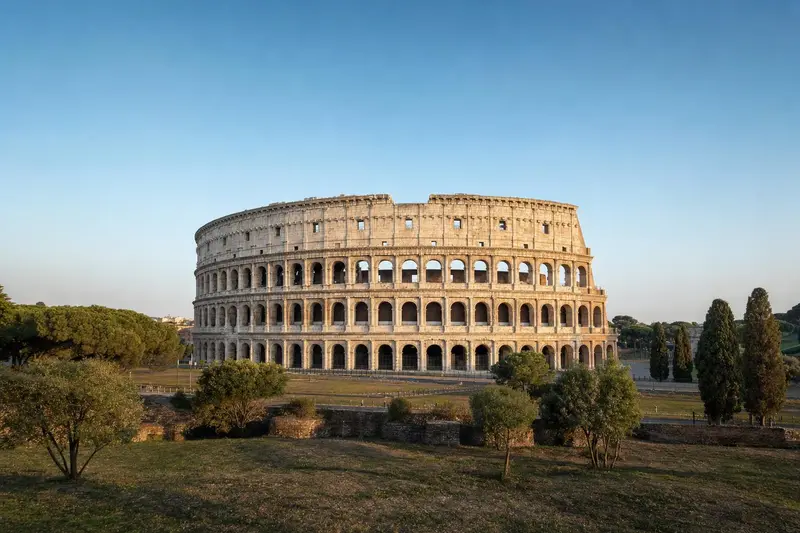
Book the park’s 24-hour Colosseum, Roman Forum and Palatine ticket. Arrive at the Colosseum 15 minutes before your reserved time and bring ID. Vespasian began the amphitheatre and his son Titus finished it. Domitian later added tunnels beneath the arena. The Forum and Palatine share a separate entrance. You get one visit to both within 24 hours before or after your Colosseum time. In the Forum, follow the Via Sacra past the Arch of Titus, the vaults of the Basilica of Maxentius and the columns of the Temple of Saturn.
Afternoon
Climb the Palatine from within the archaeological area, without going out through the gates. Roman tradition places the city’s beginnings here. Augustus chose the hill for his house, and later emperors built palaces alongside it. From the Farnese Gardens, look down over the Forum and the long hollow of the Circus Maximus.
Evening
Walk up to Piazza del Campidoglio on the Capitoline Hill by the Cordonata, the gentle ramp Michelangelo designed. He laid out the whole square and turned it to face St Peter's rather than the Forum. The bronze Marcus Aurelius in the middle is a copy; the original is inside the Capitoline Museums, worth a look if you have energy left. Round the side of the Palazzo Senatorio you can see down over the Forum, then go to dinner.

Where to eat. Monti, the neighbourhood just up from the Colosseum, is the easy place for a Roman dinner among small trattorie and wine bars: order cacio e pepe, carbonara or amatriciana. At lunch, pizza al taglio (pizza by the slice, sold by weight) near the Forum keeps the day moving.

The Vatican and the Tiber

Day 2 · walking and the metro

Morning
Reserve a morning entry through the Vatican Museums’ official ticket office. The ticket includes the Sistine Chapel. On your way there, give time to the Laocoön, the Apollo Belvedere and the Raphael Rooms. Save a little of the morning for Michelangelo’s ceiling and the Last Judgment.
Afternoon
After the museums, go around the Vatican walls to St Peter’s Square and join the basilica’s security line. General admission is free. An optional paid booking gives you a reserved entry time and a digital audio guide. Inside, look for Michelangelo’s Pietà and Bernini’s baldachin. If you want the view over the square, allow extra time and get a separate ticket for the dome.
Evening
Walk along the Tiber to Castel Sant'Angelo, built as Hadrian's mausoleum and later a papal fortress joined to the Vatican by a fortified corridor, the Passetto. Clement VII took refuge here during the Sack of Rome in 1527. Cross the bridge in front, lined with ten marble angels commissioned by Clement IX, and let the evening settle over the river.

Where to eat. Prati, the grid of streets north of the Vatican, has everyday places for lunch away from the crowds right beside St Peter's Square. After the bridge at Castel Sant'Angelo the lanes lead you back into the centro storico, where dinner is easy to find.

The centro storico: Navona, the Pantheon and the fountains

Day 3 · all on foot

Morning
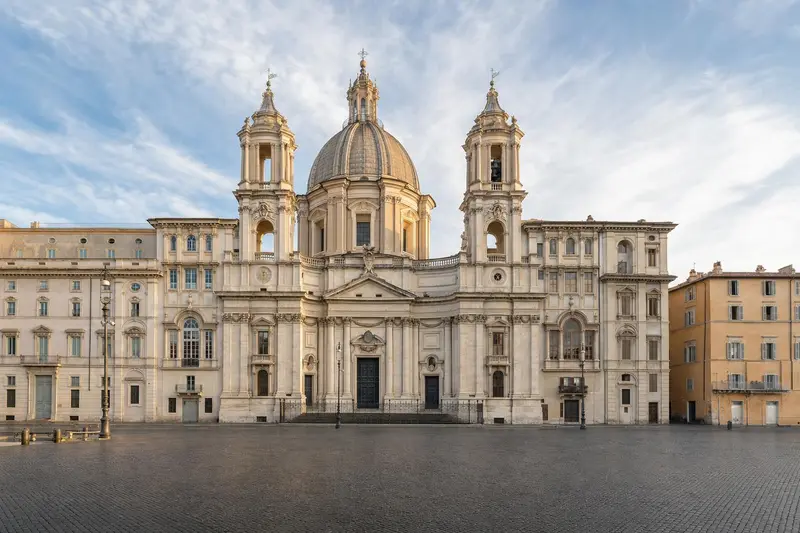
Start at Piazza Navona, whose long oval follows the stadium Domitian built here in the first century. Bernini's Fountain of the Four Rivers stands in the middle and Borromini's Sant'Agnese in Agone fronts the square. The story that one of Bernini's river gods covers his eyes rather than look at the church is a legend. Then step into San Luigi dei Francesi, the French national church, for Caravaggio's three paintings of St Matthew in the fifth chapel on the left.
Afternoon
Walk to the Pantheon, built under Hadrian and kept intact because it became a church in 609. Stand under the oculus: rain does fall through it and runs away through holes in the floor, whatever you have heard. Raphael is buried inside, with the first king of Italy. Then go to Campo de' Fiori, where a market has run since 1869 and a monument marks the spot where Giordano Bruno was burned in 1600.
Evening
Walk to the Trevi Fountain, the end of the Aqua Virgo, the aqueduct from the age of Augustus that still brings water to Rome. Stand with your back to the fountain and throw a coin over your shoulder; the custom promises a return to Rome. Finish at the Spanish Steps, finished for the Jubilee of 1725, with Pietro Bernini's boat-shaped Barcaccia fountain at the foot and the house where Keats died beside the stairs.

Where to eat. Around Piazza Navona and the Pantheon, walk two or three streets back from the squares before you sit down. Coffee in Rome is drunk standing at the bar, and the Sant'Eustachio quarter by the Pantheon is the place to do it. Keep the aperitivo for the lanes around Campo de' Fiori.

The Galleria Borghese and Trastevere

Day 4 · a taxi or bus, then on foot

Morning
Reserve a time and plan the morning around it. For visits from 24 November 2026, book through Musei Italiani. The collection Cardinal Scipione Borghese founded holds Bernini’s Apollo and Daphne, his Rape of Proserpina and his David, Canova’s Paolina Borghese as Venus Victorious, and Caravaggio’s Boy with a Basket of Fruit and David with the Head of Goliath. Take it one room at a time.
Afternoon
Cross the Tiber into Trastevere, from the Latin trans Tiberim, 'across the Tiber'. Start at Santa Maria in Trastevere, rebuilt under Innocent II in the twelfth century, with a golden apse mosaic and Pietro Cavallini's scenes of the Life of the Virgin of 1291 below it. Then wander the narrow medieval lanes toward Piazza Trilussa and Ponte Sisto. If your Rome days include a Sunday, give that morning to the Porta Portese flea market instead.
Evening
Stay in Trastevere for the evening, when the lanes are at their liveliest and the trattorie fill. After dinner, walk up the Gianicolo, the hill above the district, for a last look over the rooftops of Rome. Pack before you sleep: tomorrow's fast train leaves from Roma Termini.

Where to eat. Trastevere is dense with trattorie, so choose by the crowd: a room full of Romans beats a menu with photographs. For a more local Roman table, cross the river to Testaccio, the old slaughterhouse district, working-class in character and known for its taverns.

To Florence: the Duomo and Piazza della Signoria

Day 5 · train, then on foot

Morning
Take a fast train from Roma Termini to Firenze Santa Maria Novella, the station beside the church of the same name. Leave your bags and cross the piazza to the church: Alberti completed the marble facade, and inside, Masaccio's Trinity is an early lesson in perspective, while Giotto's crucifix hangs high in the nave. It is a gentle start in the city, and it saves the great sights for the afternoon.
Afternoon
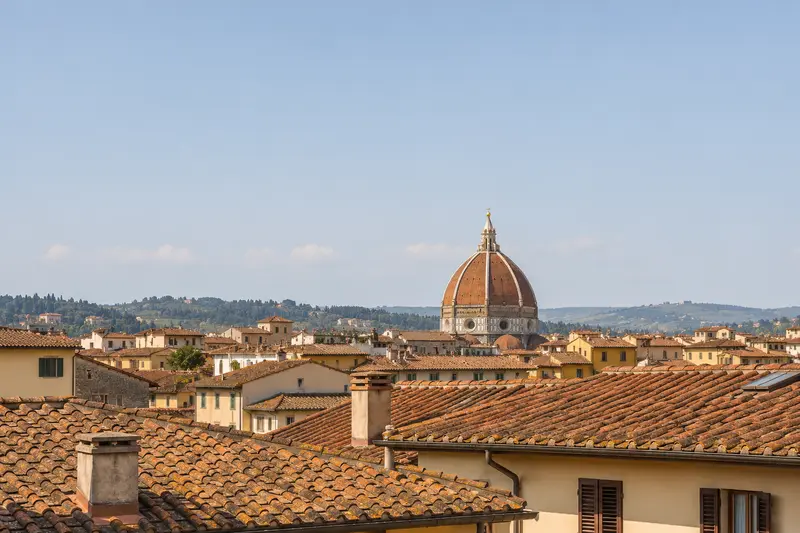
Walk to the Duomo and take in the nineteenth-century façade, the Baptistery and Giotto’s Campanile. Brunelleschi’s double-shell dome rises above them. If you’re climbing it, buy the Brunelleschi Pass and choose your entry time. There are 463 steps. Book later in the afternoon if you’re coming from the station and still need to drop your bags.
Evening
Walk to Piazza della Signoria, an open-air sculpture court beneath the tower of Palazzo Vecchio, built around 1310. The David by the door is a copy, in place since 1910. Then go down to the Arno and cross Ponte Vecchio, where Grand Duke Ferdinando I replaced the butchers with goldsmiths and which was the only Florentine bridge the Germans did not blow up in 1944.

Where to eat. Dinner is bistecca alla fiorentina, a thick T-bone steak cooked rare over coals and shared. Cross the Arno to Oltrarno for small trattorie, and leave the restaurants right around the Duomo to the tour groups.

The David, Fra Angelico and the Medici

Day 6 · mostly on foot

Morning
Book a morning entry for the Galleria dell’Accademia through B-Ticket, the gallery’s official online seller. Michelangelo’s David stands in the Tribuna built for it, at the end of the hall lined by the four unfinished Prisoners. Afterwards, walk to the Museo di San Marco. Fra Angelico painted the monks’ cells in this former Dominican convent, and his Annunciation faces you at the top of the stairs.
Afternoon
Walk to Piazza Santissima Annunziata, where Brunelleschi's loggia for the Ospedale degli Innocenti, begun in 1419, is often called the first Renaissance building. Then go to San Lorenzo, and behind the basilica find the entrance to the Medici Chapels: Michelangelo's New Sacristy holds the tombs of the dukes Giuliano and Lorenzo, with Day and Night, Dawn and Dusk, while Lorenzo the Magnificent lies beneath the Madonna. The market streets of San Lorenzo are right there.
Evening
Cross the Arno and climb to San Miniato al Monte, a Romanesque church begun in 1018, its facade of white marble and green Prato serpentine. Piazzale Michelangelo just below has the famous view; the church's terrace is quieter, and next door the Olivetan monks, there since 1373, keep a shop of honey, liqueurs and herbal teas. Take a taxi up and walk down.

Where to eat. The streets around San Lorenzo and its market feed you well at lunch: stalls and bars where Florentines stand at the counter for a panino and a coffee. For dinner, come down from San Miniato into Oltrarno and follow the small streets.

The Uffizi, Palazzo Pitti and the Boboli Gardens

Day 7 · mostly on foot

Morning
Reserve a morning slot at the Uffizi through the galleries’ ticket office. If you also want to visit Palazzo Pitti and the Boboli Gardens, choose the combined ticket and start with the Uffizi at the booked time. The Vasari Corridor needs its own slot. In the gallery, start with Botticelli’s Primavera and Birth of Venus, then choose between Leonardo’s early Annunciation, the Tribuna and the Caravaggio rooms.
Afternoon
After the Uffizi, cross Ponte Vecchio to Palazzo Pitti and the Boboli Gardens. The combined ticket lets you enter both after your Uffizi visit, within the pass’s validity. Look for the gardens’ horseshoe amphitheatre and Buontalenti’s grotto. If the museum morning runs long, give yourself time in one of the two and save the other for later in the pass.
Evening
Stay in Oltrarno and let the evening run slowly: an aperitivo, a walk through the quiet streets and dinner in one of the small trattorie. Make it an early night, because the train to Venice leaves from Santa Maria Novella in the morning.

Where to eat. Oltrarno is the part of Florence where a trattoria feeds neighbours as much as visitors. Walk a street or two off the main route to the Pitti and choose a room that is full of local voices. Coffee, as everywhere in Italy, is taken standing at the bar.

To Venice: the Grand Canal, the Rialto and St Mark's

Day 8 · train, then boat and on foot

Morning
Take the fast train from Firenze Santa Maria Novella to Venezia Santa Lucia. Before boarding a vaporetto, check which stop your accommodation recommends. From the station steps, follow the Ferrovia signs and find line 1 towards Rialto, San Marco and Lido on the departure board. Check the pier letter there and validate your ticket before boarding. Use Rialto or Rialto Mercato according to which side of the bridge you’re staying on. For rooms close to the station on the Cannaregio side, walk along Lista di Spagna. If you’re staying just across the canal in Santa Croce, go over the Ponte degli Scalzi and allow for steps with luggage.
Afternoon
Once you’ve dropped your bags, walk to the Rialto Bridge and cross into San Polo. The fruit and vegetable stalls and the Pescheria are morning stops. If you want to see the fish stalls, come back on a market morning from Tuesday to Saturday. For a first look at the city after a late train, keep it to the bridge and the Grand Canal from either bank.
Evening
If you’re staying closer to San Marco, make Piazza San Marco your short arrival walk. Follow the arcades across the square, then go past the Doge’s Palace to the lagoon at the Piazzetta. If you arrive early enough for the Campanile, check last admission and ticket availability. Save the basilica interior for tomorrow’s visit.

Where to eat. Eat like a Venetian: cicchetti (small snacks) at the counter of a bacaro, with an ombra, a small glass of wine. Standing at the counter is part of the pleasure. The bacari of San Polo and Cannaregio, away from the square, are the places to start.

St Mark's Basilica, the Doge's Palace and Dorsoduro

Day 9 · all on foot

Morning
Book St Mark’s Basilica through its own ticket office and choose a ticket that includes the Pala d’Oro if you want to see it. Give yourself time for the gold mosaics and marble floor before your separate entry at the Doge’s Palace. For a morning visit to the palace, choose a ticket with a specific entry time. Inside, take in the Golden Staircase, the Great Council Hall and the Bridge of Sighs on the way to the prisons.
Afternoon
Cross the Accademia bridge into Dorsoduro and the Gallerie dell'Accademia, Venetian painting from the fourteenth to the eighteenth century: Giorgione's Tempest, Veronese's Feast in the House of Levi, Carpaccio's cycle of St Ursula. Leonardo's Vitruvian Man belongs to the collection but is shown only on special occasions. Then walk to Santa Maria della Salute, the domed Baroque church Longhena designed after the plague of 1630.
Evening
Spend the evening bar by bar in Dorsoduro or Cannaregio, with cicchetti and an ombra at each stop. If you want a seat after all, the fish of the lagoon and rice dishes such as risotto di gò, a goby risotto from Burano, are the local specialities.

Where to eat. Lunch away from the basilica: the bacari of Dorsoduro serve cicchetti and a plate of the day to people who live nearby. Baccalà mantecato (creamed salt cod) and sarde in saor (sweet-and-sour sardines) are the Venetian classics to look for.

Markets, Titian, Tintoretto and the Ghetto

Day 10 · all on foot

Morning
Begin at the Rialto market, fruit and vegetables on one side and the fish market under the Pescheria loggia on the other. Then walk to the Frari: Titian's Assunta hangs over the high altar, Bellini's triptych of 1488 is in the sacristy, Titian and Monteverdi are buried here, and Canova's heart rests in his pyramid monument. It is brick Gothic on a vast scale, and a calm room after the markets.
Afternoon
Next door, the Scuola Grande di San Rocco holds Tintoretto's cycle, painted from 1564 over more than twenty years with his assistants, the ceiling of the upper hall showing Old Testament scenes and the walls New Testament ones. Then go north to the Ghetto in Cannaregio, established in 1516; the crowded Ghetto Nuovo grew buildings of seven and eight storeys, and five synagogues were founded in the Ghetto in the sixteenth century.
Evening
Take the vaporetto line 1 once more down the Grand Canal at dusk, with the palaces lit, and finish with one last ombra and a cicchetto at the counter. If you leave from Santa Lucia, the station is at the other end of the same canal, in Cannaregio, near the Ghetto.

Where to eat. Lunch near Rialto means cicchetti at a bacaro by the market, fish straight from the market, and a glass of wine drunk standing. In Cannaregio, bacari line the canals beyond the Ghetto and suit a last early dinner before the train.

If you have another day

An extra day is best spent as a day trip from whichever city you love most.

Orvieto, from Rome
A day trip by regional train from Roma Termini to a hill town whose cathedral has a Gothic facade of mosaics and reliefs shaped by Lorenzo Maitani in the early fourteenth century. Inside, the San Brizio Chapel holds Luca Signorelli's Last Judgment frescoes, finished in 1504, and the cathedral keeps the linen cloth of the Bolsena miracle of 1263.
Siena, from Florence
A day trip by bus or regional train to the medieval rival. Go down into Piazza del Campo, see the Palazzo Pubblico (1297 to 1310) with its tower, and go inside the cathedral. The Palio, the horse race of the contrade (neighbourhood teams), is run on the Campo on 2 July and 16 August.
Burano and Torcello, from Venice
A day on the lagoon by vaporetto from Fondamente Nuove. Burano has brightly painted houses, needle lace and a leaning bell tower. Torcello, nearby and almost uninhabited, has a basilica with a Venetian-Byzantine mosaic of the Last Judgment on its west wall.

Where to stay

Verified hotels, city by city.

Rome

Rome

  • Singer Palace Hotel Roma
  • Hotel Artemide
  • Hotel Hassler Roma
  • Palazzo Ripetta
Check dates: Rome
Florence

Florence

  • Four Seasons Hotel Firenze
  • The St. Regis Florence
  • Porta Rossa Hotel Firenze
  • Hotel Calimala Florence
Check dates: Florence
Venice

Venice

  • Santa Croce Boutique Hotel
  • Rosa Salva Hotel
  • Radisson Collection Hotel, Palazzo Nani Venice
  • Hotel Ai Reali
Check dates: Venice

Booking through these links may earn Italia Magnifica a commission, at no cost to you.

Where to eat

Verified tables in the cities on this route.

Rome

Rome

  • Osteria Di PonteA small Italian osteria on Via di Panico, a short walk from the Tiber, for a simple sit-down dinner near the castle.
  • Pizza FloridaA no-fuss Roman pizza al taglio counter in the Ghetto, good for a quick slice to eat standing between sights.
  • ManzoniA neighbourhood trattoria and pub with an open terrace, handy for a relaxed plate of Roman cooking away from the main sights.
  • Pizza in TreviWood-fired pizza with gluten-free options and Roman pasta classics, plus a terrace looking toward the fountain, for an easy sit-down meal.
All tables: Rome
Florence

Florence

  • Trattoria Vecchia GrigliaA family-run trattoria beside San Lorenzo for fresh pasta and Florentine steak, a relaxed pause between the market and the Medici Chapels.
  • Osteria Cancello dei MacciA warm, family-run Sant'Ambrogio osteria for hand-rolled pasta and ember-grilled bistecca, cooked with produce from the market round the corner.
  • Ciro & sonsA Neapolitan family pizzeria near San Lorenzo with a dedicated gluten-free kitchen, so coeliacs can order proper pizza and pasta without worry.
  • Osteria San FiorenzoRight on the edge of Piazza Santa Croce, a straightforward osteria for Florentine standbys like ribollita, pappa al pomodoro and bistecca.
All tables: Florence
Venice

Venice

  • Hostaria OsottoosopraA plain, traditional Venetian hostaria in Santa Croce, for fish dishes and pasta such as bigoli, a little off the main sightseeing routes.
  • Trattoria dai FioiA relaxed trattoria with a courtyard terrace in Castello, near the Biennale gardens, for pizza, lasagne and grilled meats.
  • Il CapriccioA San Polo restaurant and pizzeria near Campo San Polo, serving seafood with a modern touch and Neapolitan-style pizza.
  • Trattoria La Divina ComidaSeafood-led Venetian cooking, from spaghetti alla busara to creamed salt cod, in the streets between the Frari and Campo Santa Margherita.
All tables: Venice

Getting around

Each city is best on foot, and the plan needs no car. In Rome, the metro (lines A and B cross at Termini) saves your legs between the Colosseum, the Vatican and the Borghese. Between cities, take fast trains: Roma Termini to Firenze Santa Maria Novella, then Firenze Santa Maria Novella to Venezia Santa Lucia. All three stations are in the centre. Venice has no cars at all, and the vaporetto is its public transport; line 1 runs the length of the Grand Canal, calling at the landings along the way. If you drive, avoid it: Rome and Florence have limited-traffic zones (ZTL) with cameras, and Venice cannot be driven.

Sources and citations (14)
  1. Colosseum Archaeological Park · Opening times and tickets
  2. Vatican Museums · Official booking and admission
  3. St Peter’s Basilica · Entry and reservations
  4. Galleria Borghese · Official tickets and reservations
  5. Opera del Duomo · Passes and dome reservations
  6. Galleria dell’Accademia · Official tickets
  7. Uffizi Galleries · Official tickets
  8. Uffizi Galleries · Combined ticket for the Uffizi, Pitti and Boboli
  9. St Mark’s Basilica · Official ticket office
  10. MUVE · Doge’s Palace tickets and entry times
  11. Piazza del Campidoglio, Wikipedia
  12. AVM/ACTV · Ferrovia waterbus pier map
  13. AVM/ACTV · Waterbus timetables and departures
  14. AVM/ACTV · Waterbus tickets and validation

Plan the rest

A letter from Italy, once a month.

Each month: one story, two recipes, an ingredient and a wine of the month, places worth the trip, and the month’s calendar.

One letter a month. Unsubscribe at any time. We never share your address. Choose your desks