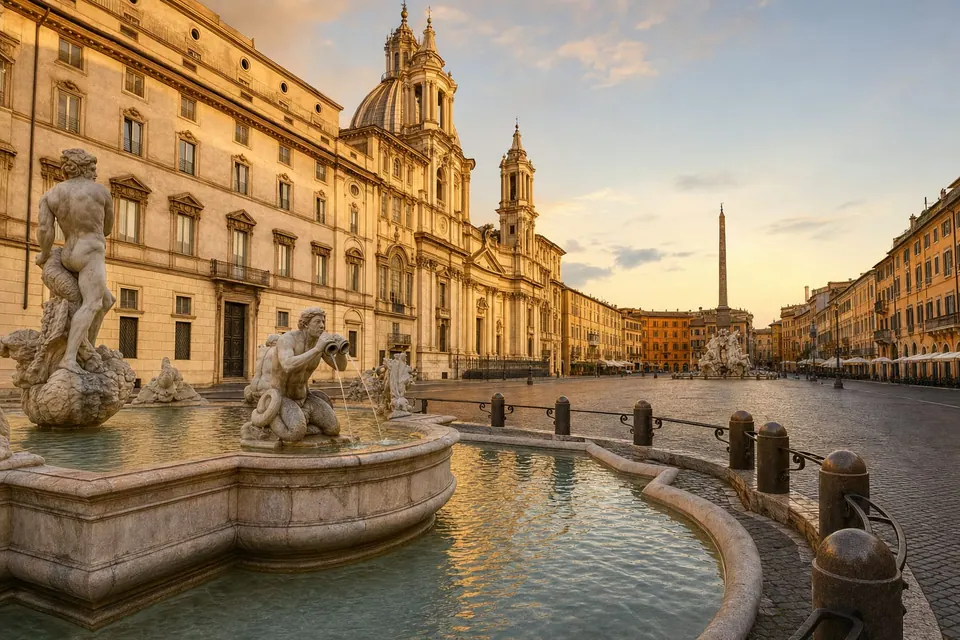
Piazza Navona's long oval shape traces the exact footprint of Domitian's stadium, built in 80 CE for Greek-style athletic contests the Romans called agones, a word that survives in the square's old name, Circus Agonalis.
The stadium crumbled after Rome's fall and was quarried for stone, but the space it left stayed open, becoming the city market by the late fifteenth century before Pope Innocent X, whose family palace faces the square, transformed it into a Baroque stage during his reign from 1644 to 1655. At its center, Gian Lorenzo Bernini's 1651 Fountain of the Four Rivers sends four river gods, the Nile, Ganges, Danube and Rio de la Plata, sprawling beneath an ancient Egyptian obelisk, positioned to face the facade of Francesco Borromini's Sant'Agnese in Agone, Bernini's great architectural rival, in what is often told as a piece of professional theater between the two men even if the design predates their direct rivalry on this square.