Skip to content

Spanish Steps

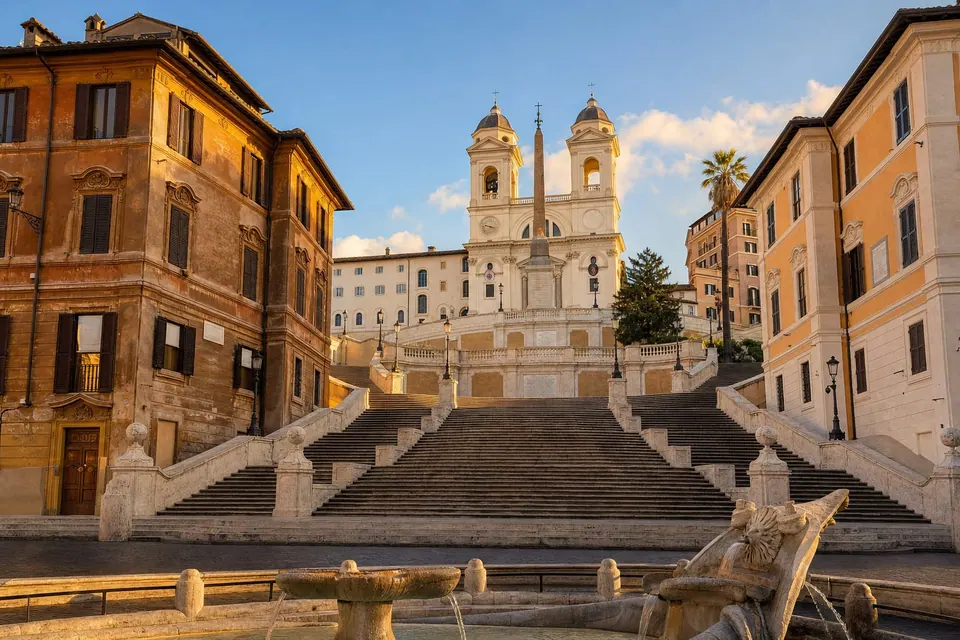
Rome's Baroque staircase of 135 steps, climbing from the Barcaccia fountain to Trinita dei Monti.

  • Rome
  • Monument
Where
Rome
Best for
135-step Baroque cascade
Allow
30 minutes
Tickets
Free

A French diplomat's bequest funded the idea as early as 1660, but decades of wrangling, including a scrapped plan to crown the steps with an equestrian statue of Louis XIV that scandalized papal Rome, delayed construction until architects Francesco de Sanctis and Alessandro Specchi finally built the 135-step staircase between 1723 and 1725.

It climbs the steep Pincian slope from Piazza di Spagna, named for the Spanish embassy to the Holy See at its base, up to the French-patronized church of Trinita dei Monti at the top, a deliberate diplomatic balancing act built into stone between two rival powers. At the foot of the steps, Pietro Bernini's Barcaccia fountain, shaped like a sinking boat, is said to commemorate a flood that once stranded a boat on this exact spot. English poet John Keats died in 1821 in the rose-colored house immediately to the right of the steps, now a small museum, having come to Rome for his health only to succumb to tuberculosis within sound of the fountain outside his window.

Four things worth finding

If you see nothing else, see these.

  1. The BarcacciaPietro and Gian Lorenzo Bernini, 1627 to 1629

    A fountain shaped like a sinking boat, low to the ground to work with the weak water pressure.Foot of the steps, Piazza di Spagna

  2. Trinità dei Monti

    The French church at the head of the staircase, with its twin towers and an obelisk in front.Top of the steps

  3. Keats-Shelley House

    The rose-colored house where Keats died in 1821, now a small museum of Romantic poetry.Right of the steps, at the bottom

  4. Babington’s Tea Rooms

    An old English tea room from the nineteenth century that has served the square for generations.Left of the steps

Plan your visit

Everything you need before you go.

Tickets
Free
Booking
No booking needed
Time needed
30 minutes
Best time
Early morning, before both the crowds and the day's heat build on the exposed steps
Getting there
The Spagna metro station (Line A) opens directly onto Piazza di Spagna at the foot of the steps.
Accessibility
The staircase itself has no ramp or lift; wheelchair users can reach the top of the Pincian hill by an alternate street route rather than the steps.

The steps themselves are free; sitting on them is prohibited by city ordinance and enforced with fines, and the Keats-Shelley House museum beside them charges separate admission.

Do not sit down for a rest partway up: Rome enforces a real fine for sitting on the steps, a rule tourists are frequently caught out by since it looks like the obvious place to pause.

Get directionsGoogle MapsApple Maps

Tours worth booking

A few we would book ourselves, to get more from your visit.

Booking through these links may earn Italia Magnifica a commission, at no cost to you.

    • Viator
    • 2h 30m
    • 5.0★ · 164 reviews
    • Viator
    • 7h
    • 5.0★ · 152 reviews
    • Viator
    • 4h
    • 5.0★ · 130 reviews
    • Viator
    • 5h
    • 5.0★ · 129 reviews
    • Viator
    • 1h
    • 5.0★ · 118 reviews
    • Viator
    • 3h
    • 5.0★ · 118 reviews

Good to know

How long should you spend at the Spanish Steps?

About half an hour to climb, look around and see the Barcaccia. Add time for the Keats-Shelley House or a tea.

Are the Spanish Steps worth visiting?

Yes, as part of a walk. It is a famous spot and often crowded, but the view from the top and the elegant shopping streets below make it worthwhile.

Can you see the Spanish Steps and the Trevi Fountain in one day?

Easily. They are a short walk apart through the center, so you can combine them with the Pantheon and Piazza Navona in one morning.

A letter from Italy, once a month.

The places, tables and makers we found worth your time. One email, no noise.

One letter a month. Unsubscribe at any time. We never share your address.

Help us get it right

What is it about?