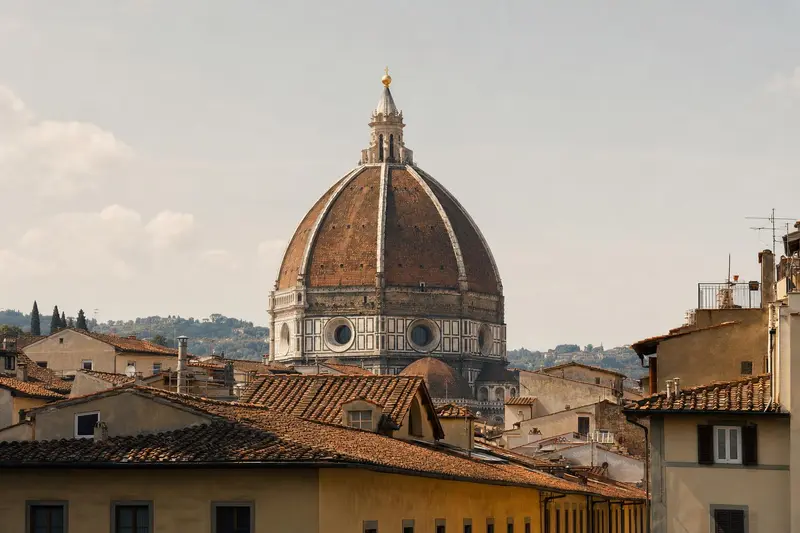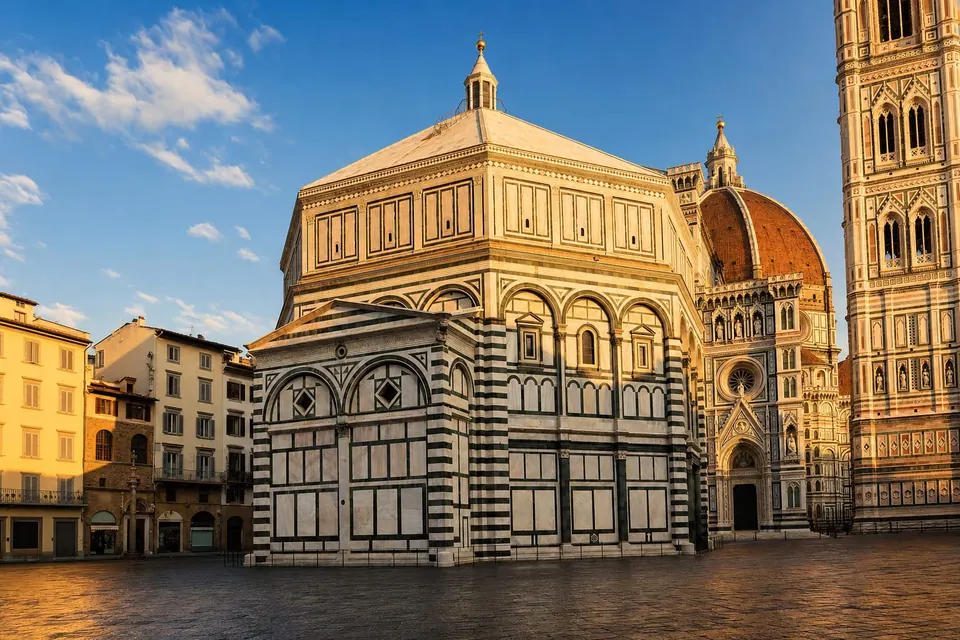
The octagonal Baptistery of San Giovanni stands on Piazza San Giovanni, opposite Florence Cathedral. The building we see today was consecrated in 1059; the Opera says it may have expanded an earlier fourth-century baptistery. White and green marble gives its Romanesque exterior a measured geometry. The often-repeated story that the building began as a temple to Mars is not established.
Gold-ground mosaics made across the thirteenth and fourteenth centuries cover the vault, apse and parts of the walls. Christ the Judge appears above scenes of Paradise and Hell, while other registers follow Genesis, Joseph, Christ and Mary, and John the Baptist. Dante calls the baptistery “my beautiful Saint John” in Inferno XIX, a canto that also recalls its baptismal font. The Opera’s conservation notice is the place to check current mosaic visibility before planning around the vault.
Three sets of bronze doors mark the portals, each with its own sculptural cycle. Andrea Pisano made the south doors between 1330 and 1336; Lorenzo Ghiberti made the north doors between 1403 and 1424, with stories of Christ; and his east doors, made between 1425 and 1452, became known as the Gates of Paradise. The doors now on the building are copies. The originals are preserved in the Opera del Duomo Museum, where the east doors are displayed in the Sala del Paradiso.
Inside, look down to the marble floor, whose early thirteenth-century inlays were inspired by textiles traded by Florence’s Merchants Guild. Donatello and Michelozzo’s monument to Cardinal Baldassarre Coscia brings sculpture into the same close, carefully ordered space. Continue the Piazza del Duomo story at Giotto’s Campanile, then use our Florence guide to plan the rest of the visit.