On Florence’s southern hillside, Piazzale Michelangelo opens onto a broad view of the city and the Arno. Giuseppe Poggi designed the square and the converging Viale dei Colli as part of the urban transformation begun when Florence became Italy’s capital. The municipal tourism office dates the completion of the square’s works to 1875. It is a work of 19th-century urban design, rather than a Renaissance monument. For the wider city, continue with our Florence guide.
Poggi imagined the piazzale as a monument to Michelangelo. Its neoclassical Loggia was intended to bring the artist’s works together in a museum, but that plan never opened. The municipal tourism account says the building became a restaurant-café in 1876; a restaurant still occupies the Loggia today.
At the centre stands a bronze copy of David, with bronze copies of four allegories from the Medici Chapels around its base: Day, Night, Twilight and Dawn. The marble David is in the Galleria dell’Accademia; the allegories’ originals remain in the Medici Chapel setting.
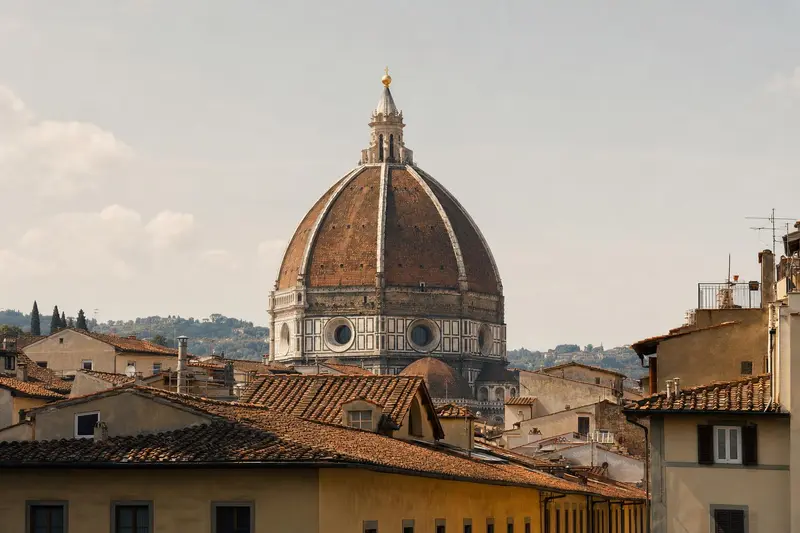
From the terrace, FeelFlorence names the Duomo and its dome, Palazzo Vecchio and the Arnolfo Tower, Santa Croce, the Arno riverbanks, Ponte Vecchio and the hills of Fiesole among the views. The 2021 minor boundary modification to UNESCO’s Historic Centre of Florence property includes the piazzale. To continue among the city’s collections, see our Uffizi Gallery guide.