

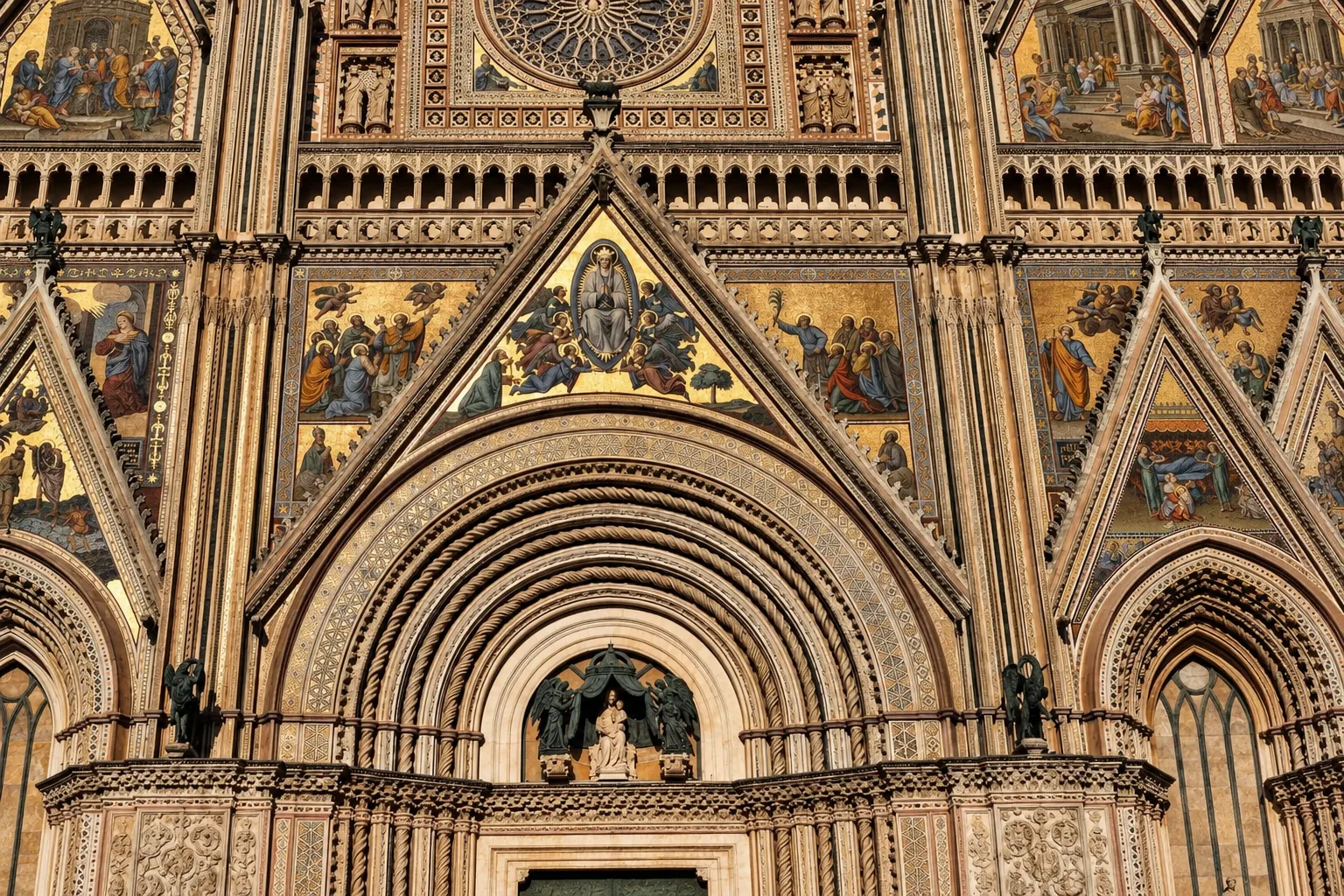
Rising on a sheer plateau of volcanic tufa, Orvieto is crowned by one of Italy's great Gothic cathedrals, its golden mosaic facade blazing above striped marble and Signorelli's apocalyptic Last Judgment.
A honeycomb of caves and the deep St. Patrick's Well run beneath.
When to visit Orvieto
Average highs and lows across the year.
What to see first
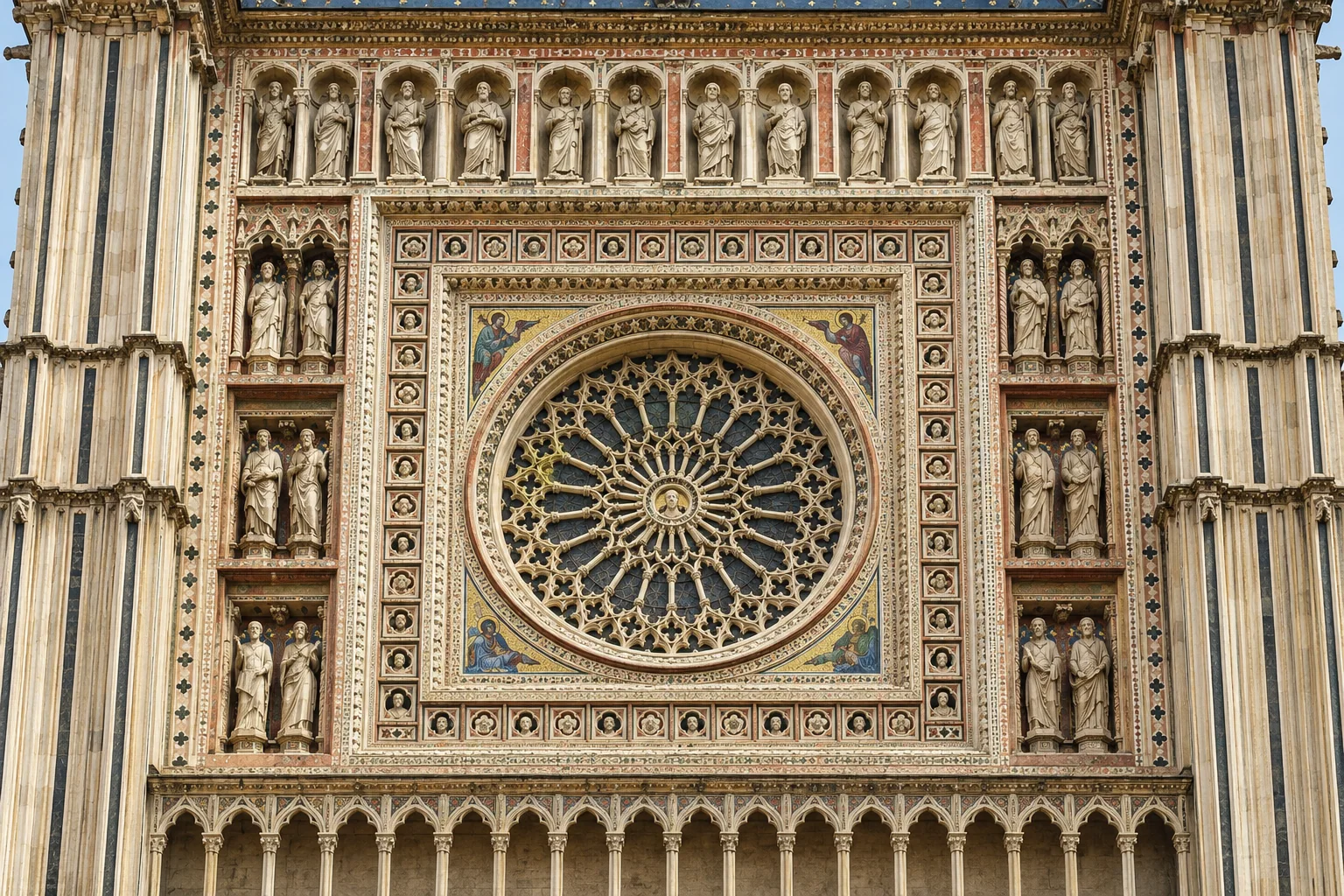
Orvieto Cathedral
A Gothic façade of mosaics and sculpture opens onto a striped nave, Signorelli’s Last Judgment and the Chapel of the Corporal.
Read the guide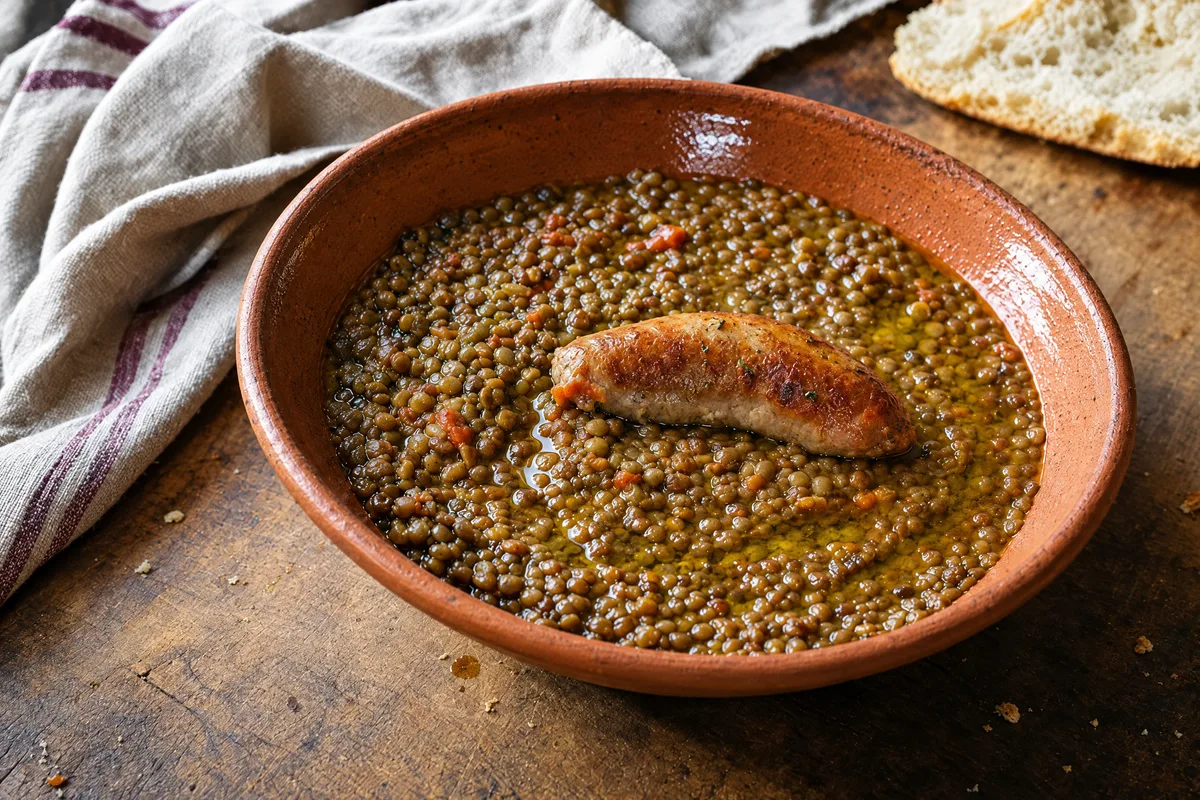
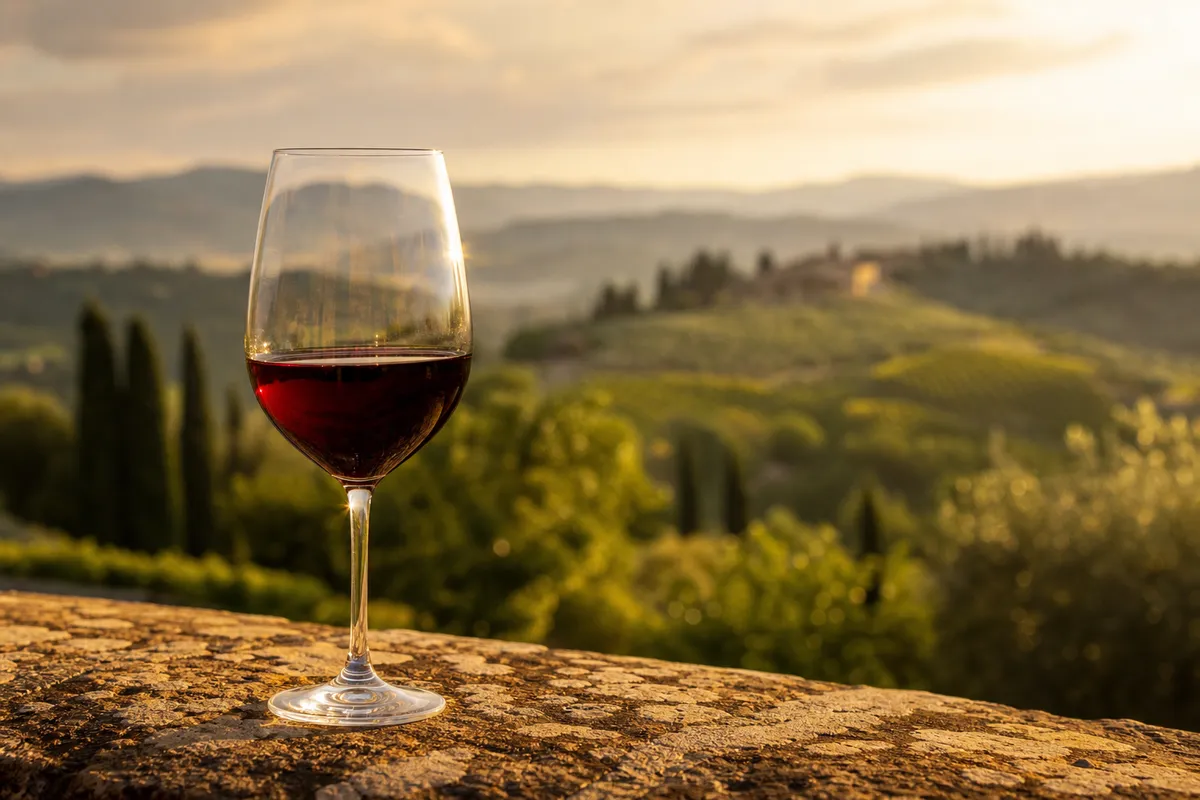
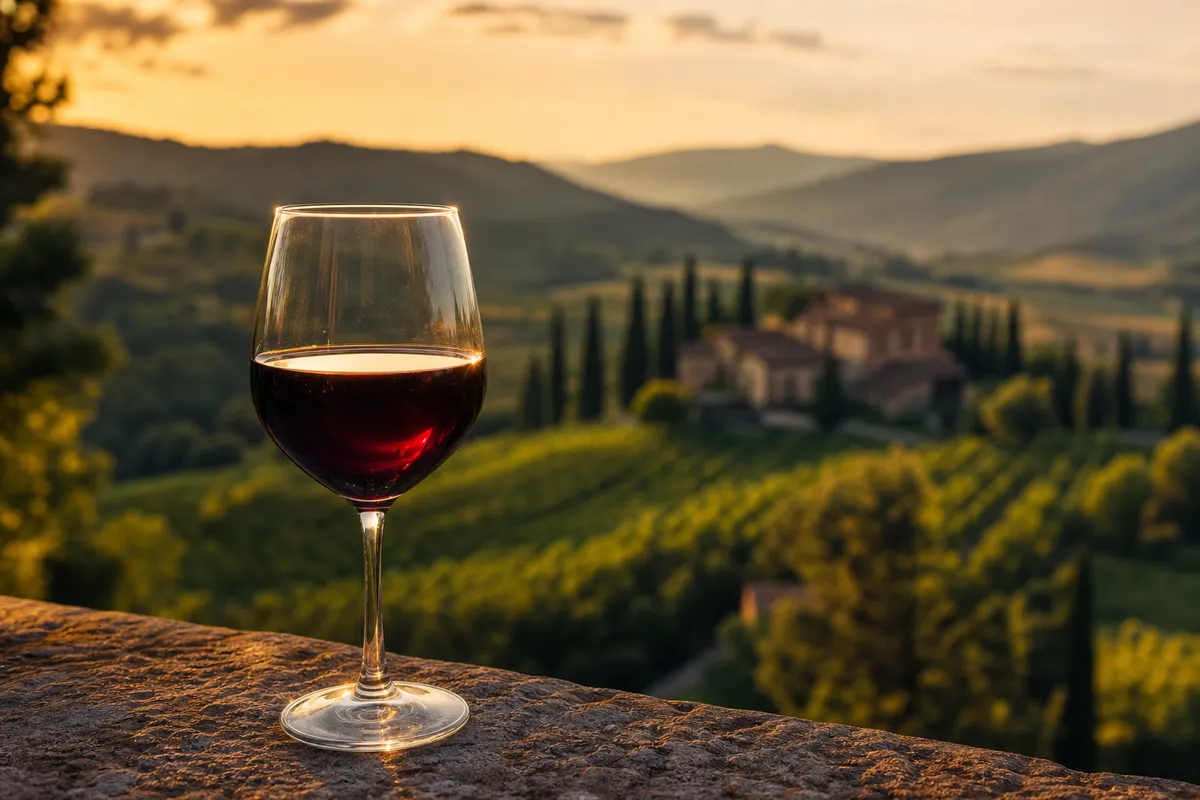
Eating and drinking in Orvieto
Well-loved everyday tables and Michelin stars, each checked open.
- Al pozzo etrusco di Fabrizio GrilliTrattoria
- Mezza lunaTrattoria
- Ristorante Il Giardino da GiovanniTrattoria
- Il Malandrino BistrotTrattoria
- Claudio AlVicoloPizzeria
- CharliePizzeria
Sleeping in Orvieto
Well-reviewed places to stay, each checked open, by town.
- Affittacamere La Rosa di Orvieto
- Affittacamere Valentina
- B&B Chiara e Benedetta
- B&B CasaVera
- Locanda Rosati
- Emme Palace Hotel & Spa
Tours worth booking in Orvieto
Compared by our editors, across providers.
Booking through these links may earn Italia Magnifica a commission, at no cost to you.
- Viator
- 2h
- 5.0★ · 13 reviews
from €119Book this tour- Viator
- 7h
- 5.0★ · 5 reviews
from €430Book this tour

Orvieto in a nutshell
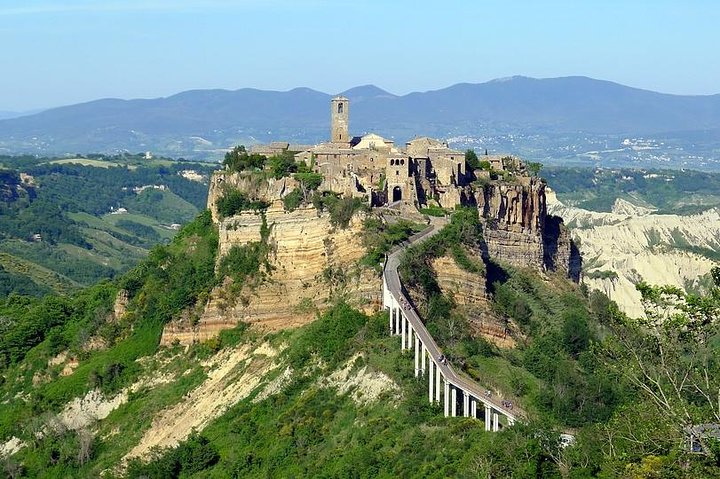
Orvieto sits on a great block of volcanic tuff above the valley of the Paglia, and the unity of city and cliff is what defines the landscape here. The historic centre is compact, walkable and unmistakable from the train, yet the municipality is much larger: railway neighbourhoods, farms, vineyards, woods and lake country stretch well beyond the edge of the rock.
Plan on at least a full day, and more if you like your travel slow. The cathedral alone repays a long visit, Etruscan Orvieto is spread across necropoleis, sanctuaries and several museums, and the wells and caves beneath the streets add a whole second city to explore.
Orvieto has been on Italy's UNESCO Tentative List since 2006, a proposal rather than an inscription.
The Rupe: tuff, water and a city on a cliff
The plateau, known as the Rupe, is built of the Orvieto-Bagnoregio ignimbrite, a volcanic deposit linked to the Vulsini volcanic system. Soft enough to carve and strong enough to build from, the tuff shaped almost everything about the town: its walls, its cellars, its quarries and its wells.
A high, defensible hill does not come with easy water, so for many centuries Orvieto's residents dug downward. Shafts, cisterns, channels, cellars, workshops and storerooms honeycomb the rock, and they were reworked again and again, which is why a cave here can be Etruscan, medieval or Renaissance at once. Today four separate visitor experiences open different parts of that underground world: St. Patrick's Well, Pozzo della Cava, Orvieto Underground and the cathedral underground chambers. None of them shows the whole picture, which is exactly why it is worth sampling more than one.
Etruscan Orvieto
Orvieto was one of the great cities of Etruria. Many scholars identify it with Etruscan Volsinii, and the state archaeological museum describes Campo della Fiera, below the Rupe, as the probable site of the Fanum Voltumnae, the sanctuary where the Etruscan cities met. "Probable" is the museum's own word, and it is a fair reminder that the ancient story here is still being read.
The ring of archaeological sites around the cliff is the best way in. Crocifisso del Tufo lies on the northern slope: tidy blocks of chamber tombs cut and built in tuff, many marked with inscriptions naming the dead or their families, so the layout of the ancient town of the dead is unusually easy to read.
Cannicella, on the southern side of the Rupe, is an archaic necropolis with a sacred area founded in the second half of the sixth century BC. Finds from it, including the much-loved figure known as the Venus of Cannicella, are shown in Orvieto's museums rather than on the site itself.
Belvedere, near Piazza Cahen, is a separate temple site, and the state museum shows finds from it. It makes a handy first or last archaeological stop if you arrive from the station side.
The museums of the ancient city
The Museo Archeologico Nazionale, in the Palazzi Papali beside the cathedral, arranges material from Orvieto's necropoleis, sanctuaries and urban excavations, along with finds from Campo della Fiera and from Porano. Its showpiece is the reconstruction of the painted Golini tombs.
The two Golini tombs were discovered in 1863 at Settecamini, between Orvieto and Porano, and belonged to the Leinies and Vercnas families. Their frescoes, famous for banquet scenes, were detached for conservation and rebuilt in the museum according to the tombs' original layout.
Across Piazza Duomo, Palazzo Faina holds two collections under one roof: the Faina collection, assembled by the Faina family in the nineteenth century, and a civic archaeological section that gathers objects excavated in the city and its territory. Together they cover Attic vases, Etruscan ceramics and coins, and they complement the state museum rather than repeating it.
The cathedral
Orvieto's cathedral is the anchor of the whole town. Its foundation is traced to 1290, and it grew over centuries. Work on the facade began around 1310 and was architecturally concluded in 1532, and the mosaics, sculpture and bronze that cover it were joined by later restorations and additions. Step inside and the alternating bands of basalt and travertine, the chapels, the choir and the organ show a building that was repeatedly furnished, stripped back and reinterpreted.
The Opera del Duomo is much more than the ticket desk. It is the historic body, the fabbriceria, responsible for building and maintaining the cathedral, and it runs the archive, the museums, the chapels and the underground chambers linked to it.
San Brizio: a chapel that works as one great painting
The Chapel of San Brizio is the reason many visitors come. Fra Angelico began the vault in 1447, and Luca Signorelli took over in 1499, painting the great sequence of the Last Days and the Last Judgment across the walls. Give it time and read it as a single cycle of vault and walls, not a string of famous figures.
The Corporal and the Miracle of Bolsena
The Chapel of the Corporal keeps the linen cloth tied to the Miracle of Bolsena of 1263, when, in the tradition, the consecrated host began to bleed onto the corporal during a Mass celebrated by a Bohemian priest. Urban IV instituted the feast of Corpus Christi the following year, and Orvieto still marks it every year with a procession and a costume parade that evokes the medieval noble families and communes.
The linen sits behind an altar tabernacle of red and white marble with mosaic decoration, made in the mid-fourteenth century by Orcagna. Before it, the cloth was kept in a reliquary of 1338 by Ugolino di Vieri, which belongs to the Opera's museum collections. Bolsena itself is a separate town across the regional border in Lazio.
Emilio Greco and the Opera's museums
Alongside the cathedral, the Opera del Duomo looks after the Museo dell'Opera (MODO), a museum system that brings together the cathedral's art and its collections under one name. One of its sites, the Museo Emilio Greco in Palazzo Soliano, presents the collection that the sculptor Emilio Greco donated to Orvieto. Greco also made the bronze doors of the cathedral, and the museum is a natural companion to a visit to the facade.
Beneath the transept and chapels, the cathedral underground chambers form a space of about 800 square metres, used over time for storage, maintenance and works, and now also for exhibitions. They are a different place from Orvieto Underground.
The civic and medieval city
Beyond Piazza Duomo, Orvieto's public life unfolds along a chain of spaces: Piazza della Repubblica, the municipal palace, Corso Cavour, Palazzo dei Sette and Piazza del Popolo. Together they tell the story of the medieval commune, papal presence, rival families, market days and assemblies.
Torre del Moro stands near the crossing of the town's main axes. The Comune dates it to the thirteenth century and gives its height as 47 metres; its civic bells and mechanical clock were installed after a restoration in 1866. It was once called the Torre del Papa, and it remains the symbol of municipal power. From the top you take in the plateau, the cathedral set in its streets and the farmland beyond.
At the eastern edge, the Albornoz Fortress was begun in 1364 by Cardinal Albornoz, destroyed in 1390 and rebuilt in 1450 under papal rule. Today its gardens are a public park with a sweeping view of the valley.
The western medieval quarter around Via della Cava and San Giovenale is quieter and more residential: cliff-edge lanes, cavities cut into the rock, old pottery workshops and views across the countryside. It is a living neighbourhood, so keep your voice low in the lanes.
Two wells
St. Patrick's Well was commissioned by Pope Clement VII, entrusted in 1527 to Antonio da Sangallo the Younger and completed in 1537 under Paul III. It is 54 metres deep and 13 metres across, lit by 72 windows, and its double spiral staircase, 248 steps in all, let pack animals go down for water and come back up without ever meeting. It was first called the Well of the Fortress because it served the Albornoz Fortress.
Pozzo della Cava is a different experience altogether: a privately run archaeological complex of nine underground spaces in the medieval quarter. Its 36-metre well adapts an earlier Etruscan shaft, and the route shows cisterns, pottery kilns and centuries of reuse.
Orvieto Underground is a guided route that starts from Piazza Duomo 23 and takes in selected caves. It is not a key to every cellar under the town; many cavities are private and stay that way. The underground experiences differ in subject, length, stairs and confined spaces, so pick the one that suits you rather than buying each.
Beyond the Rupe
The municipality is far larger than the hill town. Orvieto Scalo, the railway and interchange settlement below the historic centre, is one of several communities that also include Ciconia, Sferracavallo, Morrano, Canale, Sugano, Torre San Severo, Prodo and Corbara.
Monte Peglia, designated a UNESCO Man and the Biosphere reserve in 2018, covers 42,342 hectares of forest and ancient volcanic landscape between the Tiber and Paglia systems. Biosphere status is not World Heritage inscription. It is excellent country for a day out.
The Tiber River Regional Park spans parts of seven municipalities, Orvieto among them, and takes in the river corridor, the artificial Lake Corbara, the Alviano basin and the Forello gorge.
Wine and food
Orvieto DOC is a protected white-wine denomination, and its production zone crosses from the province of Terni in Umbria into the province of Viterbo in Lazio. It includes a defined Classico subzone, the historic heart of the area.
Nearby, Rosso Orvietano (also called Orvietano Rosso) DOC covers red wines from fourteen municipalities of the province of Terni, Orvieto among them. Lago di Corbara DOC is a third, separate denomination in the river-and-lake landscape. A single winery may make wines under more than one of these names.
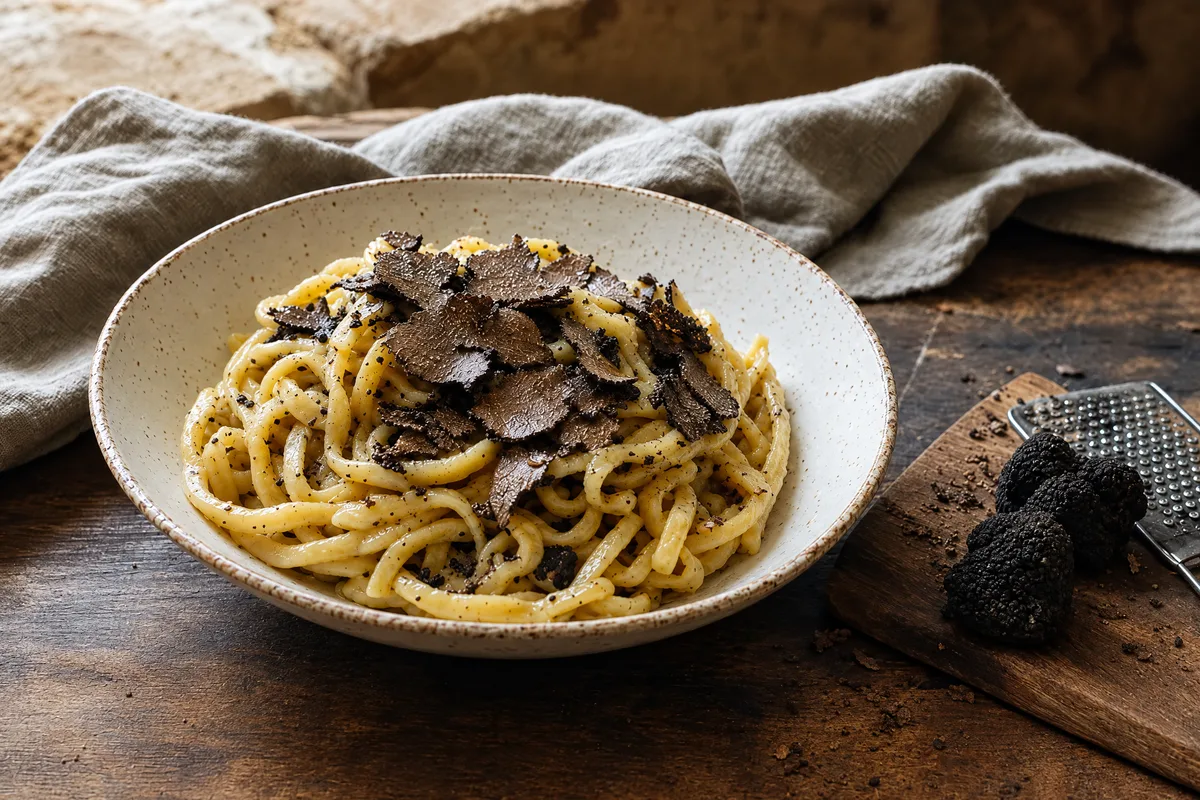
On the table, look for lumachelle orvietane, the savoury ring-shaped baked treats that the regional tourism authority documents as a local specialty, alongside the hearty fare of the area such as legumes, pork, game and truffles.
Walking the hill and planning your time
Orvieto is a hill town, so expect slopes, stone paving and steps between the station side and the cathedral quarter. Torre del Moro has an elevator, yet stairs can remain on the way to the terrace, and St. Patrick's Well involves 248 steps with no step-free alternative. Underground routes add stairs, dampness and tight spaces, so ask the operator about the exact route if mobility is a concern.
The cathedral is also a working church, and Mass takes priority over visiting. Dress for a sacred space and keep your voice low.
Opening days, worship hours, ticket combinations and works change, so confirm them on the Opera del Duomo's own site and the museums' sites before you go.
Itineraries
One full day: arrive at Piazza Cahen, orient yourself from the fortress gardens, walk the civic spine to Piazza Duomo, and give the cathedral and San Brizio real time. Continue through Torre del Moro and Piazza del Popolo toward Via della Cava, and finish in the western quarter without squeezing an underground tour into the last hour.
Two days: spend the first on the cathedral, the Opera's museums and the civic city, and the second on Etruscan Orvieto: Crocifisso del Tufo, the archaeological museums and Belvedere. Add one underground route, chosen for its subject.
Three days or a slow stay: add the western medieval quarter, a second underground system only if it offers something new, and one country day. Corbara and the Tiber park suit a river-landscape outing; Monte Peglia rewards a walk; Orvieto's white wines are worth a cellar visit. Neighbouring Porano is where the Golini tomb story connects, and Bolsena is the home of the Corporal tradition.
More of Umbria

A letter from Italy, once a month.
The places, tables and makers we found worth your time. One email, no noise.
One letter a month. Unsubscribe at any time. We never share your address.