

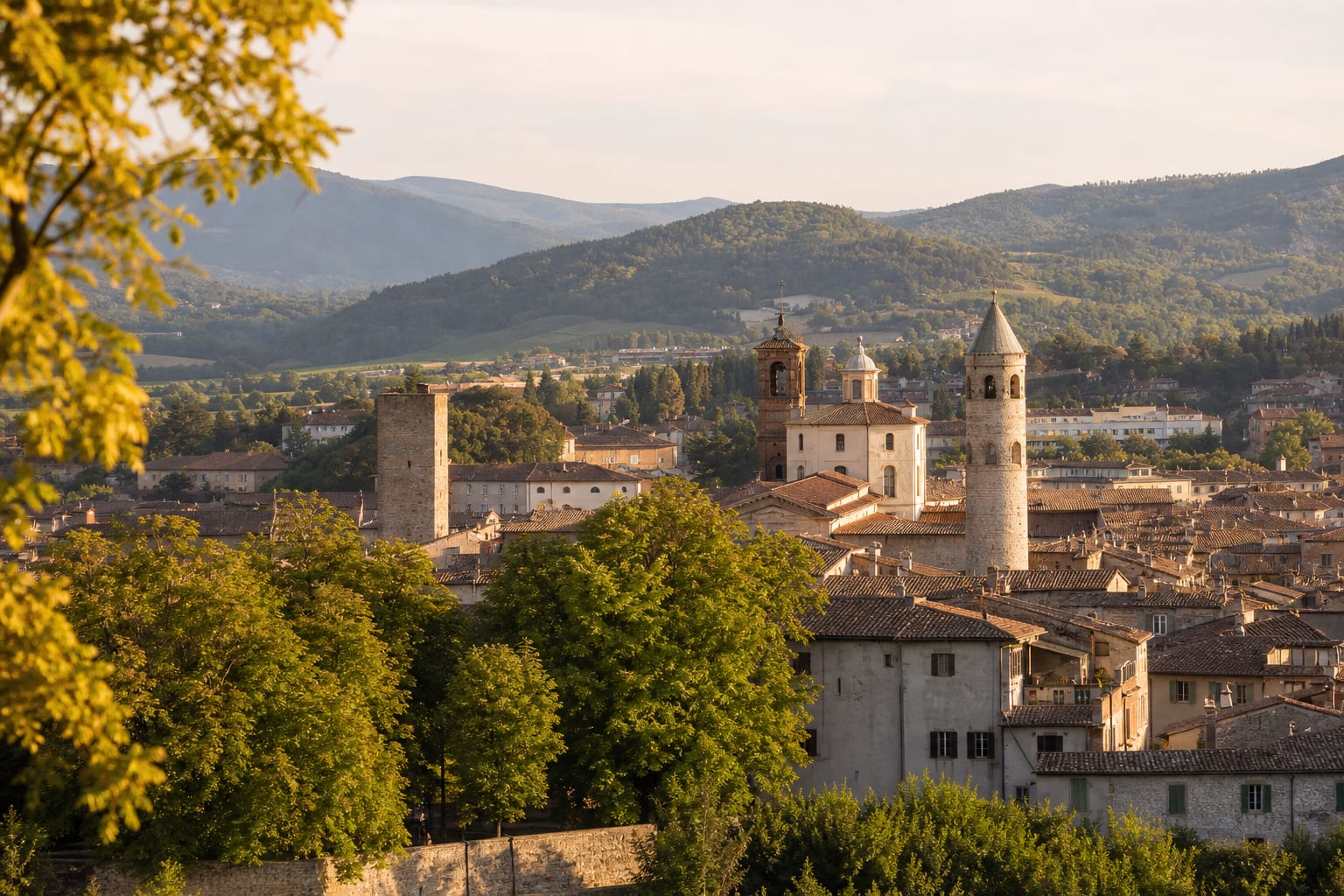
In the upper Tiber valley near the Tuscan border, Città di Castello pairs a refined Renaissance centre with the surrounding hills' renown for truffles.
The town is best known for its museums devoted to the abstract painter Alberto Burri, a native son.
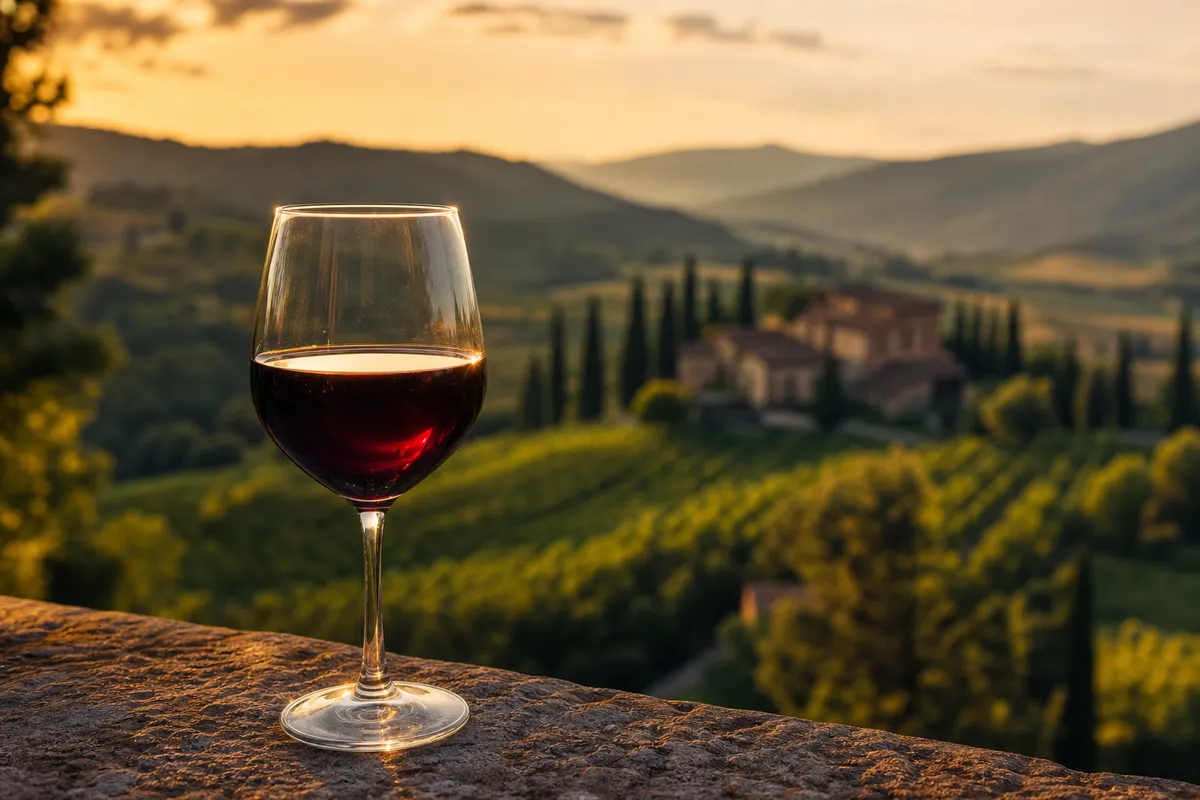
Città di Castello: the Upper Tiber as a borderland
Città di Castello is the principal town of the northern Umbrian Tiber valley, in the Province of Perugia. The name covers several things at once: the municipality, the walled historic centre, and the wider Upper Tiber cultural area that reaches toward Tuscany and the Marche. Its museums, rural churches, and hamlets are not all part of the old town, and the territory around it is large.
Regional landscape planning describes the Tifernate as a border system shaped by the Tiber, the cultivated valley floor, the hills, and routes toward Tuscany and the Marche, with an urban centre transformed repeatedly rather than frozen in one period. Modern tobacco-drying structures are part of that story, because some of them acquired new cultural uses.
The municipality extends far beyond the centre. Trestina and Cerbara are its major outlying settlements, and Istat's 2021 register lists twenty-four inhabited centres and forty smaller inhabited nuclei, along with special localities such as Cinquevie and Coldipozzo.
Scale changes a visit. Palazzo Vitelli, the cathedral, and Palazzo Albizzini belong to a walkable centre, while the Ex Seccatoi del Tabacco, the river landscapes, Trestina, Morra, Canoscio, Badia Petroia, and Garavelle are reached in different ways.
Tifernum Tiberinum
The ancient name Tifernum Tiberinum is fundamental, but the archaeological authority warns against treating the identification of the Roman centre with the modern city as a simple certainty. Earlier evidence was not significant enough to locate the ancient settlement precisely. More recent discoveries in the former F.A.T. and Mattonata area have made the urban location clearer: mosaics, domestic evidence and inscriptions point to a substantial centre from the early imperial period.
The same authority identifies the elliptical structure as a first-century spectacle building and frames it typologically as an amphitheatre, while also recording that the usual structural supports for the cavea are absent. That is an excavation-based interpretation, and the exact plan of the building is not settled.
The regional archaeological mapping is extensive: it identifies Tifernum Tiberinum as a Roman municipium and records legal archaeological constraints at ex F.A.T., Via delle Santucce, Meltina, Via del Geminaio and Via del Borghesi.
Pliny the Younger is the richest ancient literary witness for the Tifernate territory and held property here. The villa and archaeological museum commonly associated with his Villa in Tuscis are in the neighbouring Comune di San Giustino, at Villa Magherini Graziani and Colle Plinio, and the association is a scholarly attribution presented by the San Giustino custodian. Città di Castello explains the ancient regional connection, while the villa and museum belong to San Giustino.
A civic centre built in layers
The Vitelli family added another system of residences. Palazzo Vitelli alla Cannoniera is now home to the Pinacoteca Comunale, while Palazzo Vitelli a Sant'Egidio, built in the sixteenth century for Paolo II Vitelli, is another residence, and Palazzo Vitelli a San Giacomo houses part of the historical archive.
The regional Vitelli itinerary names four residences: Palazzo Vitelli in Piazza, Palazzo Vitelli a San Giacomo, Palazzo Vitelli alla Cannoniera and Palazzo Vitelli a Sant'Egidio, while the municipal Pinacoteca record speaks of five palaces, so the family's building programme was larger than any one list.
Palazzo Vitelli alla Cannoniera and the Pinacoteca
The Comune places the Pinacoteca Comunale in Palazzo Vitelli alla Cannoniera, constructed between 1521 and 1545. It describes the garden facade decoration by Cristofano Gherardi, called Doceno, probably working to a plan by Giorgio Vasari, and connects the modern civic collection to Elia Volpi's 1912 donation.
Raphael's Stendardo della Santissima Trinità, an early work made for the city, was restored by the Istituto Centrale per il Restauro and lent to the Metropolitan Museum of Art before returning to Città di Castello. The Comune presents it as significant to Raphael's early activity in the city.
Alberto Burri in two architectures
Città di Castello's modern identity is inseparable from Alberto Burri, whose work is housed in two distinct settings. The Fondazione Palazzo Albizzini Collezione Burri was established in 1978. Its first venue opened in Palazzo Albizzini in December 1981; the foundation describes about 150 works from 1948 to 1989 across twenty rooms. The late fifteenth-century palace is itself a distinct building held on loan by the foundation.
The Ex Seccatoi del Tabacco opened as the second venue in July 1990. The eleven former drying sheds carry the economic history of tobacco cultivation, the memory of books dried there after the 1966 Florence flood and Burri's own use of the complex as a studio. The venue contains major painting cycles, a permanent graphic-work section and a multimedia documentary area.
Access differs between the two places by building design. The foundation says Palazzo Albizzini's historic layout limits step-free access to the ground floor, while the Ex Seccatoi route is accessible with a stairlift and includes communication supports.
Cathedral, campanile and the Canoscio Treasure
The Cathedral of Saints Florido and Amanzio is a living church and the diocesan cathedral, distinct from its cylindrical campanile, crypt, treasury and the Museo del Duomo. Tourist access yields to worship, pastoral use and conservation.
The Museo del Duomo traces its foundation to 1940, after the 1935 discovery of the Canoscio Treasure, and occupies twelve rooms in the former canonica. Its permanent collection connects sacred works, church furnishings and archaeological material.
The Canoscio Treasure is an early Christian silver assemblage of twenty-five objects, including plates, patens, chalices, a pyxis, strainers, a small ladle and spoons. It was found by chance in spring 1935 near the sanctuary at Canoscio, close to Trestina, and is held today in the Museo del Duomo.
Linen, type and archives that still work
Tela Umbra began in 1908 through Alice Hallgarten and Leopoldo Franchetti. The organisation describes hand weaving on late nineteenth-century looms, with linen and designs derived from older Umbrian traditions. Its Museo della Tela Umbra occupies nine rooms on the second floor of Palazzo Alberti Tomassini and contains looms, textiles, lace, tools and a rural-school classroom.
The Grifani Donati printing workshop belongs to another living craft. Its own history places printing in Città di Castello from 1538 and the business from 1799. The Regione recognised it in 2004 as a living museum of graphic arts. Working presses and demonstrations make it a workshop rather than a static display.
The historical municipal archive is a major research institution rather than a decorative claim of antiquity. SIUSA describes 4,366 archival units dating from 1178 to 1968, with part of the holdings at the Biblioteca Carducci in Palazzo Vitelli a San Giacomo. Consultation is by request.
Rural sacred places and the wider municipal footprint
The municipal story continues beyond the walls. Umbria Tourism identifies the Oratorio di San Crescentino at Morra, Canoscio, Badia Petroia, Villa Montesca and Garavelle among the important places of the territory.
Morra's oratory, Canoscio's sanctuary, the abbey at Badia Petroia, the educational history of Montesca and the rural museum at Garavelle each reward a trip beyond the walls. Trestina and Cerbara are inhabited towns with their own services and heritage rather than outlying sites. The Upper Tiber makes sense only when the old centre and this inhabited network are read together.
Each of these places has its own story. The Morra oratory was built in 1420 and enlarged in 1507, and its source separates the Flagellation and Crucifixion attributed to Signorelli himself from workshop decoration. Badia Petroia preserves an altered Benedictine complex, a tripartite crypt, reused materials and fabric affected by the 1917 earthquake. Villa Franchetti, or La Montesca, belongs to a separate educational and landscape history, and Garavelle's Centro delle Tradizioni Popolari Livio Dalla Ragione is a collection in a rural building.
Regional heritage inventories list many protected properties and historic villas in the municipality, along with nine former industrial sites: Ex F.A.T., Ex Vigili, Ex Mattatoio, Ex Mulini Tifernati, Ex VALTIB at Trestina, Ex Mulino Bonsciano, Ex Paolini, Mulino Morra and Ex COLAT at Garavelle.
The municipal territory includes protected landscape areas and four Special Areas of Conservation, with extensive forest and ecological-network cover, but no Special Protection Area, national park or regional park.
White truffle, wine and beef
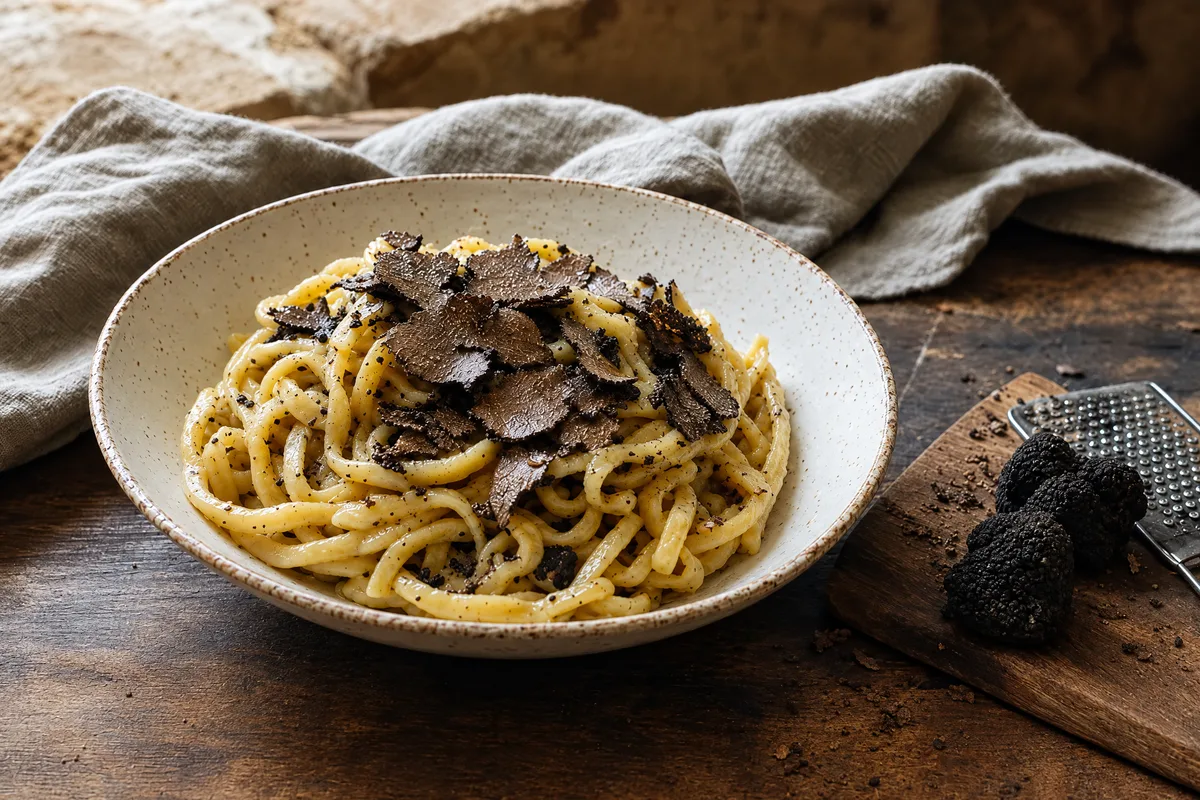
The regional traditional-product sheet identifies Tartufo bianco pregiato, Tuber magnatum Pico, and records trifola as a local term in the Città di Castello and Gubbio areas. Its production territory extends across many Umbrian municipalities. PAT status records a traditional product; it is not DOP or IGP certification, and it does not make every truffle sold in Città di Castello local.
The Salone Nazionale del Tartufo Bianco Pregiato is a long-running annual event in Città di Castello, with a dedicated organising association.
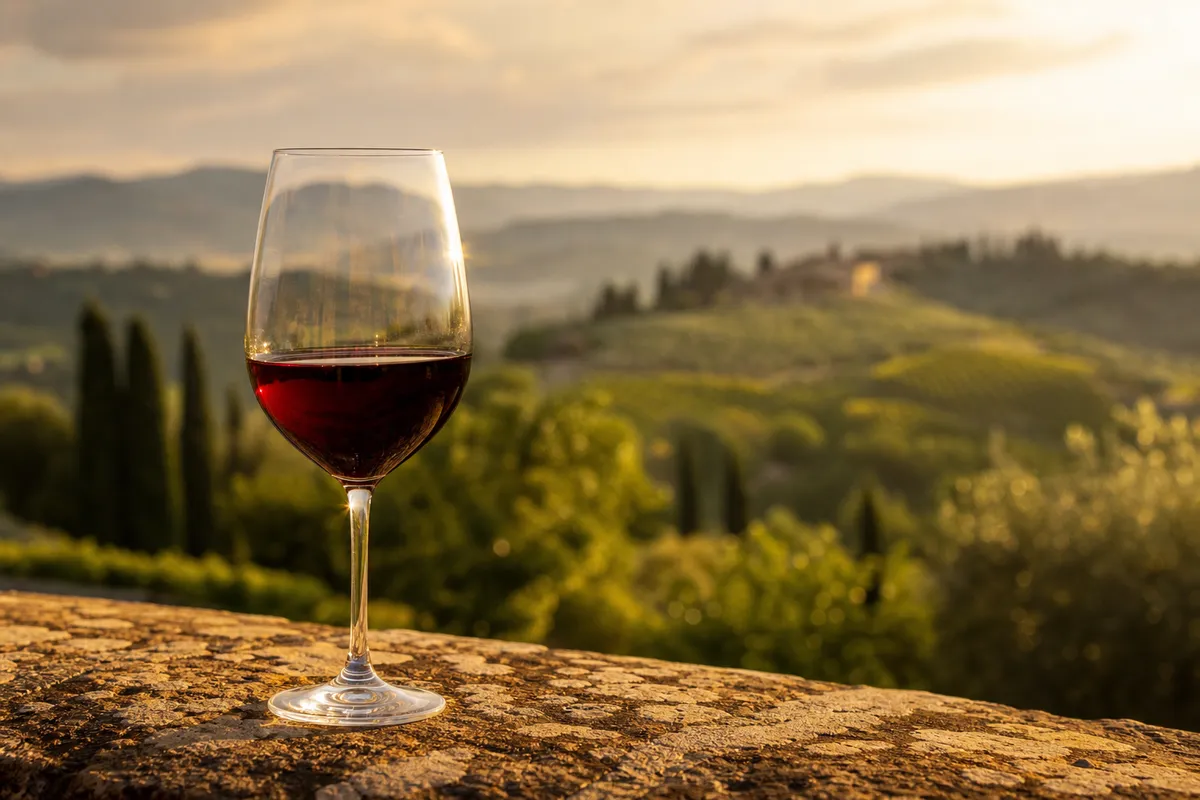
Colli Altotiberini is a registered protected wine designation whose area covers only part of the municipality, so not every vineyard or restaurant in Città di Castello falls within it.
Vitellone Bianco dell'Appennino Centrale is an IGP whose specification includes the Province of Perugia and controls breeds, age and traceability. Being sold in town does not make a cut or a dish IGP.
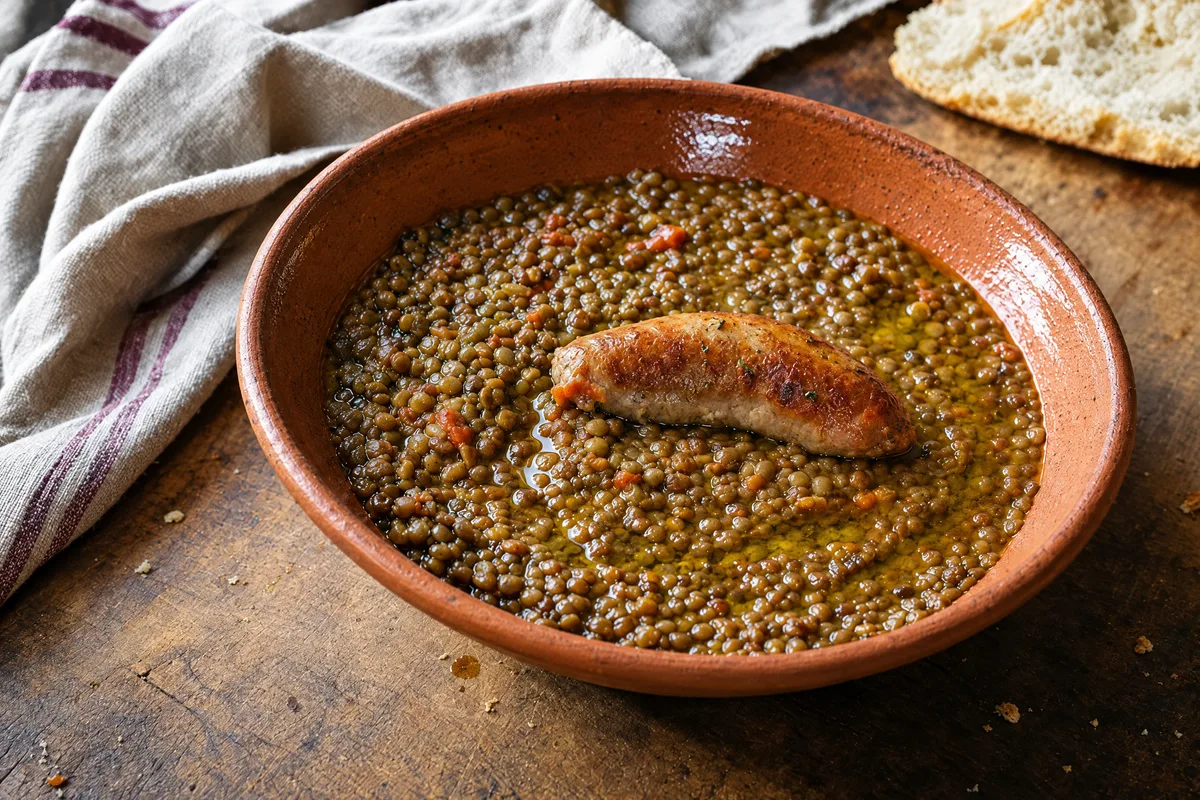
The national specification includes Città di Castello in the Colli del Trasimeno geographical mention of Umbria DOP extra virgin olive oil, and the municipality also intersects the Colli Altotiberini DOC wine area. Geography alone certifies neither product nor producer. Slow Food lists Mazzafegato producers at San Pietro a Monte and Bivio Canoscio, and also profiles a smoked Vinosanto from the area.
Access
The municipality approved a barrier-elimination plan, the PEBA, in March 2025 and extended its planning work to Trestina and Cerbara. A plan records assessment and intended action rather than certifying that streets, museums or transport are step-free; Palazzo Albizzini's own limits are described above.
A first visit
A good first route starts with orientation in Piazza Gabriotti and the cathedral quarter, then separates the Pinacoteca's Renaissance collection from the Burri foundation's two venues. Treat the cathedral as a living church, and give the printing and textile workshops time rather than treating them as shopping stops. A second day can reach the Ex Seccatoi and selected rural or valley sites. Città di Castello rewards those distinctions: Tifernum and modern city, palace and museum, findspot and custody, municipality and Upper Tiber.
More of Umbria

A letter from Italy, once a month.
The places, tables and makers we found worth your time. One email, no noise.
One letter a month. Unsubscribe at any time. We never share your address.