

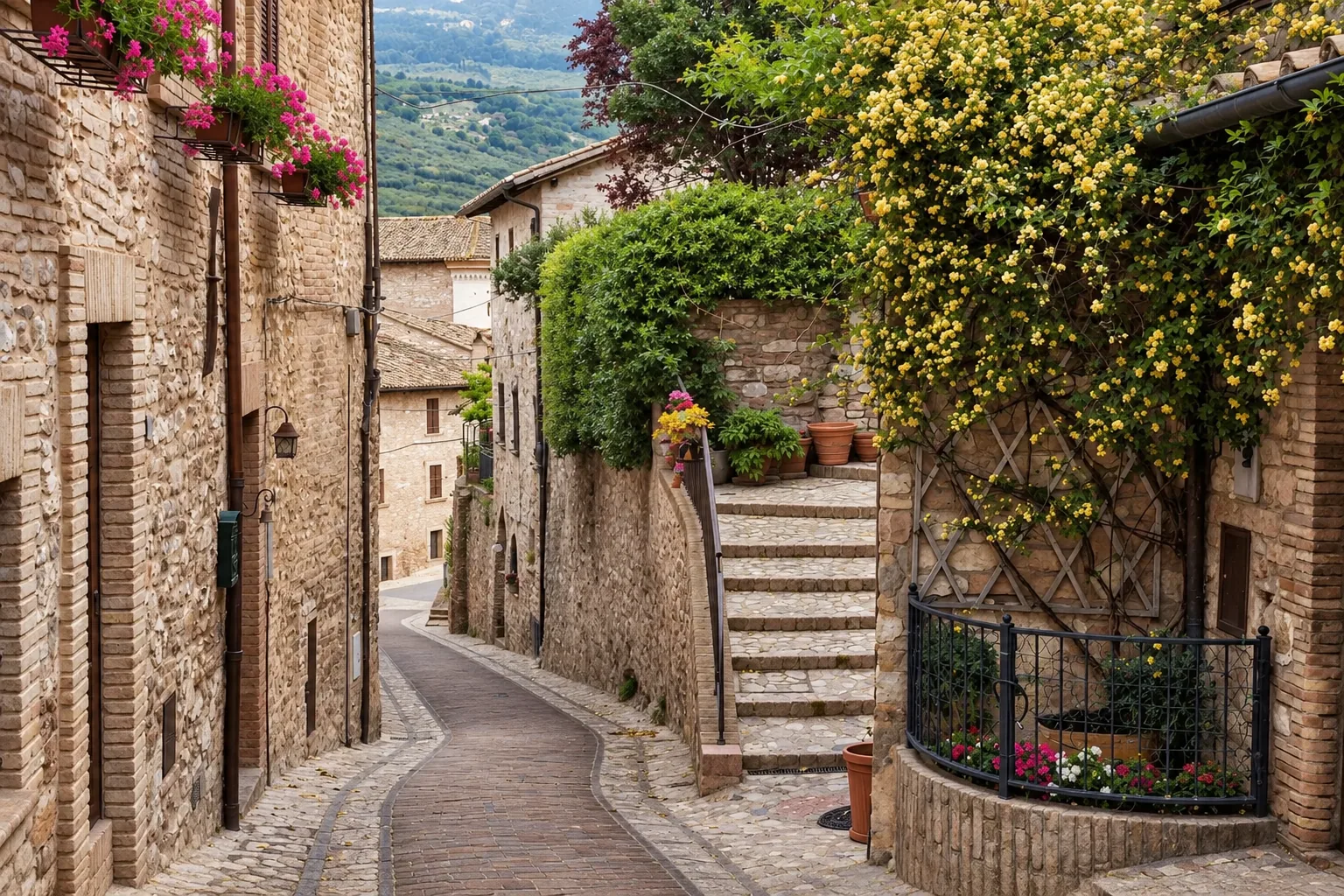
A rose-stone town wrapped in Roman gates, Spello is famous for its June Infiorate, when residents carpet the lanes in flower petals.
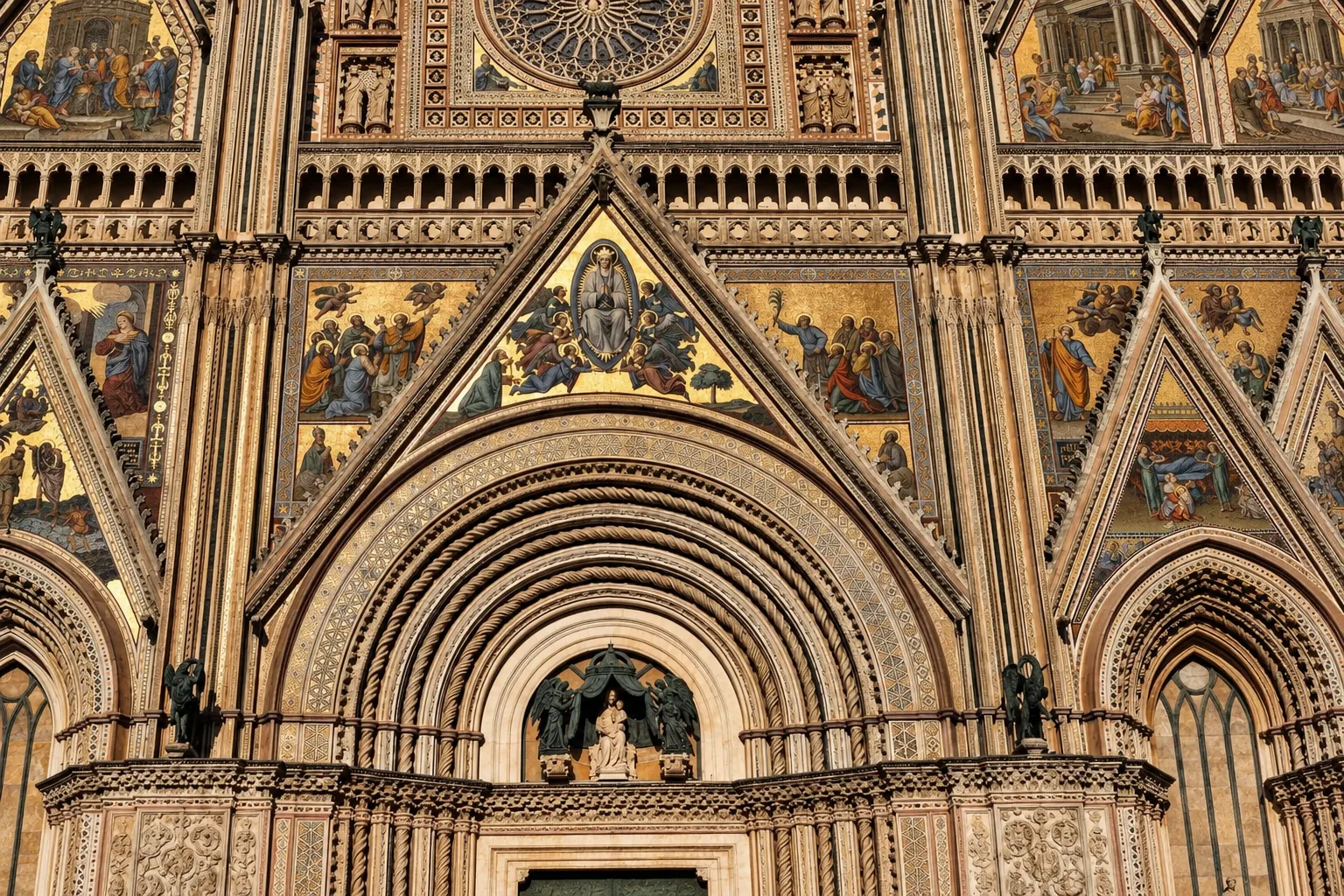
Inside Santa Maria Maggiore, the Baglioni Chapel holds Pinturicchio's jewel-bright frescoes above a maiolica floor.
When to visit Spello
Average highs and lows across the year.
What to see first
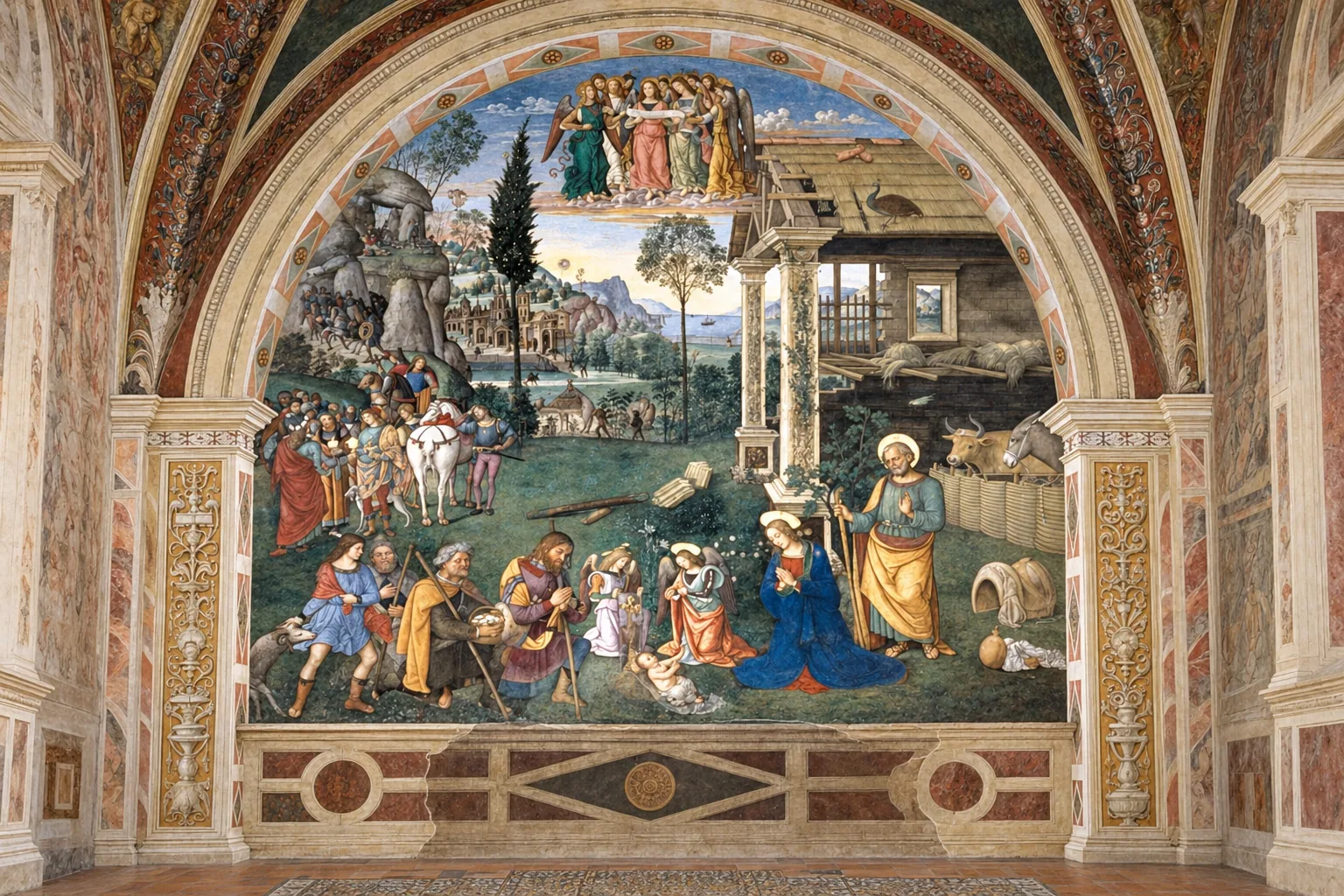
Baglioni Chapel
Pinturicchio's jewel-toned 1500-1501 frescoes in Spello's Baglioni Chapel, with a Deruta maiolica floor.
Read the guide
The year in Spello
The rituals, races, and processions the city still keeps.
Spello at a glance
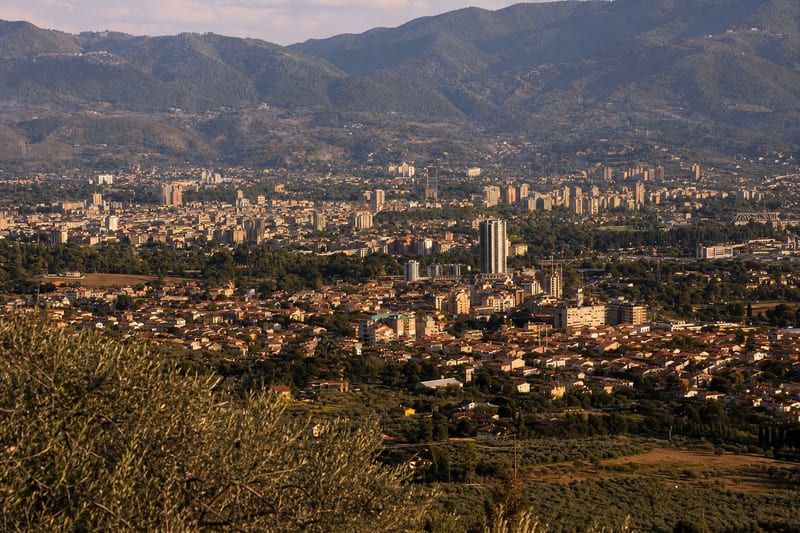
Spello climbs the southern flank of Monte Subasio, a honey-coloured stone town of steep lanes that looks out over the Umbrian Valley. The municipality is bigger than the walled centre: its territory runs from the valley floor up through olive slopes to high mountain country, with the old town perched on a spur in between.
Officially, Spello is an active comune in the Province of Perugia (Istat code 054050). Its neighbours are Foligno, Bevagna, Cannara, Assisi and Valtopina, each a municipality in its own right, so a day that touches Assisi or Foligno crosses a municipal line even when the landscape feels continuous.
A first visit strings together Porta Consolare, Corso Cavour, Santa Maria Maggiore with its Pinturicchio chapel, the upper Roman gates and, down in the lower town, the Villa of Mosaics. Because the historic settlement sits on a spur, expect to climb, and give the upper lanes more time than the map suggests. A longer stay adds the Roman amphitheatre area near Villa Fidelia, the civic and diocesan picture gallery, the flower-carpet tradition of the Infiorate and a walk among the olive terraces.
The historic centre and its frazioni
The walled town occupies only part of the municipal territory. The municipality's planning material names Capitan Loreto, Limiti, Collepino and San Giovanni as frazioni, and Acquatino appears among the settlements of the territory as well. The national census goes further and lists ten localities, among them the centres of Capitan Loreto, Collepino, Ponte Chiona and Spello itself.
The practical upshot is simple. A table in Capitan Loreto is not inside the medieval walls, and a lane in Collepino is not central Spello, yet all of them belong to the same comune. Think of Spello as a cluster of places between valley and mountain, with the stone town as its showpiece.
Foligno, Assisi, Bevagna, Cannara and Valtopina remain separate towns with their own character. Assisi shares Monte Subasio with Spello, and the park that covers the mountain spans several municipalities at once.
Hispellum and the Roman gates
Long before the postcard, this was Hispellum. The Roman town survives as a distributed set of remains woven through the modern streets, not as one fenced archaeological park, which is part of the pleasure: you walk through it on the way to lunch. The Soprintendenza dates the wall circuit to the Augustan period and counts five gates plus smaller posterns along the line. A terrace wall of local limestone between Piazza Sant'Andrea and Piazza della Repubblica marks and supports the eastern side of the Roman forum.
Porta Consolare was the principal ancient entrance. It has three arches, a central passage for vehicles and flanking passages for pedestrians, and it carries three marble statues of the late first century BCE that came from the amphitheatre area. They were set on the exterior in the Renaissance, so the gate shows you two eras at once.
Porta Venere is another three-arched gate, flanked by two twelve-sided towers in local limestone that date from the twelfth century. They are popularly called the Torri di Properzio, but the inscription naming the poet Propertius on the tympanum is a seventeenth or eighteenth-century addition, so read the name as local affection rather than history.
Not every gate survives as well. Porta Urbica, the so-called Arch of Augustus in Via Giulia and Porta dei Cappuccini are fragments in very different states, so expect a pier with traces of an inscription in one place and the curve of an arch in another. Treat the circuit as a walk of discoveries rather than a checklist of intact monuments.
The amphitheatre, the theatre and the Rescript
Outside the Roman walls, the area toward San Claudio and Villa Fidelia held a large public and sacred complex. The Soprintendenza distinguishes an amphitheatre, a theatre, a sanctuary and later layers. The amphitheatre still shows masonry, while the theatre was largely destroyed in the early twentieth century and little of it can be seen. Villa Fidelia, with its gardens, is a later villa laid over part of the ancient setting, not the Roman sanctuary itself.
The most famous object from this area is the Rescript of Constantine, dated between 333 and 337 CE. It allowed Spello to hold its own scenic and gladiatorial games without travelling to Volsinii. It was found in 1773 near the ruins of the Roman theatre and is displayed in the Sala Grande of the Palazzo Comunale.
The Palazzo Comunale also holds a lapidary group: funerary inscriptions, sculpture, a fragment of an armoured statue, a sarcophagus panel and pieces of the theatre's stage building. Seen together, these stones tell you how Hispellum looked and was used.
The Villa of Mosaics
The Villa of Mosaics lies below the walled centre in the Sant'Anna area. It came to light during works in July 2005, when excavation revealed twenty rooms from the central sector of a substantial Roman residence.
The museum distinguishes an Augustan phase from a later one between the second and early third centuries CE, and ten of the twenty rooms preserve polychrome mosaic floors. Together the rooms cover about 500 square metres, and modern names help you find your way: a Bird Room, an Amphora Room, a triclinium, a Radiant Sun Room, a geometric-mosaic room, a peristyle, a Shield Room and a heated room. The main room shows a wine-pouring scene, while the undecorated rooms were probably service spaces.
Those room names are modern conveniences, and the owner is unknown. The idea that the household made wine is an interpretation drawn from the imagery, not something an inscription confirms. It is a lovely detail to carry uphill with you when you later look at the gates and forum wall.
Santa Maria Maggiore
Santa Maria Maggiore is an active parish church in the Diocese of Foligno, and the adjacent Palazzo dei Canonici houses the civic and diocesan picture gallery. It is a place of worship first, so visit as a guest.
The Baglioni Chapel
On the left wall, the Annunciation carries the painter's self-portrait and his signature. The rear wall shows the Adoration of the Shepherds and the arrival of the Magi, and Christ among the Doctors fills the right wall. On the vault, four enthroned Sibyls (Tiburtine, Erythraean, European and Samian) look down over the scene.
Look at the floor too. The majolica tiles come from Deruta and are dated 1566, a later campaign than the frescoes, which gives the small space three layers of colour: walls, vault and pavement.
The civic and diocesan picture gallery
The Pinacoteca Civica e Diocesana occupies rooms in the Palazzo dei Canonici. The municipality describes the present display as a selected, visitable deposit shaped by the space available, not necessarily the complete collection.
It brings together metalwork, wooden sculpture and paintings, and names works linked to the Maestro dell'Assunta di Amelia, Cola Petruccioli, Zaccaria di Filippo Mazzola, Andrea d'Assisi and Pinturicchio.
The Palazzo Comunale holds other collections as well: historic and notarial archives, the Fondo Antico library, the archaeological lapidary, the Rescript and an Emilio Greco collection. They are separate from the gallery even though all of them are civic heritage.
Monte Subasio and the olive slopes
Monte Subasio Regional Park covers 7,169 hectares across Assisi, Spello, Valtopina and Nocera Umbra and rises to 1,290 metres. Spello is one gateway to the mountain, shared with its neighbours.
The olive slopes between Assisi and Spoleto are a FAO Globally Important Agricultural Heritage System, designated in 2018, and Spello is one of the municipalities in this six-town system. The designation recognizes a traditional agricultural landscape of terraces and olive groves; it is not a UNESCO World Heritage listing.
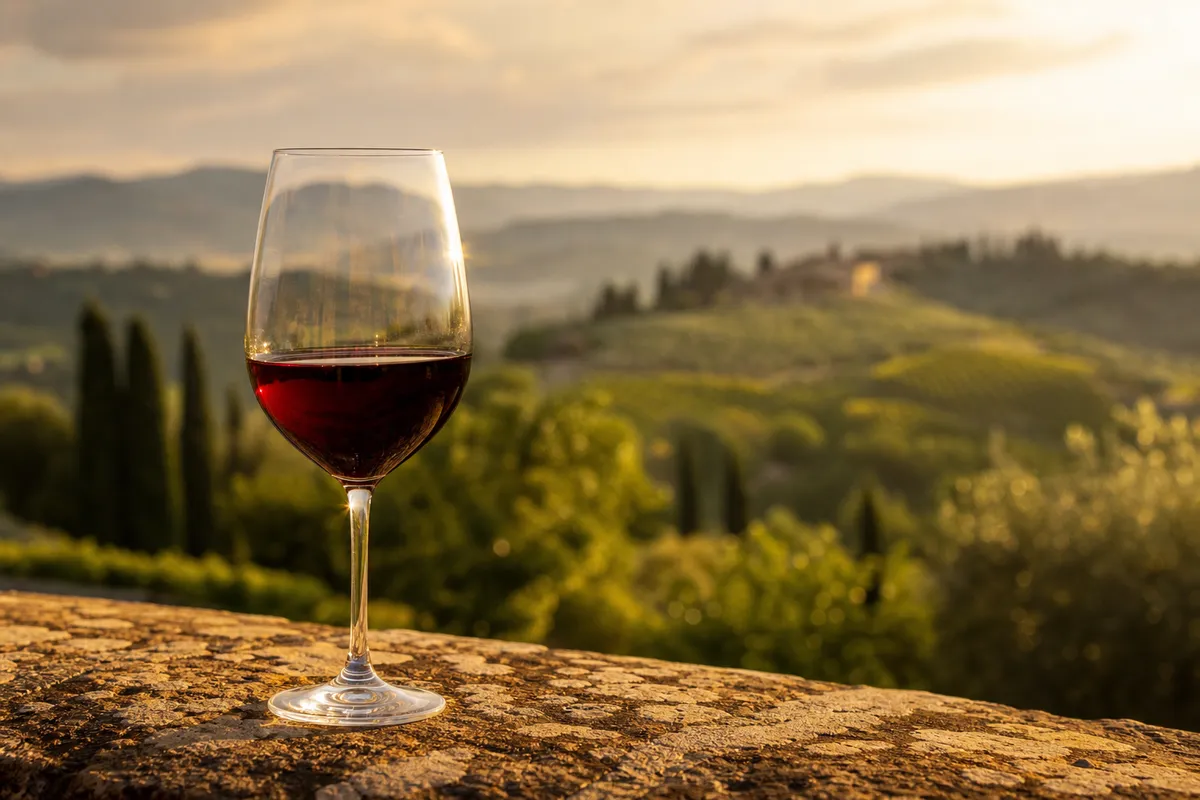
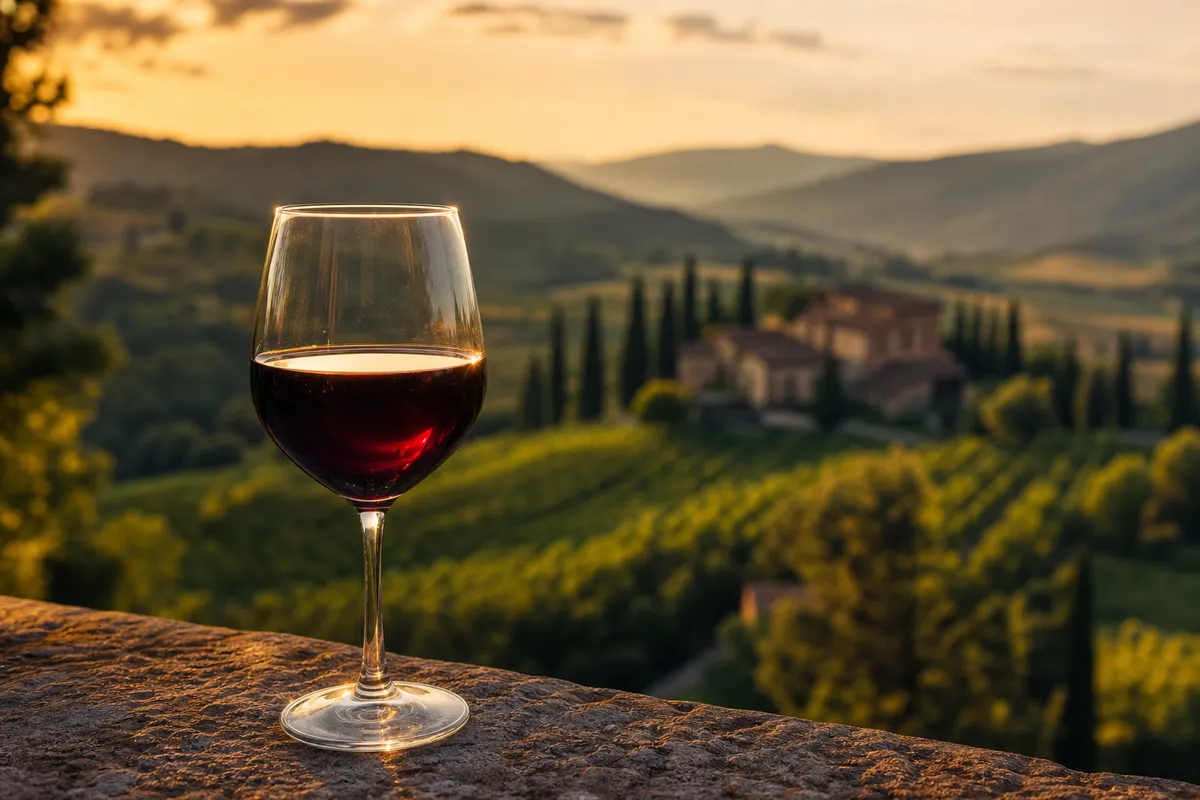
Spello also lies in the production zone for Umbria DOP extra-virgin olive oil with the Colli Assisi Spoleto mention. Location alone does not certify a particular grove, mill or bottle, so look for the DOP name on the label. The name Spello is also a protected geographical indication for wine, and again the place name alone does not guarantee that a given bottle carries it.
The Infiorate
The Infiorate are a living Corpus Domini tradition in which groups create ephemeral pictures and carpets of flowers through the night, following the organizer's rules, before the Sunday procession. The works are ephemeral, and their brief life is part of the point.
Corpus Domini is a movable feast, so the weekend changes from year to year. The Museum of the Infiorate in Piazza della Repubblica holds photographs, designs, video and interpretive material, which lets you appreciate the tradition outside the flower days themselves.
Pacing your visit
Spello rewards a slow pace. One day can link the Villa of Mosaics with a loop through the historic centre, from Porta Consolare up to the upper gates. A second day can add the picture gallery, the civic collections and the Roman area near Villa Fidelia, and the olive slopes or Monte Subasio deserve a day of their own. For opening days and any festival closures, check the municipality's official channels before you travel.
More of Umbria

A letter from Italy, once a month.
The places, tables and makers we found worth your time. One email, no noise.
One letter a month. Unsubscribe at any time. We never share your address.