

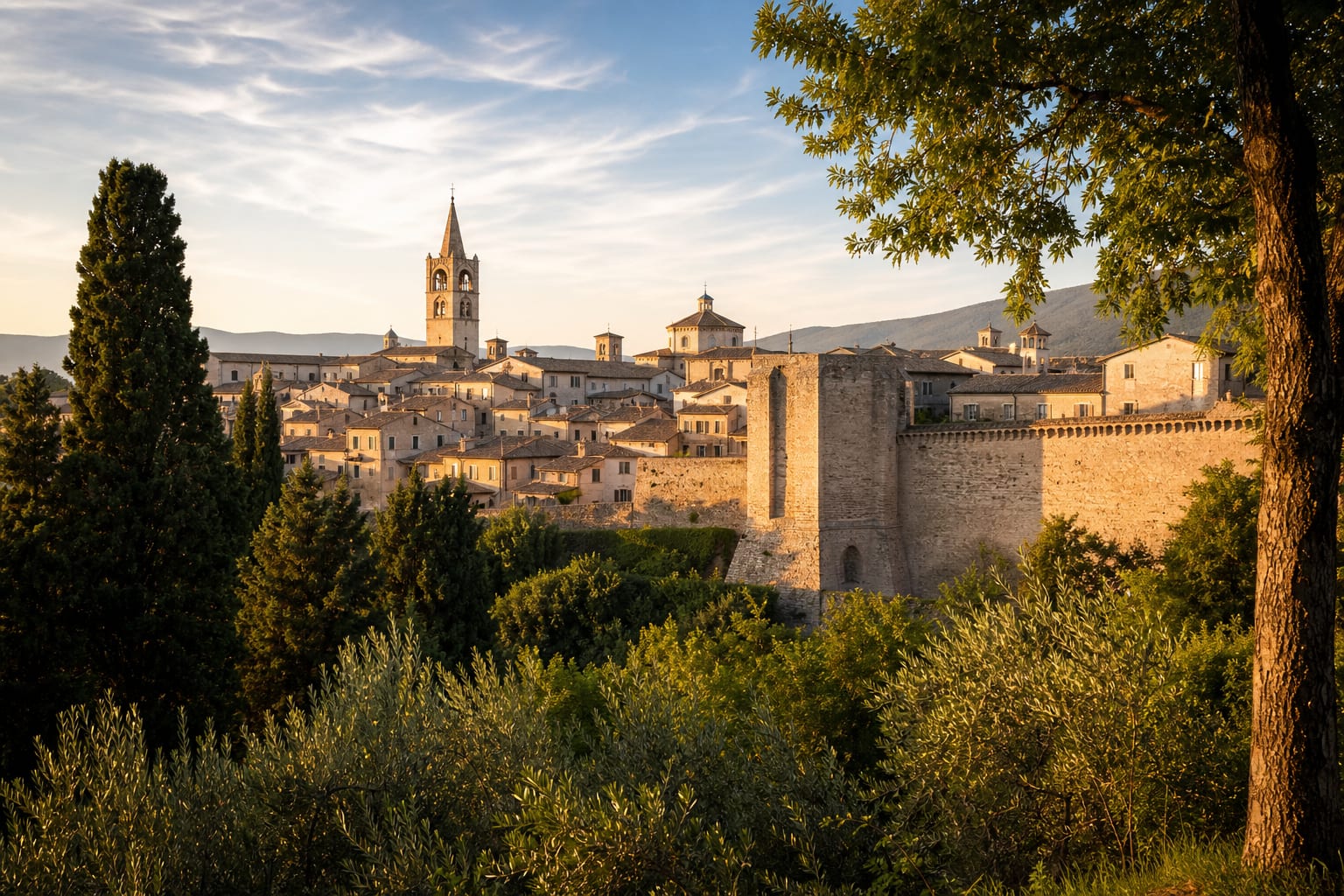
Set on the plain where Umbria's valleys meet, Foligno printed the world's first edition of Dante's Divine Comedy in 1472.
Each summer the city revives the baroque pageantry of the Giostra della Quintana, a costumed jousting tournament.
What to see first
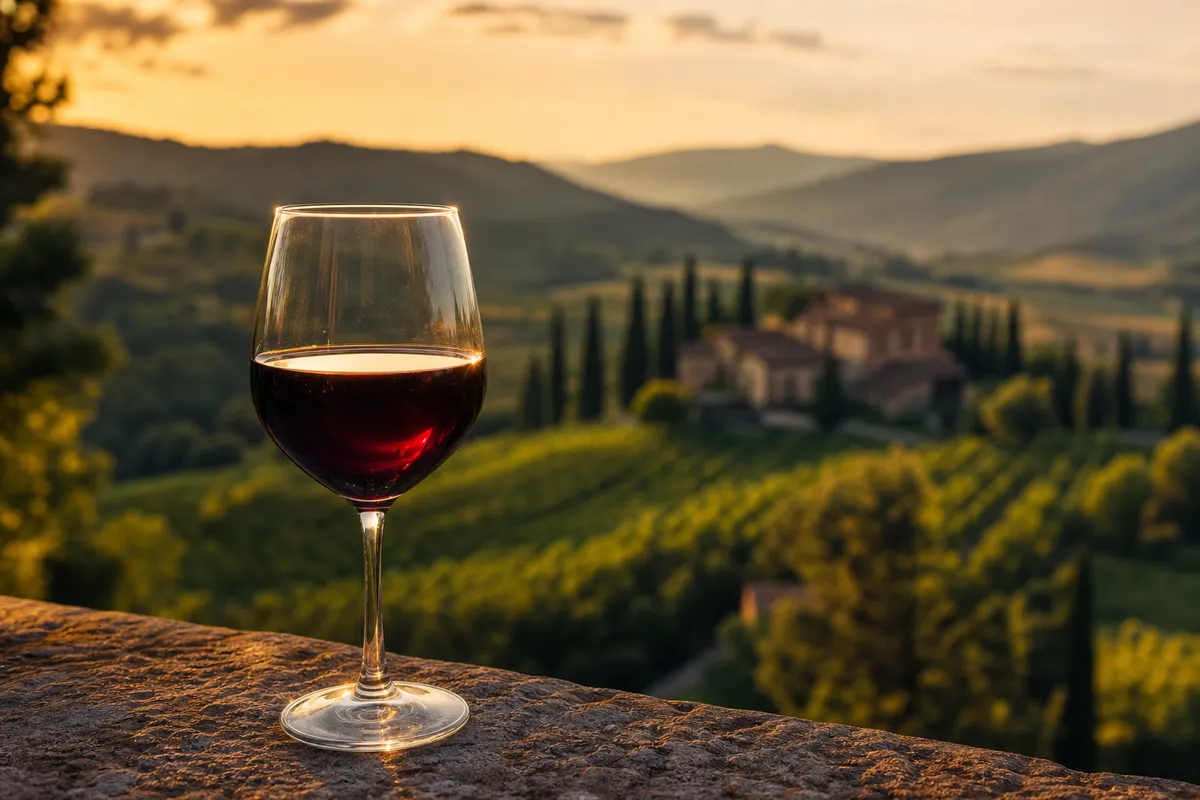
Foligno in one view
Foligno, in the Province of Perugia, is best understood on two scales at once. Its compact historic centre sits on the plain of the Topino, but the same municipality reaches east through the Menotre valley and the Apennines to Colfiorito. A morning around Piazza della Repubblica and a day among the upland settlements are not interchangeable experiences. Distance, elevation, transport, weather, access, and local services change sharply between them.
Above all, Foligno is more than its city centre. Colfiorito, Annifo, Casenove, Pale, Rasiglia, Sant'Eraclio, Scopoli, Verchiano, and many smaller centres belong to a large and varied municipal territory with dozens of resident centres. These are communities, not decorative outskirts.
The municipal tourism service treats a nine-municipality Valle Umbra area as one remit: Foligno, Bevagna, Gualdo Cattaneo, Montefalco, Nocera Umbra, Sellano, Spello, Trevi, and Valtopina. It is a tourism-service boundary rather than a single historical, cultural, or landscape region.
Ancient Fulginiae
Ancient Fulginiae is related to modern Foligno but is not identical to the present municipality or its medieval centre. The Umbrian heritage authority places the Roman settlement on a branch of the Via Flaminia that ran from Narni through Spoleto toward Forum Flaminii. It describes a plain settlement in the territory of the Fulginates, with earlier fortified sites on the eastern heights and a Roman urban area reconstructed from necropoleis, houses, street traces, aerial evidence, and the amphitheatre zone.
That distinction changes the walk. The concentration of Roman finds around Santa Maria in Campis and the plain does not make every street inside the later walls an exposed Roman monument, and a reused block does not prove a building's ancient identity. Palazzo Trinci's archaeological museum supplies the broader sequence.
The great necropolis at Santa Maria in Campis is especially important to the reconstruction of the Roman city. Its grave groups are sources for social and urban history, though a group recovered there is not automatically on display in Palazzo Trinci.
Piazza della Repubblica as a civic system
Piazza della Repubblica gathers several distinct institutions. Palazzo Trinci was the residence of the family that ruled from 1305 to 1439; after that dynasty ended, the complex served the Apostolic Governorate until 1860. The present facade belongs to reconstruction after the 1832 earthquake, while the courtyard, Gothic stair, suspended connections, rooms, and collections preserve other phases. The adjacent Palazzo Comunale, Cathedral of San Feliciano, Palazzo delle Canoniche, and Palazzo Orfini have their own ownership, functions, entrances, and access rules.
Inside Palazzo Trinci, the late Gothic decorative programme is a destination in its own right. The Loggia of Romulus and Remus, the Liberal Arts and Planets, the Ages of Man and heroes, and the Hall of the Giants form related but distinct cycles associated by the municipal interpretation with Gentile da Fabriano and collaborators. Ottaviano Nelli's signed chapel cycle belongs to another commission. The palace also contains the Civic Art Gallery, Archaeological Museum, Museum of the Municipal Institution, and Multimedia Museum of Tournaments, Jousts and Games.
Cathedral, crypt, museum, and sacred objects
The Cathedral of San Feliciano is a living church, not merely a facade on the square. The municipal record describes two facades, Romanesque fabric, later interventions, and a neoclassical interior associated with Giuseppe Piermarini.
The Cathedral, the Crypt of San Feliciano, Palazzo delle Canoniche, and the Diocesan Capitular Museum are distinct places. The museum presents about forty works and traces the cathedral through Romanesque, Renaissance, Baroque, and neoclassical phases. Named holdings include a fifteenth-century wooden statue of San Feliciano, two Roscioli busts associated with Bernini's workshop, a rock-crystal staurotheca, silver, and an ostensorium designed by Pietro da Cortona.
The cult of San Feliciano belongs to the cathedral's institutional history rather than to archaeology, and worship access and museum admission are separate matters.
Printing, paper, and the Dante connection
Foligno's printing story comes with a date question. Municipal sources traditionally date completion of the first printed edition of Dante's Commedia to 11 April 1472 by Johann Numeister and Evangelista Angelini, with Emiliano Orfini's workshop context. The municipality's Editio Princeps material also notes a recent scholarly proposal of 5-6 April. Either dating belongs to Palazzo Orfini and the city's early printing economy, not to a claim that Dante visited Foligno or wrote about the city.
The Printing Museum occupies Palazzo Orfini. Its displays cover paper and publishing, a reconstructed fifteenth-century press, watermarks, matrices, later periodicals, and the local almanac tradition. The museum holds a leaf from the 1472 Commedia showing Paradiso XI, rather than a complete Foligno copy of that edition. The municipal library separately maintains a Dante documentation collection of more than 300 editions.
The link to the Menotre valley also matters. The museum interprets the paper production that used the valley's water and connected city publishing to upland settlements. Rasiglia and Pale, described below, carry that story of water and paper further.
The Quintana
The Giostra della Quintana is a living civic tradition organised by the Ente Autonomo Giostra della Quintana, a recognised association whose members are Foligno's ten rioni.
Palazzo Candiotti is both a historic building and the Ente's headquarters. Since 2021 it has housed an interactive Quintana museum using multimedia, augmented reality, and virtual reality. The museum complements, rather than replaces, the live event.
The Quintana is the Palio that the ten rioni of Foligno have contested twice a year, in June and September, since 1946, with a procession, events in each rione, and the joust at the Campo de li Giochi.
Contemporary Foligno
Foligno's cultural identity did not stop with the Trinci. The Centro Italiano Arte Contemporanea, founded in 2009, uses two venues: the CIAC building and the former church of Santissima Trinità in Annunziata. The main venue presents changing exhibitions and a permanent collection owned by the Fondazione Cassa di Risparmio di Foligno. The former church is a monographic venue for Gino De Dominicis's Calamita Cosmica. The two venues are distinct buildings with their own programmes and collections.
Calamita Cosmica, a 24-metre work shaped as an enormous human skeleton with a bird-like beak and a gilded iron rod, fills the former church. The municipality identifies the Foundation as owner and the former church as permanent venue.
The Oratorio della Nunziatella supplies a different relationship between building and in-situ work. The civic sanctuary contains Perugino's Baptism of Jesus, an Annunciation linked to the foundation tradition, and other frescoes and altars. The municipal account explicitly calls the reported weeping a traditional miraculous event, not a testable material fact.
Raphael's Madonna of Foligno is a reminder that provenance is not location. The Vatican catalog records its 1511 commission for Santa Maria in Aracoeli in Rome, transfer to the Monastery of Sant'Anna in Foligno in 1565, removal to Paris in 1797, return to Rome in 1816, and current location in the Vatican Pinacoteca. Its title and Foligno provenance do not mean it is displayed in Foligno today.
Colfiorito and the plateau
Colfiorito is a municipal settlement and visitor base, not a synonym for the whole plateau. The Piani di Colfiorito comprise seven karst basins across an Apennine system between Umbria and Marche. The marsh, the regional park, the Ramsar site, the natural-history and archaeological museums, the modern settlement, and the former camp buildings are all distinct places.
The Ramsar record is an international wetland designation, not a UNESCO World Heritage inscription. Its official identity is Palude di Colfiorito, site 122, designated 14 December 1976 and recorded at 157 hectares. The regional park has a different legal identity and a stated area of 338 hectares. The permanent marsh surface, wider plateau, and park boundary are not interchangeable measurements.
The municipality publishes three park itineraries and a longer cycle circuit. The wetland route is about 5 kilometres with 50 metres of ascent, the castelliere route 4 kilometres with 180 metres, and the mountain route 11 kilometres with 120 metres. Remain on public routes and do not enter fields or wetland habitat for photographs.
Plestia and the regional border
Ancient Plestia lies across a modern boundary. The Umbria heritage authority documents the Iron Age occupation, Plestini, sanctuary of Cupra, Roman monumentalisation, domus mosaics, and public structures around Santa Maria di Pistia. It also records separate excavations in the territory of Colfiorito di Foligno.
The Comune di Serravalle di Chienti describes the urban area around Santa Maria di Plestia as divided by the present Perugia-Macerata and Umbria-Marche boundary, with public structures excavated on the Marche side. The ancient city therefore straddles a regional border.
The Archaeological Museum of Colfiorito is a separate institution in the settlement. It interprets the Plestini through about 1,450 objects from settlements, sanctuaries, burials, and the Roman city. Highlights include four bronze votive laminae dedicated to Cupra, reconstructed tomb contexts, a lapidary, vehicle-related grave groups, and finds from Monte Orve.
The former Casermette also carry twentieth-century history. The Colfiorito Memorial interprets the fascist concentration camp active from 1939 to 1944 through photographs, documents, testimony, and a surviving camp building. It is a separate institution from the archaeological and natural-history museums, though all share parts of the same visitor base.
Monastery, valley, and settlements east of the plain
Sassovivo Abbey rises outside the centre, among holm oak woods and old olive trees. It was founded in the second half of the eleventh century on the ruins of a fortified residence of the Monaldi family. Its Romanesque cloister is by the Roman master Pietro de Maria, and the abbey also has the Crypt of San Marone, a church with fragments of fifteenth-century frescoes, and the Loggia del Paradiso with fresco fragments attributed to Giovanni di Corraduccio. A monastic community remains in residence, so a visit follows its rhythm of prayer.
Rasiglia's waterways, Pale's rock and Menotre landscape, Scopoli, Casenove, Verchiano, Annifo, and the other upland communities form a connected municipal geography. Each has its own character, water, heritage, and roads, so there is no single "Foligno countryside" experience.
Food geography with legal edges
Patata Rossa di Colfiorito IGP is a protected product whose area crosses the regional border. Its specification includes only delimited parts, at or above 470 metres, of Foligno, Nocera Umbra, Valtopina, Sellano and six Marche municipalities including Serravalle di Chienti. Eating a red-skinned potato in central Foligno does not prove the IGP, and the protected name is not exclusive to Umbria. Check the label, producer, and certification.
Umbria DOP olive oil with the geographical mention Colli Assisi Spoleto includes Foligno among many municipalities. This is another production zone, not a city brand. A bottle must carry the protected designation and required geographical mention; a restaurant address or grove view does not establish certification.
The municipality beyond the familiar names
The 2021 Istat territorial base lists 17 inhabited centres in the municipality, among them Annifo, Budino, Capodacqua, Casenove, Colfiorito, Colle San Lorenzo, Fiamenga, Foligno, Maceratola, Pontecentesimo, Rasiglia, Scopoli, Sostino, Uppello, Verchiano, San Giovanni Profiamma, and Belfiore, along with 40 smaller inhabited nuclei, five productive localities, and scattered houses. Pale is one of those nuclei, as are Leggiana, Popola, and Tenne.
Routes, habitats, water, and geological scale
Four rivers, the Topino, Menotre, Timia-Teverone-Maroggia, and Clitunno, cross the municipality, which also includes a Special Protection Area at Palude di Colfiorito, ten Special Areas of Conservation, and a regional park. The conservation areas include Palude di Colfiorito, Piano di Ricciano, Col Falcone, Piani di Annifo-Arvello, Selva di Cupigliolo, Sasso di Pale, Fiume Menotre at Rasiglia, Lecceta di Sassovivo, Boschi di Terne-Pupaggi, and Castagneti di Morro. The geological inventory adds the springs of Rasiglia and areas including the Piani di Colfiorito and Sasso di Pale-Menotre. The pilgrimage lines crossing the territory include the Via Lauretana Assisi-Colfiorito, Via di Francesco Assisi-Piediluco, and Via del Sud. These are conservation and interpretation areas, not permission to enter fields, caves, woods, riverbanks, or fragile habitat.
Earthquakes, weather, and alerts
Foligno is classified as seismic zone 1 and lies in regional alert zone C. Plans for an upland drive, wetland walk, gorge visit, or event journey should leave room for changing weather.
Rasiglia and Pale
The municipality identifies Rasiglia's Capovena, Alzabove, and Venarella springs and connects its channels to water-powered textile production. That history is about workers, machinery, and water management as much as a "little Venice" label. Regional evidence adds the Sorgenti di Rasiglia geosite and the Fiume Menotre (Rasiglia) protected area. The municipality describes the visit as not wheelchair accessible, with surfaces, slopes, bridges, and crowds that make step-free progress difficult.
Pale likewise joins industrial, religious, and natural history. Municipal material traces paper production to the thirteenth century and identifies San Biagio, the caves, and the hermitage of Santa Maria Giacobbe. Regional layers add Sasso di Pale-Menotre as an area geosite and Sasso di Pale as a protected area. The municipality describes both the Pale and Menotre-valley visits as not wheelchair accessible, and the caves and gorge path depend on rock and weather conditions.
Rebuilding and UNESCO
Piazza della Repubblica is also a record of reconstruction. The municipal accounts place Palazzo Comunale, Palazzo Trinci, and San Feliciano in one civic ensemble while keeping their functions distinct. Palazzo Comunale carries rebuilding after the earthquakes of 1832 and 1997.
The Longobards in Italy. Places of the Power (568-774 A.D.), property 1318, is a serial site of seven component groups, and its Umbrian components are San Salvatore in Spoleto and the Clitunno Tempietto in Campello sul Clitunno. Foligno and Sassovivo are not components of the property.
A two-day sequence
For a first day without a car, begin at the station and walk into the centre. Use Piazza della Repubblica to distinguish Palazzo Trinci, cathedral, diocesan museum, and Palazzo Orfini. Give Palazzo Trinci a full visit rather than treating its frescoed rooms and four museums as a quick lobby. Continue to the Printing Museum, then choose either Nunziatella or the two CIAC venues. The centre has a limited-traffic zone, so driving in is rarely the easiest option.
Treat the Quintana as a layer of its own. During event periods, expect temporary traffic controls and book seating from the organiser; outside an edition, Palazzo Candiotti's museum explains the rioni and ceremonial language.
Use a second day for only one outer system. Sassovivo is a monastery visit governed by worship. Rasiglia and Pale form a water and walking direction. Colfiorito requires transport to a separate plateau, then a choice among MAC, the natural-history museum and park, the memorial, and a public trail. Plestia is best treated as an interpretation stop, since the ancient city straddles the regional border.
Foligno's depth lies in the connections, not in pretending they are one place: Roman plain and medieval civic centre, cathedral and museum, printing workshop and surviving page, rioni and modern event, contemporary art and reused architecture, wetland and farmed plateau, ancient Plestia and a modern regional border.
More of Umbria
A letter from Italy, once a month.
The places, tables and makers we found worth your time. One email, no noise.
One letter a month. Unsubscribe at any time. We never share your address.