

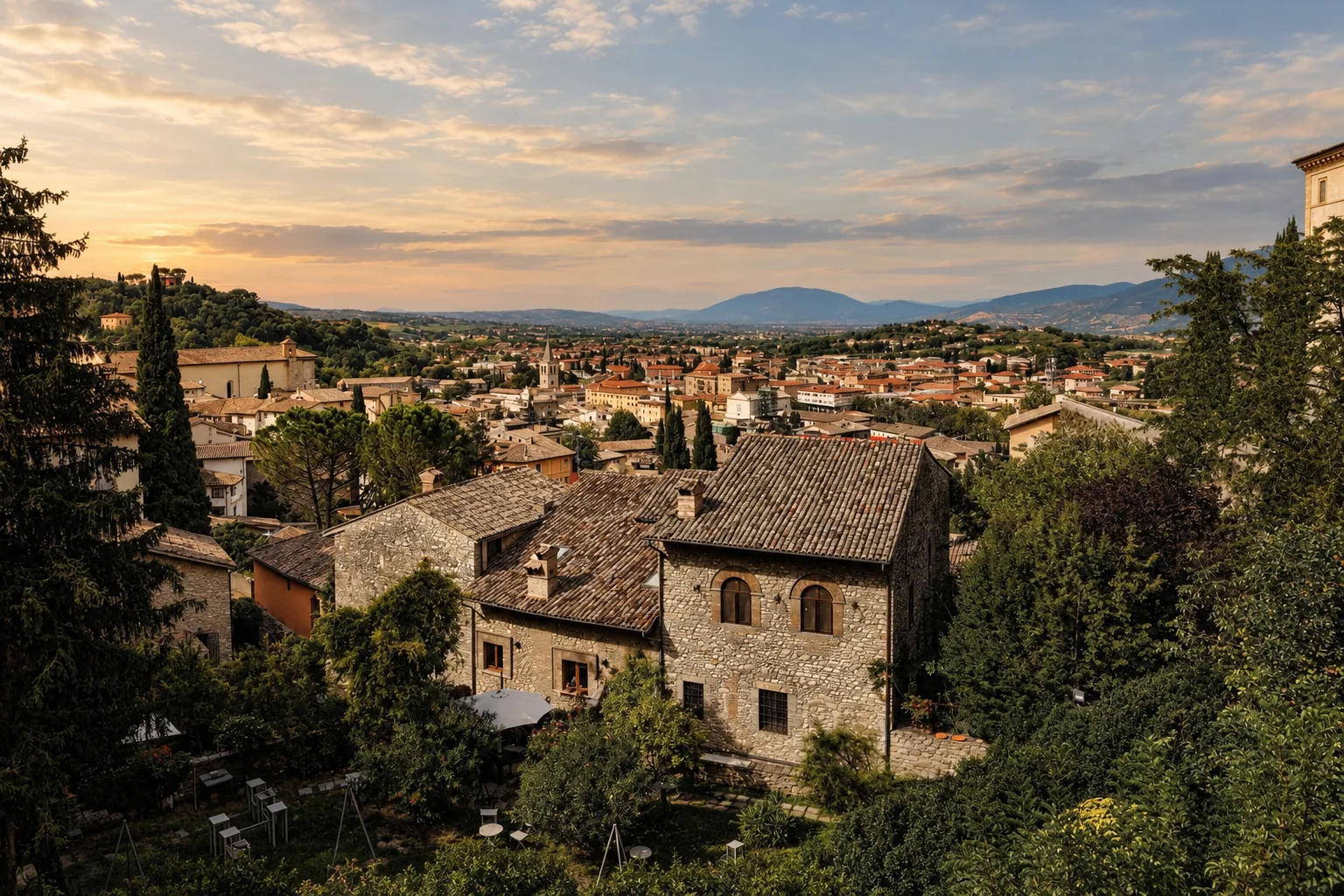
Spoleto draws the world each summer for its Festival dei Due Mondi, a celebrated gathering of theatre, music, and dance.
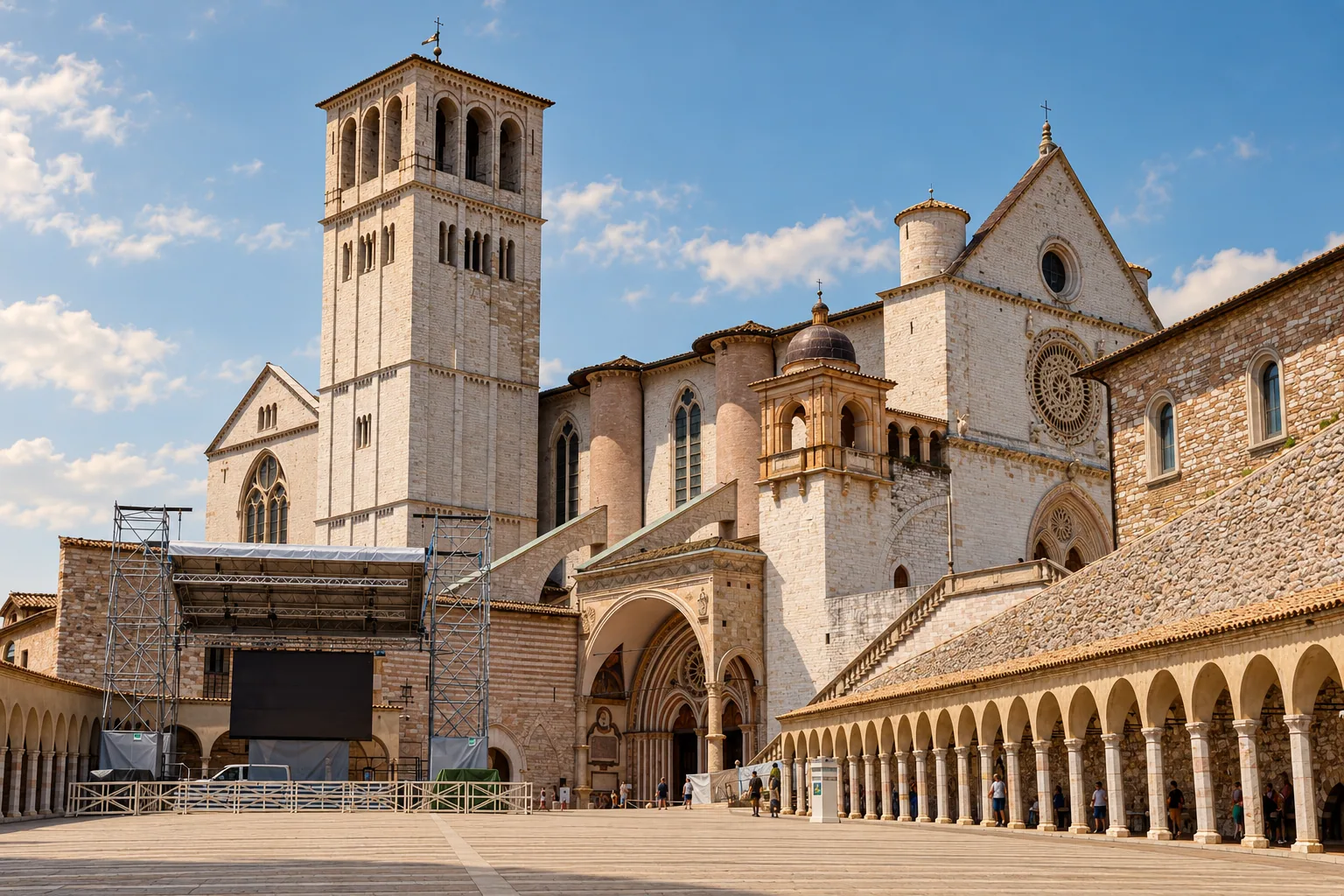
The cathedral's sloping piazza frames Filippo Lippi's final frescoes and a Romanesque facade glittering with mosaic.
When to visit Spoleto
Average highs and lows across the year.
What to see first
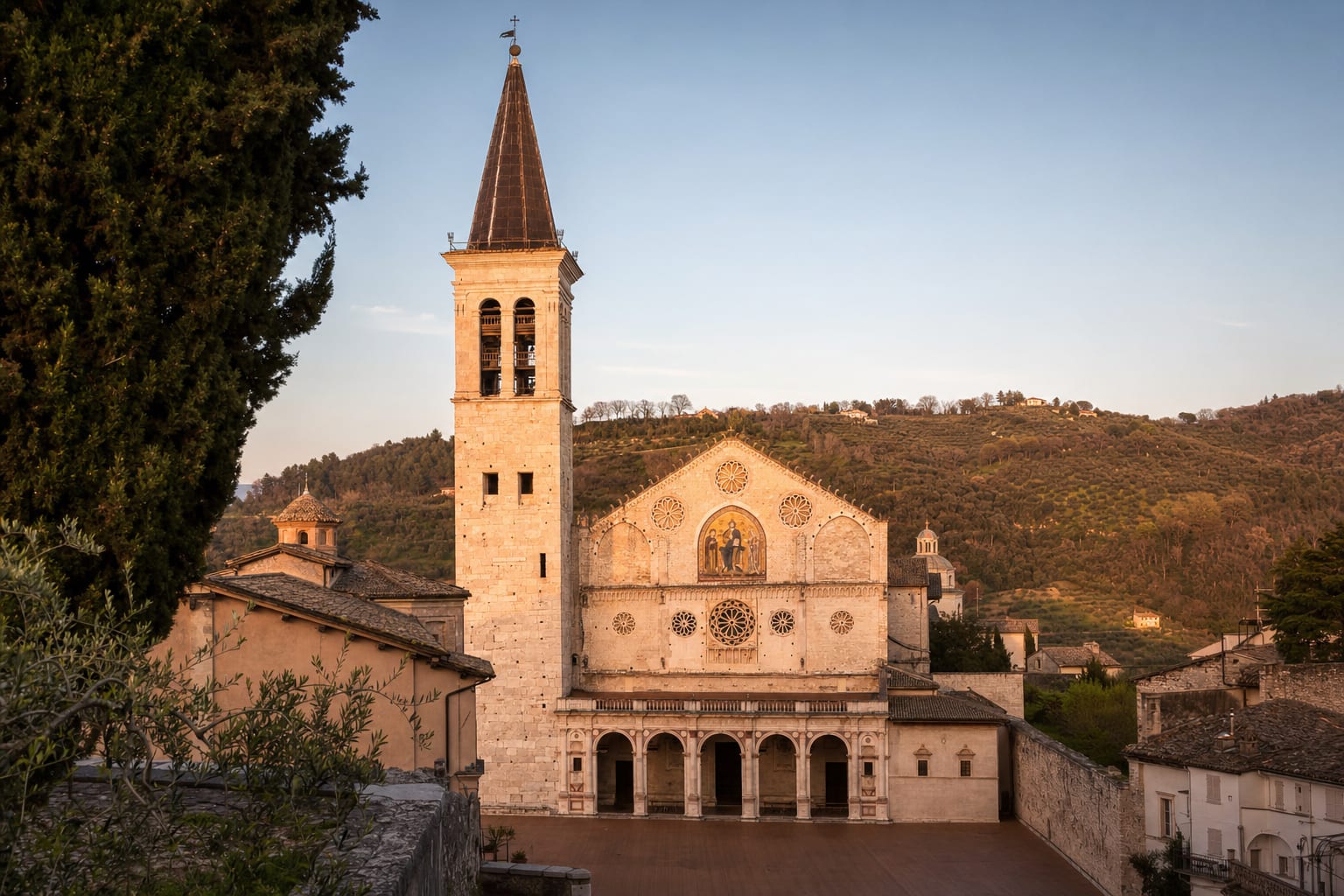
Spoleto Cathedral
The cathedral at the foot of Spoleto's sloping festival piazza, home to Filippo Lippi's last frescoes.
Read the guide
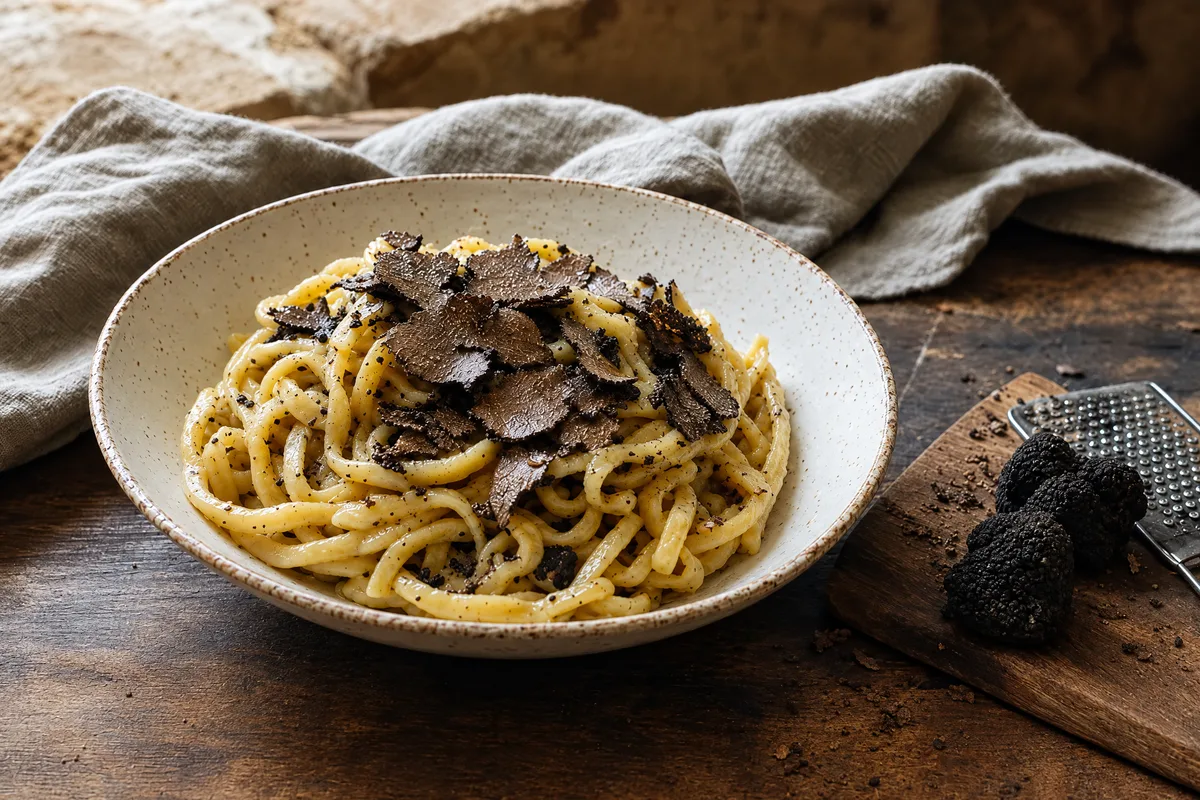
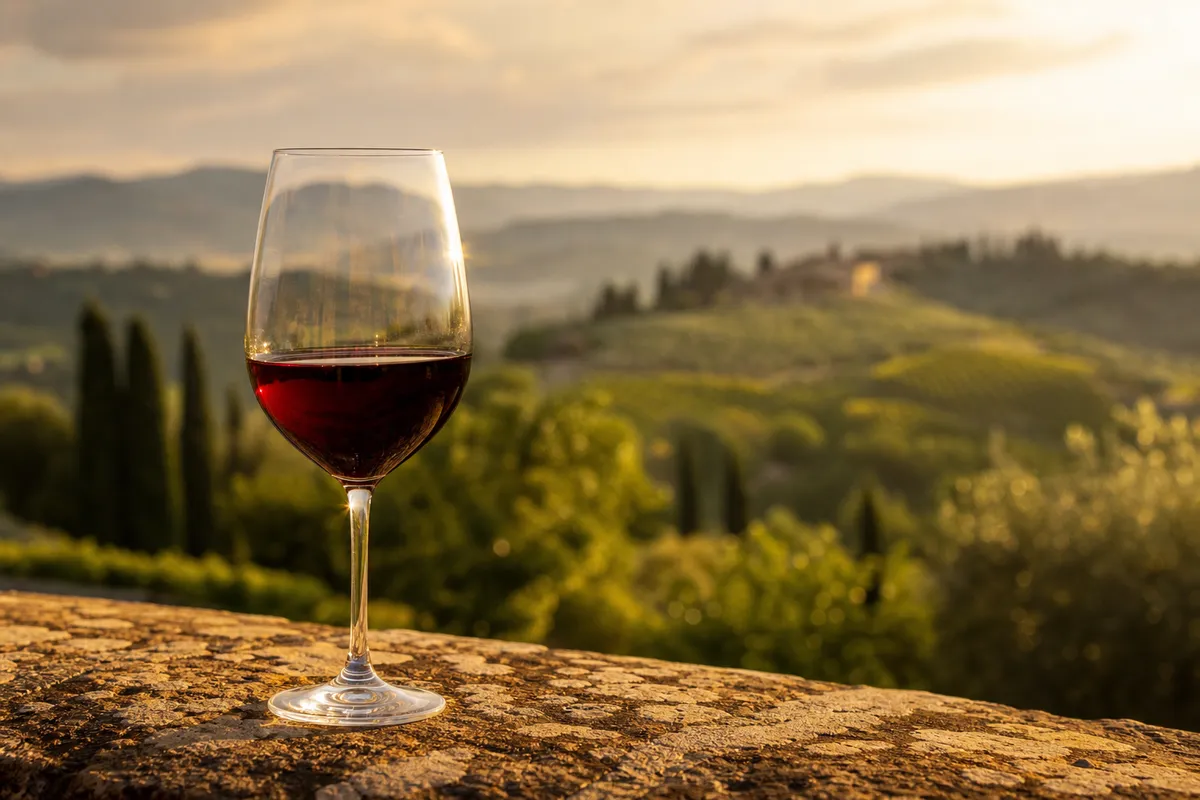
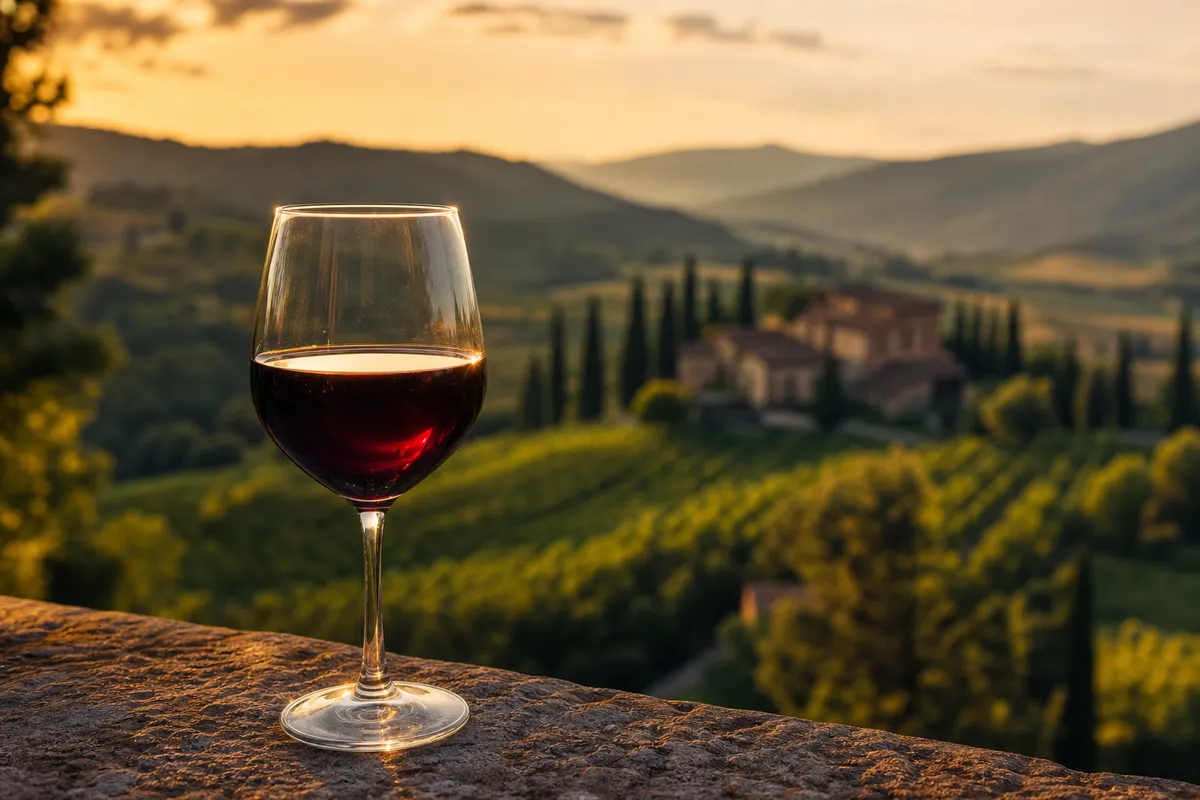
Eating and drinking in Spoleto
Well-loved everyday tables and Michelin stars, each checked open.
- Il Tempio Del GustoTrattoria
- Sabatini il Giardino del Corso di Zeppadoro BenedettoTrattoria
- La TorrettaTrattoria
- Old pigPizzeria
- C'era una volta l'osteriaOsteria
- Pizzeria dell'Orologio da BÌBÌPizzeria
Sleeping in Spoleto
Well-reviewed places to stay, each checked open, by town.
- Aurora Boutique Hotel & Private SPA Etruria Collection
- Agriturismo Rivoli
- Casale del Monsignore
- Agriturismo “Villino Bellavista” e ristorante “La Sinfonia”
- Villa del Cardinale
- Hotel San Luca Spoleto
Spoleto: a city read in layers
Spoleto rewards a slower kind of looking. Its historic centre rises above the Umbrian plain, where streets, stairs, retaining walls, theatres, churches, and later palaces repeatedly occupy older ground. The town you walk today grew over Roman Spoletium, whose remains survive beneath and within it.
The most useful way to understand the city is not as a checklist of isolated monuments but as a set of distinct systems. The Roman theatre is an archaeological structure, while the National Archaeological Museum is the institution housed in the former monastery of Sant'Agata above and beside it. The Rocca Albornoz is a fourteenth-century fortress, while the Museo nazionale del Ducato is the museum installed inside it. The Cathedral of Santa Maria Assunta is a living church and building; the Filippo Lippi apse cycle, Alberto Sotio painted cross, chapels, relics, and diocesan collections are works and holdings with their own locations and conditions of access.
Two World Heritage stories also need clean boundaries. The Basilica of San Salvatore is the Spoleto component of UNESCO property 1318, Longobards in Italy. Places of the Power. The Tempietto sul Clitunno is another component of that serial property, but it stands at Pissignano in the separate municipality of Campello sul Clitunno. UNESCO has also inscribed a second serial property, the system of Italian-style condominio theatres of Central Italy, and its map identifies Spoleto's Teatro Nuovo Gian Carlo Menotti as component 1762-010. These inscriptions do not make the whole municipality, the cathedral, the Rocca, or every theatre in Spoleto World Heritage.
A first walk through the historic centre
Begin around Piazza della Libertà, then move toward the Roman theatre and Sant'Agata complex. The theatre belongs to the first century BC and its lower circulation passage remains legible. Medieval building changed the stage area, and twentieth-century restoration reconstructed the seating sufficiently for the space to serve cultural performances. Entering through the museum is important because the institution supplies the archaeological sequence that the stones alone cannot: Bronze Age occupation, the Umbrian settlement, the Latin colony and municipium, Roman civic life, and evidence from the wider territory and Valnerina.
From the theatre, continue through the former forum area. The Arch of Drusus and Germanicus survives as a Roman honorific arch marking access to the forum. Nearby, Casa Romana is a separate archaeological site, a wealthy domus dated to the early first century AD with black-and-white mosaics and a recognisable domestic plan. An inscription fragment naming Polla led to the hypothesis that the house belonged to Vespasia Polla, mother of Vespasian, but the official account presents this as a hypothesis, not an established owner identification.
Climbing onward reveals other fragments of the Roman city, including wall stretches and later structures that reused or crossed the ancient fabric. These form an urban archaeological network rather than a series of interiors open to visitors. The Torre dell'Olio and Porta Fuga belong to a different, medieval layer and to a local account of the city's defence; it is best understood as tradition where the documentary record does not sustain literal detail.
Cathedral, artworks, chapels, and diocesan complex
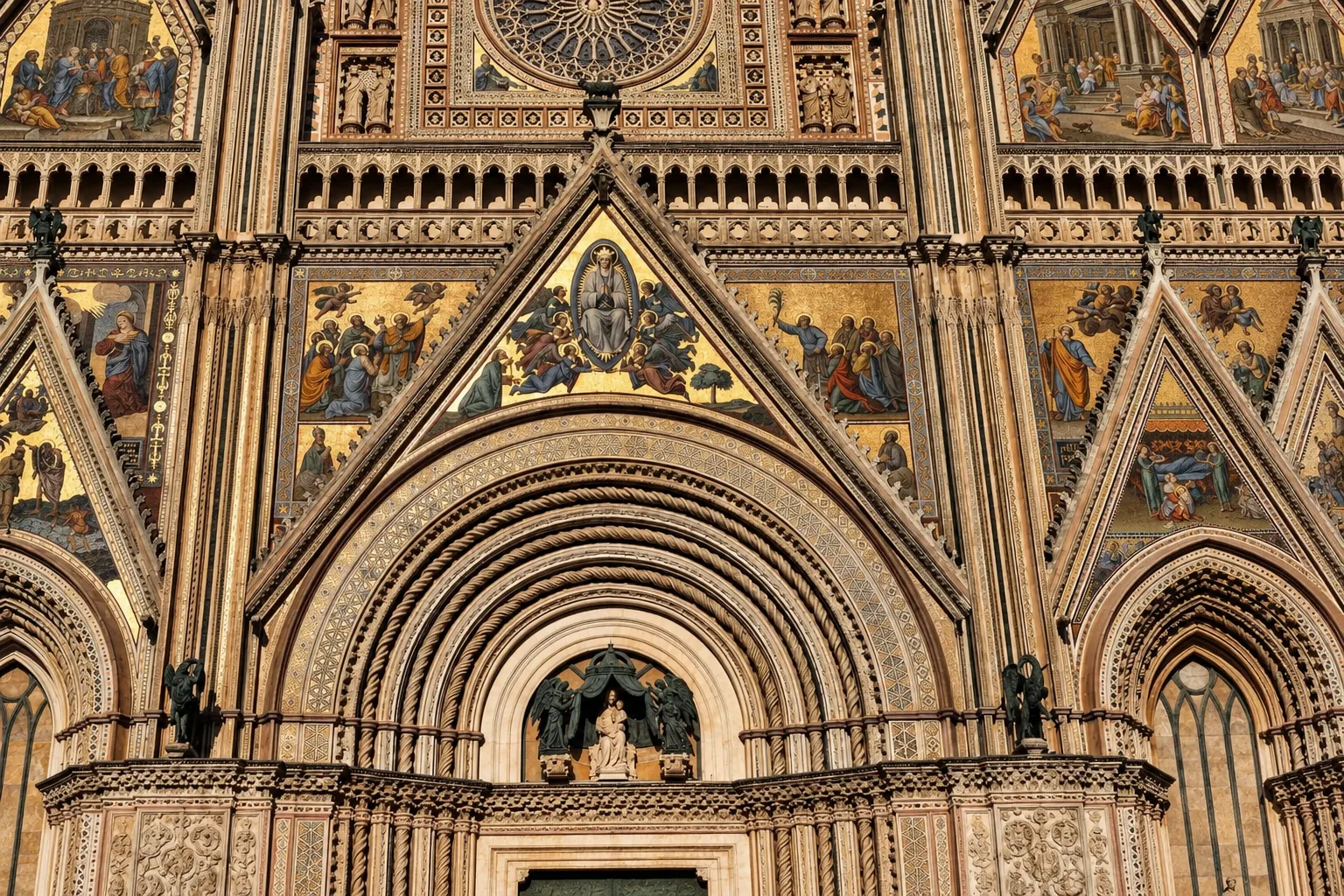
The Cathedral of Santa Maria Assunta closes the descending prospect of Piazza del Duomo. The present building was reconstructed in the late twelfth century over earlier episcopal and Christian structures. Its facade combines local pale and pink stone, a mosaic attributed to Solsterno, and a Renaissance portico commissioned in 1491 from Ambrogio Barocci. The cathedral remains a place of worship. Entry to the church and admission to the wider cultural route are not the same, and services take precedence over visits.
Inside, the apse cycle painted by Filippo Lippi and assistants is an artwork within the cathedral, not a separate building and not a UNESCO component. Its subject sequence culminates in the Coronation of the Virgin. Lippi died at Spoleto and his tomb is also in the cathedral. The painted cross signed by Alberto Sotio and dated 1187 is another distinct work.
The Eroli and Assunta chapels contain frescoes associated respectively with Pintoricchio and Jacopo Siculo. The Chapel of the Holy Icon preserves a small devotional image linked by the cathedral's official interpretation to a gift from Frederick Barbarossa in 1185. The Chapel of the Relics preserves an autograph letter from Francis of Assisi to Brother Leo. Each is a chapel, object, or documentary relic inside the cathedral, with worship, conservation, and access conditions that may differ from the nave.
The paid monumental itinerary extends beyond the free-access church to the upper cathedral, bell tower, Sala della Bellezza Ritrovata, Museo Diocesano, and Basilica of Sant'Eufemia. The diocesan museum occupies rooms of the archiepiscopal palace and holds art from across the Archdiocese of Spoleto-Norcia. A work in that collection may come from another church or municipality.
Rocca Albornoz and the Museo del Ducato
The Rocca Albornoz stands on Colle Sant'Elia above the city. Construction began in 1360 at the direction of Cardinal Egidio Albornoz as part of the restoration of papal authority. Its later uses included a long period as a prison. Courtyards, defensive ranges, wall paintings, towers, and views belong to the fortress as an architectural monument.
The Museo nazionale del Ducato di Spoleto is a separate institution housed inside the Rocca. Opened in 2007, its fifteen-room route presents the territory from early Christian evidence through Lombard rule and later medieval production. The museum's paintings, sculpture, architectural fragments, and grave goods do not make the fortress itself a collection. The museum's official account highlights the Trittico di Santa Maria delle Grazie by Niccolò di Liberatore.
The museum helps explain Spoleto's role as the centre of a Lombard duchy, but it is not itself the UNESCO component. For property 1318, the relevant Spoleto monument is the Basilica of San Salvatore. The Rocca is part of that broader story but is not itself a UNESCO component.
Ponte delle Torri, Monteluco, and the edge of town
The Ponte delle Torri crosses the Tessino ravine between Colle Sant'Elia and the Monteluco side. Its construction history is debated; the bridge and aqueduct you see are medieval in their present form. The municipality reopened the crossing in December 2024, after more than eight years of closure, following consolidation, restoration, and work to utilities below the walkway.
Crossing the bridge changes the character of the visit. Monteluco is a wooded height tied to ancient sacred-grove traditions and later Christian eremitic settlement. The regional walking route from Spoleto to Monteluco is 4.44 kilometres with 420 metres of ascent and is rated medium difficulty. That figure describes a specific itinerary, not every path on the mountain. Stone, dirt, gradient, heat, storms, leaf litter, and winter ice can make conditions harder. Carry water, and do not assume the bridge or wooded paths are step-free.
San Salvatore and exact World Heritage boundaries
The Basilica of San Salvatore stands on Ciciano hill in Spoleto's cemetery area outside the medieval walls. Its architecture combines late antique and early medieval construction, classical forms, reused Roman elements, and newly worked pieces. UNESCO property 1318 recognises the Lombard cultural synthesis through a seven-part serial property. San Salvatore is the Spoleto component; the entire city is not the component.
The Tempietto sul Clitunno is not counted among Spoleto's sites. The Ministry of Culture places it at Pissignano, Comune di Campello sul Clitunno. It is a separate component of the same UNESCO serial property, with its own custodian, ticket, access conditions, and municipality.
Teatro Nuovo, other stages, and the Festival
Teatro Nuovo Gian Carlo Menotti was built from 1854 to 1864 to a design by Ireneo Aleandri and opened in August 1864. Its horseshoe auditorium, tiers of boxes, stage equipment, and relationship between civic and private investment place it within the condominio-theatre tradition. UNESCO lists it as component 1762-010, one of ten components in property 1762.
This inscription applies to Teatro Nuovo, not to every performance venue in Spoleto. Teatro Caio Melisso beside Piazza del Duomo is an older and separate municipal theatre. The Roman theatre is an archaeological monument that also hosts performances. San Nicolò, Sant'Agata, San Simone, Piazza Duomo, Palazzo Collicola, Casa Menotti, and other places can become Festival venues, but a temporary event use does not merge them into the Festival organisation or the UNESCO property.
Gian Carlo Menotti created the Festival dei Due Mondi in 1958. The Fondazione Festival dei Due Mondi now organises it, with its own legal identity, governance, archive, programme, ticketing, and access information.
Modern and civic collections
Palazzo Collicola is both an eighteenth-century aristocratic building and a present civic museum complex. Its Piano Nobile retains decorated rooms, furnishings, and older art; the Galleria d'Arte Moderna Giovanni Carandente holds modern and contemporary work connected to Spoleto's twentieth-century artistic history. The permanent collection includes artists such as Alexander Calder, Leoncillo, Sol LeWitt, Beverly Pepper, Pino Pascali, David Smith, Anthony Caro, Alberto Burri, Carla Accardi, and Pietro Consagra, but individual display status can change with rehanging and exhibitions.
The 1962 exhibition Sculture nella città is central to this history, though surviving outdoor works, relocated works, museum holdings, loans, and documentary records are not interchangeable. Casa Menotti, the Festival documentation centre, likewise preserves an archive and institutional memory distinct from Palazzo Collicola's collection.
Other places worth time include the Museo del Tessuto e del Costume, the church of Santi Giovanni e Paolo and its paintings, San Pietro extra moenia, San Ponziano, San Domenico, Sant'Ansano and the crypt of Sant'Isacco, San Nicolò, the municipal palace, Torre dell'Olio and Porta Fuga, and the surviving Roman walls.
Food and wine without false borders
Spoleto DOC is a protected wine name centred on Trebbiano Spoletino. The current consolidated specification permits white, reserve, sparkling, and passito types based on at least 85 percent Trebbiano Spoletino. Its grape-production zone includes all Montefalco and only defined parts of Campello sul Clitunno, Castel Ritaldi, Foligno, Spoleto, and Trevi. The word Spoleto on the label therefore does not mean that every grape came from the whole municipality or that every winery is inside the city.
Umbria DOP olive oil is always accompanied by a geographical mention. For Colli Assisi Spoleto, the specification includes only the part of Spoleto east of the SS3 Flaminia, alongside a much wider list of municipalities. It is wrong to describe all oil pressed or served in Spoleto as DOP. Look for the full protected name and certified producer information.
Prosciutto di Norcia IGP belongs to a different production geography. Its processing area comprises designated territory above 500 metres in Norcia, Preci, Cascia, Monteleone di Spoleto, and Poggiodomo. Monteleone di Spoleto is a separate municipality; the shared word Spoleto does not bring the IGP area into the Comune di Spoleto. A restaurant in Spoleto may serve the product, but service location is not production origin.
Valnerina and surrounding municipalities
Spoleto is a practical western gateway toward the Valnerina, but it is not itself one of the fourteen municipalities in the Regione Umbria's Inner Valnerina programme area. That official area includes Arrone, Cascia, Cerreto di Spoleto, Ferentillo, Montefranco, Monteleone di Spoleto, Norcia, Poggiodomo, Polino, Preci, Sant'Anatolia di Narco, Scheggino, Sellano, and Vallo di Nera. The historical, cultural, tourism, and landscape meanings of Valnerina are broader and can differ from this programme boundary.
This distinction matters for itineraries. Campello sul Clitunno and its Tempietto lie north of Spoleto in a separate municipality. Norcia, Vallo di Nera, Scheggino, and Sant'Anatolia di Narco each deserve a trip of their own.
Planning two days
Two full days allow a coherent first visit: Roman theatre and museum, forum zone, Casa Romana, cathedral, and lower civic collections on one day; Rocca, Museo del Ducato, Ponte delle Torri, Monteluco, and the San Salvatore exterior on another. A third day can add Campello sul Clitunno or a Valnerina destination, but those are separate places rather than hidden districts of Spoleto.
How to sequence a first day
Start with the archaeological museum and let the Roman evidence establish the chronology. Walk through the theatre with the museum interpretation in mind: the cavea and ambulacrum belong to the ancient entertainment building, Sant'Agata records the medieval religious reuse of its area, and modern performances add another function without erasing either. The important lesson is not simply that Spoleto has a Roman theatre. It is that one parcel of the city contains archaeological structure, monastery, museum institution, collection, and contemporary venue, each answering a different question.
Continue toward the Arch of Drusus and Germanicus, then Casa Romana. The arch belongs to public monumental space; the house interprets elite domestic space. At Casa Romana, look at how the rooms organise movement around the atrium and how mosaic patterns change across thresholds. Treat the Polla inscription as evidence that generated a scholarly proposal, not as a name plaque identifying a known resident. If conservation work changes the path, the restriction is part of caring for the mosaics, not a reason to improvise past barriers.
The cathedral then shifts the day from archaeology to a living sacred complex. First read the facade from the square, then distinguish the free church interior from the paid monumental circuit. Within the building, the apse cycle should be seen as a spatial programme: architecture, painting, liturgy, and patronage meet in one termination of the nave. The Sotio cross belongs to a different century and artistic language. The chapels are not decorative footnotes, and the letter to Brother Leo is a documentary object rather than a generic Franciscan association. A complete visit therefore needs time for close looking, while a worship service requires silence and may close parts of the route.
End at Palazzo Collicola. The palace gives the day a useful final contrast: aristocratic rooms and furnishings coexist with a modern-art institution whose display can be rehung. Displays there are rehung, so expect a changing selection rather than a fixed list. The outdoor 1962 legacy extends beyond the museum walls, and the label Sculture nella città can mean an exhibition history, a surviving street work, a relocated object, or documentary material in an archive.
How to sequence a second day
At the Rocca, separate architectural observation from museum interpretation. Courtyards, wall paintings, defensive mass, and the building's prison history belong to the monument. The Museo del Ducato supplies objects and narratives about early Christianity, Lombard power, and later medieval art. Gallery rotations, conservation, loans, and temporary displays can move objects, so a particular work may not be on view.
Respect gates and signs on the Ponte delle Torri, and turn back if conditions change. The height and exposure can be difficult for people with vertigo, while wet stone, wind, and crowding alter the experience. A visitor who cannot or does not wish to cross still has a meaningful upper-city circuit around the Rocca. Crossing leads toward the Fortilizio dei Mulini and the Monteluco landscape, but a bridge visit and the 4.44-kilometre hike are different commitments.
San Salvatore requires a deliberate detour. It is worth seeing because its fabric is the exact World Heritage component; the facade, reused stone, cemetery setting, and component boundary carry its significance whether or not the interior is open.
Planning around performances
A Festival visit is best built from the ticket outward. Teatro Nuovo, Teatro Caio Melisso, Teatro Romano, Piazza Duomo, Sant'Agata, San Simone, and San Nicolò have different seating, surfaces, shelter, acoustics, and access paths. An outdoor performance needs a weather plan, and a historic building needs attention to its entrance and seat access.
Teatro Nuovo now carries an exact UNESCO component identity, but it remains a working theatre. Its World Heritage value concerns the condominio system and architectural attributes, not every production staged there. Conversely, a Festival performance in the Roman theatre does not make that ancient structure component 1762-010.
Reading labels and menus critically
On a wine list, ask for producer and full denomination. Trebbiano Spoletino can name a grape variety without proving Spoleto DOC status. Spoleto DOC refers to the specification and its delimited, multi-municipality production zone. On an oil label, Umbria DOP should be accompanied by its geographical mention, and Colli Assisi Spoleto has a defined territory rather than a broad marketing meaning. Prosciutto di Norcia IGP is equally precise: eating it in Spoleto does not move its processing origin. These boundaries allow a richer story about trade between plain, hills, and Valnerina while preventing a menu from becoming false geography.
A realistic third day
Choose one direction rather than collecting distant names. North toward Campello sul Clitunno, the Tempietto can extend the Longobard comparison: two distinct components, two municipalities, related uses of classical language and reused material. Its ticket is separate from San Salvatore's.
East toward the Valnerina, select one municipality and build the day around its own heritage, landscape, and return connection. Cerreto di Spoleto and Monteleone di Spoleto are not parts of the Comune di Spoleto despite their names. Norcia is not a quick annex to a hill-town afternoon.
Within the Comune di Spoleto, a third day can instead deepen Monteluco, lesser churches, the former railway landscape, or the 1962 art trail. This is often the better choice for a car-free visitor, and it rewards depth over a long list of names.
More of Umbria
A letter from Italy, once a month.
The places, tables and makers we found worth your time. One email, no noise.
One letter a month. Unsubscribe at any time. We never share your address.