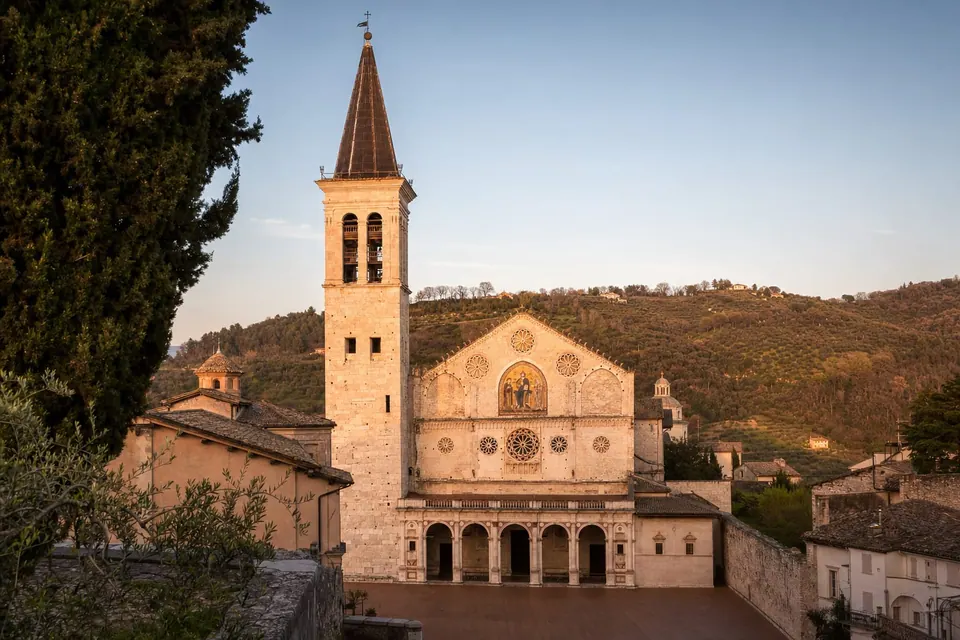
Spoleto's Duomo sits at the foot of a broad, sloping piazza, a stage set that the Festival dei Due Mondi has used for decades as its closing venue. The Romanesque façade, begun in the twelfth century, wears a Renaissance porch and a great rose window, and above it a Byzantine-style mosaic of a blessing Christ signed by Solsternus in 1207.
Inside, the apse is the reason to come: Filippo Lippi painted its frescoes of the Virgin's life from 1467 and died in Spoleto before he finished them, and his tomb lies in the south transept. Pinturicchio frescoed the Eroli Chapel. A ticketed circuit adds the bell tower, the diocesan museum and Sant'Eufemia.
A cathedral built in stages
Spoleto's cathedral, dedicated to Santa Maria Assunta, sits at the top of Piazza Duomo, and the wide, gently climbing square is part of the pleasure: it slows your arrival and lets the facade unfold a little at a time. A cathedral at Spoleto is documented as early as 956, but the church you see now grew out of a major Romanesque reconstruction.1,2
Two consecrations mark the way. The rebuilt church is associated with a consecration by Pope Innocent III in 1198 and another in 1216, which tells you this was a campaign completed in stages, not a building with one tidy birthday.1,2
The bell tower has its own story. It was probably built between 1173 and 1198, using reused ancient material and swallowing an earlier tower inside its masonry, so it reads as both a landmark and a compact record of recycling.3,2
The facade: Romanesque above, Renaissance below
Start in the square and let your eye climb. Five rose windows ornament the upper level, the central one about four meters across, and the central portal carries fine Romanesque sculpture. Higher still, a mosaic bears the name of Solsterno and the date 1207, a monumental work set right into the front of the church.1,4
Below, a Renaissance portico attributed to Ambrogio Barocci changed the lower facade and sheltered the approach to the doors, yet the rose windows and the sequence of portals still keep the older vertical reading intact. The pleasure is seeing how these campaigns meet: arcades, mosaic, portico and portals are layers of one front rather than a single untouched design.1,4,2
Inside: a Baroque-era interior around a medieval core
Step through the door and the mood changes. The interior was transformed by a major seventeenth-century rebuilding, followed by the rededication of 1680 and later work associated with Giuseppe Valadier, so this is not an intact Romanesque shell.1,2
The plan is a Latin cross with three aisles. Look down as well as up: the floor keeps Cosmatesque patterns from the Romanesque building beside a later red-and-white diamond pattern laid from 1481.1
Filippo Lippi in the apse
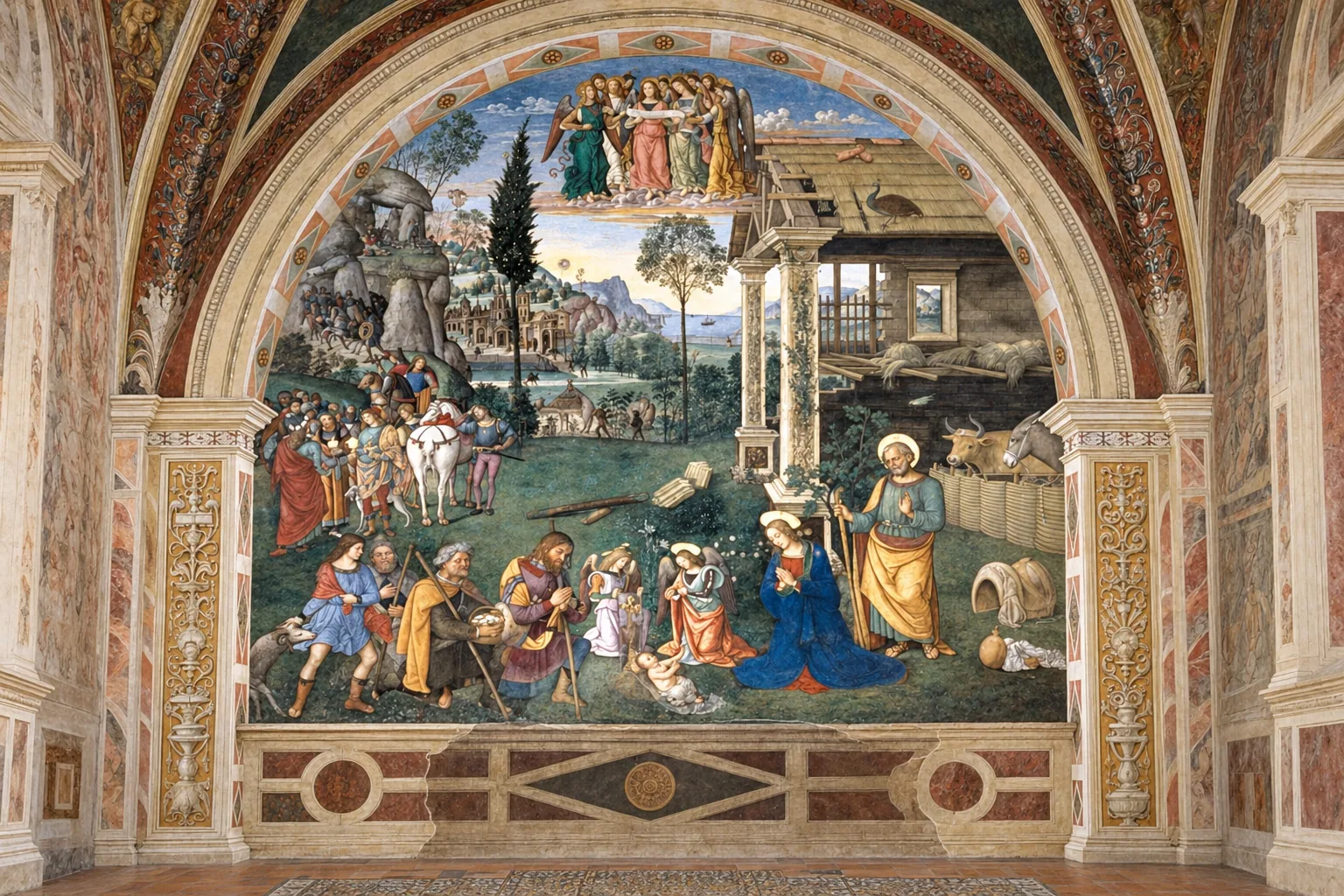
The apse is the great draw. Filippo Lippi frescoed it with scenes from the life of the Virgin: the Annunciation, the Nativity, her Dormition or death at the center, and the Coronation above, among angels and saints. The painter died in Spoleto and was buried inside the cathedral.1,5,6
The frescoes are dated to 1466 to 1469, and Fra Diamante and Filippino Lippi completed them after Filippo's death. His tomb is a separate monument from about 1475 to 1499, with a design attributed to Filippino Lippi, execution linked to the Bregno workshop, and an epitaph by Poliziano.6,7,1
Treasures beyond the apse
Two older treasures repay a slow look. A large painted cross dated 1187, in tempera on parchment mounted on wood and measuring 263 by 197 centimeters, is among the oldest works here. The Santissima Icone is an intimate Madonna Haghiosoritissa dated to about 1090 to 1110 and measuring just 31 by 24 centimeters, a small devotional image rather than a grand altarpiece.8,9,5
The side chapels reward a detour. The Eroli and Assunta chapels, at the start of the right aisle, hold frescoes by Pintoricchio and Jacopo Siculo. The Santissima Icone chapel in the right transept holds the small panel that Emperor Frederick Barbarossa gave the city in 1185 as a sign of peace. And the Chapel of the Relics, at the end of the left aisle, keeps Saint Francis's autograph letter to Brother Leo.4
The crypt of San Primiano
Beneath the church lies a semi-annular crypt set across the line of today's cathedral. It is probably from the ninth century, and its geometry hints at a sacred layout older than the later nave.10,11
The form is a clue to its age. Semi-annular plans were common in the eighth and ninth centuries as a way of reaching the tombs of martyrs, and this one belonged to an earlier Carolingian cathedral. It is the only surviving early medieval architectural space of the complex, and painted decoration still clings to its walls.10
The museum and Sant'Eufemia next door
The Museo Diocesano is a separate institution in the archiepiscopal palace, founded in the late 1960s and holding the diocesan collection. Through the museum route you reach Sant'Eufemia, a historic church of the Curia complex that is neither a chapel of the cathedral nor part of it. Its origins are uncertain, most plausibly on the site of the Lombard ducal palatium, and a Benedictine convent was added in the tenth century. Inside, a cross-vaulted nave is flanked by aisles with galleries, the matroneum once reserved for nuns, and a marble altar with Cosmatesque work stands here that originally belonged to the cathedral. Together they make a rewarding second act to a cathedral visit; check the official cathedral site before you go for current visiting details.12,13,14
Spoleto and UNESCO
Spoleto has genuine World Heritage connections, but the cathedral is not one of them. In the serial property Longobards in Italy, the Spoleto component is the Basilica of San Salvatore. The city also has a link to the World Heritage listing of Italian-style condominio theaters of the eighteenth and nineteenth centuries, whose Spoleto component is the Teatro Nuovo Gian Carlo Menotti, not the cathedral or its piazza.15,16,17
Sources and citations (19)
- Duomo di SpoletoLa CattedraleOrigins and reconstruction chronologyRead source
- BeWeB Chiese ItalianeChiesa di Santa Maria AssuntaArchitectural chronology and preceding churchRead source
- Duomo di SpoletoIl CampanileBell tower history, reused material and earlier towerRead source
- Comune di SpoletoCattedrale di Santa Maria AssuntaFacade mosaic descriptionRead source
- Archdiocese of Spoleto-NorciaInterno della CattedraleDiocesan Lippi cycle overviewRead source
- Catalogo Generale dei Beni CulturaliTransito della MadonnaNational catalogue scene and cycle historyRead source
- Catalogo Generale dei Beni CulturaliMonumento funebre di Filippo LippiNational catalogue: dating, attributions, epitaph and movement historyRead source
- Catalogo Generale dei Beni CulturaliCroce dipintaNational catalogue: identification, dating, materials and dimensionsRead source
- Catalogo Generale dei Beni CulturaliMadonna Haghiosoritissa detta Santissima IconeNational catalogue: identification, dating and dimensionsRead source
- Duomo di SpoletoLa Cripta di San PrimianoCrypt geometry, survival and proposed ninth-century dateRead source
- Archdiocese of Spoleto-NorciaPresentazione dei lavori di restauro della cripta di S. PrimianoConservation project: early medieval date and research uncertaintyRead source
- Duomo di SpoletoMuseo DiocesanoMuseum location, foundation and collection overviewRead source
- Ministero della CulturaMuseo Diocesano e Basilica di Sant'EufemiaNational museum place identity and diocesan collectionRead source
- Duomo di SpoletoSant'EufemiaSant'Eufemia identity and Curia complex contextRead source
- UNESCO World Heritage CentreLongobards in Italy. Places of the Power (568-774 A.D.)Official property and Spoleto Basilica of San Salvatore componentRead source
- UNESCO World Heritage CentreThe system of Italian-style condominio theatres of the 18th and 19th centuries in Central ItalyExact 2026 property title, ten components, condominio model, and separate ICH noteRead source
- UNESCO World Heritage CentreThe system of Italian-style condominio theatres of the 18th and 19th centuries in Central Italy - MapsMap list: component 1762-010 Teatro Nuovo Gian Carlo MenottiRead source
- Archdiocese of Spoleto-NorciaBasilica CattedraleBasilica Cattedrale: diocesan and rector identityRead source
- Duomo di SpoletoOrari e informazioniOperator information and visitor productsRead source