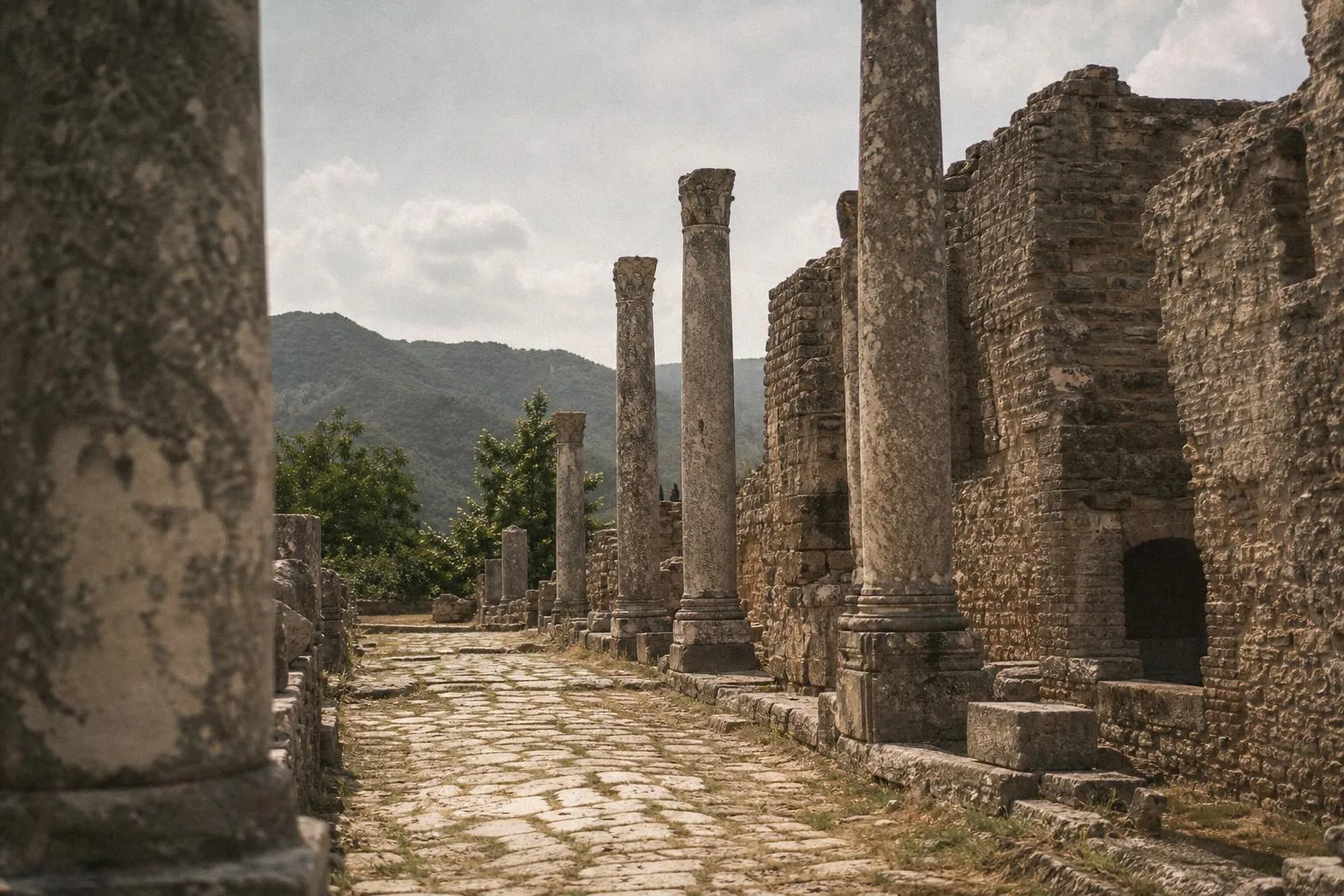
Rome founded Carsulae around 220 BC along the Via Flaminia, and Augustus later gave it the temples, forum and baths of a proper municipium, yet by the sixth century the town had emptied out, abandoned for reasons historians still argue over rather than destroyed by war or disaster.
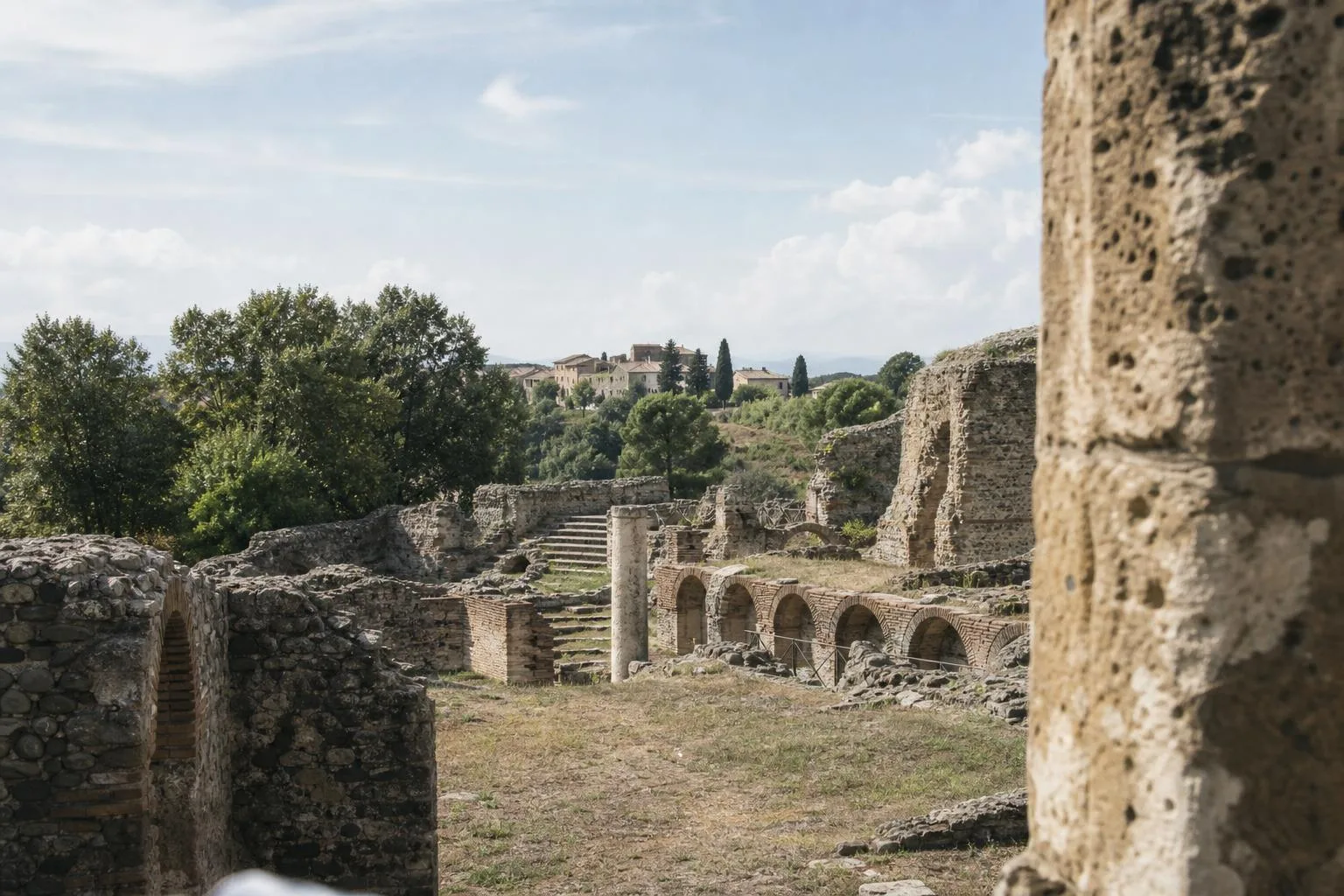
What remains is unusually intact: twin temples face the forum, a theater and amphitheater sit close enough to have shared audiences, and the Arco di San Damiano still marks where the Via Flaminia entered town, its paving grooved by cart wheels. A small medieval church, built from salvaged Roman stone, stands incongruously among the ruins. Systematic excavation began in 1951 and resumed in 2006, focused now on the baths and forum, and a visitor center with accessible paths and a café sits at the entrance.
Carsulae at a glance
Carsulae is an open archaeological landscape in the Comune di Terni where a long stretch of the ancient Via Flaminia still organizes the remains of a Roman town. You move between road, forum, basilica, temples, theater, amphitheater, baths, tombs and a medieval church, and that relationship is the whole point: public, sacred, civic and funerary spaces make sense because they still share one piece of ground.1,2
The site is a state cultural site within the Musei Nazionali di Perugia, and it lies in the territory of Terni, near San Gemini.3,4,5,1
A town made by a road
The story starts with the Via Flaminia. The road was built through this area by about 220 to 219 BCE, and it was the principal condition for Carsulae’s growth. The site itself was well exposed, with fertile farmland and springs, which made it a natural place for a town.2,6
The town itself is a little later. The urban center was in place by the end of the second century BCE, and the Republican phase is known mainly from inscriptions and limited structural remains beneath later works.6
Carsulae took the monumental form most visible today in the Augustan period, when it reached its greatest splendor, became a municipium governed first by duoviri and then by quattuorviri, and enrolled its citizens in the Clustumina tribe. It stayed a thriving, lively center at least until the early fourth century CE. The urban stretch of the Flaminia served as the main north to south axis, and it still preserves limestone paving, sidewalks in places and drainage channels.2,6,1
Why the town faded
The western branch of the Flaminia, the one through Carsulae, lost traffic to the eastern route through Narnia, Interamna Nahars (the ancient Terni) and Spoletium. The town also had no defensive walls, and a strong earthquake collapsed some of the sinkholes on which many public and private buildings stood, leaving the site inhospitable.6,2,7
Carsulae was definitively abandoned between the end of the fourth and the beginning of the fifth century CE.6
Forum, basilica and the heart of the town
Start on the paved road and follow its line. The trapezoidal forum lies on the west side of the Flaminia. Two small quadrifrons arches marked the entrances from the road, part of the square carried pink marble paving, twin temples stood to the south, and apsidal public rooms ran along the north. Julio-Claudian honorific fragments from this zone include a portrait head of Claudius.2
Across the road stands the basilica, a large apsidal building with three aisles and the bases of its internal columns still legible. Here "basilica" means a Roman civic hall, not a Christian church.2
The Domus of the Mosaics
Excavations have uncovered a large residence facing the forum, dated to the late first century BCE. The plan includes reception rooms, peristyles and water features, and a private bathing sector. A second phase adds a heated bath complex (frigidarium, tepidarium and calidarium) and further rooms with large mosaic floors. It gives the public square a domestic counterpart and shows how wealthy townspeople lived beside the forum.8,9
Theater, amphitheater and water
A paved street leads east from the Flaminia to the entertainment district. The theater's seating rests on vaulted rooms, while the amphitheater was built using a natural sinkhole. Their shared alignment suggests coordinated planning, but each kept its own role.2,6
A small colonnaded building near the theater is possibly a palaestra, and a long, multi-room cistern stands near the amphitheater. South of the center lie the partly excavated public baths, where floor mosaics were found. Drainage channels beside the Flaminia and several cisterns serving major buildings show that water was managed deliberately.2,8,1
The Arch of San Damiano and the tombs
The church beside the forum
Center, collections and a long dig
The Umberto Ciotti Visitor and Documentation Center stands at the entrance and holds a small display of archaeological material from the site.1,10
Digging and discoveries here are documented from the sixteenth century, with intensive campaigns from 1951 to 1972 and research continuing afterwards. The plan you walk is therefore the sum of many excavation and conservation episodes, and large areas remain only partly investigated. Early finds include a sarcophagus, an inscription, a funerary cippus and a cistern.2,3,11
Sources and citations (13)
- Ministero della CulturaArea archeologica di CarsulaeDescription: urban cardo, paving, sidewalks and drainageRead source
- Musei Nazionali di Perugia - Direzione regionale Musei nazionali UmbriaArea archeologica di CarsulaeMonuments: paved Flaminia and channelsRead source
- Direzione Regionale Musei UmbriaStatuto dell'Area Archeologica di CarsulaeArticles 1-4: status, mission and functionsRead source
- Ministero della CulturaMusei nazionali di Perugia - Direzione regionale Musei nazionali UmbriaCurrent regional institution recordRead source
- Direzione generale MuseiElenco musei del Sistema museale nazionale - February 2026February 2026 national museum-system list: Terni, CarsulaeRead source
- Musei Nazionali di Perugia - Direzione regionale Musei nazionali UmbriaOfficial bilingual Carsulae mapOfficial map history: road built by 220 BCERead source
- Soprintendenza Archeologia Belle Arti e Paesaggio dell'UmbriaArcheologia a TerniSABAP Terni archaeology contextRead source
- Musei Nazionali di Perugia - Direzione regionale Musei nazionali UmbriaNew mosaics at Carsulae and conservation investmentMiC regional museums news: domus dating, rooms and private bathsRead source
- Ministero della CulturaMiC investment for new Carsulae mosaicsMiC press release: Domus of the Mosaics projectRead source
- Carsulae official visitor serviceCentro visita e documentazione U. CiottiFacility and permanent-display descriptionRead source
- Sistema Archivistico NazionaleCarsulae archival inventory unitArchival discovery documentationRead source
- Comune di TerniPiano regolatore - parte operativaMunicipal planning rules: Carsulae archaeological areaRead source
- Comune di TerniValorizzazione dell'area archeologica di Carsulae2026 agreement: unified ticketing, centre use, maintenance and securityRead source