The Via Flaminia's construction in 220 BC turned this Tiber-side settlement into Ocriculum, a Roman municipium that grew wealthy on agriculture, river trade and pottery production across a site covering roughly thirty-six hectares near modern Otricoli.
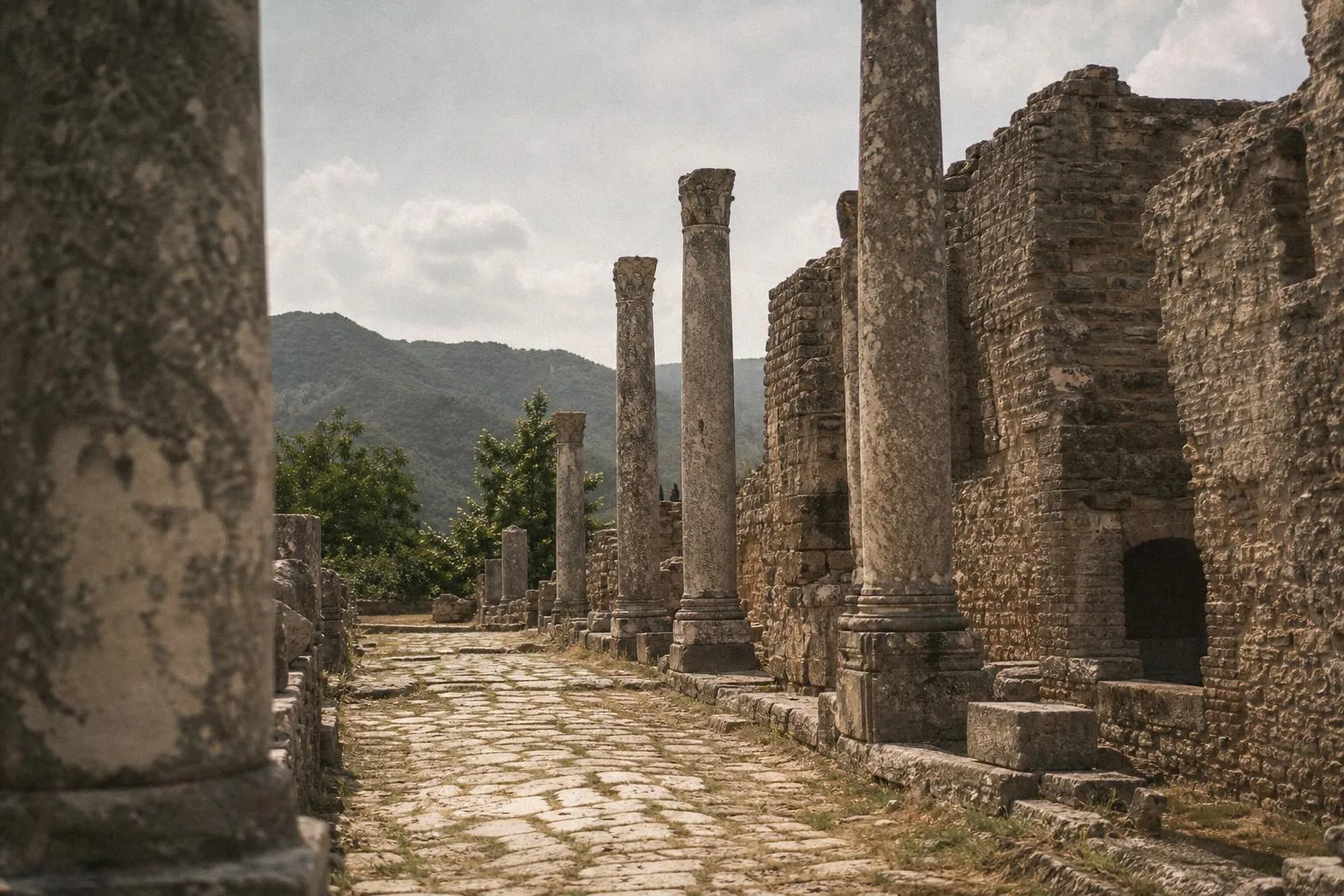
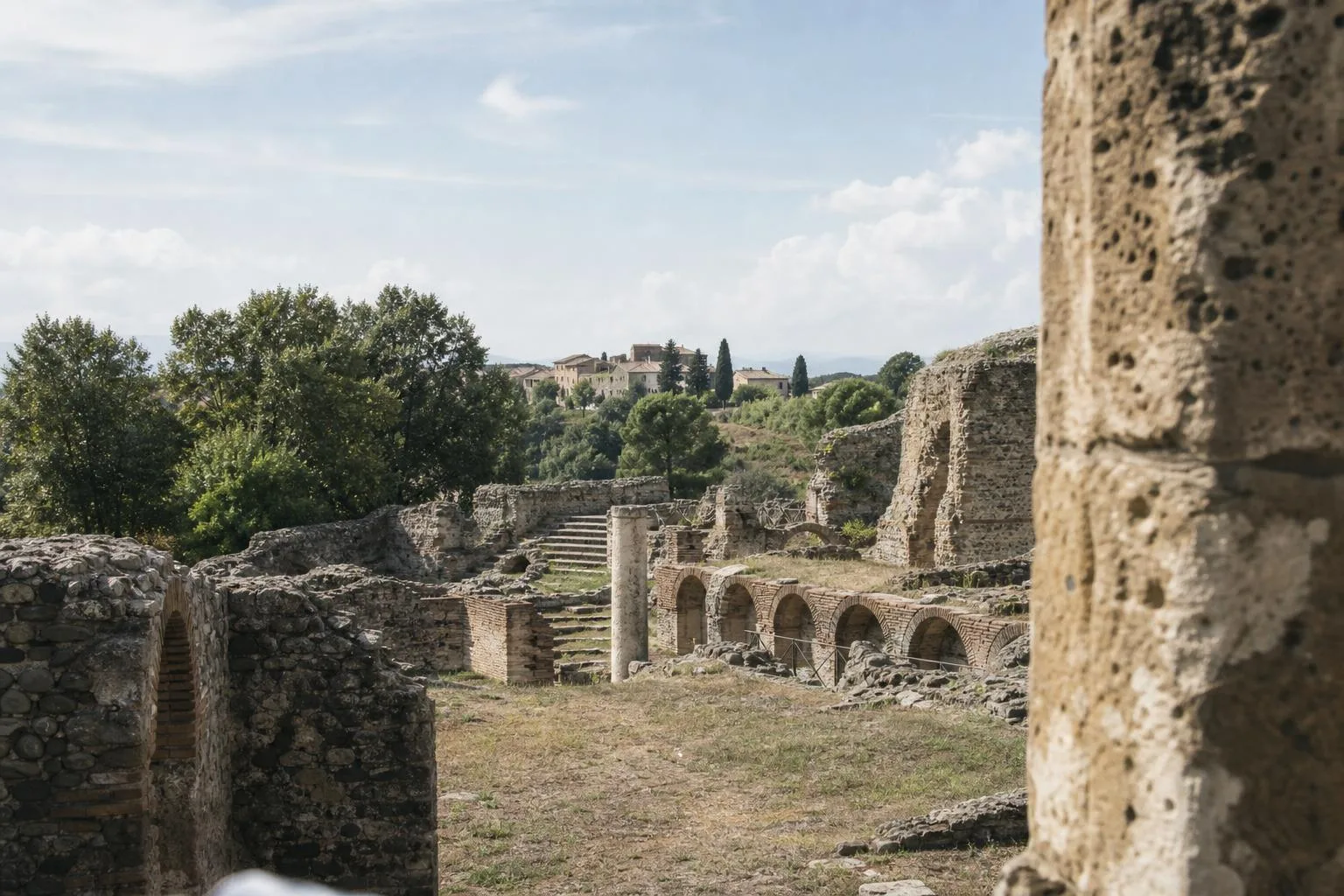
A first-century theater, carved partly into the natural terrain in opus reticulatum brickwork, stands alongside a similarly dated amphitheater and a second-century-BC bath complex whose octagonal room still shows its mosaic floor. Funerary monuments in tower, niche and drum forms line the approach, and stretches of the Via Flaminia itself survive with stone paving still grooved by ancient cart wheels. Lombard invasions emptied the town between 569 and 605 AD, and it was never resettled, leaving the ruins to the Soprintendenza Archeologia, Belle Arti e Paesaggio dell'Umbria, which now manages the park alongside an antiquarium displaying finds from the site's archaic necropolis.
Ocriculum and Otricoli
Ocriculum is the ancient Roman town that stood where modern Otricoli is today. The Archaeological Park of Ocriculum is the visitor area that keeps part of that settlement and its landscape, which makes it a place to read a town rather than to tick off a single monument. Ancient Ocriculum was the first Umbrian municipium along the Via Flaminia and an important Tiber river port between Rome and northern Italy.1,2
The park covers about 36 hectares beside the Tiber, among the largest archaeological areas in Umbria, crossed by paths that wander among surviving structures and earlier burial evidence. The setting is the story: the river and the Via Flaminia met here, and road traffic, river trade, civic life, spectacle, bathing and burial each had their own corner of the town. What you see is largely a flourishing Roman city of the second century CE, with its great substructures, theater, baths, nymphaeum and amphitheater.1,3
Before the Romans
Ocriculum did not start as a Roman town. The first settlements date to the eighth century BCE and grew around two centers: La Scorga, a river emporium on the Tiber plateau trading with Umbrians, Sabines, Faliscans and Etruscans, and the defensible hill of Otricoli, later ringed by a wall of local tuff blocks in the fourth century BCE. The name is said to come from the Umbrian okris, a sacred height.4
East of the park, along the modern SS3 Flaminia, a necropolis of the seventh century BCE shows that people lived and buried their dead here long before the Romans arrived.1
Ally of Rome, then municipium
After the Battle of Mevania in 308 BCE, Ocriculum allied with Rome by a pact of friendship, and in 90 BCE it became a Roman municipium enrolled in the Arnensis tribe.5
The Via Flaminia, built in 220 BCE, crossed the settlement and boosted its trade. Through the Tiber port, known as the Port of Oil, olive oil, wine, ceramics and other local products traveled to Rome.5
Under Augustus the city received a theater, amphitheater, forum, nymphaeum, baths and the Great Substructures, and villas ringed it, owned by figures such as Pompeia Celerina, Pliny the Younger's mother-in-law, and Titus Annius Milo.5
The Via Flaminia and its edges
A preserved stretch of the Via Flaminia runs about 6 meters wide and 25 meters long, paved in leucitite, a dark volcanic stone, and still marked by wheel ruts. Funerary structures and a fountain lined the roadside, and they give a sense of how people arrived at the town.2
Forum, basilica and great substructures
The forum lay east of the main north-south street, with the remains of a basilica and imperial portraits nearby. Alongside them run large two-level substructures about 80 meters long, engineering that supported and shaped the civic area. You see foundations and footprints rather than intact interiors, which is typical of a Roman town that was quarried and excavated over centuries.2
Theater, baths and amphitheater
The theater preserves reticulated masonry, the net-patterned Roman masonry, and its circulation spaces. The baths visible today date to the second century CE and include an octagonal room. The amphitheater is Augustan and stands outside the ancient urban area, away from the civic core.2
Late antiquity and early Christianity
Late-antique Ocriculum was a bishop's seat, and Bishop Herculius took part in the Roman council of 487. Local tradition also preserves stories about San Fulgenzio.6
During the Gothic War, from 535 to 553, the town on the open plain proved hard to defend and its people moved to the fortified hill, one of the earliest examples in Italy of a return to a hilltop settlement in the early Middle Ages. In 817 the Pactum Ludovicianum placed the town permanently among the possessions of the Roman Church.6
Digging up Ocriculum
The major papal excavations are dated to 1775 to 1783, commissioned by Pope Pius VI. Important sculptures and mosaics were taken to collections elsewhere, above all the Vatican Museums, and others reached the Hermitage Museum in Saint Petersburg, which is why the town's most famous finds are not in Otricoli today.5,7,1
Material from later work is kept at Il Funghetto in Otricoli, a climate-controlled heritage deposit for Ocriculum sculpture, architectural fragments, ceramics and everyday objects, used for research and restoration.8
Finds that live elsewhere
The colossal marble head known as the Giove di Otricoli dates to the first half of the first century BCE. It was excavated in the octagonal room of the baths in 1781 and 1782 and is cataloged in the Sala Rotonda of the Vatican's Museo Pio Clementino.9,10
The great mosaic floor in that same Vatican room is an eighteenth-century assembly of early third-century mosaics found at both Otricoli and Sacrofano, so it is not all from Ocriculum.11
A late-Republican portrait head in the Torlonia Collection, traditionally called the Old Man from Otricoli and set on a modern bust, is presumed to come from Otricoli, although the findspot is not certain.12
Sources and citations (12)
- Terre di OtricoliThe Archaeological Park of OcriculumPage title and opening descriptionRead source
- Umbria TourismArchaeological Park of OcriculumFrom the origins of the city and Archaeological evidence sectionsRead source
- Istituto Centrale per il Patrimonio ImmaterialeOcriculum AD 168Place description: 36-hectare archaeological parkRead source
- Terre di OtricoliPre-Roman ageTimeline, two centres, name originRead source
- Terre di OtricoliThe RomansRomans page, statusRead source
- Terre di OtricoliLate AntiquitySections on bishopric, Bishop Herculius and San Fulgenzio traditionsRead source
- Ministero della CulturaAntiquarium comunale di OtricoliDescription: original works transferred to Vatican Museums after eighteenth-century excavationsRead source
- SABAP UmbriaIl Funghetto di OtricoliRepository description, collection categories, climate control and research-restoration functionRead source
- Vatican Museums Online CatalogueTesta colossale di Giove, c.d. Giove di Otricoli [MV.257.0.0]Object record MV.257.0.0: title, chronology, material, dimensions, provenance and collocazioneRead source
- Vatican Museums Online CatalogueInformation on the Online CatalogueCatalog scope: objects on visitor route may moveRead source
- Musei VaticaniSala RotondaSala description: floor assembled in the eighteenth century from mosaics found at Otricoli and SacrofanoRead source
- Fondazione TorloniaMale portrait on modern bust, called Old Man from OtricoliMT 533 title, inventory, late-Republican date, modern bust, presumed Otricoli findspot and Galba identification historyRead source