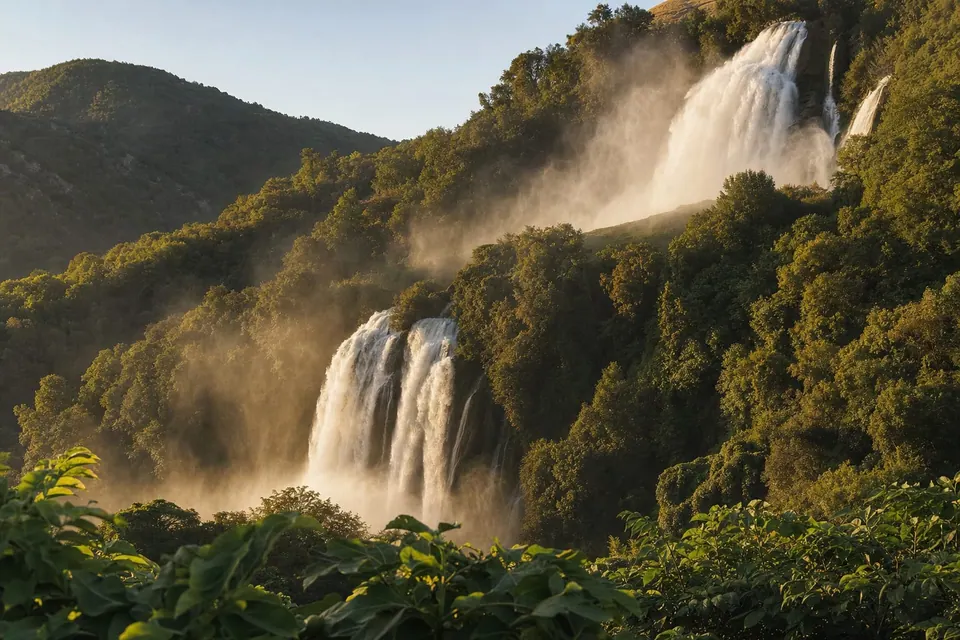
Roman engineer Manius Curius Dentatus ordered the Velino river diverted over this cliff in 271 BC, cutting a channel to drain the malarial Rieti plain into the Nera below; the result is still billed as Europe's tallest human-made waterfall, a 165-meter triple drop.
Because the same water also feeds a hydroelectric plant, the cascade runs only at scheduled hours, several release windows a day depending on the season, so its full roar (and the rainbow that forms in the spray on sunny afternoons) is a timed event rather than a constant. Lord Byron gave it several stanzas in Childe Harold's Pilgrimage, calling it a "matchless cataract." Six marked trails wind through the park; the short Sentiero 1, the Antico Passaggio, crosses just behind the water at the lower belvedere, about as close a soaking as most visitors get.
A waterfall shaped by people and stone
Marmore Falls is one of Europe's great engineered wonders: a waterfall where the Velino River drops toward the Nera near Terni, in three main leaps commonly given as 165 meters in all. Nothing about it is fake, yet nothing about it is purely natural either. Roman drainage works started the diversion, later engineers reshaped it, travertine formed and vegetation grew up around the spray, and a modern hydroelectric system now decides how much water goes over the edge.1,2,3
That last point shapes every visit. Water is released through controlled gates on a schedule. At other times part of the river is diverted to generate power and the falls run at reduced flow, which is lovely in its own quiet way but very different from the full roar. Before you go, check the official site for the current release calendar.1
The falls sit within the Nera River Regional Park, a wider protected landscape spread across Terni, Montefranco, Arrone and Ferentillo. It takes in the middle and lower Nera, the confluence of the Velino, Piediluco and Marmore, along with major hydroelectric works.3
A river diversion with a long history
The story begins on the Rieti plain, where the Velino spread into marsh. In 271 BCE the Roman consul Manius Curius Dentatus ordered the Cava Curiana, a channel that drained that water toward the Nera system and sent it over the escarpment. The falls are therefore bound up with land reclamation, flood control and the relationship between two river basins.1,2,4,5
Romans did not have the last word. Later campaigns are linked to some of the great engineers of their day: Fioravante Fioravanti in 1417 to 1422, Antonio da Sangallo the Younger in 1545, Giovanni Fontana in 1598 to 1601 and Andrea Vici in 1787 to 1793. Each of these campaigns reshaped the works, so the cascade you see today is the layered result of more than two thousand years of hydraulic work.2,4,5
Stone is part of the tale too. The falls stand on travertine, a limestone laid down by the Velino. Pliny the Elder wrote that marble grows in this place, meaning that river-deposited rock, and travertine remains the building stone of much of Terni's territory.4
Two levels, many viewpoints
The park works on two levels. The upper entrance is at Marmore, near the Campacci area and the Specola viewpoint, which gives quick access to the brink and the upper landscape. The lower entrance is at Collestatte Piano, at the foot of the falls, close to the Byron forecourt, the excursion area and the most immersive spray. Marmore and Collestatte Piano are separate localities, not interchangeable names for the waterfall.1,4,6
Between the two levels runs a network of trails that is best described by its texture: earth and exposed roots, wooden stairways and boardwalks, surfaces that are often wet. Antico Passaggio is a long climb of irregular steps linking the lower and upper levels. Anello della Ninfa loops among secondary cascades, and L'Incontro delle Acque stays close to the bed of the Nera. La Maestosità climbs toward Pennarossa to two frontal viewpoints from which all three drops read as a single composition, while La Rupe e l'Uomo is a gentler route across the upper Campacci landscape, with wide views over the Valnerina.7
The most dramatic vantage is the Balcone degli Innamorati, the Lovers' Balcony, reached through a tunnel on the Trail 1 system. It puts you close to the spray and the thunder of the falls, and it is usually visited with a guide.8
Caves, plants and river life
Friable travertine and the ceaseless movement of water have hollowed caves and karst-like forms into the rock around the falls. The main cavities are gathered into three complexes: the Grotta della Morta with the Grotta delle Diaclasi, the Grotta delle Colonne, and the Grotta della Condotta, partly collapsed and crossed by an old conduit.2
Along the water the vegetation is lush. Large willows, alders and holm oaks crowd the banks, Aleppo pine clings to the limestone outcrops, and the hills above carry oaks, maples and beeches.2
The wider Nera park is richer still. Mediterranean trout, native river crayfish, rovella, Tiber barbel, stickleback, Apennine amphibians, kingfisher and dipper live across the park as a whole. You won't necessarily spot them at the falls, but they show how much life the river supports.9
Water, power and industry
The same water that makes the spectacle also makes electricity. In the hydroelectric system, water routed through intakes and penstocks drives turbines connected to alternators, and transformers then prepare the power for the grid. The visible cascade is not itself a power station, but the two are part of one landscape.10
Galleto at Papigno is the large Galleto–Monte Sant'Angelo plant, which also governs the water released over the falls. The works at Galleto, designed by Cesare Bazzani, date to 1929 and the expansion at Monte Sant'Angelo to 1973, and since the 1930s the falls have been part of that large system.11,2
Grand Tour, poetry and painting
Marmore was a stop on the Grand Tour between the seventeenth and nineteenth centuries, visited, described and reproduced by the great artists of the age. Lord Byron wrote of the Velino and the cascade in Canto IV of Childe Harold's Pilgrimage, and the falls drew painters and photographers as well.2,12,13,14,15
The Metropolitan Museum of Art holds Jean-Baptiste-Camille Corot's Waterfall at Terni of 1826 and Robert Macpherson's albumen print Falls of Terni from about 1860, and the Fitzwilliam Museum holds George Augustus Wallis's Cascate delle Marmore, Terni, dated between 1788 and 1806.12,13,2,15,14
Close to the upper belvedere stands HYDRA, a multimedia museum on the history of the falls that uses video mapping, holograms and augmented reality. It is a separate museum from the park itself.16
The falls also appear on UNESCO's Tentative List, where the World Heritage Centre has listed Cascata delle Marmore and Valnerina, with its monastic sites and ancient hydrogeological reclamation works, since 2006. That is a statement of potential, not an inscription.17
Sources and citations (17)
- Cascata delle Marmore visitor serviceDomande frequentiFAQ sections Informazioni generali sulla Cascata > Che cos’è la Cascata delle Marmore?; Il rilascio dell’acqua; Percorsi e accessibilità; Biglietti e visite guidate; Parcheggi e navettaRead source
- Comune di Terni tourism portalCascata delle MarmorePage heading and description paragraphs: 165 m Velino-Nera fall; Roman origin and later campaigns; Grand Tour and hydropower; travertine caves; vegetation and faunaRead source
- Regione UmbriaParco regionale del fiume NeraOpening park description: four municipalities and 2,120 ha; waters and power works; middle-lower Nera boundary; landscape and hydrological modification paragraphsRead source
- Comune di Terni tourism portalMarmoreMarmore description paragraphs: locality boundary, Velino and Cava Curiana, settlement and Marmore stationRead source
- Soprintendenza Archeologia, Belle Arti e Paesaggio dell'UmbriaPaesaggi in Umbria: bonifiche, sistemi idraulici e archeologia industrialeSABAP Umbria PDF Gli impianti industriali e lo sviluppo della vocazione turistica, printed pp. 100-111 (physical pp. 1-6): hydraulic history, plants, protected works, industrial archaeology, and bibliographyRead source
- Cascata delle Marmore visitor serviceCome visitare la Cascata delle MarmoreSections DAL BELVEDERE INFERIORE, PER SPOSTARSI AL BELVEDERE SUPERIORE, DAL BELVEDERE SUPERIORE, and PER SPOSTARSI AL BELVEDERE INFERIORERead source
- Comune di Terni tourism portalEsplora i sentieri della Cascata delle MarmoreEsplora i sentieri della Cascata delle MarmoreRead source
- Cascata delle Marmore visitor serviceBalcone degli InnamoratiBalcone degli InnamoratiRead source
- Regione UmbriaHabitat del Parco del Fiume NeraHabitat del Parco del Fiume NeraRead source
- Cascata delle Marmore visitor serviceUomo acqua energia: sistema delle centraliUomo acqua energia: sistema delle centraliRead source
- Enel Green PowerCentrale Idroelettrica di Galleto - Monte Sant'Angelo, ItaliaCentrale idroelettrica di GalletoRead source
- Project GutenbergChilde Harold's Pilgrimage, Canto IVChilde Harold’s Pilgrimage, Canto IV, stanzas LXIX-LXXII: Velino, precipice, spray, cataract, and irisRead source
- The Metropolitan Museum of ArtJean-Baptiste-Camille Corot, Waterfall at TerniMet Collection API object 438635 fields objectID, title, artistDisplayName, objectDate, medium, repository, and rights/public-domain metadataRead source
- The Metropolitan Museum of ArtRobert Macpherson, Falls of TerniMet Collection API object 285822 fields objectID, title, artistDisplayName, objectDate, medium, repository, and rights/public-domain metadataRead source
- The Fitzwilliam MuseumGeorge Augustus Wallis, Cascate delle Marmore, TerniFitzwilliam object PD.29-1997 fields title, painter, method, date range 1788-1806, accession, current location, and image recordRead source
- Cascata delle Marmore visitor serviceBiglietti combinati e HYDRABiglietti combinatiRead source
- UNESCO World Heritage CentreCascata delle Marmore and Valnerina: Monastic sites and ancient hydrogeological reclamation worksTentative List entry 2031 fields: title Cascata delle Marmore and Valnerina, State Party Italy, submission 01/06/2006, Cultural category, criteria (i)(iv)(v)(vi)Read source