Skip to content

Farfa Abbey

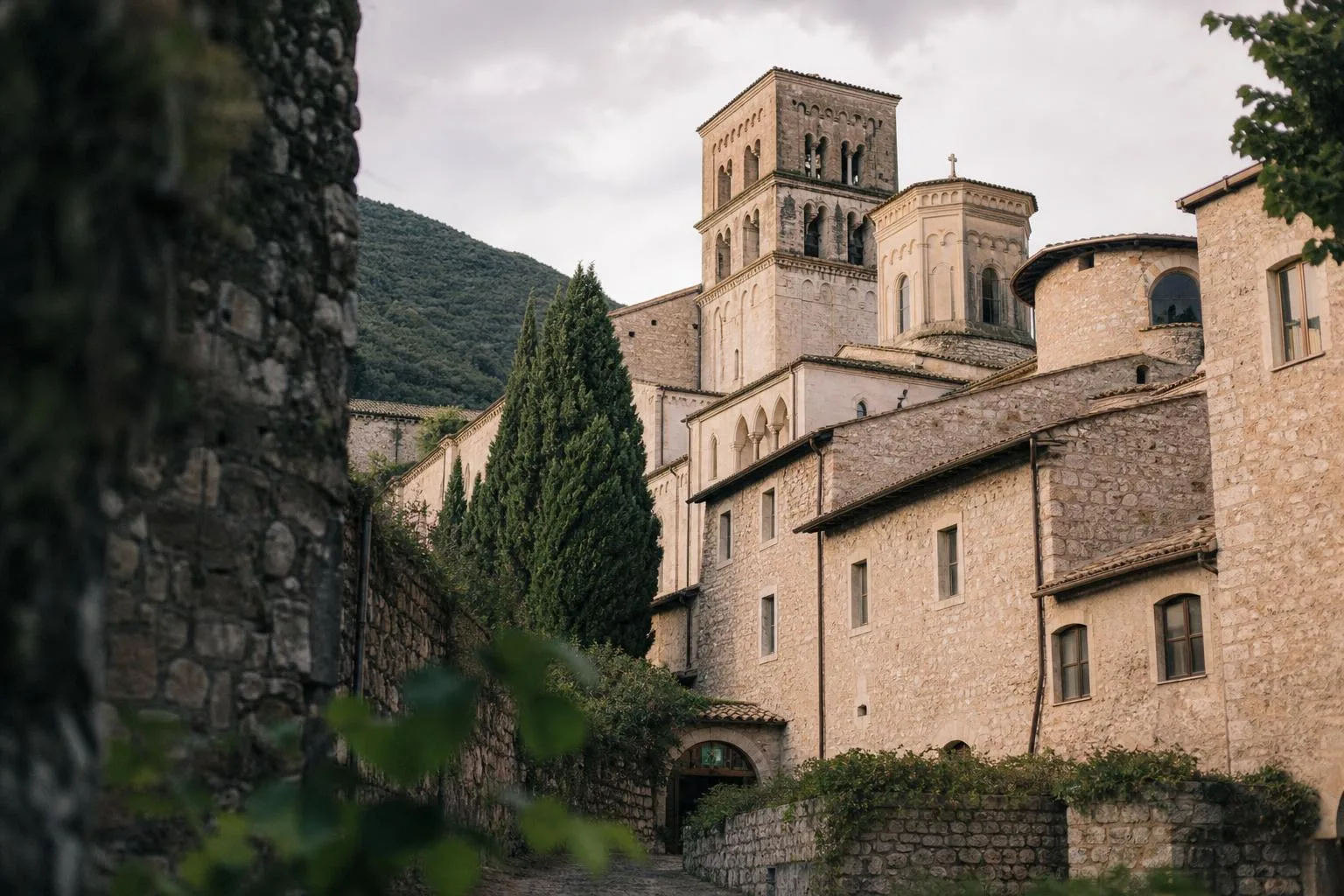
A Benedictine abbey reborn in 1920, once one of medieval Europe’s richest monasteries.

  • Fara in Sabina
  • Church
Where
Fara in Sabina
Best for
Medieval monastic power
Allow
1 hour
Tickets
Free

Founded in the late sixth century, Farfa grew into one of medieval Europe’s wealthiest monasteries, its abbots at one point answering to no bishop but the pope himself and controlling, by some counts, over six hundred dependent churches and monasteries and more than a hundred castles across central Italy.

Saracen raiders sacked it in the ninth century, and centuries of decline followed before the Benedictines returned in 1920 to re-found the community that still lives and prays here today. The basilica mixes eras candidly: a Carolingian bell-tower base, a Baroque nave, and, overhead, Dirck Barendsz’s 1561 Last Judgment ceiling fresco. An altarpiece by Orazio Gentileschi and a working 1947 organ round out a church that still holds daily Mass for its monks and the handful of villagers who share their borgo.
Four things worth finding

If you see nothing else, see these.

  1. Barendsz’s Last JudgmentDirck Barendsz, 1561

    A huge fresco by a Dutch painter trained in Italy, with a crowded, swirling heaven and hell.Back wall of the nave

  2. Gentileschi’s altarpieceOrazio Gentileschi, 1597 to 1599

    An altarpiece of Saint Ursula by the painter better known for his Caravaggesque canvases.In the church

  3. The Carolingian bell towerNinth century

    Carolingian pilasters at the base are a rare survival in Italy.Base of the tower

  4. The cloisterMedieval

    Medieval structural elements and a ninth-century stone tablet of an abbot.Beside the church

Plan your visit

Everything you need before you go.

Tickets
Free
Booking
No booking needed
Time needed
1 hour
Best time
Weekday late morning, between Masses, when the basilica sits quiet.
Getting there
Farfa has no train station; it's reached by car from the Passo Corese exit on the A1 motorway, with free parking just outside the walled borgo.
Accessibility
The basilica and main square are level and accessible; some areas of the monastic complex and the library involve stairs.

The basilica itself is free to enter; guided tours of the abbey complex, museum and library are arranged separately through the abbey's tourism office and may carry a fee. Modest dress is expected, since this is a living monastic community, not a museum piece.

Call ahead for the guided tour that includes the library and the frescoed refectory; without it, you'll only see the basilica and the small village square.

Get directionsGoogle MapsApple Maps

Good to know

How long should you spend at Farfa Abbey?

About an hour for the basilica, the cloister and a walk in the village.

Is Farfa Abbey worth visiting?

Yes, it is a hidden gem in Sabina, once one of the most powerful monasteries in Europe and still home to a Benedictine community.

Can you visit Farfa Abbey without a car?

It is difficult: there is no train station, and the easiest access is by car from the Passo Corese exit on the A1.

A letter from Italy, once a month.

The places, tables and makers we found worth your time. One email, no noise.

One letter a month. Unsubscribe at any time. We never share your address.

Help us get it right

What is it about?