

Climbing the flank of Monte Ingino in austere grey stone, Gubbio is among Italy's best-preserved medieval towns.
Its Palazzo dei Consoli rises over a cliff-supported piazza and guards the Eugubine Tablets; each May the town runs the headlong Corsa dei Ceri.
When to visit Gubbio
Average highs and lows across the year.
What to see first
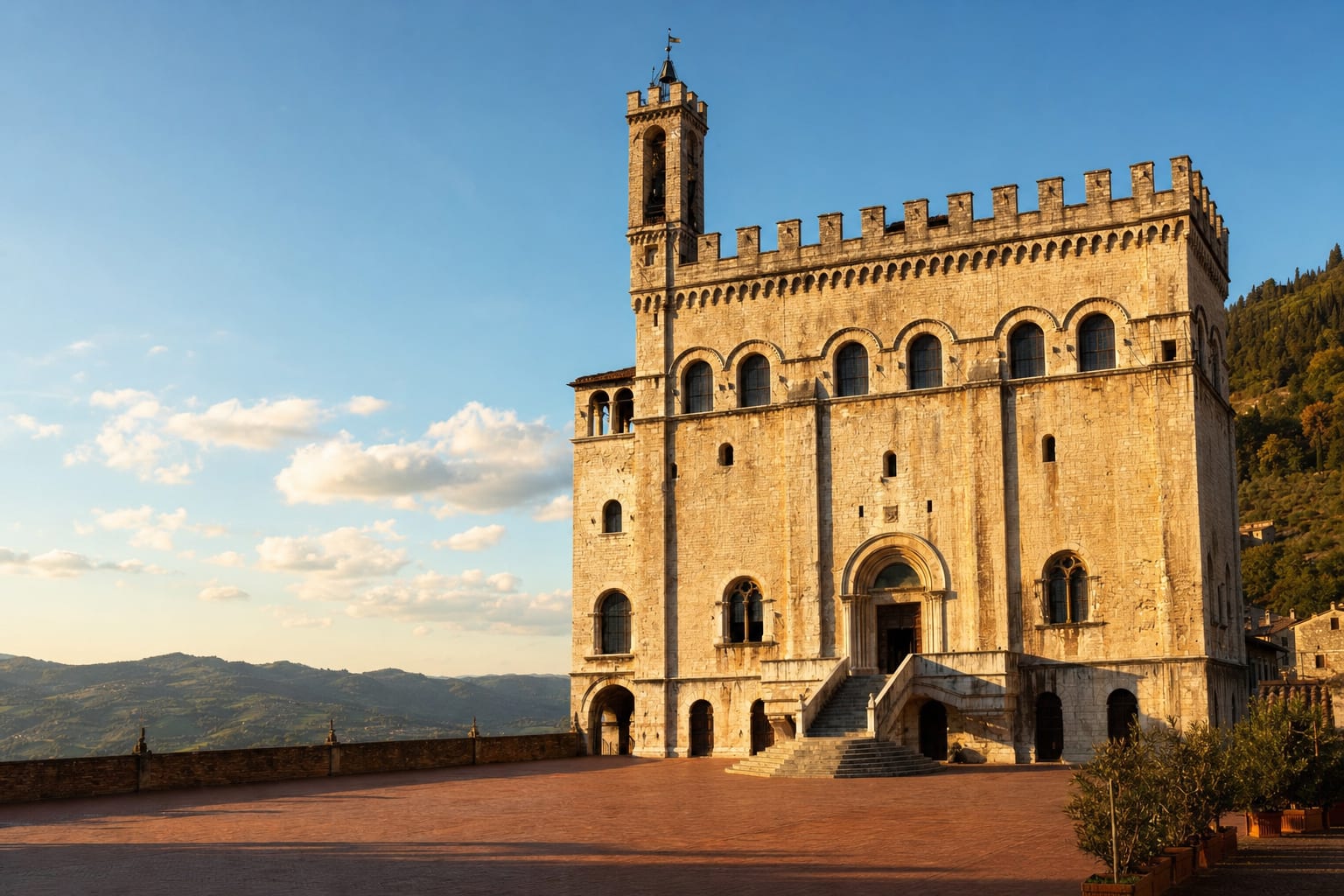
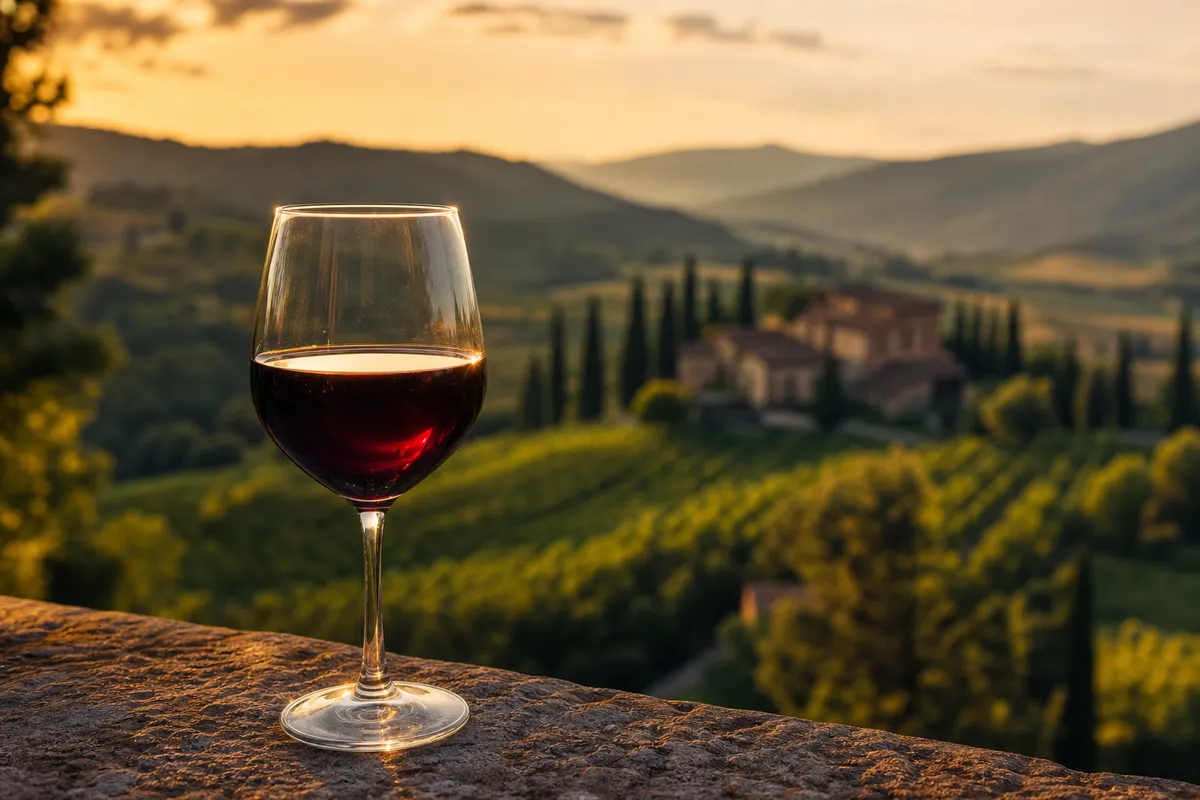
Palazzo dei Consoli
Gubbio's cliff-edge civic palace, home to the bronze Eugubine Tablets in ancient Umbrian.
Read the guide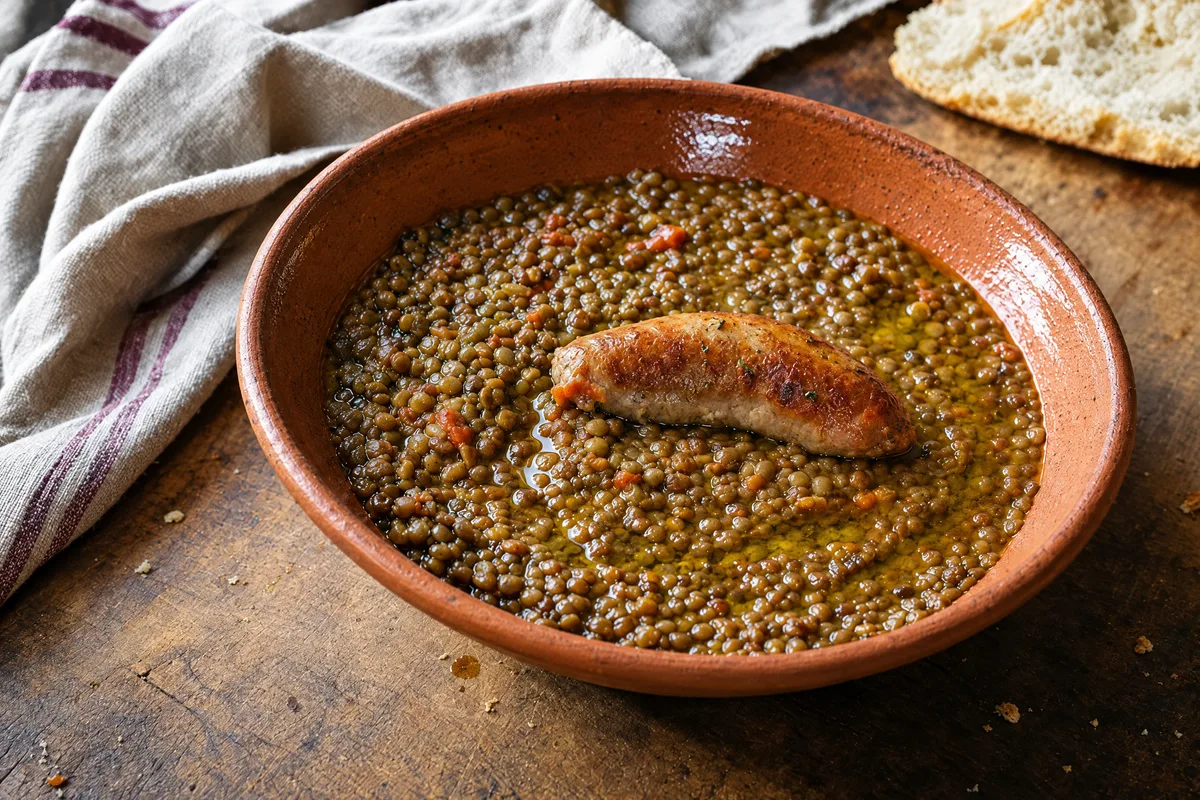
The year in Gubbio
The rituals, races, and processions the city still keeps.
Palazzo dei Consoli and the Museo Civico
The museum is a municipal collection system inside a historic building. The rooms of Palazzo dei Consoli have housed Museo Civico collections since 1909, but the institution is not identical to the architecture. Its official collection map spans archaeology, the Sala dell'Arengo lapidary, the Iguvine Tables, ceramics, paintings, oriental material, Risorgimento material, and numismatics. A useful visit follows different histories of custody and collecting rather than treating every object as something excavated in Gubbio.
The archaeological section interprets a long local sequence from prehistory through the early medieval period. The ceramic section has a particularly strong relationship to Gubbio because it includes archaic maiolica, Renaissance red and gold lustre associated with the workshop of Mastro Giorgio Andreoli, later historicist production, and modern continuities. The pinacoteca, eastern collection, Risorgimento collection, coin holdings, and lapidary have different acquisition histories. Not every object was found in Gubbio.
The seven Iguvine Tables
The Iguvine or Eugubine Tables are a collection of seven bronze tablets, not one undifferentiated monument and not seven free-standing sites. The official museum describes them as written in the ancient Umbrian language using Etruscan and Latin alphabets, produced at different times between the third and first centuries BC. Their ritual prescriptions and institutional information make them fundamental evidence for the language, religion, and civic organization of the ancient Umbrians.
The distinction between language and script is essential. The texts are Umbrian even where Latin letters are used; a change of alphabet does not turn part of the collection into a Latin-language document. Each of the seven bronzes has its own sides, inscriptions, and conservation history.
The municipality states that the Tables have belonged to the Comune di Gubbio since 1456 and are preserved in the Museo Civico. The museum account reports their discovery around the middle of the fifteenth century in the Roman Theatre area. These are different relationships: reported discovery area, municipal ownership, museum custody, palace location, and current public display. None supplies an exact archaeological context.
Ancient Iguvium and the Roman city in the plain
The Roman Theatre stands at the northern edge of the ancient urban area in the Guastuglia zone. The state manager describes a limestone building with two orders of arcades, a cavea divided into four wedges, an orchestra draining toward a cistern, and a stage front articulated by niches. A building inscription preserved in fragments at the Museo Civico connects Augustan-period work to the magistrate Gnaeus Satrius Rufus. The theatre, the inscription fragments and architectural decoration in the civic museum, the archaeological park, and the contemporary performance venue are separate parts of the story.
The Antiquarium is not merely a ticket office for the theatre. Its rural building incorporates remains of a large Roman domus with atrium, tablinum, kitchen, latrine, cocciopesto floors, and a fragmentary black-and-white mosaic with a polychrome Scylla emblem. Its upper floor displays archaeological material. The domus and its mosaic, the Guastuglia excavations, the theatre, and the nearby mausoleum each tell a different part of the story. A digital reconstruction helps interpretation but is not evidence that missing ancient fabric survives.
Federico da Montefeltro and Palazzo Ducale
Palazzo Ducale is a state museum and Renaissance residence in the upper city, facing the cathedral. It was built over earlier medieval structures for Federico da Montefeltro under the design direction of Francesco di Giorgio Martini, with work continuing under Guidobaldo. Its courtyard, rooms, fireplaces, ornament, excavated lower structures, picture collection, and modern-art holdings make it a layered place rather than a detached imitation of Urbino.
The studiolo requires exact separation. The original intarsia ensemble was removed, sold, passed through the art market, and eventually reached the Metropolitan Museum of Art in New York. Gubbio has a high-quality replica installed in 2009. A visitor seeing the room in Gubbio is not seeing the original woodwork, while the Metropolitan room is not a detached site belonging to the Gubbio municipality.
Cathedral, basilica, and a living religious landscape
The Cathedral of Saints Marian and James is the cathedral church of the Diocese of Gubbio, not a museum annex to Palazzo Ducale. The diocese identifies its dedication, chapter, and continuing liturgical use, and describes construction and enlargement between the thirteenth and fourteenth centuries and the relic tradition of the two martyrs at the altar.
The adjacent Museo Diocesano occupies its own institutional and visitor role between cathedral and palace, and its sacred art comes from specific parishes and churches rather than a generic "Gubbio."
The Basilica of Sant'Ubaldo is a diocesan basilica on Mount Ingino and the destination of the Ceri route. The diocese identifies it as a sanctuary and gives its own contact and administration. Diocesan tradition relates the death of Bishop Ubaldo in 1160, the initial deposition of his body in the cathedral, and the continuing devotion that links patron, city, mountain, and basilica. Devotional tradition and historical documentation are best kept distinct.
Churches remain places of worship even when an exhibition ticket includes them: services, funerals, feast preparations, and processions take precedence over sightseeing, and dress and silence are expected. The 15 and 16 May period is a festival, not an ordinary sightseeing day.
Festa dei Ceri: objects, ritual, and route
The Festa dei Ceri takes place on 15 May, the eve of the diocesan feast of Sant'Ubaldo. The Comune describes three tall, heavy wooden structures surmounted for the festival by statues of Sant'Ubaldo, San Giorgio, and Sant'Antonio Abate and attached to carrying frames. The festival is a religious, civic, family, occupational, neighbourhood, and performative system. Translating Ceri simply as candles hides the fact that these are large engineered wooden objects carried by teams at speed.
The main Ceri, their three saint figures, the carrying frames or barelle, the Ceri Mezzani and Ceri Piccoli, the ceramic brocche, costumes, flags, and bells are all part of the festival's material culture. The main structures normally rest at the Basilica of Sant'Ubaldo, while the saint figures return to the city after the race. The statuettes associated with festival preparation are connected to San Francesco della Pace.
The morning raising takes place in Piazza Grande, followed by rotations and separate display through the city. The late-afternoon blessing leads into a fixed urban run, return to Piazza Grande, passage through Porta Sant'Ubaldo, and steep ascent of Mount Ingino to the basilica. The city adjusts access, barriers, emergency lanes, parking, and public transport each year for the festival.
For the Festa, the city rearranges access, parking, bus terminals, and emergency areas each year, and dense crowds, heavy structures moving fast, and steep streets make ordinary walking advice inadequate. Follow stewards and barriers, keep emergency routes clear, avoid positioning children or mobility aids on the race line, and choose a viewing place with an exit plan.
Bottaccione: two different geological stories
The best-known scientific story concerns the Cretaceous-Paleogene boundary. Research on the Bottaccione section identified the iridium anomaly in a thin boundary clay and helped build the extraterrestrial-impact hypothesis for the mass extinction about 66 million years ago. That work did not discover a meteorite in the gorge and the layer is not a piece of the Chicxulub crater.
A second, distinct reference point is the Campanian Global Boundary Stratotype Section and Point. ISPRA records the 2023 golden spike ceremony for the physical reference marking the Santonian-Campanian boundary at about 83.6 million years. A GSSP is an international stratigraphic reference, not UNESCO World Heritage or a UNESCO Global Geopark inscription. It is a different layer from the younger K-Pg iridium layer, though both are exposed in the Bottaccione succession.
Eating in Gubbio
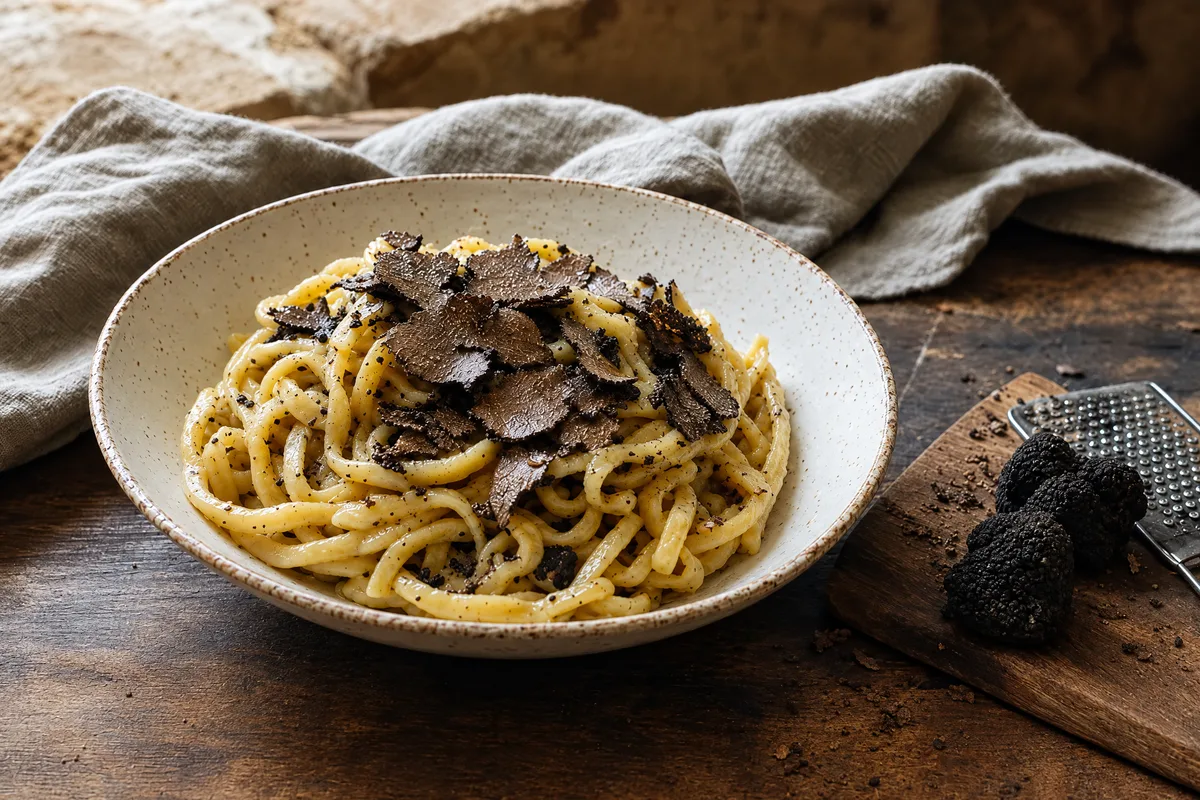
Gubbio's food is best approached through named local dishes rather than a generic inventory of Umbrian cooking. The Comune associates Eugubine cooking with grilled meats, substantial tagliatelle, Easter cheese crescia, crescia al panaro, and fricco made with several meats, alongside local charcuterie, cheese, field greens, olive oil, and white and black truffles from the wider Gubbio territory. It is a sound discovery map rather than a standardized recipe.
Crescia al panaro is a round flatbread cooked on a griddle and served with sliced meats or fricco. Fricco has several variants, built on lamb, duck, chicken, or rabbit rather than one fixed method. Easter cheese crescia is a separate seasonal preparation.
White and black truffle are strongly associated with the Gubbio territory in municipal tourism copy, but "truffle of Gubbio" is not a protected designation, a single species, or a guarantee of local harvest at a given restaurant. Species, season, and origin vary, so ask what is on the plate. Wild herbs and mountain meats call for care with safety and provenance.
Beyond the headline monuments
The Franciscan landscape is layered: the Church of San Francesco, Vittorina, San Francesco della Pace, the Spadalonga family tradition, the story of Francis and the wolf, the stone associated with a pact, medieval texts, later paintings, and present communities. The story of Francis and the wolf, told "according to tradition," is a devotional and literary tale rather than a documented event.
More of Umbria
A letter from Italy, once a month.
The places, tables and makers we found worth your time. One email, no noise.
One letter a month. Unsubscribe at any time. We never share your address.