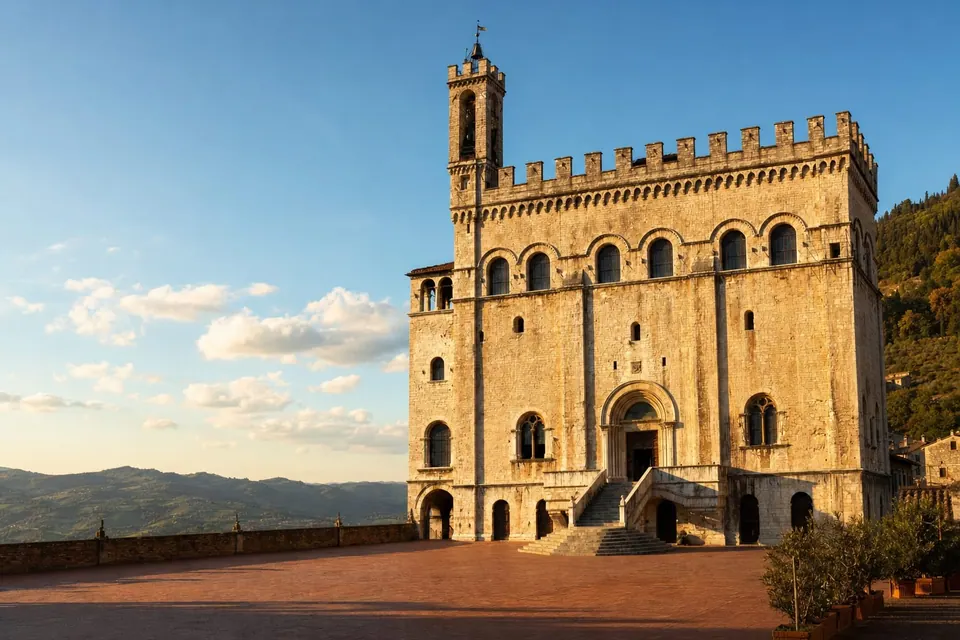
Gubbio's civic palace rises nearly one hundred meters from street to bell tower, built between 1332 and 1349 by the architect Angelo da Orvieto on a vast artificial platform that lets it stand level against the hillside.
Inside, the former chapel houses the Eugubine Tablets, seven bronze plates inscribed in the Umbrian language, a tongue that predates Latin and survives nowhere else in such detail; scholars still mine them for what they reveal about pre-Roman ritual and law. The palace has served as Gubbio's civic museum since 1909, adding Roman antiquities, medieval paintings, ceramics and an iron cage once used to publicly shame convicted criminals. From the loggia facing the valley, the view runs south across the rooftops to the Apennines beyond.
A palace built for a city's self-government
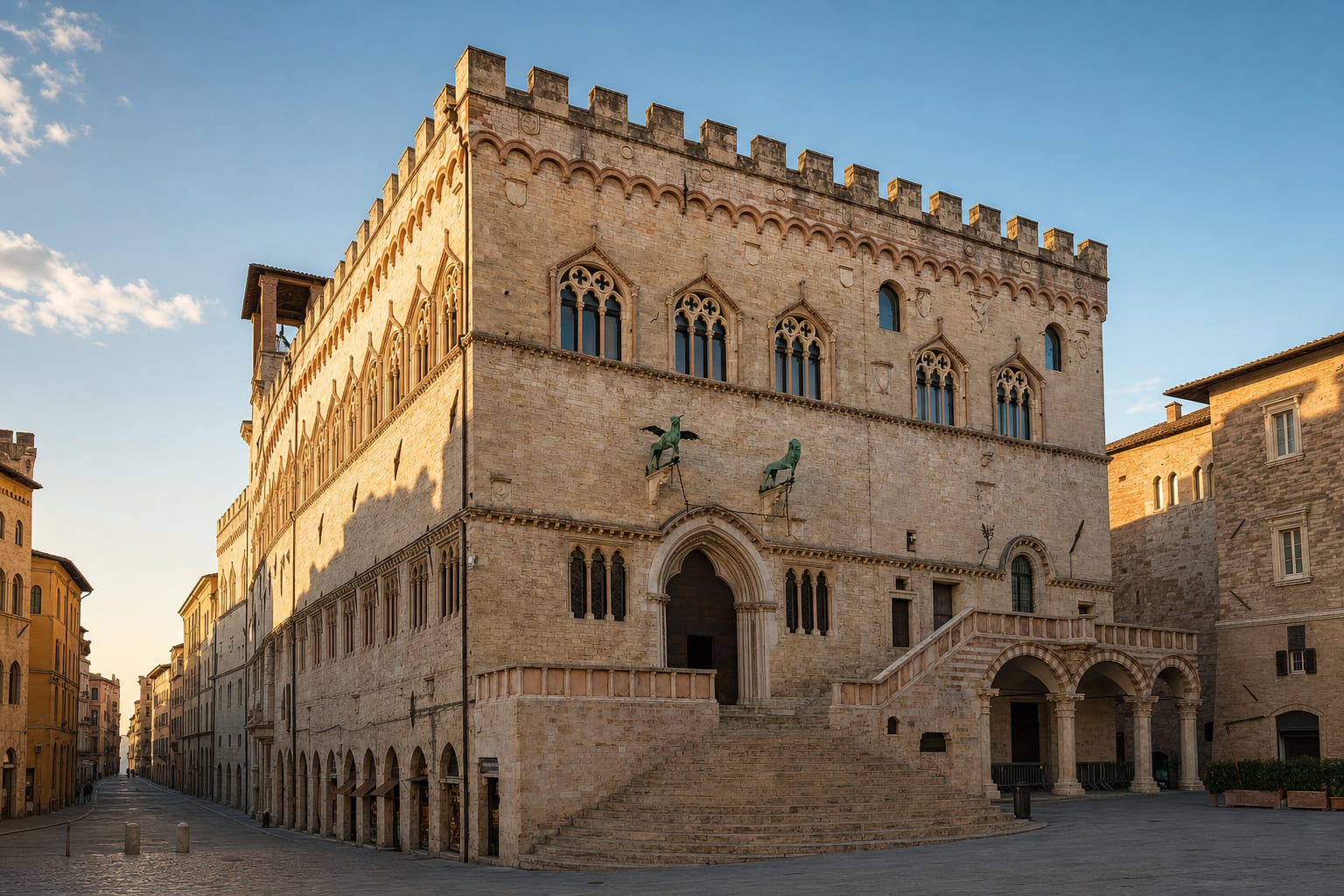
Palazzo dei Consoli is the great Gothic civic palace of Gubbio, set along Piazza Grande high on the slope of the old town. It began as the seat of the commune's government, and few buildings in Umbria show so plainly how ambitious a medieval city could be.1
The story starts in the early fourteenth century, when Gubbio decided to replace its older public seat with two new palaces and a vast suspended square where the four historic districts met. The decree dates to 1321-1322 and construction began in 1332. The building was first known as Palazzo del Popolo, and the architect was Angelo da Orvieto, whose name is carved on the portal. Matteo di Giovannello, called Gattapone, is documented as a surveyor at a later stage.1
The building was designed as a working machine of government, and you can still read its politics from the bottom up. The General Council met in the great Sala dell'Arengo, the Gonfaloniere and the consuls worked on the upper floors, and the Capitano del Popolo occupied the level of Piazza Grande.1
Reading the facade and the bell
From the square, large buttresses divide the facade into three vertical fields. A fan-shaped staircase climbs to the main portal, and paired windows, pointed arcading, Guelph merlons and a slender crenellated bell tower all draw the eye upward. On the valley side a narrower wing ends in an airy loggia, with an unfinished communication ramp built into its base, so it is worth walking around the palace rather than stopping at the ceremonial front.2,3,1
The palace is Gothic in style and rises more than sixty meters including its tower, which is why it dominates Gubbio's skyline from so many angles. A panoramic loggia takes full advantage of the height.1
Its voice matters too. The Campanone, the great bell, dates from 1769, weighs twenty quintals and is rung by the bell-ringers with their feet, a detail that says a great deal about how physical civic tradition is in Gubbio.2
Inside the Museo Civico
Since 1909 the palace has housed the Museo Civico, and the museum's roots reach back to 1456, when the commune acquired the Iguvine Tables. The collection now unfolds across five levels of the building, from prehistory to the twentieth century, so you pass through the palace's own rooms as you move through the centuries.1,4
The first room to know is the Sala dell'Arengo, a great barrel-vaulted hall that has held a museum display since 1909. Its stone, inscriptions, sculpture and architectural fragments draw on Roman Iguvium, the theater and later periods, and the hall itself is one of the best places in town to feel the scale of the medieval commune.5,4
The archaeological section runs from the Palaeolithic to the early Middle Ages, taking in objects from the city and its territory, domestic and public contexts, sculpture and architectural pieces tied to the Roman Theatre, inscriptions and coins.6,5
Coins get a coherent sequence of their own: Umbrian aes grave and Roman coinage, a medieval hoard, and issues of the Gubbio mint under ducal and papal rule. Together they sketch how money, authority and politics in the city changed over the centuries.6
The Iguvine Tables
The Tavole Eugubine, or Iguvine Tables, are the museum's great treasure. They are seven bronze tablets written in ancient Umbrian using both Etruscan and Latin alphabets, dated between the third and first centuries BCE. They preserve a major ritual text of ancient Italy and open a rare window on the religion of Iguvium, the ancient Umbrian city beneath and around modern Gubbio.7
They were found in the mid-fifteenth century near the Roman Theatre, and the commune acquired them in 1456. They are displayed in the former palace chapel, where fourteenth-century frescoes survive.7,4
That setting adds a layer of its own. The chapel keeps a Maestà dei Consoli attributed to Mello da Gubbio, so a bronze text from the ancient world is read beneath a painted civic devotion from the Middle Ages. The tablets themselves are far older than the palace, but the building has been their home for a long time.7
Ceramics, paintings and far-off collections
The ceramics are shown in the Sala della Loggetta and a narrow connecting passage the museum calls a secret corridor, which makes the route part of the experience. The section follows local production from archaic majolica to the twentieth century, with special attention to Gubbio's Renaissance lusterware and Mastro Giorgio.8
Not everything on show was made in Gubbio. Apothecary jars and pieces linked to Urbania, Venice, Castelli, Deruta, Germany, China and Japan widen the story well beyond one celebrated workshop.8
The picture gallery fills five rooms formed from spaces once associated with the consuls and the Gonfaloniere, and one room still carries the traditional name Fons Arenghi. Much of the collection came into civic hands after religious institutions were suppressed, so many works were painted for churches and convents before they hung in a government palace.9
Two smaller collections reward a pause. The Vivian Gabriel collection holds more than one hundred objects from Tibetan, Nepalese, Indian and Chinese contexts, donated in the early twentieth century. The Risorgimento collection began in 1936, was reorganized in the palace in 2007, and brings together objects, archival material and weapons that keep the memory of Italian unification alive.10,11
Across the square
Piazza Grande is a separate place from the palace, a suspended civic terrace that opens out toward the countryside, while Palazzo Pretorio stands opposite as an unfinished Gothic municipal building. Neither is a room or wing of Palazzo dei Consoli, but together the three make one of the most dramatic urban ensembles in central Italy.12,2
One more building is easy to mix up with the palace. Federico da Montefeltro's famous Gubbio studiolo belonged to Palazzo Ducale, not to Palazzo dei Consoli. The original woodwork dates from about 1478 to 1482 and is now in the Metropolitan Museum of Art in New York.13
A replica was installed in Gubbio's Palazzo Ducale in 2009, so you can still see the studiolo's effect in town, just at a different address from the Consoli.14,13
Before you go, check the museum's official site for current opening arrangements.14,13
Sources and citations (14)
- Museo Civico di Palazzo dei ConsoliStoriaStoria page (fetched 2026-09-30): decree 1321-1322, start 1332, Palazzo del Popolo, Angelo da Orvieto architect and portal inscription, Gattapone surveyor at a later stageRead source
- Comune di GubbioMuseo Civico Palazzo dei ConsoliFacade, fan stair, tower, valley wing, loggia, unfinished ramp and CampanoneRead source
- Umbria TourismPalazzo dei ConsoliFacade, windows, battlements and towerRead source
- Museo Civico di Palazzo dei ConsoliCollezioniCollection hierarchy, 1456 and 1909 milestonesRead source
- Museo Civico di Palazzo dei ConsoliSala dell'ArengoRoom architecture, 1909 installation and displayed material classesRead source
- Museo Civico di Palazzo dei ConsoliSezione archeologicaChronological range, room themes, theatre and numismatic materialRead source
- Museo Civico di Palazzo dei ConsoliTavole EugubineSeven bronze tablets, Umbrian language, two alphabets and date rangeRead source
- Museo Civico di Palazzo dei ConsoliSezione ceramicheSezione ceramiche page: Sala della Loggetta, passage, apothecary jars, other production centresRead source
- Museo Civico di Palazzo dei ConsoliArt GalleryArt Gallery page: five rooms, Fons Arenghi, suppressionsRead source
- Museo Civico di Palazzo dei ConsoliCollezione orientaleCollezione orientale pageRead source
- Museo Civico di Palazzo dei ConsoliCollezione risorgimentaleCollezione risorgimentale pageRead source
- Umbria TourismPiazza Grande - GubbioSuspended-square history and distinct Palazzo Pretorio descriptionRead source
- The Metropolitan Museum of ArtStudiolo from the Ducal Palace in GubbioMet Museum record: studiolo from the Ducal Palace, about 1478-82Read source
- Musei Nazionali di PerugiaPalazzo Ducale di GubbioReplica installed at Palazzo Ducale in 2009; Wayback 20260618 snapshotRead source