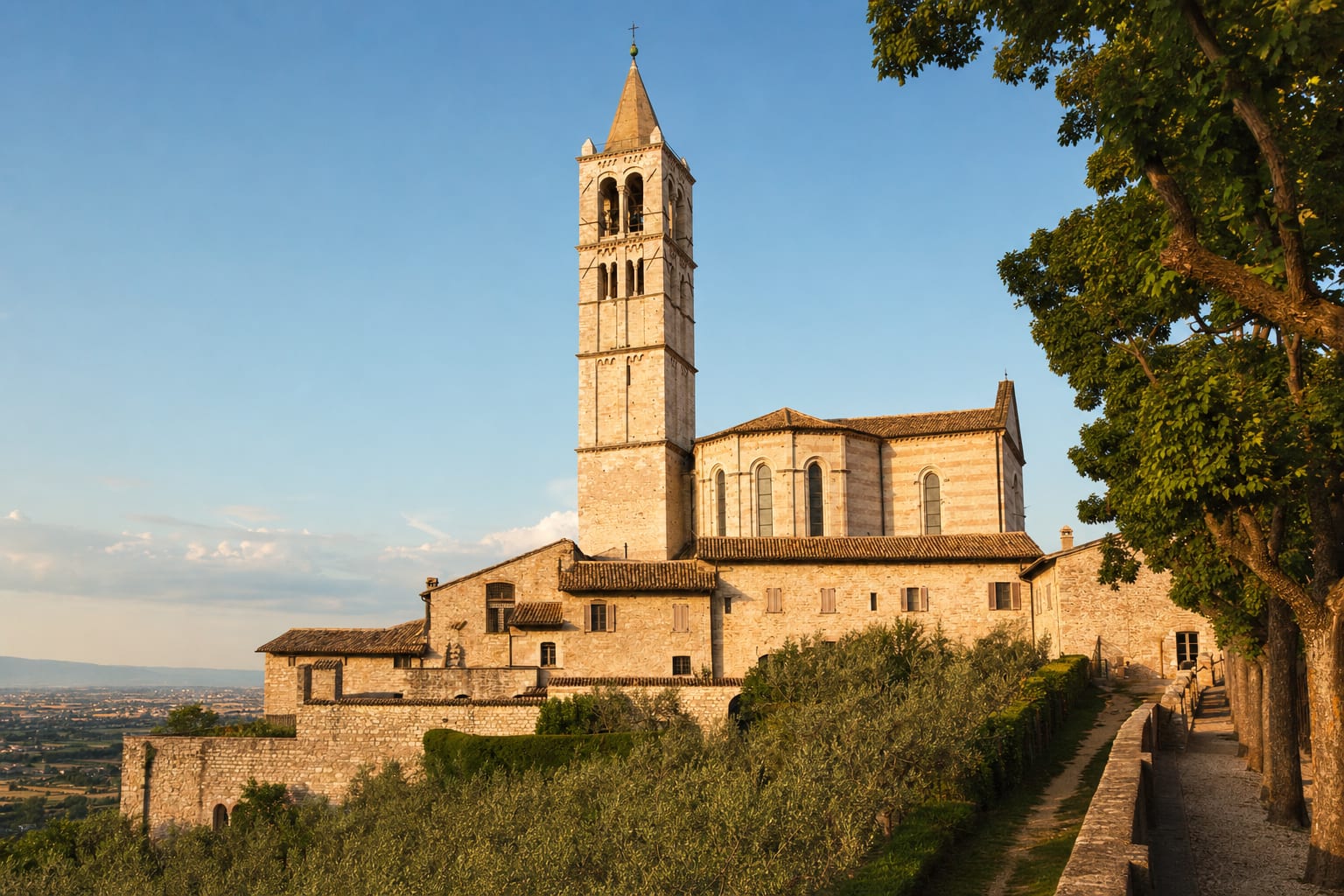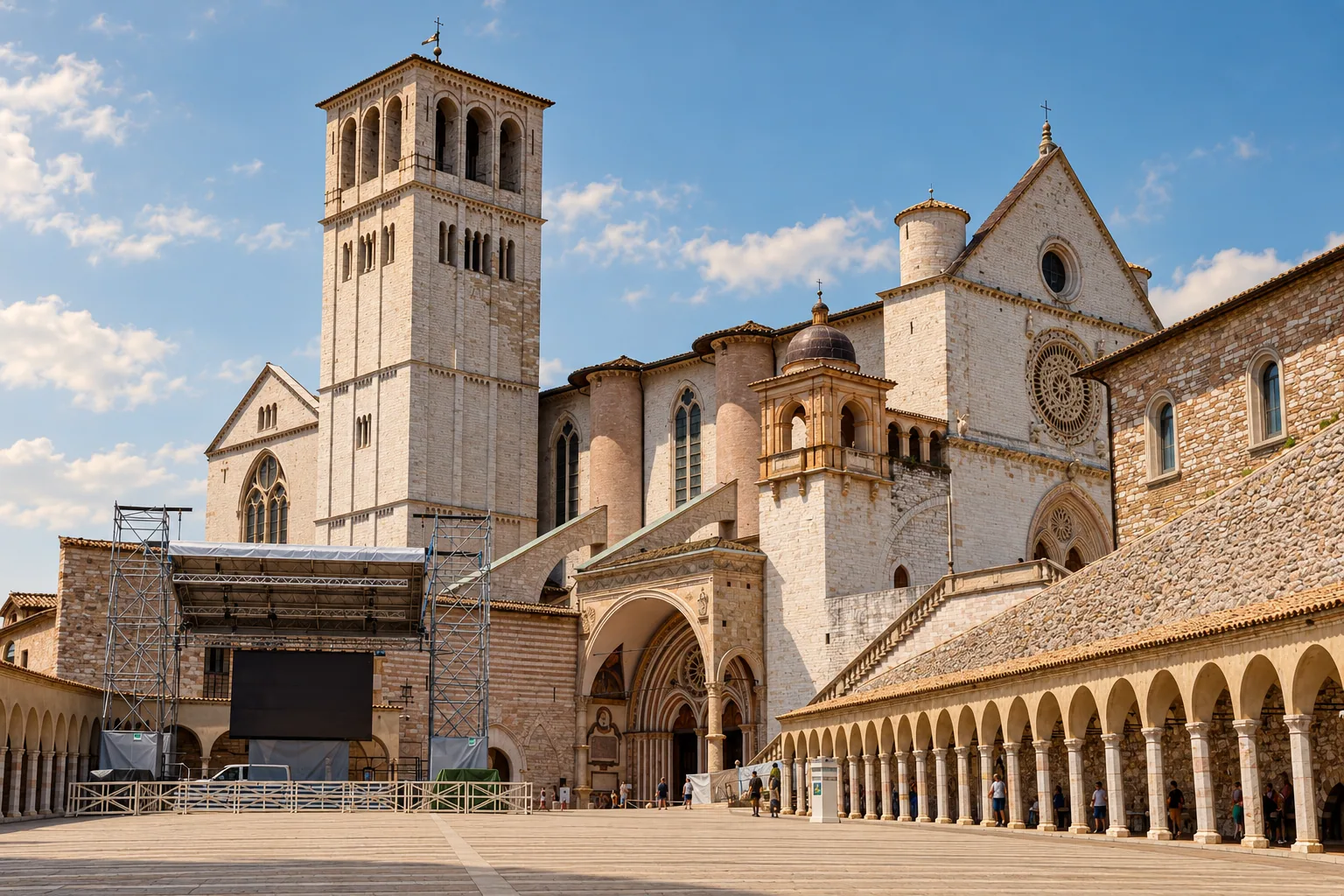
Work began on this double church in 1228, just two years after Francis of Assisi's death, built directly into the hillside so that a Lower and an Upper Church stack one above the other over his tomb in the crypt below.
The Lower Church, dim and Romanesque, holds the saint's remains and an early cycle attributed to Cimabue; the Upper Church, brighter and among the first Gothic interiors in Italy, carries the famous 28-scene Life of Saint Francis cycle, long credited to Giotto and pivotal in teaching Italian painting how to tell a story across a wall rather than present isolated icons. Simone Martini and the Lorenzetti brothers added further chapels and scenes as the decoration continued through the fourteenth century, filling nearly every surface until, as the saying goes, the walls ran out. A powerful 1997 earthquake collapsed sections of the Upper Church's vault, destroying some frescoes outright, though a major restoration since has returned the basilica to public view.
The basilica at a glance
The Basilica of San Francesco is the burial church of Francis of Assisi and one of the great painted interiors of medieval Europe. It is really two churches stacked on one hillside: a low, dark, candlelit Lower Church built around the saint's tomb, and a tall, bright Upper Church with stained glass and a famous cycle of frescoes. Beside them stands the Sacro Convento, the friary that has cared for the site for centuries.1,2,3
It is also a church of some standing in the Catholic world. Pope Gregory IX named it a special church in April 1228 and, two years later, called it head and mother of the Franciscan order. In 1754 it was raised to patriarchal basilica and papal chapel, and since 2006 it has carried the title of papal basilica. Gregory IX's 1230 bull also entrusted its custody to the friars of the community, the group that became the Conventual Friars Minor.1
How it was built
Work began in 1228. The Lower Church was far enough along for the solemn transfer of his remains in 1230, and the Upper Church was finished and the whole complex consecrated by Innocent IV in 1253. So the burial church and the finished two-story basilica are two different milestones, a couple of decades apart.1,2,3,4
The two levels are built for different moods. The Lower Church is dense and vaulted, a place of pilgrimage that leads toward the tomb. The Upper Church is one wide nave of four bays with a broad transept and a polygonal apse, pointed cross vaults and large windows: a Gothic design adapted to Italian stone and color.1,2,3,4
The Upper Church
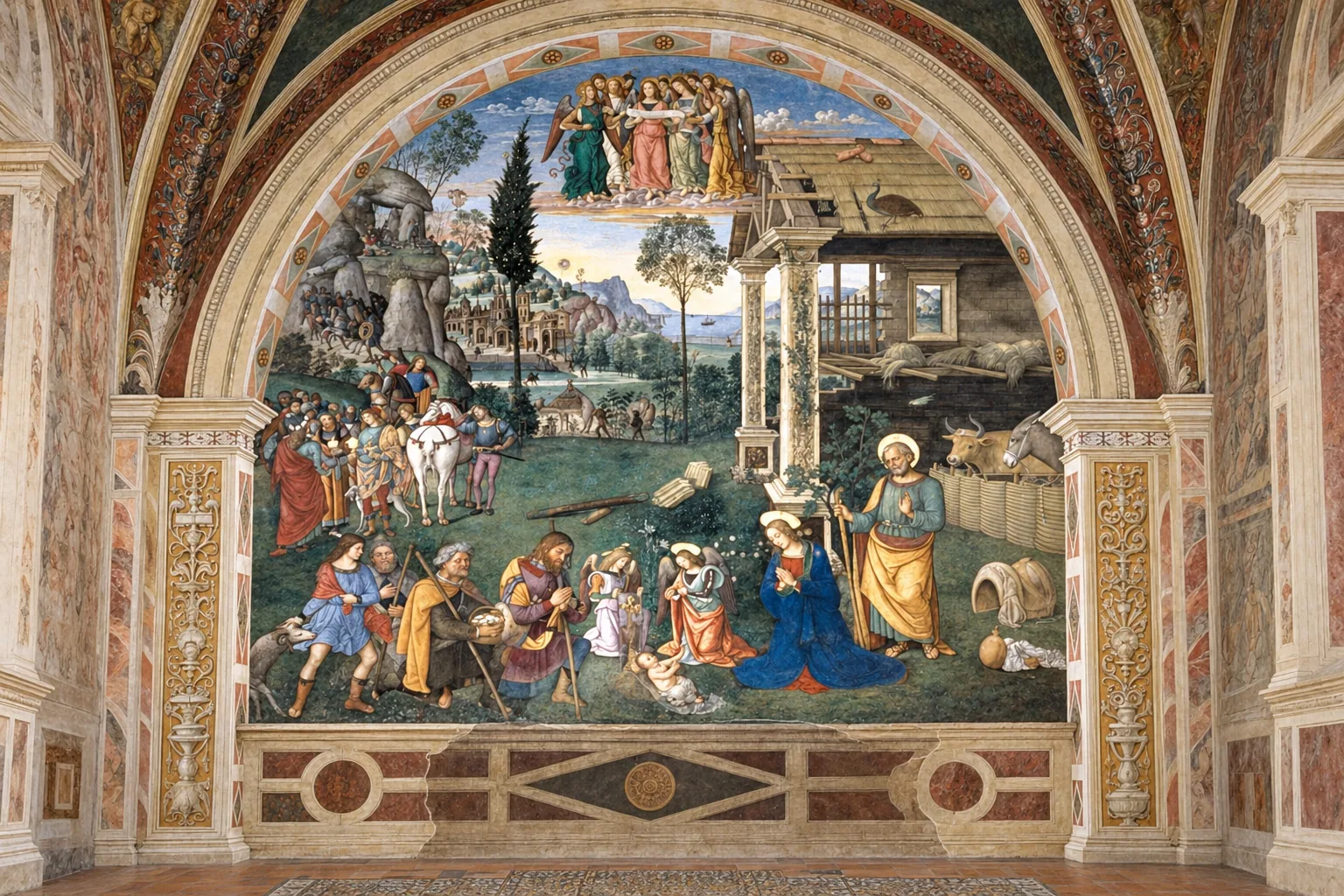
Look up and around the nave and you are inside a painted book. Cimabue and the so-called Maestro Oltremontano worked in the presbytery and transept, Jacopo Torriti and other painters decorated the upper registers, and the walls carry Old and New Testament scenes, Evangelists and Doctors of the Church. The stained glass belongs to the same scheme.3,4
Along the lower part of the nave runs the best-known sequence, twenty-eight scenes from the life of Saint Francis. It is the scene-by-scene heart of the church for most visitors.3,4
The cycle is traditionally attributed to Giotto, and many scholars still give it to him, but its authorship is one of the great debates in Italian art. Other specialists see a Roman workshop at work. The argument turns on the pair of Isaac scenes in the register above, painted by an unknown hand called the Isaac Master, whose convincingly three-dimensional space marks a sharp change of style. Either way, the oldest sources tie Giotto's name to Assisi.3,5
The Lower Church and the tomb of Francis
The Lower Church packs several generations of painters into a smaller, darker space. Giotto and his workshop are credited with four vault webs over the high altar, where allegories of Poverty, Chastity and Obedience and the glory of Francis are shown. Elsewhere you find the Magdalene Chapel, work by Cimabue, Pietro Lorenzetti and Simone Martini, and further chapels, transepts, a choir and later paintings. Give yourself time here, because each chapel is its own small world.2,4
Below the high altar lies the tomb, a quiet devotional space with a simple stone sarcophagus set in the central pier. The crypt around it was cut into the rock in the early nineteenth century.6,7
The four early companions Leone, Masseo, Rufino and Angelo are placed in corner niches, and Jacopa de' Settesoli is placed between the access stairs. A votive lamp burns at the tomb, fed with oil donated each year by a different Italian region for the feast of 4 October.6
The convent, the library and the treasury museum
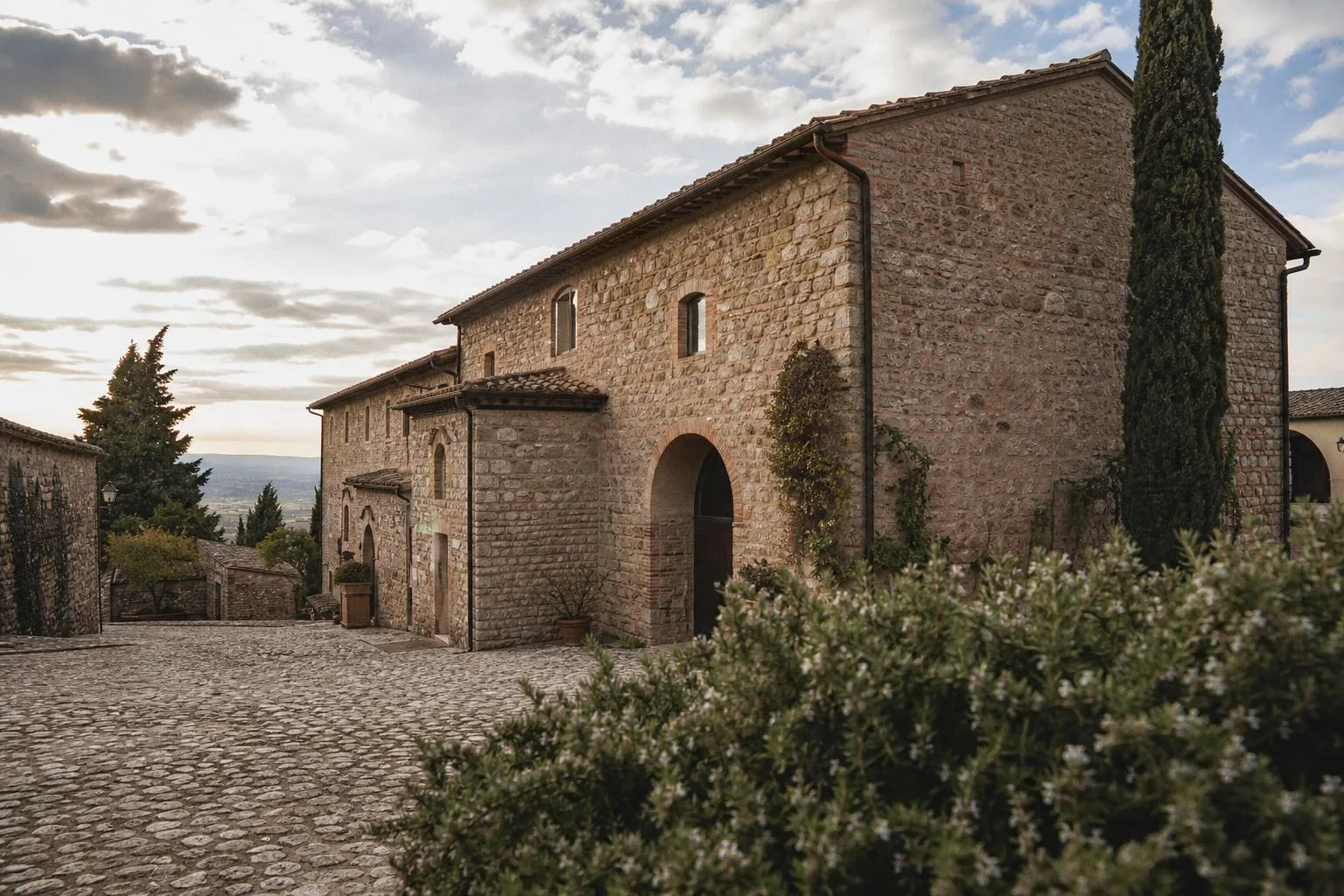
The Sacro Convento, consecrated with the basilica in 1253, is the friary beside the churches. Its modern story has been turbulent: Napoleonic troops sacked it in 1798, in 1875 it became a national boarding school for the orphans of elementary-school teachers, and only in 1927 was it returned to the Conventual Friars Minor. Every surface is built of Subasio stone, which glows pink in sunlight and looks white under the moon.8
Inside the convent are several collections of books and papers: the friary's own ecclesiastical library, the ancient holdings of the municipal library of Assisi kept here by agreement, and the library of the International Society for Franciscan Studies. The historical archive of the convent, the photographic archive and the archive of the basilica's musical chapel sit alongside them.9,10
The Museo del Tesoro, the treasury museum, grew from liturgical gifts made to the basilica from the thirteenth century onward. Its highlights include a panel of Saint Francis with four healing miracles, the illuminated missal of Louis IX, a chalice dated 1290 linked to the workshop of Guccio di Mannaia and given by Nicholas IV, a Flemish tapestry of the Franciscan Tree, and liturgical books, vestments, relics and musical instruments.11
The museum also houses the Perkins Collection, a gift from the art historian Frederick Mason Perkins of around fifty panels, with works associated with Pietro Lorenzetti, Lorenzo Monaco, Sassetta and others.11
A World Heritage landmark
UNESCO inscribed "Assisi, the Basilica of San Francesco and Other Franciscan Sites" in 2000 under criteria (i), (ii), (iii), (iv) and (vi). The basilica is the heart of the listing, but the listing is a wider serial property.12,13
The basilica belongs to the first component, the city of Assisi with San Damiano, the Eremo delle Carceri, Rivotorto and the surrounding historic landscape. A second component covers Santa Maria degli Angeli and the Palazzo dei Capitani del Perdono, so a visit here pairs naturally with the other Franciscan places.13,14
UNESCO says the medieval masterpieces of Assisi, among them the basilica and paintings by Cimabue, Pietro Lorenzetti, Simone Martini and Giotto, have made the city a fundamental reference point for the development of Italian and European art and architecture.12
The 1997 earthquake and the work of recovery
On 26 September 1997 an earthquake brought down parts of the Upper Church vault. Four people died, two friars and two heritage technicians, and two vault webs and part of the entrance arch were destroyed. It is a sober chapter in the building's story and deserves to be remembered as such.15,16,17
The recovery that followed was painstaking. Roughly 300,000 painted fragments were gathered from the rubble and sorted, and computer-assisted research helped piece them back together, notably for Cimabue's Saint Matthew vault. Any virtual reconstruction of the lost painting is an interpretation, not original painted surface.18,16,19,17
Before you go
The basilica's official website is the place to check opening arrangements and visitor information.20
Sources and citations (22)
- Custodia Generale Sacro ConventoLa Basilica di San Francesco in AssisiCustodian two-level complex summaryRead source
- Custodia Generale Sacro ConventoChiesa InferioreLower Church architectureRead source
- Custodia Generale Sacro ConventoChiesa SuperioreUpper Church architectureRead source
- Ministero della CulturaBasilica di San Francesco - AssisiMinistry chronologyRead source
- TreccaniGiotto (Enciclopedia dell'Arte Medievale, A. Tomei, 1995)Section 'Il ciclo delle Storie di s. Francesco' (fetched 2026-09-30)Read source
- Custodia Generale Sacro ConventoTomba di San FrancescoCustodian tomb and crypt spatial historyRead source
- Visit AssisiBasilica Papale di San Francesco e Sacro ConventoMunicipal crypt date conflictRead source
- Custodia Generale Sacro ConventoSacro ConventoSacro Convento page (basilica.sanfrancesco.org, fetched 2026-09-30)Read source
- Custodia Generale Sacro ConventoBiblioteca e ArchivioCustodian library and deposited-fonds distinctionsRead source
- Custodia Generale Sacro ConventoArchivio FotograficoPhotographic archive identity and roleRead source
- Custodia Generale Sacro ConventoMuseo del TesoroCustodian museum history and collection scopeRead source
- UNESCO World Heritage CentreAssisi, the Basilica of San Francesco and Other Franciscan SitesUNESCO property 990 list entry (read via web.archive.org snapshot; unesco.org returns 403)Read source
- UNESCO World Heritage CentreProperty 990 documents and component mapsProperty documents and maps (read via web.archive.org snapshot; unesco.org returns 403)Read source
- UNESCO World Heritage CentrePeriodic Reporting Cycle 3, Section II2024 periodic report section 1.3Read source
- Ministero della Cultura#iorestoacasa. Giotto ad AssisiMinistry conservation chronology and collapse scopeRead source
- Ministero della Cultura - Ufficio Sisma 2016Antonio Paolucci and the restoration of the Upper Basilica after 1997Ministry earthquake and restoration noticeRead source
- Giuseppe Basile (ICR restoration director)Il cantiere in sintesi: dati, problemi, metodi, risultatitwo vault webs fell; entrance arch with eight pairs of saints damagedRead source
- ICCU - DigItaliaGiotto com'era. ‘Restituzione virtuale’ delle Storie Francescane nella Basilica Superiore di San Francesco in AssisiPages 129-130: computer-assisted reassembly and Saint Matthew virtual projection on a 1:5 modelRead source
- CNRBasilica S. Francesco, la vela del Cimabue ricostruita con tecnica virtuale (comunicato 3817, 29 Oct 2001)CNR comunicato 3817Read source
- Custodia Generale Sacro ConventoGli orari della BasilicaOrari page (basilica.sanfrancesco.org, fetched 2026-09-30)Read source
- PexelsStunning View of Basilica of San FrancescoPexels source page, contributor and displayed license statusRead source
- PexelsPexels LicenseCurrent Pexels license termsRead source