The Wine Museum of Torgiano, called MUVIT, was founded in 1974 by the winemaker Giorgio Lungarotti and his wife Maria Grazia in the seventeenth-century Palazzo Graziani-Baglioni. It is a private museum, one of the finest wine museums in Italy, about wine as culture rather than as a product.
Around twenty rooms show Greek, Etruscan and Roman vessels, medieval to modern ceramics with wine as food, medicine and myth, winemaking tools and presses, and a large collection of engravings that reaches from Mantegna to Picasso and Guttuso. Your ticket includes a glass of Lungarotti wine for adults, served at the museum's osteria or the winery's enoteca, and the olive and oil museum, MOO, is a short walk away.
The Wine Museum at a glance
MUVIT, the Museo del Vino in Torgiano, is a museum devoted to a single theme, and that theme is far bigger than a bottle. Giorgio and Maria Grazia Lungarotti conceived and built it, and it opened to the public on 23 April 1974, the night Torgiano traditionally lights the bonfires of San Giorgio among the vines. The Fondazione Lungarotti runs it today.1,2,3
The route unfolds across twenty rooms and more than 3,000 objects: archaeology, tools for growing and making wine, ceramic wine vessels from the Middle Ages to the present, prints and drawings, rare books, goldsmith work and textiles. Wine is the thread that ties it all together, so expect a museum of art and everyday life seen through the vine rather than a cellar tour.2
The driving mind behind the collections is Maria Grazia Marchetti Lungarotti, an art historian and archivist. The museum she created in the early 1970s grew into a small museum cluster, with the olive and oil museum and, in 1987, a foundation devoted to Italy's agricultural heritage.3
A palace built for the harvest
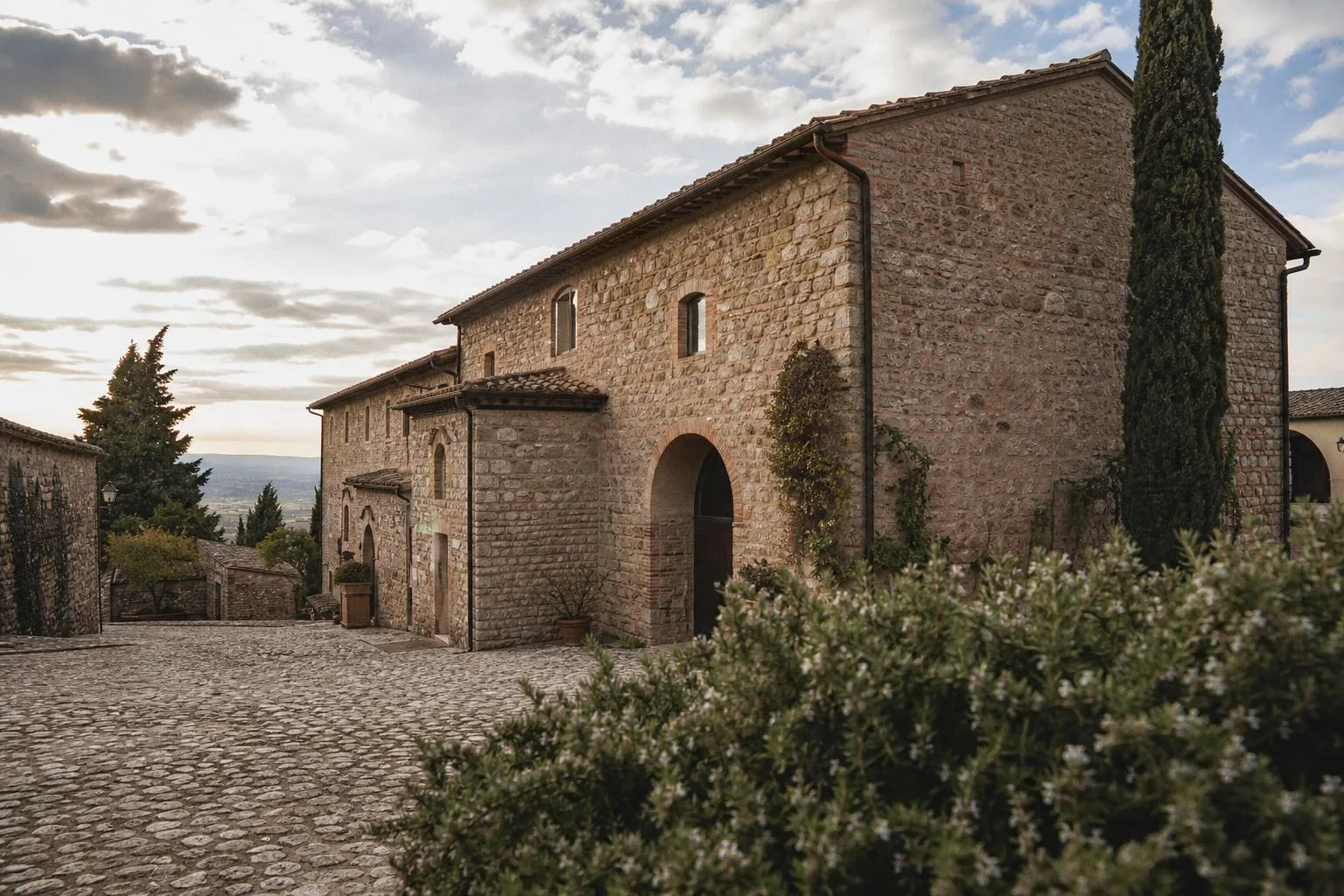
The setting is part of the story. MUVIT occupies the pars agricola, the working farm wing, of Palazzo Graziani-Baglioni, a sober three-storey country house on Corso Vittorio Emanuele II. The building dates from the late seventeenth century, absorbs older structures, and carries a terracotta plaque inscribed 1694 at the entrance, probably marking the end of construction.4
It began as the summer residence of the Graziani, a Perugian family, and took its double name in 1774, when Anna, the last of the Graziani line, married Count Pietro Baglioni. The palace had two doors: the main portal led up the staircase to the family's rooms, while the secondary door opened onto estate offices, processing equipment and storerooms. You enter the museum through that farm door, and the route spreads over the ground floor, a lower floor and a mezzanine, restored with care for the original structures and materials.4,2
Upstairs, the residential piano nobile is a separate world, with a gallery frescoed in the later eighteenth century by Paolo Brizi showing the four continents, a library and period rooms. It belongs to the palace rather than to the museum route.4,2
From vine to press
The viticulture rooms open with the old Umbrian farm landscape: scattered farmhouses and the vite maritata, vines "married" to living trees, either as single trees or planted in rows. That landscape was shaped by sharecropping, and the tools, images and charts here show that cultivation methods barely changed until the 1960s.5
Look for the stone channel outlets at the museum entrance, which recall Roman treading floors, and a first-century relief in room I showing two treaders crushing grapes hand in hand, turning to the rhythm of a flute. The monumental beam press known as the torchio di Catone evokes the great noble and monastic cellars that processed a whole district's grapes; it stands with two vertical presses of the type named after Pliny. Both designs were still working past the middle of the twentieth century.5
The same rooms explain how must fermented in barrels and was racked into clean ones in March, while the lees left behind were pressed again into a lesser wine called mezzo vino or vinello, and a reconstructed convent still shows how widely distillation spread. Rooms V and VII to X then turn to the crafts that grew up around wine: coopers, blacksmiths, basket weavers, rope makers, embroiderers and potters.5,6
Wine in the ancient world
Room I throws you straight into the Mediterranean of trade, beginning with a wall-sized cross-section of an amphora cargo. The ancient sequence starts in the Cyclades with two large orange-clay jugs of the Amorgos Group from the third millennium BC, then moves through burnished Hittite and Syro-Hittite jugs and on to Greek, Etruscan and Roman drinking vessels from the sixth century BC to the fourth century AD.7
The centrepiece of the symposium room is a mid-sixth-century BC kylix by one of the Little Masters, inscribed "Phrinos made me, be merry." Linger too over the Etruscan bronze wine service, Roman glass and a bronze askos that speaks to villa life around the Bay of Naples on the eve of Vesuvius's great eruption.7
Ceramics, glass and iron
Ceramics are the museum's primary collection, reaching well beyond Umbria to cover Italian production from the Middle Ages to today. A highlight is the lustred Infantia de Bacho by Mastro Giorgio Andreoli of Gubbio, signed and dated 1528 and drawn from an engraving by Marcantonio Raimondi after an idea by Raphael. Its ruby lustre explains why even Urbino's finest potters sent their best work to Gubbio to be lustred. Watch too for the plate on which Giacomo Mancini, "El Frate," painted himself praying before a wine barrel.8
Room XIII covers wine as medicine, pairing texts from Hippocrates, Dioscorides and Galen to Mattioli with the ewers, bottles and pharmacy jars of the apothecary's trade. Glass runs from a sixteenth-century French trick carafe to a cup by Josef Hoffmann of the Vienna Secession, a goblet designed by Jean Cocteau in 1963 and a Venini bottle from the 1970s. Wrought iron is represented by wafer irons from the thirteenth to the seventeenth century, some made as wedding gifts bearing two family crests.8
Symbols, prints and books
The symbolism room follows how Dionysian myth was absorbed into Christian imagery: wine becomes the blood of Christ, the wine press a sign of the Passion, and the giant grape cluster carried back from Canaan a figure of the Redeemer.9
The prints and drawings number more than 600 sheets from the fifteenth to the twentieth century. The sequence opens with Andrea Mantegna's Baccanale con tino and includes Marcantonio Raimondi, Annibale Carracci, Hendrick Goltzius, Piranesi, Giovanni Fattori, Renato Guttuso and Pablo Picasso.10
Room XIX gathers treatises, literature, sacred texts, proverbs and almanacs. Highlights include a sixteenth-century Plato Symposium in the edition collated by Marsilio Ficino, a sixteenth-century Virgil illustrated with woodcuts, Ovid's Metamorphoses, and the illustrated Sistine Vulgate printed by the Giunti in Venice in 1611, set against the Carmina Burana and the poems of François Villon.11
MOO, the sister museum
The same foundation runs MOO, the Museo dell'Olivo e dell'Olio, a separate museum elsewhere in the village. It sits in a cluster of medieval houses inside the old castle walls, partly in rooms that once held a working olive mill, and its eleven rooms trace olive growing and oil making from stone mortars of the fifth millennium BC to modern continuous-cycle extraction.12
Sources and citations (13)
- Lungarotti50 anni del Museo del Vino MUVITAnniversary article: 'Inaugurato il 23 aprile del 1974 da Giorgio e Maria Grazia Lungarotti'; 23 April as the night of the San Giorgio bonfires among the vinesRead source
- Musei Lungarotti TorgianoMUVIT Museo del VinoOpening paragraph: conceived by Giorgio and Maria Grazia Lungarotti, opened 1974, managed by Fondazione Lungarotti OnlusRead source
- Musei Lungarotti TorgianoLa Fondazione LungarottiFoundation page, profile of Maria Grazia Marchetti Lungarotti, paragraph 2Read source
- Comune di TorgianoPalazzo Graziani-Baglioni - Sale EspositiveComune page, paragraphs 3-4: summer residence of the Graziani, 1774 marriage, late-17th-century structure, 1694 terracotta plaqueRead source
- Musei Lungarotti TorgianoViticolturaViticoltura page, paragraph 1Read source
- Musei Lungarotti TorgianoArtigianatoOnly Artigianato body paragraphRead source
- Musei Lungarotti TorgianoIl vino nel mondo anticoIl vino nel mondo antico page, paragraphs 1-2Read source
- Musei Lungarotti TorgianoVite, vino e arti del fuocoVite, vino e arti del fuoco page: ceramics as 'raccolta primaria'; El Frate plate; 'Tra le opere esposte' paragraph on AndreoliRead source
- Musei Lungarotti TorgianoSimbologiaSimbologia page, paragraph 1Read source
- Musei Lungarotti TorgianoIncisioni e disegniIncisioni e disegni page, paragraph 1Read source
- Musei Lungarotti TorgianoEditoriaEditoria page, paragraphs 1-2Read source
- Musei Lungarotti TorgianoMOO Museo dell'Olivo e dell'OlioMOO page, paragraphs 1-2Read source
- Musei Lungarotti TorgianoContattiMUVIT Museo del Vino contact block: Corso V. Emanuele 31, Torgiano (PG)Read source