

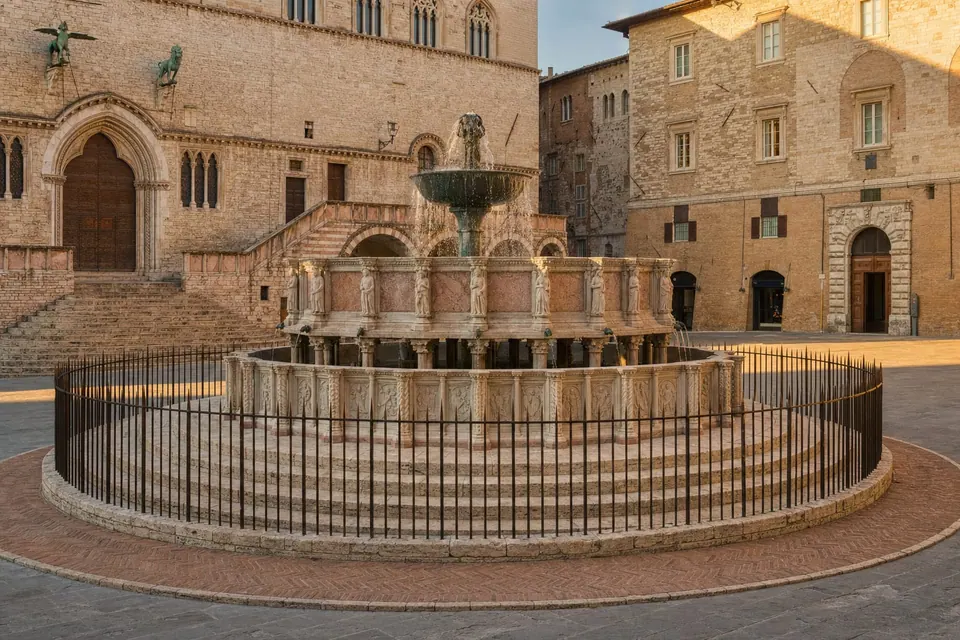
Between the cathedral and Palazzo dei Priori, the Fontana Maggiore marks the end of Perugia’s medieval aqueduct. Friar Bevignate planned the fountain, Boninsegna da Venezia worked on the water supply, and Nicola and Giovanni Pisano carved its reliefs and figures. The fountain took shape between 1278 and 1280. Before you look at the carving up close, take in the two basins from across Piazza IV Novembre. See how closely the place where water arrived sits between the city’s civic and religious buildings.
Read the lower basin at eye level
The lower basin carries fifty reliefs. The months and zodiac sit alongside the liberal arts, stories from the Bible and episodes from Rome’s past. Follow the agricultural scenes for one turn of the basin and look at the tools and working gestures. Then find the she-wolf nursing Romulus and Remus. It belongs to a very different story unfolding at the same height. The repeated marble panels let the eye move from farming to learning and to the origins of Rome with just a few steps.
Raise your eyes to the upper basin
Standing figures divide the upper basin into facets. Sacred figures, historic personages and allegories share one level, with the bronze bowl and three female figures above them. Their meaning has been read in several ways, including as Faith, Hope and Charity. For a second look, cross the square and see the composition against the cathedral and the palace. Those changes of viewpoint reveal as much about its place in Perugia as the individual figures do.
Fontana Maggiore in a nutshell
Fontana Maggiore stands in Piazza IV Novembre at the summit of Perugia's historic centre. It is an outdoor civic fountain, a piece of urban design, and a densely carved medieval monument. It was built between 1278 and 1280 to celebrate the completion of the new aqueduct. Fra Bevignate directed the project, Boninsegna da Venezia handled its hydraulic dimension, and Nicola and Giovanni Pisano made the sculptural program. The fountain was a collaboration between water engineering, architectural direction, stone carving, bronze work, and communal ambition, not the isolated invention of a single sculptor.1,2
View the fountain from the open square at Piazza IV Novembre. Check the gradients and paving on the route you choose to reach the square. Allow about fifteen minutes to circle the fountain and look closely at the reliefs.1
A civic centre made legible
The monument is most intelligible when read with its setting. Palazzo dei Priori defines one side of the piazza, the Cathedral of San Lorenzo another, and the fountain occupies the shared civic space between them. The acropolis itinerary begins here, with the fountain, palace, and cathedral as a connected opening sequence. This relationship does not make the fountain an annex of either building. It remains a distinct public monument whose imagery draws together work, learning, religion, civic history, and the cycles of time.3
Begin at a distance. From the edge of the square, the profile resolves into two superimposed polygonal marble basins, then a bronze vessel and a group of three bronze female figures at the summit. Moving closer changes the experience from architecture to reading. Reliefs occupy the lower register; upright figures punctuate the upper one. Water outlets, joints, inscriptions, repairs, and variations in the stone become visible only at this slower scale. A complete circuit is more useful than searching immediately for one famous panel.1,4
Water at the top of the hill
The reason for the fountain is inseparable from Perugia's terrain. Construction of the aqueduct began in 1254 and ended in 1280 under Fra Bevignate and Boninsegna da Venezia. The route ran about four kilometers from Monte Pacciano to Fontana Maggiore, with a pressurized conduit to overcome the terrain. The fountain, which celebrated the completion of the new aqueduct, stands at the civic endpoint of that water system. It marked more than access to water: it made a difficult municipal infrastructure visible in the city's principal public space. A more direct route was completed in 1322, showing that the water system continued to change after the fountain's inauguration.1,2
Makers, dates, and inscriptions
The fountain was built between 1278 and 1280. The Latin inscription on the second basin records completion in 1278 and names Fra Bevignate, Nicola and Giovanni Pisano, and Boninsegna da Venezia. The bronze cup dates to 1277 and carries the signature of Rubeus. Together this points to a phased story, with different elements and skills converging around the aqueduct's completion, rather than to every carving being the work of one securely identified hand.1,4
Nicola and Giovanni Pisano are both credited with the sculpture of the fountain as a whole. At the level of the individual piece, attribution gets more complicated: for a marble figure removed from the monument, the assignments have changed over time between Nicola, Giovanni, their workshops, and Fra Bevignate's possible role in the program. The honest way to see it is as a collaboration, not as a series of panels each signed by one hand.4,5,6
The two marble basins
There are fifty bas-reliefs and twenty-four statues across the two concentric basins. The lower basin carries scenes connected with agrarian tradition, the months and zodiac signs, the Liberal Arts, biblical subjects, and Roman history. The upper basin uses twenty-four slabs separated by allegorical, sacred, and historical figures.1,4
The lower register rewards sequential looking because its themes place different kinds of knowledge beside one another. Agricultural work and the months establish time as lived labor. Zodiacal signs give those cycles a cosmological frame. The Liberal Arts represent learned disciplines. Biblical and Roman subjects connect sacred history and civic antiquity to the working year. The result is an expansive public program.1,2
On the upper basin, the alternation of slabs and standing figures changes the rhythm. The figures are allegorical, sacred, and historical personages. Their proximity produces relationships, but proximity alone does not establish a single intended narrative. Weathering, replacement, restoration, older descriptions, and disputed identifications make any confident panel-by-panel reading risky.1,4
The program works at more than one scale. The civic scale is the new water supply made visible in the principal square. The structural scale is the ascent from relief-covered lower basin to upper figures and finally to the bronze summit. The object scale is the individual carving, spout, inscription, cast, or replacement.1,4
The months and agricultural scenes invite sequential reading, but the fountain is not a textbook you can exhaust in one clockwise run. The upper figures, bronze summit, water outlets, and inscriptions interrupt that sequence with different materials and heights. Linger where things are less certain: a worn relief can still be compelling, and a copy is no lesser part of the monument, since it tells the story of its conservation.1,4
Bronze at the summit
The bronze bowl and three female figures form the fountain’s highest group. The figures have been read as water bearers, nymphs or personifications of Faith, Hope and Charity. Their identity remains open to interpretation.1,4
The group is bronze, approximately 123 centimeters high, cast in a tin-rich alloy using the lost-wax process. The faces and hairstyles are individually modeled, and the casting shows some technical imperfections. These details make the bronzes real material objects, not distant symbols, and explain why conservation and exposure matter.1,4,5
Originals, replacements, and conservation
The monument outdoors includes later substitutions. An allegorical figure of Rome and a diptych showing the she-wolf with Romulus and Remus were removed in 1948–1949 after deterioration of their marble surfaces and replaced by copies. Historic catalogue records place the removed Rome figure at Palazzo dei Priori. Confirm its current location and display with the museum before planning to see the original.4,5,6
The bronze water outlets have their own conservation history. There are twelve animal protomes serving as spouts. One fell after a corroded internal tube failed; the intervention replaced that component, treated the bronze surface, and reattached the work. A second intervention addressed the other eleven protomes, whose bronze corrosion and internal fixings also needed attention.7
Conservation changes how you read the monument. A dark surface is not proof of neglect, a pale panel is not necessarily a recent copy, and visible joints are not self-explanatory.4,5,6,7
How to look at the fountain
A useful first circuit follows form rather than iconography. Count the changes between the lower relief band, the projecting upper figures, the bronze vessel, and the summit group. Notice how the basins narrow upward and how the profiles remain legible against the palace and cathedral. On a second circuit, choose one theme, such as months and agricultural work, and follow only those panels. This keeps the visit coherent without pretending that every worn image can be identified unaided.1,4
The fountain can then be connected to the broader city. Historical catalogue records connect material removed from the fountain with Palazzo dei Priori, while the medieval aqueduct survives as a separate urban system. These are not interchangeable stops. A visitor who wants the fullest account can begin with the fountain, follow the acropolis sequence, and look into the aqueduct separately. Before you go, check access to any interior and the current display of removed sculpture.1,2,3,4,5
Public space and practical access
Because the fountain is in an active piazza, the visit has no controlled beginning. Ceremonies, markets, concerts, maintenance, crowds, rain, temporary equipment, and security measures can change the space around it. For surface gradients, the best approach, seating, quiet hours, or access during an event, ask the municipal information service for current conditions.1
The monument should be observed without climbing, leaning on the basins, touching sculpture, or obstructing circulation. A fountain can be visible while temporarily dry or undergoing maintenance, so do not count on seeing the water run. Evening illumination can change how the carvings read. Early morning may offer a quieter view, though that is a suggestion, not a promise.1
View the fountain from the open square. If you use a wheelchair or prefer a shorter route, check the gradient and paving on the way to Piazza IV Novembre. A history video in Italian Sign Language is available online.1,2
Material, light, and a second visit
Marble and bronze ask for different kinds of attention. Raking light can clarify shallow relief, drilled detail, chisel transitions, worn edges, and the difference between projecting figures and flat narrative fields. Bronze responds with a different surface and silhouette. A surface that looks uneven may reflect centuries of exposure, a documented intervention, fabrication technique, water, or changing light, so appearance alone will not tell you a date or a condition.1,4,7
If time permits, return after seeing the palace frontage. The second view makes the fountain's scale easier to understand because the civic ensemble is no longer background.1,3
What is settled and what is not
Fontana Maggiore unquestionably joins public water, communal representation, and ambitious sculpture. Its documented authors and broad subject groups are well established, but the identity of every individual hand and the meaning of every figure are less settled. Leaving the disagreement open makes the monument richer.1,2,4,5


