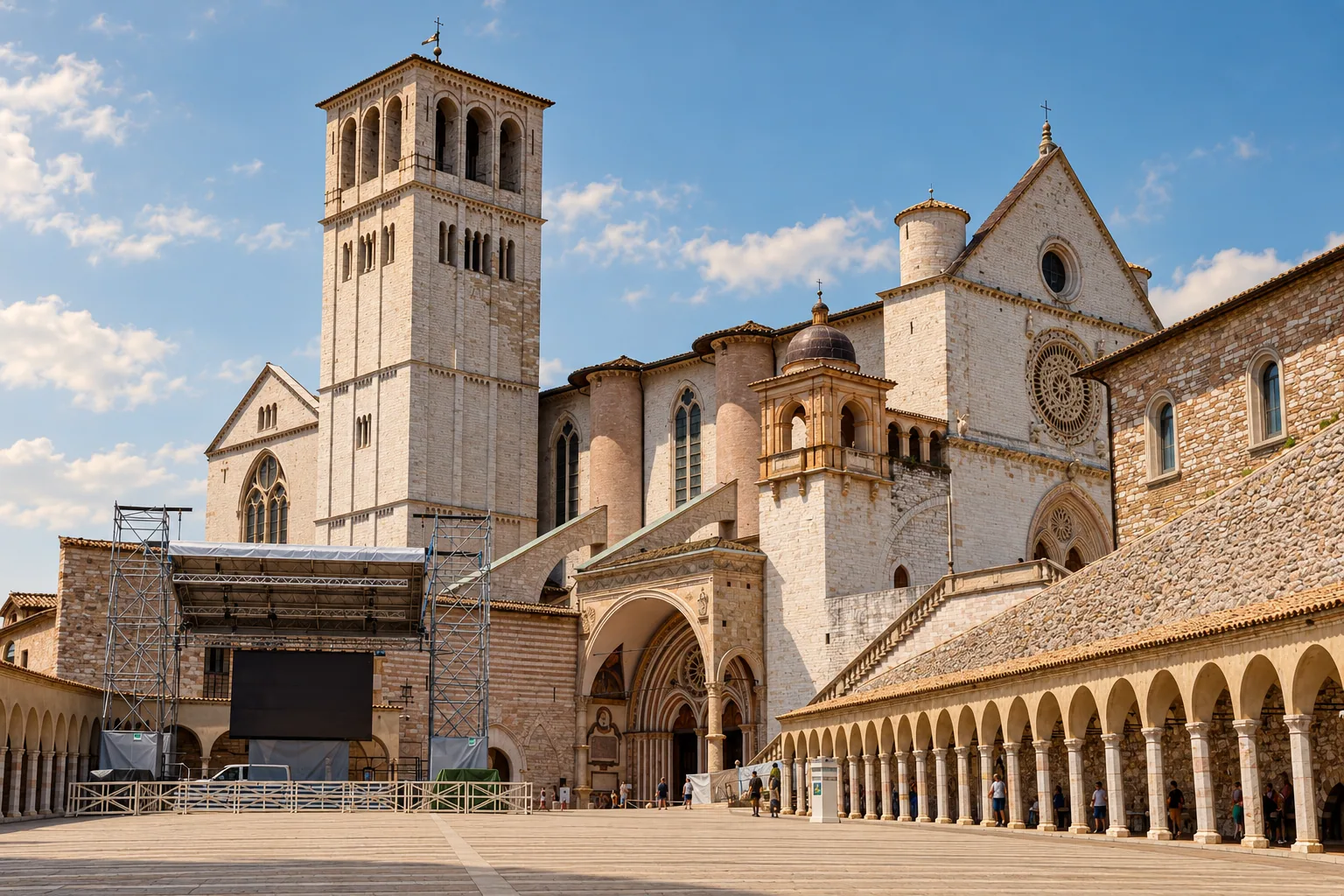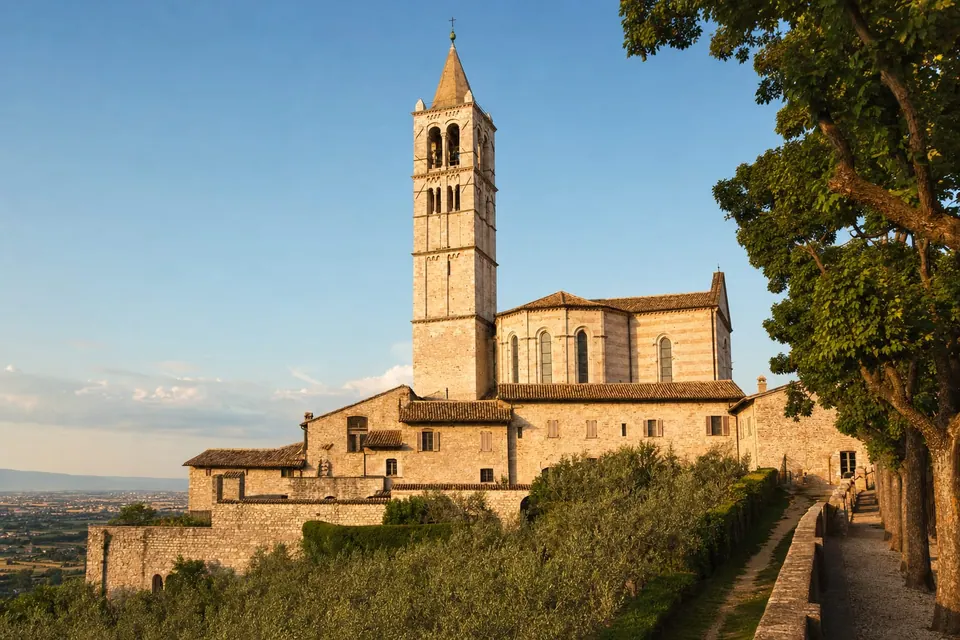
Pink and white stripes and great flying buttresses mark Clare's basilica across town from Francis's, built in the years after her death and consecrated in 1260, when her remains were carried inside to rest beneath the high altar.
Her body lay hidden for six centuries, discovered intact in 1850 and moved into a visible shrine in the crypt in 1872, where pilgrims file past it today. The San Damiano crucifix hangs in a side chapel, the Byzantine-style icon that, according to Franciscan tradition, spoke to Francis in 1205 and told him to rebuild God's church, kept here by the order Clare founded after his death. The building's severe Gothic lines outside give way inside to a single luminous nave, closer in spirit to Clare's own austerity than to the frescoed grandeur of the basilica across the valley.
Clare's church in Assisi
The Basilica of Santa Chiara is the church built for Saint Clare, the friend and follower of Francis who founded the Poor Clares, and it remains a working sanctuary. It stands in Piazza Santa Chiara, near Porta Nuova, and its pink-and-white stone walls make it easy to spot.1,2,3
Construction began in 1257, beside the older church of San Giorgio, and the adjoining monastery was built at the same time. On 3 October 1260 Clare's remains were placed beneath the high altar, and the church was consecrated in 1265.4,5
Clare herself had first been buried at San Giorgio, and the new basilica rose right beside that earlier church. Today the Chapel of San Giorgio opens from the right side of the nave, which keeps that first chapter of the story close at hand.4
The church and its neighbors have distinct lives. Friars Minor serve the basilica and the chaplaincy of the monastery next door, where a community of cloistered Poor Clares lives.3
An Umbrian Gothic landmark
The church is classified as Umbrian Gothic, and its design is generally attributed, with some caution, to the Franciscan friar Filippo da Campello. The three dates of 1257, 1260 and 1265 mark the beginning, the arrival of Clare's remains and the consecration, rather than the moment every chapel and painted surface was finished.5,4
White and pink stone from Monte Subasio is laid in horizontal courses across the exterior, which gives the walls their banded, glowing look. The gabled facade has a recessed portal, a large rose window and a small oculus above. Walk around the building and you will find transepts, a polygonal east end and a campanile, so the church reads as a three-dimensional whole rather than a single postcard front.2
Three large flying buttresses brace the north side, and one of them carries an inscription of 1351. The supports on the south side are absorbed into the monastery. The stone of the rose window is medieval, while its glazing by Moretti-Caselli was installed only in 1927.2
The nave, the chapels and the vault
Inside, a single nave rises gently through four cross-vaulted bays toward the transept and a polygonal apse. A passage runs around the upper wall at the level of the capitals. The nave is relatively plain, so your eye goes to the painted works gathered near the transept.4
Two chapels beside the transept were added after the original plan. The Chapel of Sant'Agnese, on the left, now serves as the chapel of the Blessed Sacrament. The Chapel of San Giorgio, on the right, holds the San Damiano Cross and borders the sisters' choir, so it is a place for quiet rather than lingering.4
The Chapel of San Giorgio also contains a Majesty associated with the painter Puccio Capanna, along with other fourteenth-century murals.4
Look up above the high altar and you will see four vault cells, each showing a pair of women saints: Mary and Clare, Cecilia and Lucy, Agnes the martyr and Agnes of Assisi, and Catherine of Alexandria and Margaret.6
The San Damiano Cross and the painted panels
The San Damiano Cross is the church's best-known treasure, and it is worth remembering that it is not the same thing as the basilica or the sanctuary of San Damiano. The Poor Clares brought it with them from San Damiano when they moved to their new monastery, and it is now displayed in the Chapel of San Giorgio.7
The Cross is Byzantine-influenced and probably the work of an unknown artist of the first half of the twelfth century, with paint on rough linen laid over a walnut panel. It shows Christ with open eyes among surrounding figures.7
A second painted cross is easy to confuse with it. Above the high altar hangs a shaped cross known as the cross of Mother Benedetta, dated to around 1260 and attributed to the Master of Santa Chiara.4
The transepts hold two large panels. In the northern transept, the Santa Chiara panel is dated by its inscription to 1283 and commonly attributed to the Master of Santa Chiara. It measures 276 by 163 centimeters and surrounds the central figure of Clare with eight scenes from her life.8
On the east wall of the southern transept, the Madonna della Cortina panel shows the Virgin as Hodegetria, holding and indicating the blessing Child while angels lift a curtain behind her.9
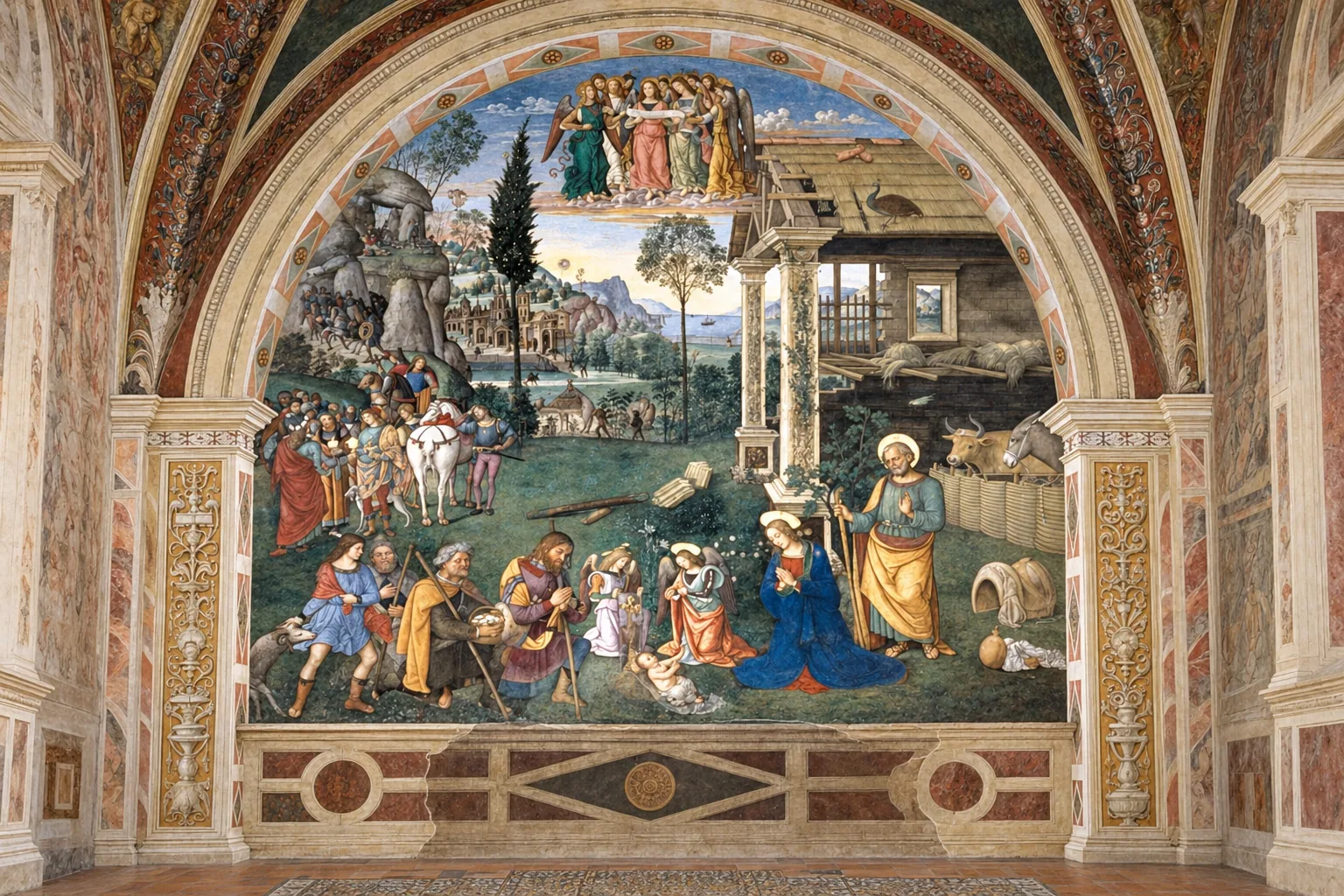
The walls of the transepts carry older frescoes too. The northern transept preserves Genesis scenes and a Nativity, and the southern transept scenes from the life of the Virgin and the infancy of Christ, a Last Judgment, and scenes of Clare's death and funeral.4
Clare's tomb in the crypt
The story of Clare's burial is told in a sequence of dates. She was buried at San Giorgio in August 1253 and moved beneath the new high altar on 3 October 1260. Her tomb was opened on 23 September 1850, work on the public crypt ran from 1852 to 1872, and a later enlargement created the area where relics are displayed.10,5
At the center of the original crypt, a dodecagonal structure marks the passage where the simple travertine sarcophagus was found, and it also serves as an altar.10
Behind a grille, an urn of crystal and Monte Subasio stone holds a body-shaped reliquary resting on a rough wooden board. The reliquary contains Clare's surviving remains, so what pilgrims see is a clothed reliquary, not an intact body.10
An examination in 1986 to 1987 found that 57 bones remained. Through an opening the sisters can see the bones, while pilgrims see the clothed body-reliquary.11
A newer area of the crypt displays a group of Franciscan and Clarian relics.10
Santa Chiara and Assisi's World Heritage setting
Santa Chiara is not inscribed on its own. UNESCO inscribed Assisi, the Basilica of San Francesco and Other Franciscan Sites in 2000 under criteria i, ii, iii, iv and vi, a serial property larger than the basilica itself.12
Santa Chiara sits within the Assisi historic-center component of that property, while the second component covers Santa Maria degli Angeli.13
Visiting as a pilgrim
Plan on treating the church as a sanctuary first. Start outside with the facade and buttresses, give the nave a quiet moment, then visit the Chapel of San Giorgio in silence. The main doorway has six steps, but a side entrance under the arches has a small ramp and the nave is on one level. The crypt below is reached by a stairway of 27 steps with a handrail and is not wheelchair accessible.14
Opening arrangements and worship times are set by the basilica, so check its official site before you go.14
Sources and citations (19)
- Visit AssisiBasilica Santa ChiaraMonument page: Piazza Santa Chiara and Porta NuovaRead source
- Protomonastero Santa ChiaraLa Basilica di S. Chiara in AssisiPDF pp. 5-10: exterior materials, facade, apse, transepts and campanileRead source
- Assisi OFMBasilica di Santa ChiaraSanctuary page: Friars Minor service and chaplaincy roleRead source
- Basilica di Santa ChiaraGuida semplice della BasilicaSimple guide: 1257 start, 1260 translation, 1265 consecrationRead source
- Basilica di Santa ChiaraOrigine della BasilicaBasilica origin: 1257, 1260 and 1265 milestonesRead source
- Basilica di Santa ChiaraLe vele nella crociera sopra l'altareVault page: four cells and saint pairingsRead source
- Basilica di Santa ChiaraIl Crocifisso di San DamianoObject page: movement from San Damiano and current presentationRead source
- Basilica di Santa ChiaraLa tavola di S. ChiaraPanel page: inscription date, attribution, dimensions, location and eight scenesRead source
- Basilica di Santa ChiaraLa tavola della Madonna della CortinaPanel page: wall, Hodegetria subject, Child, angels and curtainRead source
- Basilica di Santa ChiaraLa cripta e le reliquieLa Cripta: 1260 transfer, 1850 opening, 1852-1872 works and later extensionRead source
- Basilica di Santa ChiaraIl corpo di Santa ChiaraBody page: 1986-1987 examination, 57 bones, treatment and two viewing modesRead source
- UNESCO World Heritage CentreAssisi, the Basilica of San Francesco and Other Franciscan SitesProperty page: title, inscription year, criteria and serial context (read via web.archive.org snapshot; unesco.org returns 403)Read source
- UNESCO World Heritage CentreAssisi property 990 component mapOfficial component map: Santa Chiara within the historic-centre component (read via web.archive.org snapshot; unesco.org returns 403)Read source
- Visit AssisiAssisi per tuttiAssisi per tutti, Basilica di Santa Chiara entry (fetched 2026-09-30): main door six steps, accessible side entrance under the arches, level nave, 27-step crypt stairway with handrailRead source
- Wikimedia CommonsFile:Santa Chiara Assisi2.jpgFile page: author, May 2006 date, and public-domain statusRead source
- Wikimedia CommonsFile:Santa Chiara (Assisi) 06 05 2026 09.jpgFile page: creator, capture date, subject, and CC0 dedicationRead source
- Basilica di Santa ChiaraInfo e contattiPhotography authorization section and restricted annual windowRead source
- Catalogo generale dei Beni CulturaliBasilica di S. Chiara, AssisiCatalog record 1000154531A: property category and protection authorityRead source
- Protomonastero Santa ChiaraProtomonasteroProtomonastero page: Poor Clare institution and historical titleRead source