Skip to content

Orvieto Cathedral

A Gothic façade of mosaics and sculpture opens onto a striped nave, Signorelli’s Last Judgment and the Chapel of the Corporal.

  • Orvieto
  • Church
Where
Orvieto
Best for
Gold-ground façade mosaics and marble reliefs
Allow
1 hour
Tickets
From €8
Checked October 2026

On 13 November 1290, Pope Nicholas IV laid the first stone of a new cathedral at Orvieto, then a frequent home of the papal court. The Opera del Duomo connects the project to a larger reordering of the city and the need for a grand church for papal ceremonies. The cathedral’s other great story is devotional: Catholic tradition recounts that a priest in Bolsena saw the consecrated host bleed onto the altar linen in 1263; Pope Urban IV brought the Corporal to Orvieto and established the feast of Corpus Christi the next year. The linen is preserved in the Chapel of the Corporal, while its 1338 reliquary is displayed in the Opera’s museum collection.

The west façade grew from about 1310 to its architectural completion in 1532, layering gold-ground mosaics and four carved marble piers around a central rose window. Look carefully at the three bronze doors: only Emilio Greco’s central door is sculpted, with reliefs of the Works of Mercy. Inside, columns divide the church into three naves and bands of basalt and travertine pull the eye toward the choir. Then turn into San Brizio. Fra Angelico began its vault in 1447; Luca Signorelli continued the cycle from 1499, filling the walls with the Antichrist, the end of the world and the Last Judgment before completing the work in 1504. The Opera says Signorelli’s cycle inspired Michelangelo’s Sistine Chapel.

Start outside, where the façade’s stories unfold in separate registers, then give the interior and San Brizio time of their own. If seeing the Corporal matters to you, note that the linen is displayed only at designated religious seasons and feast days; its chapel also has a separate free entrance for prayer. For context beyond the piazza, continue with our Orvieto city guide.
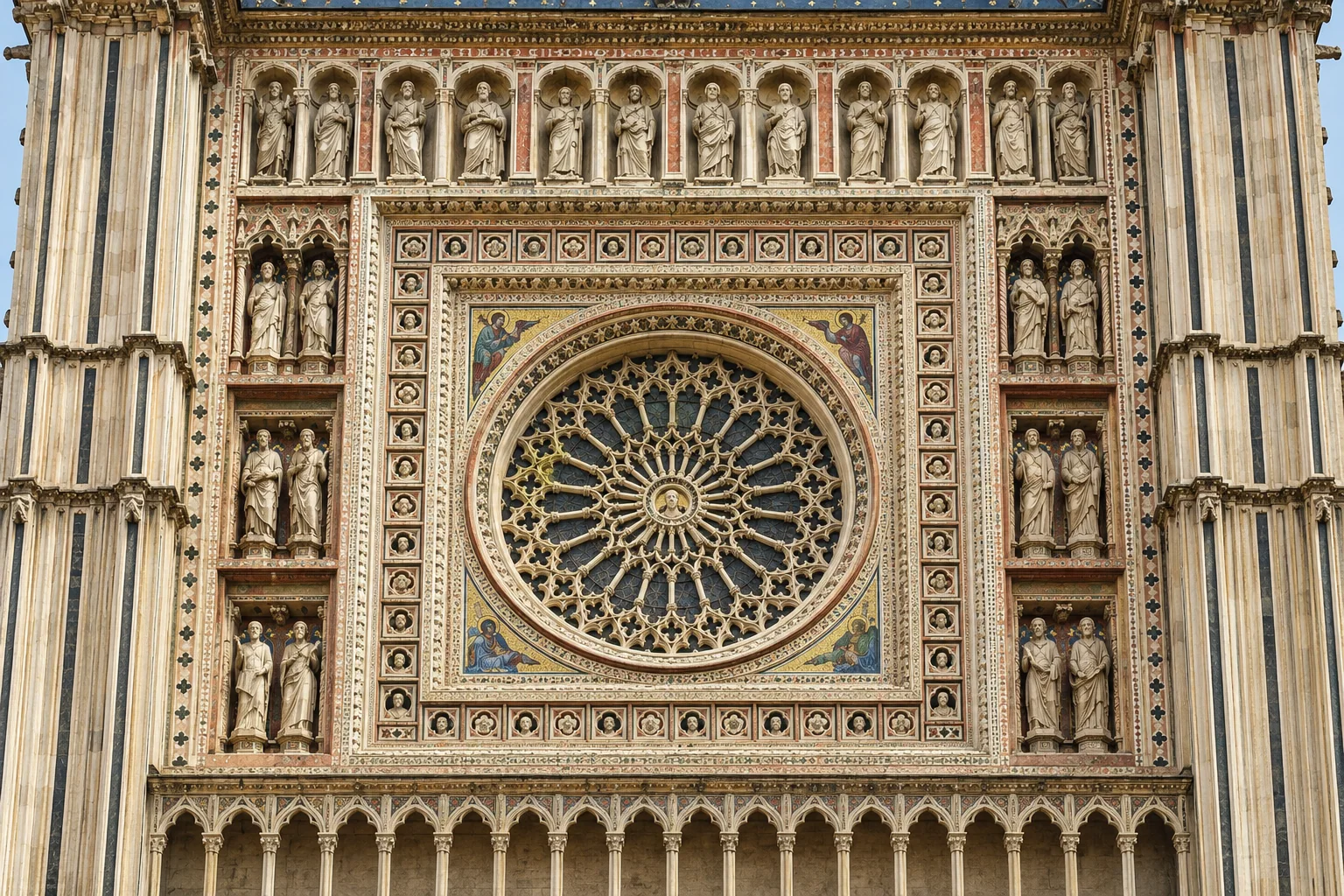
Circular rose window in a decorated square surround, with carved stone niches and gold-background mosaic panels.
The rose window and its mosaic setting, in a view grounded in a photograph from April 2011.
Sources and citations (19)
  1. Opera del Duomo di OrvietoFAQs — Opera del Duomo di OrvietoWhat is included?; Can I access only the Cathedral?; free admission FAQRead source
  2. Opera del Duomo di OrvietoThe Chapel of the Corporal — Opera del Duomo di OrvietoChapel intro, Bolsena narrative and Corpus Christi tradition; tabernacle and reliquary; separate prayer access and relic exposition periodsRead source
  3. Opera del Duomo di OrvietoPlan your visit — Opera del Duomo di OrvietoTicket table and descriptions; tickets offered online and at Piazza Duomo desk; concessions; San Brizio entry conditionsRead source
  4. Opera del Duomo di OrvietoThe Chapel of San Brizio — Opera del Duomo di OrvietoChronology and fresco cycle lines 29–46; admission method and guided-group rules lines 80–89Read source
  5. Opera del Duomo di OrvietoThe Chapel of San Brizio — Opera del Duomo di OrvietoChronology and fresco cycle lines 29–46; admission method and guided-group rules lines 80–89Read source
  6. Opera del Duomo di OrvietoPlan your visit — Opera del Duomo di OrvietoTicket table and descriptions; tickets offered online and at Piazza Duomo desk; concessions; San Brizio entry conditionsRead source
  7. Opera del Duomo di OrvietoThe Chapel of the Corporal — Opera del Duomo di OrvietoChapel intro, Bolsena narrative and Corpus Christi tradition; tabernacle and reliquary; separate prayer access and relic exposition periodsRead source
  8. Opera del Duomo di OrvietoFAQs — Opera del Duomo di OrvietoWhat is included?; Can I access only the Cathedral?; free admission FAQRead source
  9. Opera del Duomo di OrvietoAccessibility — Opera del Duomo di OrvietoAccessibility statement and recommended contact for specific needs, lines 29–41Read source
  10. Opera del Duomo di OrvietoAccessibility — Opera del Duomo di OrvietoAccessibility statement and recommended contact for specific needs, lines 29–41Read source
  11. Opera del Duomo di OrvietoHow to get here — Opera del Duomo di OrvietoBy car and by train sections; Campo della Fiera, lifts/escalators, station/funicular/bus, 800m and about-15-minute walkRead source
  12. Opera del Duomo di OrvietoThe façade — Opera del Duomo di OrvietoIntro/chronology lines 29–40; bas-relief piers 41–45; rose window 46–50; sculpture/mosaics 51–62; doors 63–69Read source
  13. Comune di OrvietoCome arrivare – Mobilità — Comune di OrvietoAlternative mobility sections: funicular/minibuses lines 78–94, mechanized route/elevators line 98–102Read source
  14. Opera del Duomo di OrvietoThe façade — Opera del Duomo di OrvietoIntro/chronology lines 29–40; bas-relief piers 41–45; rose window 46–50; sculpture/mosaics 51–62; doors 63–69Read source
  15. Opera del Duomo di OrvietoHow to get here — Opera del Duomo di OrvietoBy car and by train sections; Campo della Fiera, lifts/escalators, station/funicular/bus, 800m and about-15-minute walkRead source
  16. Opera del Duomo di OrvietoThe interior — Opera del Duomo di OrvietoIntro and apses lines 29–40; organ 45–47; choir 48–50; apse paintings 59–63Read source
  17. Opera del Duomo di OrvietoThe origins — Opera del Duomo di OrvietoEN page section Before the Duomo; first-stone date and papal/urban context, lines 39–42Read source
  18. Opera del Duomo di OrvietoThe origins — Opera del Duomo di OrvietoEN page section Before the Duomo; first-stone date and papal/urban context, lines 39–42Read source
  19. Opera del Duomo di OrvietoThe interior — Opera del Duomo di OrvietoIntro and apses lines 29–40; organ 45–47; choir 48–50; apse paintings 59–63Read source

Look closer

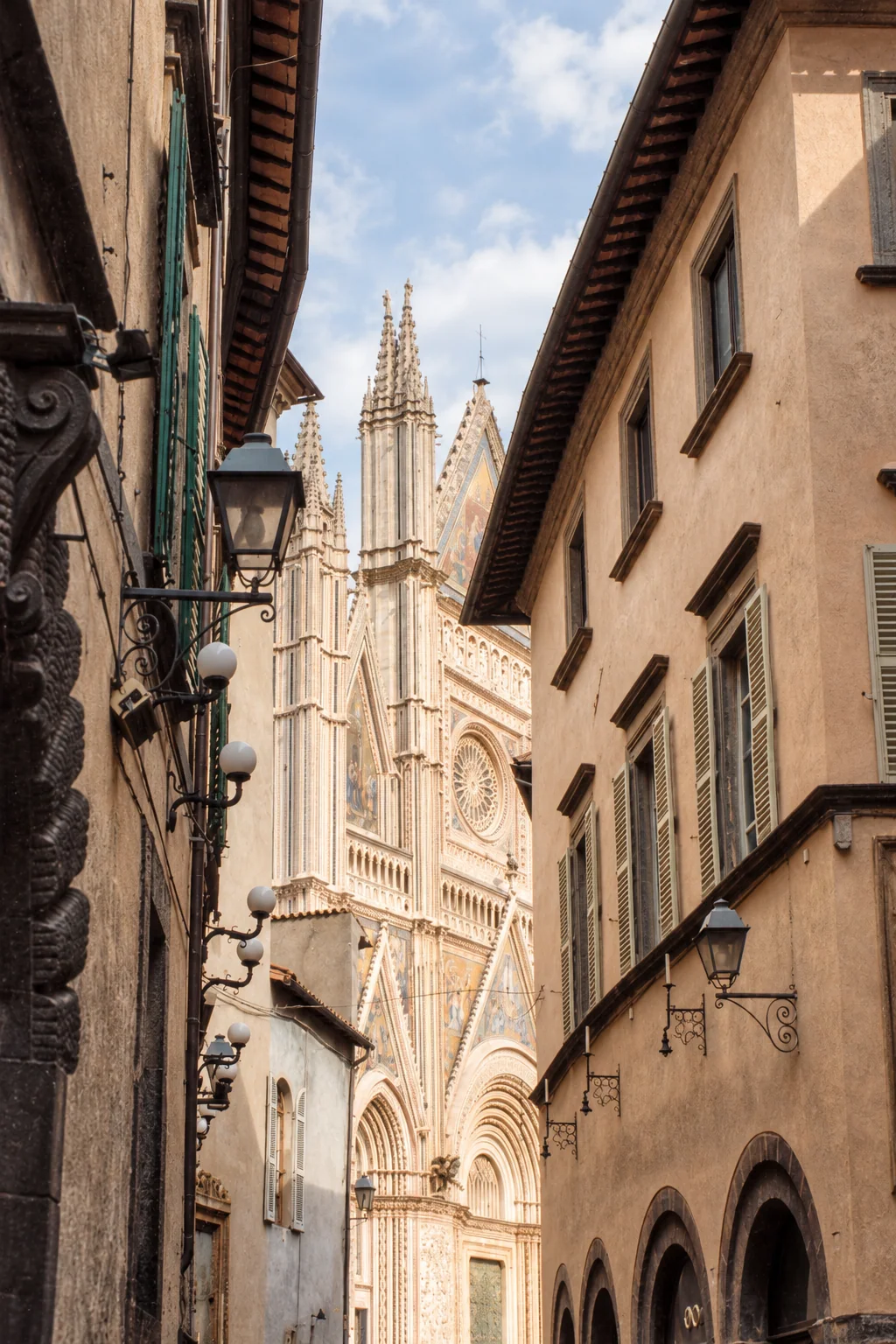
Partial oblique view of Orvieto Cathedral’s spires and façade, framed by the roofs and windowed walls of a narrow street.
A glimpse from the streetThe cathedral seen between neighbouring buildings, in a view grounded in a photograph from July 2005.
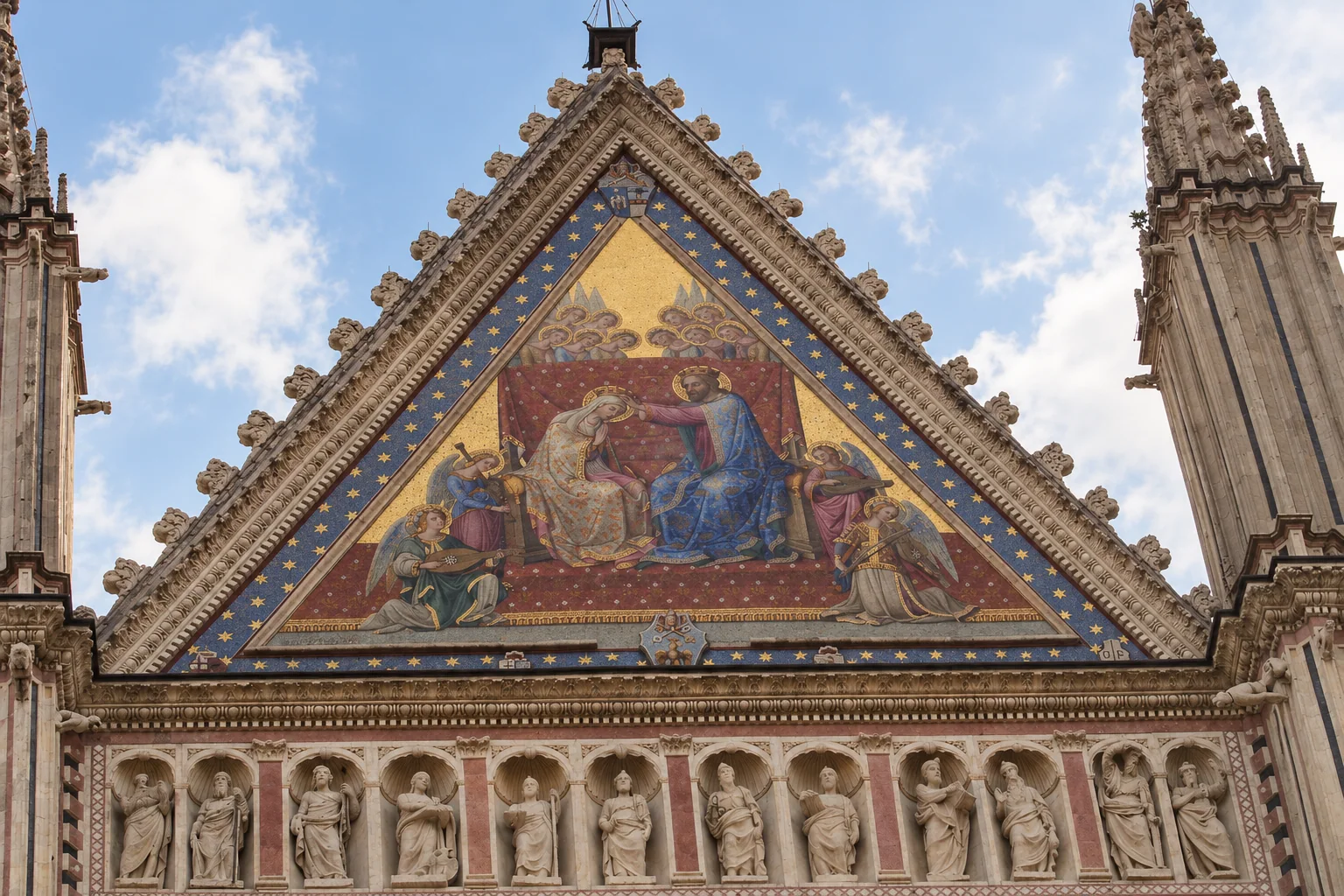
Triangular gold-background mosaic with blue star-patterned border, carved stone edges and a partial statue row beneath.
The central mosaic gableThe central mosaic gable and star-patterned border, in a view grounded in a photograph from May 2006.
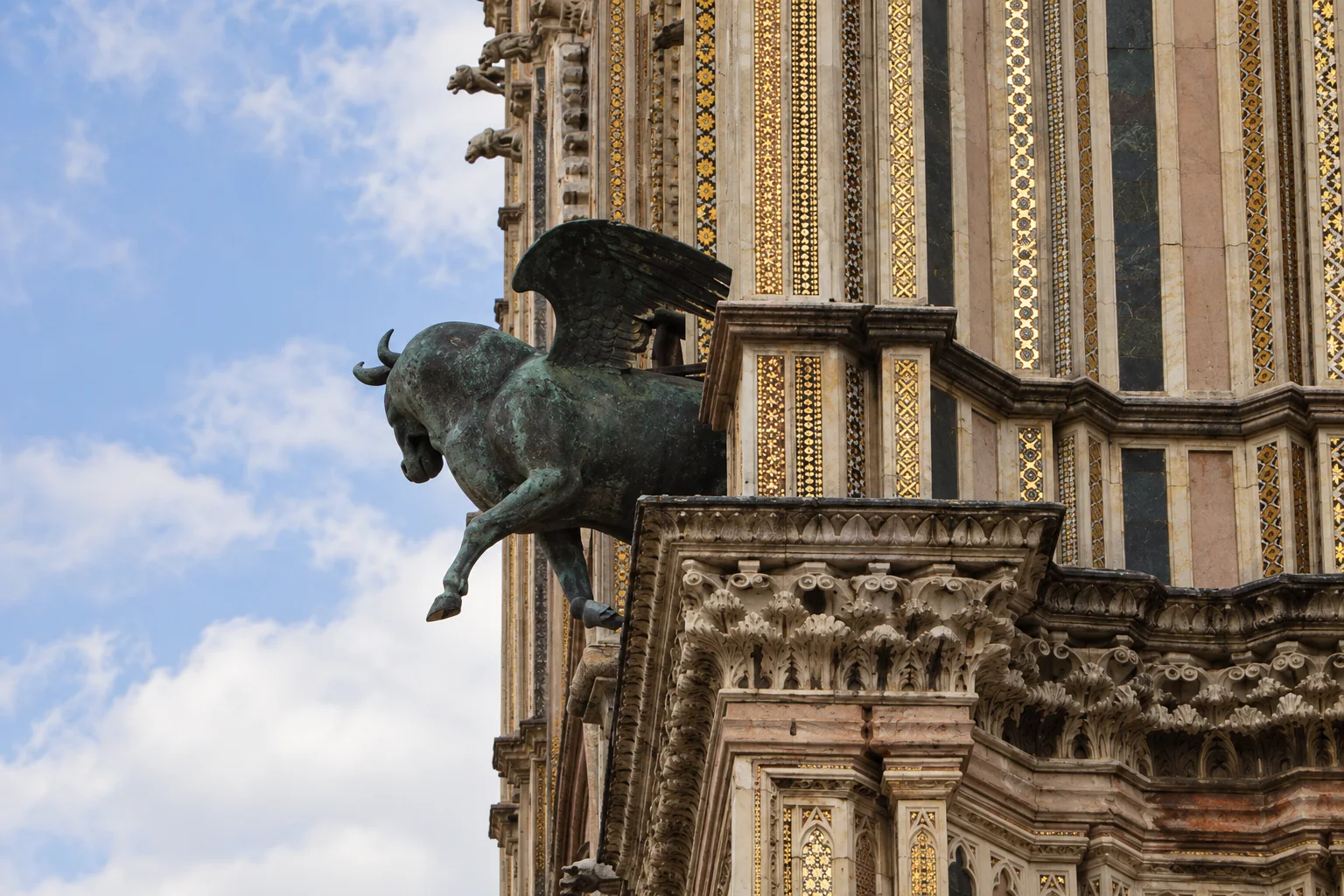
Green-patinated projecting bronze beside narrow vertical mosaic bands and a carved stone cornice.
Bronze and mosaic bandsA projecting bronze and the decorated façade corner, in a view grounded in a photograph from April 2011.

Five things worth finding

If you see nothing else, see these.

  1. A façade built in chaptersLorenzo Maitani; Andrea di Cione (Orcagna); Emilio Greco

    Work on the façade began around 1310 and reached architectural completion in 1532. Four carved piers carry biblical reliefs; golden mosaics tell episodes from Mary’s life. Count three bronze doors: only the central door, commissioned from Emilio Greco in 1962 and installed in 1970, is sculpted.West façade, Piazza Duomo

  2. The rose window by OrcagnaAndrea di Cione (Orcagna)

    Orcagna took charge of the Cathedral works in 1358 and worked on the rose window. The operator describes Christ at its centre, 52 saint heads around the square frame, and paired prophets on either side.Upper centre of the west façade

  3. Signorelli’s Last DaysFra Angelico; Luca Signorelli

    Fra Angelico began the vault in 1447 with Christ the Judge and prophets. Signorelli continued the work in 1499 and completed the chapel’s scenes of the Antichrist, the end of the world and the Last Judgment in 1504. The Opera says the cycle inspired Michelangelo’s Sistine Chapel.Chapel of San Brizio

  4. Basalt, travertine and a three-nave plan

    Columns and piers divide the church into three naves; alternating basalt and travertine create the long interior’s distinctive perspective. Look up toward the carved, gilded and painted organ case above the entrance to the Chapel of the Corporal.Cathedral interior

  5. The linen and its tabernacleNiccolò da Siena; Andrea di Cione (Orcagna); Ugolino di Vieri

    The mid-14th-century tabernacle by Orcagna houses the altar linen associated in Catholic tradition with the 1263 Bolsena miracle. The separate 1338 reliquary by Ugolino di Vieri belongs to the Opera’s museum collection; the linen is displayed only at designated religious seasons and feast days.Chapel of the Corporal; reliquary in the Opera museum collection

Plan your visit

Everything you need before you go.

Tickets
From €8
Booking guidance
Tickets online or at the Cathedral ticket office
Time needed
1 hour
Best time
Plan around the Cathedral’s liturgies: tourist visits pause during celebrations at the High Altar and in San Brizio. Check the Opera’s current visitor notices before travel, especially if seeing the Corporal is your priority.
Getting there
From Orvieto Scalo railway station, take the funicular to Piazza Cahen or the local bus into the historic centre; the Comune says electric minibuses also leave Piazza Cahen, including a line toward the Duomo. From the funicular, the Opera estimates a 15-minute walk via Corso Cavour and Via del Duomo. By car, use the Campo della Fiera/Foro Boario parking area and its lift or escalator route, then walk about 800 metres to Piazza Duomo.
Accessibility
The Opera provides routes for visitors with mobility requirements. Before visiting, ask the ticket office which spaces meet your access needs, including San Brizio, the museum and underground chambers: +39 0763 342477 or biglietteria@duomodiorvieto.it. Its public information does not specify a continuous step-free route through every space.

The operator’s current full-price €8 ticket includes the Cathedral, Chapel of San Brizio, Museo Emilio Greco and Cathedral Underground, with an audio guide. The €11 combination adds the Claudio Faina Etruscan Museum. Tickets are sold online and at the desk outside the Cathedral. The operator does not state a general advance-booking requirement for individual visits; pre-booked groups with an authorised guide have priority in San Brizio, and guided tours there are limited to 15 minutes. Free-entry categories require proof; collect free tickets at the desk. The Chapel of the Corporal has a separate free entrance for prayer only; tourist access to the Cathedral and San Brizio is ticketed. The linen is displayed only from Christmas to Epiphany, from Easter to Pentecost, on Corpus Christi and on the Assumption. Tourist visits pause during liturgies at the High Altar and in San Brizio. Check the operator’s ticket page before travel for current scope and any access notices. Last updated October 2026. Prices change, so check the official site before you go.

Allow about an hour as an Italia Magnifica planning estimate for the façade, Cathedral and San Brizio; add time for the museum and underground chambers. Start with the four carved façade piers, then look up to the rose window before going inside.

Get directionsGoogle MapsApple Maps

Tours worth booking

A few we would book ourselves, to get more from your visit.

Booking through these links may earn Italia Magnifica a commission, at no cost to you.

    • Viator
    • 2h
    • 5.0★ · 13 reviews
    • Viator
    • 7h
    • 5.0★ · 5 reviews
    • Viator
    • 1h
    • 5.0★ · 2 reviews
    • Viator
    • 2h
    • 5.0★ · 1 reviews
    • Viator
    • 9h
    • 5.0★ · 1 reviews
    • Viator
    • 10h
    • 5.0★ · 1 reviews

Good to know

What does the €8 Cathedral ticket include?

The Opera lists the Cathedral, San Brizio Chapel, Museo Emilio Greco and Cathedral Underground, with an audio guide. A €11 combined ticket adds the Claudio Faina Etruscan Museum. Check the operator’s current ticket page for the exact inclusions before you go.

Can I visit the Chapel of the Corporal for free?

The operator permits a separate free entrance to the chapel for prayer only. Tourist admission to the Cathedral and San Brizio is ticketed. The linen is displayed only from Christmas to Epiphany, Easter to Pentecost, on Corpus Christi and on the Assumption.

How much time should I allow?

About an hour is an editorial planning estimate for the façade, Cathedral interior and San Brizio. Allow extra time for the included underground chambers and museum. The operator does not publish a standard visit duration.

How do I reach the Cathedral from the railway station?

At Orvieto Scalo, take the funicular to Piazza Cahen or a local bus, then use the electric minibus or walk about 15 minutes to Piazza Duomo. By car, the Opera recommends Campo della Fiera/Foro Boario; after the lift or escalator route, the Cathedral is about 800 metres on foot.

Should I book ahead?

The Opera sells individual tickets online and at the ticket office in Piazza Duomo 25. For San Brizio, groups booked with an authorised guide have priority; guided tours there are limited to 15 minutes. Check current visitor arrangements when planning your route.

Is the whole visit step-free?

The Opera confirms that mobility routes are available, but does not specify a continuous step-free route through every space. Contact the ticket office before visiting with your requirements and the rooms you want to see: +39 0763 342477 or biglietteria@duomodiorvieto.it.

A letter from Italy, once a month.

The places, tables and makers we found worth your time. One email, no noise.

One letter a month. Unsubscribe at any time. We never share your address.

Help us get it right

What is it about?