Skip to content

St. Patrick's Well

Antonio da Sangallo's 53-meter double-helix well, built for a pope who feared a siege.

  • Orvieto
  • Monument
Where
Orvieto
Best for
Double-helix staircases
Allow
1 hour
Tickets
From €6
Checked September 2026

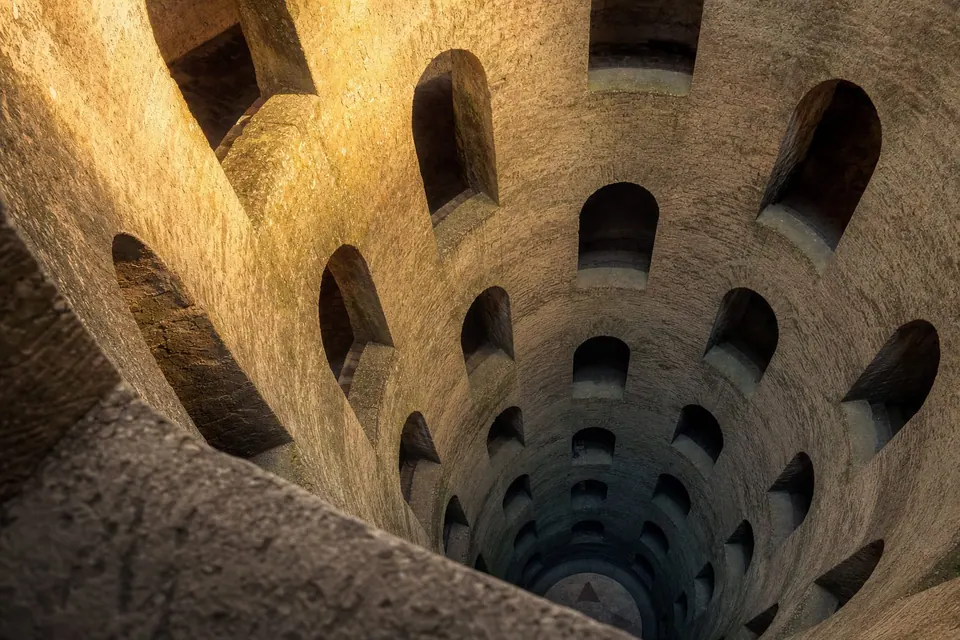
In 1527, imperial troops sacked Rome and Pope Clement VII fled to Orvieto, worried the city's water supply couldn't survive a siege of its own. He put Antonio da Sangallo the Younger on the problem, and between 1527 and 1537 Sangallo sank a well 53 meters straight into the tufa, wrapping it in two spiral ramps that never cross.

Mules loaded with empty jugs went down one ramp while others, full, came up the other, and the two trains never had to pass each other on the 248 steps. Seventy small windows light the shaft as you descend. The well takes its name, Pozzo di San Patrizio, from an Irish legend about a cave so deep it could only be purgatory.

Sources and citations (5)
  1. Comune di OrvietoPozzo di San PatrizioDescription: 1527 commission, Clement VII, Sangallo and siege-water purposeRead source
  2. Ministero della CulturaPozzo di San PatrizioDescription: Clement VII refuge, Sangallo project and water shortage contextRead source
  3. Comune di OrvietoFortezza AlbornozDescription: former Pozzo della Rocca, fortress service and city supplyRead source
  4. CoopCulturePozzo di San PatrizioMonument summary: Clement VII, 1527 and Antonio da SangalloRead source
  5. Umbria TourismPozzo di San PatrizioHistory: 1527 commission, Sangallo and city-water purposeRead source
Four things worth finding

If you see nothing else, see these.

  1. The twin spiral rampsAntonio da Sangallo the Younger, 1527 to 1537

    Two ramps wind around each other without ever crossing, one for going down, one for coming up.Inside the shaft

  2. The 72 windowsSangallo’s design

    Small openings light the descent, making the well feel like a stage set rather than a cave.Along the shaft wall

  3. The bridge and the waterSangallo’s design

    A small bridge at the bottom joins the two ramps, above water fed by a natural spring.Bottom of the well

  4. The Latin inscription16th century

    It says, roughly, that what nature denied to defense, industry supplied.Entrance

Plan your visit

Everything you need before you go.

Tickets
From €6
Booking
No booking needed
Time needed
1 hour
Best time
Right at opening, or evening in high season, to beat the tour-bus groups
Getting there
The well sits in Piazza Cahen, at the eastern edge of Orvieto's hilltop old town, a short walk from where the funicular from the train station below arrives; there's paid parking nearby for drivers.
Accessibility
Not accessible to visitors with serious mobility difficulties: the only way down and up is 248 steps split across two spiral staircases, with no lift.

Reduced ticket (€4.50) for ages 65+, university students, groups of 6 or more, and Carta Unica Orvieto holders; free for children under 6, licensed tour guides, and companions of visitors with disabilities. Last updated September 2026. Prices change, so check the official site before you go.

Bring a light layer even in August: the shaft holds a steady 14°C (57°F) year-round, whatever the season outside.

Get directionsGoogle MapsApple Maps

Tours worth booking

A few we would book ourselves, to get more from your visit.

Booking through these links may earn Italia Magnifica a commission, at no cost to you.

    • Viator
    • 7h
    • 5.0★ · 5 reviews
    • Viator
    • 1h
    • 5.0★ · 2 reviews
    • Viator
    • 2h
    • 5.0★ · 1 reviews
    • Viator
    • 2h
    • 4.8★ · 17 reviews
    • Viator
    • 2h
    • 3.0★ · 2 reviews
    • Viator
    • 6h

Good to know

How long should you spend at St. Patrick’s Well?

About an hour. The descent and the climb back up are the main part, and the rest is reading the engineering.

How many steps are there in St. Patrick’s Well?

Each ramp has 248 steps, so going down and coming back up is a substantial walk. The steps are even and gentle, but the return is tiring on a hot day.

Is St. Patrick’s Well worth visiting?

Yes, especially as a pair with Orvieto’s cathedral: it is a Renaissance engineering marvel, it is quick, and it is a cool break from the hilltop sun.

A letter from Italy, once a month.

The places, tables and makers we found worth your time. One email, no noise.

One letter a month. Unsubscribe at any time. We never share your address.

Help us get it right

What is it about?