Skip to content
The ancient Greek theatre of Taormina with Mount Etna smoking beyond

Ten Days in Sicily

Two days in Palermo, then the Valley of the Temples, the Baroque Val di Noto, Syracuse and Ortigia, and Etna and Taormina to finish.

Sicily is best crossed in a long arc, from Palermo in the north-west to Taormina in the east, because the island keeps its ancient and its wild sides in the same frame. You begin among Norman churches with Arab ceilings and Byzantine gold, pass the Greek temples of Agrigento and the honey-coloured Baroque towns of the Val di Noto, spend two nights on the island of Ortigia, and finish beneath Etna. You need a car for most of it.

Day by day

Ballarò, the Palatine Chapel and the Norman city

Day 1 · mostly on foot

Morning
Start early at Ballarò, among the fish stalls, spice shops and the vendors’ sing-song abbanniate. Then walk to the Palazzo dei Normanni and choose a visit that includes the Cappella Palatina. Check whether the Royal Apartments are open on your day. In the chapel, look above the Byzantine mosaics to the painted wooden muqarnas ceiling, where musicians and hunters appear among the figures.
Afternoon
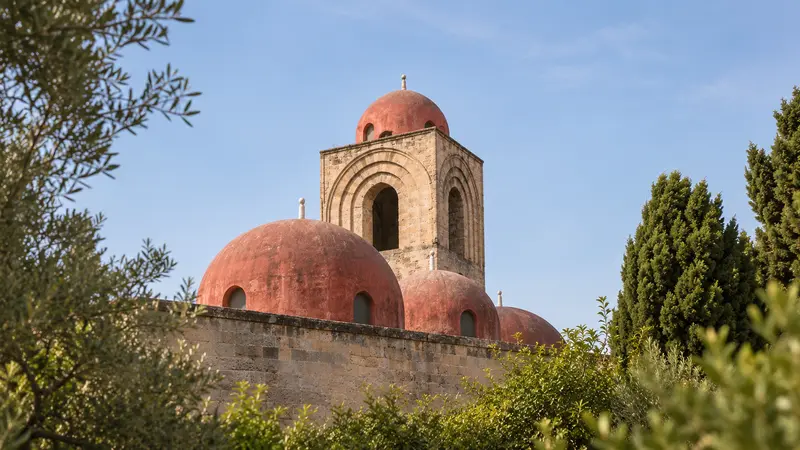
See the red domes and cloister garden of San Giovanni degli Eremiti, then follow Via Vittorio Emanuele to Palermo Cathedral. The main worship area is free to enter during visiting hours. Buy an Area Monumentale ticket if you want to see the royal tombs of Roger II and Frederick II, and check what your ticket includes if you’re going up to the roof.
Evening
Quattro Canti, the crossroads where the old city's four quarters meet, is best as the light fades. Each of its four curved Baroque façades rises from a fountain to a statue of a season, then a Spanish king, then one of the city's patron saints. Walk the length of Via Maqueda, then dine in the lanes around Teatro Massimo or in the Kalsa. Go to bed at a sensible hour: tomorrow starts with another market.

Where to eat. Eat as you walk through Ballarò: panelle (chickpea fritters) and crocchè (potato croquettes), or a pani ca meusa, the spleen sandwich. Ask for it schietta, with just lemon, or maritata, with cheese. A slice of sfincione, Palermo's thick, spongy pizza, makes a good breakfast.

Il Capo, Teatro Massimo and Monreale

Day 2 · on foot, then bus or taxi to Monreale and back

Morning
Start at the Capo market, then walk to Teatro Massimo, Italy’s largest opera house. If a guided visit fits, choose an early departure and book through the theatre. On a Sunday or holiday, go straight to Monreale if you want to see the cloister before its earlier closing.
Afternoon
Take AMAT bus 389 from the Indipendenza Pisani stop, near the Norman palace. Get off at Fontana del Drago Monreale and walk uphill to Piazza Guglielmo II for the cathedral and cloister. The cathedral holds William II’s gold mosaics and the Christ Pantocrator. Buy the cloister ticket through CoopCulture. Check admission at the cathedral separately, especially if you want the terraces. Check the two sets of hours: on Sundays the cloister closes early and the cathedral opens for visits after services. Leave the terraces for a day with time for the stairs.
Evening
Return to Fontana del Drago Monreale for bus 389 back to Palermo. Check the last usable departure before you leave Palermo, or agree on a taxi pickup if the return timetable is tight. Have dinner around Vucciria or in the Kalsa and leave the car for tomorrow’s drive.

Where to eat. At the Capo, lunch is fried: panelle and crocchè in a sesame roll, and arancine, the round rice balls of Palermo, filled with meat ragù, peas and cheese. At Vucciria, after dark, the food is grilled and eaten on the street.

The Martorana, then south to Agrigento

Day 3 · short walk, then the first long drive

Morning
Spend the early morning in Piazza Bellini. La Martorana was founded in 1143 by Giorgio d'Antiochia, admiral to Roger II, and holds some of the oldest Byzantine mosaics in Sicily, including the panel in which Christ crowns Roger as king. Next to it stands San Cataldo, with its red domes. Then collect the hire car, ideally from a depot outside the restricted centre, and cross the island to Agrigento.
Afternoon
Drive from Palermo to the Valley of the Temples and use the Juno entrance on Via Panoramica dei Templi. Check the last admission for your date before setting off and buy a ticket for the park. Start at the Temple of Hera, also called the Temple of Juno, at the east end. Then walk west along the ridge to the Temple of Concordia, whose conversion into a church helped preserve it. There is little shade along the ridge, so bring a hat and water.
Evening
The temples are best in the low light before sunset, when the stone turns gold. Then climb to the old hill town of Agrigento for dinner, with the valley and the sea below; the playwright Luigi Pirandello was born in the countryside outside town, at a place called Caos.

Where to eat. In the upper town of Agrigento the trattorie serve Sicilian staples: caponata (sweet-and-sour aubergine), pasta with sardines and wild fennel, and almond pastries. Almonds are the local crop, and the town celebrates their blossom in a festival each late winter.

Kolymbethra, the museum and Ragusa Ibla

Day 4 · morning on foot, afternoon by car

Morning
Return from Agrigento via Porta V, the entrance nearest the Kolymbethra garden. For today’s visit, choose the combined park and garden ticket if you need both admissions. The garden lies below the temples, among citrus and old olive trees watered by channels that go back to Greek Akragas. Check the garden’s opening time before you leave. The Pietro Griffo archaeological museum has its own ticket and entrance in Contrada San Nicola. Inside, look for the reassembled stone giant from the Temple of Olympian Zeus.
Afternoon
Drive south-east to Ragusa. After the 1693 earthquake the town split in two: Ragusa Superiore, laid out on a grid on the upper ridge, and Ragusa Ibla, rebuilt over the medieval town below. Park above and walk down into Ibla, the one you want. Its cathedral of San Giorgio is the work of Rosario Gagliardi, commissioned in 1738, and the Giardino Ibleo lies at the eastern end of the old town.
Evening
Ibla is a maze of lanes, stairways, small piazzas and Baroque churches, and the best thing to do with the evening is to wander without a map. Walk to the Giardino Ibleo as the light softens, and look for the Portale San Giorgio just outside it: it is all that survived of the older church of San Giorgio, lost in the earthquake.

Where to eat. Eat in Ibla itself, in the lanes around the cathedral and the Giardino Ibleo. Look for local Ragusano cheese, ricotta, and pasta with a pork ragù; you will meet Modica's chocolate properly tomorrow.

Modica and golden Noto

Day 5 · steep on foot, with a short drive

Morning
Start in Modica Bassa on Corso Umberto I. Stop below San Pietro to see the apostles lining its stairs, then continue along the Corso to the foot of the long staircase to San Giorgio. Climb it for the view over the roofs and return the same way. For a shorter walk, stay on Corso Umberto near San Pietro and leave the upper church for another visit. Allow for steps at San Pietro too if you want to go inside.
Afternoon
Stop at Antica Dolceria Bonajuto on Corso Umberto for a quick shop visit. To see how the chocolate is made, book its separate Fattojo workshop visit, which includes a tasting. A shop stop fits a shorter day. If you book the workshop, check the start time before planning the drive to Noto. To buy Cioccolato di Modica IGP, look for the IGP mark. Bonajuto makes its chocolate under its own name.
Evening
In Noto, start at Porta Reale and follow Corso Vittorio Emanuele to Piazza Municipio, where the cathedral faces Palazzo Ducezio. With time for another short detour, turn into Via Nicolaci and look up at the carved figures holding the balconies. If you arrive late, keep the main street for a walk and dinner, then save the interiors for tomorrow.

Where to eat. Lunch in Modica Bassa, in the lanes just off Corso Umberto. Dinner in Noto after the passeggiata, with a glass of Nero d'Avola, the red grape of this corner of Sicily.

Noto, then the Greek theatre of Syracuse

Day 6 · short walk, then a drive and an archaeological park

Morning
Start the Sicilian way: granita with a warm brioche, at Caffè Sicilia on Corso Vittorio Emanuele, in the Assenza family's hands since 1892. Almond and mulberry are the classics. Then see the cathedral of San Nicolò, whose dome fell in 1996 and which returned to use in 2007, and walk the Corso once more in the morning light. In May, flower pictures cover Via Nicolaci for the Infiorata.
Afternoon
From Noto, drive to the Neapolis archaeological park on the mainland before checking in on Ortigia. Buy a ticket through the park’s official booking link and check the last admission for your date. Sunday and holiday entry can end earlier. If the timing is tight, put the park first tomorrow and walk Ortigia today. Inside Neapolis, give time to the Greek Theatre and the Latomia del Paradiso quarry, where the Ear of Dionysius is cut into the limestone. Theatre performances have their own tickets.
Evening
Cross one of the bridges onto Ortigia, the old island city, and settle in. Walk to the Fonte Aretusa on the sea wall, a freshwater spring edged with papyrus and tied to the myth of the nymph Arethusa, and sit on the waterfront as the light goes. The island is small and flat, and you will not need the car again for two days.

Where to eat. Dinner in Ortigia, in the lanes off the cathedral square: fresh fish and seafood, with a glass of Etna white. At breakfast in Noto, order granita and brioche together and dunk the bread.

Ortigia: temple, cathedral and sea

Day 7 · all on foot

Morning
Begin at the cathedral in Piazza Duomo. It is a Greek temple of Athena from the fifth century BC, turned into a church in the seventh century, and its Doric columns are built into the walls, inside and out. Walk Via Minerva along the north side of the building to see them from the street. The Baroque façade was added after the 1693 earthquake. At the southern end of the square stands the late Baroque front of Santa Lucia alla Badia.
Afternoon
Walk to the ruins of the Temple of Apollo, one of the oldest Doric temples in Sicily, from the sixth century BC. Follow the sea wall to the Fonte Aretusa and on to the Castello Maniace at the island's tip, built by Frederick II from 1232 and named for the Byzantine general George Maniakes. Ortigia is small, so there is no rush; stop wherever there is a bar on the water.
Evening
Return to Piazza Duomo for the passeggiata, when the whole island seems to be out in the square. The cathedral front turns warm in the last light. Have an aperitivo on the square, and a long dinner in the lanes behind it. Tomorrow you leave the island, so pack the car now if you can.

Where to eat. Ortigia is a seafood town: raw prawns, grilled fish, pasta with sea urchin or clams. Sicilian cannoli and cassata come from the pastry shops around Piazza Duomo.

Ortigia market and Catania

Day 8 · morning on foot, a drive, then Catania on foot

Morning
Go early to Ortigia’s market near the Temple of Apollo for fish, olives and a sandwich for the road. If you’re leaving the car on the mainland, use the Molo Sant’Antonio car park and walk in along Via Malta and across Ponte Santa Lucia to Piazza Pancali. Go back the same way to collect the car for Catania. Check Siracusa’s restricted traffic zone before driving onto Ortigia.
Afternoon
For Catania’s old centre, set your navigation to the AMTS Borsellino car park by the port. Approach from the waterfront and follow the signed entrance, keeping out of the restricted streets around Piazza Duomo. If you’re staying inside the restricted zone, get the property’s parking and access directions before driving in. From Borsellino, walk to Piazza Duomo for the lava-stone elephant and the cathedral of Sant’Agata. Then follow Via Vittorio Emanuele II to the foot of Via dei Crociferi for the Baroque church fronts.
Evening
If you arrive late, keep Piazza Duomo and the short walk up Via dei Crociferi before dinner. With time to spare, go back towards Via Etnea for the evening passeggiata. Check tomorrow’s Etna plan before settling in. Weather and volcanic activity can change access, and it will be colder at altitude.

Where to eat. In Catania the rice ball is an arancino, often cone-shaped like the volcano. Fillings include ragù, and alla norma with aubergine; Bronte pistachio is the local pride, grown on Etna's western flank.

Mount Etna and a winery on its slopes

Day 9 · mountain in the morning, vineyards in the afternoon

Morning
Drive from Catania through Nicolosi to Rifugio Sapienza. Check the local access notices and cable-car service before setting out. With the cable car running and the station open, you can buy a return ticket to the upper station at about 2,500 metres and take in the view on your own. For the higher hike, book a licensed alpine or volcanological guide. During Nicolosi’s attention phase, that guide is required inside the mapped hazard zone around the summit craters. A higher alert can close the area even to guided groups. If the upper route is closed but access to Sapienza is open, stay by the lower Silvestri craters where the paths are open. If access to Sapienza is suspended, spend the morning in Catania.
Afternoon
Give yourself a late tasting slot if you’re doing the longer hike. From Sapienza, come down towards Zafferana Etnea and choose a winery on the eastern slope near Milo before driving on to Taormina. Check the address before booking. A winery on the north slope makes for a longer detour. Etna DOC was established in 1968, with Nerello Mascalese in many of the reds and Carricante in the whites.
Evening
Drive on to Taormina, high above the coast, where you spend the night. The old town is small and pedestrian in feel, so leave the car at the edge and walk in. Stroll to Piazza IX Aprile, the terrace over the Ionian Sea, and watch the evening light fade over the water. Your last day starts with the theatre.

Where to eat. Eat where the winemakers eat: in a village on the slope, with pasta and local pistachio, or at the winery itself. Bronte pistachios grow on Etna's western flank and turn up in everything from pasta to pastries.

Taormina: the theatre and Isola Bella

Day 10 · Taormina on foot, with an optional trip down to the coast

Morning
Start at the ancient theatre on Via Teatro Greco. Check the archaeological park’s hours if a performance is scheduled. If your flight leaves time for a visit, keep the theatre and a short walk along Corso Umberto to Piazza IX Aprile, then collect your bags. For a full day in town, continue to the Villa Comunale gardens if they’re open.
Afternoon
For Mazzarò, take the cable car from Via Pirandello when it’s running. During the November 2026 works, the replacement bus runs from Piazza San Pancrazio and the upper station on Via Pirandello to Piazzale Funivia in Mazzarò. Check the last bus uphill before leaving town. The cable car is due to reopen on 8 December 2026. The beach and the ticketed island are separate visits. The island closed for works on 2 November, with completion expected by 15 December. Check both notices before setting out.
Evening
If the coast trip doesn’t fit, stay in the upper town. Walk Corso Umberto from Porta Messina through Piazza IX Aprile to Porta Catania, with time for a coffee on the way. For a flight from Catania, work back from your check-in time and leave time for traffic, refuelling and the rental return at the address on your agreement.

Where to eat. Taormina is in the province of Messina, whose granita is made with coffee and topped with whipped cream, served with a warm brioche. Order it as a mezza con panna, the local classic.

If you have another day

Add a day at the start in Palermo, or find room in the south-east, and any of these fits.

Cefalù
A day trip from Palermo by regional train or car. Its cathedral was begun by Roger II in 1131, with a Christ Pantocrator filling the apse and two Norman towers on the front. It belongs to the same UNESCO listing as Palermo's Norman churches and Monreale, and the old town below it is a pleasure to wander.
Villa Romana del Casale
Inland near Piazza Armerina, a fourth-century Roman villa floored with about 3,500 square metres of mosaics, including women athletes in two-piece garments and a Great Hunt that follows exotic animals as they are shipped. A landslide buried it, which is why it survived. It needs a car and a full day.
Scicli
A small Baroque town near Modica, part of the same UNESCO listing of the late Baroque towns of the Val di Noto. Walk its main street and see the noble palaces built after 1693, including Palazzo Beneventano and Palazzo Fava, for a quieter taste of the south-east.

Where to stay

Verified hotels, city by city.

Palermo

Palermo

  • Domìa Boutique Hotel
  • Villa Igiea
  • Palazzo Natoli
  • Villa Masetta
Check dates: Palermo
Catania

Catania

  • Liberty Hotel
  • Etnea 454 Catania Luxury Rooms
  • Ollen Apartments
  • Hotel Bastiò Suites
Check dates: Catania
Taormina

Taormina

  • Villa Fiorita
  • Hotel Villa Belvedere
  • Grand Hotel Timeo
  • NH Collection Taormina
Check dates: Taormina

Booking through these links may earn Italia Magnifica a commission, at no cost to you.

Where to eat

Verified tables in the cities on this route.

Palermo

Palermo

  • Pizzeria Sant’AgostinoA family-run pizzeria on Via Sant'Agostino in Palermo's old centre, an easy, unfussy stop for pizza near the Capo market.
  • Osteria MaquedaA Sicilian osteria on Via Maqueda in the historic centre, with fresh pasta made in an open kitchen and a list of Sicilian wines.
  • Pizzeria da CostantinoA wood-fired pizzeria on Via Mariano Stabile in Palermo, with a crisp-edged base and toppings such as caciocavallo palermitano.
  • Mercato Maqueda Cucina Pizza e VinoA casual spot on Via Napoli in Palermo's old centre for pizza, meat dishes and wine, with cocktails too.
All tables: Palermo
Catania

Catania

  • Katanesi Pizza & DrinkA casual pizzeria and drinks bar in Catania, for an easy evening pizza and a drink.
  • L'Antica Pizzeria da Michele CataniaA Catania outpost of the historic Naples pizzeria, keeping to its short menu of margherita, marinara and fried montanara.
  • Ciauru i MariA seafood-led restaurant in Palazzo Tornabene on Piazza Ogninella, near the Duomo and Teatro Bellini, with a menu that follows the day's catch.
  • Catania Social ClubA relaxed Sicilian restaurant, pizzeria and cocktail bar on Piazza Scammacca, with pasta, pizza and sharing boards of cured meats and cheese.
All tables: Catania
Taormina

Taormina

  • Porta MessinaA traditional Sicilian restaurant and pizzeria in central Taormina, with seafood linguine, wood-fired pizza and cooking classes for cannoli and arancini.
  • Liola Osteria and BarA small family-run osteria just outside Porta Messina, for traditional Sicilian dishes and linguine with prawns, orange and pistachio; booking ahead helps.
  • La RomanaA pizzeria on Via Cappuccini for thin-crust pizza and Roman dishes such as supplì, with a terrace that also serves Sicilian classics.
  • Restaurant @ Villa CarlottaA rooftop restaurant at a villa hotel with wide views from Etna to the Calabrian coast, serving Sicilian dishes such as seafood and lamb.
All tables: Taormina

Getting around

You need a car for most of this route. Palermo, Ortigia and Taormina are walkable, but the links between Agrigento, Ragusa, Noto, Syracuse and Catania are best done by car, and public transport is thin and slow. Collect it on day three in Palermo and arrange a one-way hire to return it at Catania. Historic centres on this route, Palermo and Ortigia among them, restrict traffic in limited-traffic zones (ZTL): where cameras record the plate, a fine arrives by post long afterwards. Ask your hotel to register your plate if it can, and park at the edge, where blue lines mean paid parking.

Sources and citations (30)
  1. Parco dell’Etna · Current municipal access orders
  2. Comune di Nicolosi · Etna South access rules and hazard-zone map
  3. Funivia dell’Etna · Cable-car and guided visit tickets
  4. Agrigento Archaeological Park · Valley of the Temples tickets
  5. FAI · Kolymbethra garden, access from Porta V
  6. Agrigento Archaeological Park · Pietro Griffo Museum and park tickets
  7. Syracuse Archaeological Park · Neapolis tickets and last entry
  8. Naxos and Taormina Archaeological Park · Ancient theatre tickets
  9. Cappella Palatina (Palermo), Wikipedia
  10. Modica, Wikipedia
  11. Fondazione Federico II · Royal Palace and Palatine Chapel tickets
  12. Palermo Cathedral · Free area, monument tickets and visiting hours
  13. Teatro Massimo · Guided visits
  14. Comune di Palermo · AMAT route and stop data
  15. Monreale cathedral and cloister · Tickets and hours
  16. CoopCulture · Monreale cloister admission
  17. ASM Taormina · Cable car works and replacement bus
  18. ASM Taormina · Cable car hours
  19. Naxos and Taormina Archaeological Park · Isola Bella closure
  20. Naxos and Taormina Archaeological Park · Isola Bella admission
  21. Comune di Taormina · Corso Umberto and the historic centre
  22. Catania Airport · Rental companies and return information
  23. Visit Sicily · Modica’s churches and Corso Umberto
  24. Antica Dolceria Bonajuto · Workshop and tasting reservations
  25. Visit Sicily · Walking route through Baroque Noto
  26. Antica Dolceria Bonajuto · The house chocolate and the IGP
  27. Siracusa Turismo · Ortigia restricted traffic zone and Molo Sant’Antonio parking
  28. AMTS Catania · Borsellino car park
  29. AMTS Catania · Restricted traffic and pedestrian areas
  30. Comune di Catania · Via dei Crociferi

Plan the rest

A letter from Italy, once a month.

Each month: one story, two recipes, an ingredient and a wine of the month, places worth the trip, and the month’s calendar.

One letter a month. Unsubscribe at any time. We never share your address. Choose your desks