

Skip to content

Teatro Antico di Taormina

Ancient Theatre of Taormina

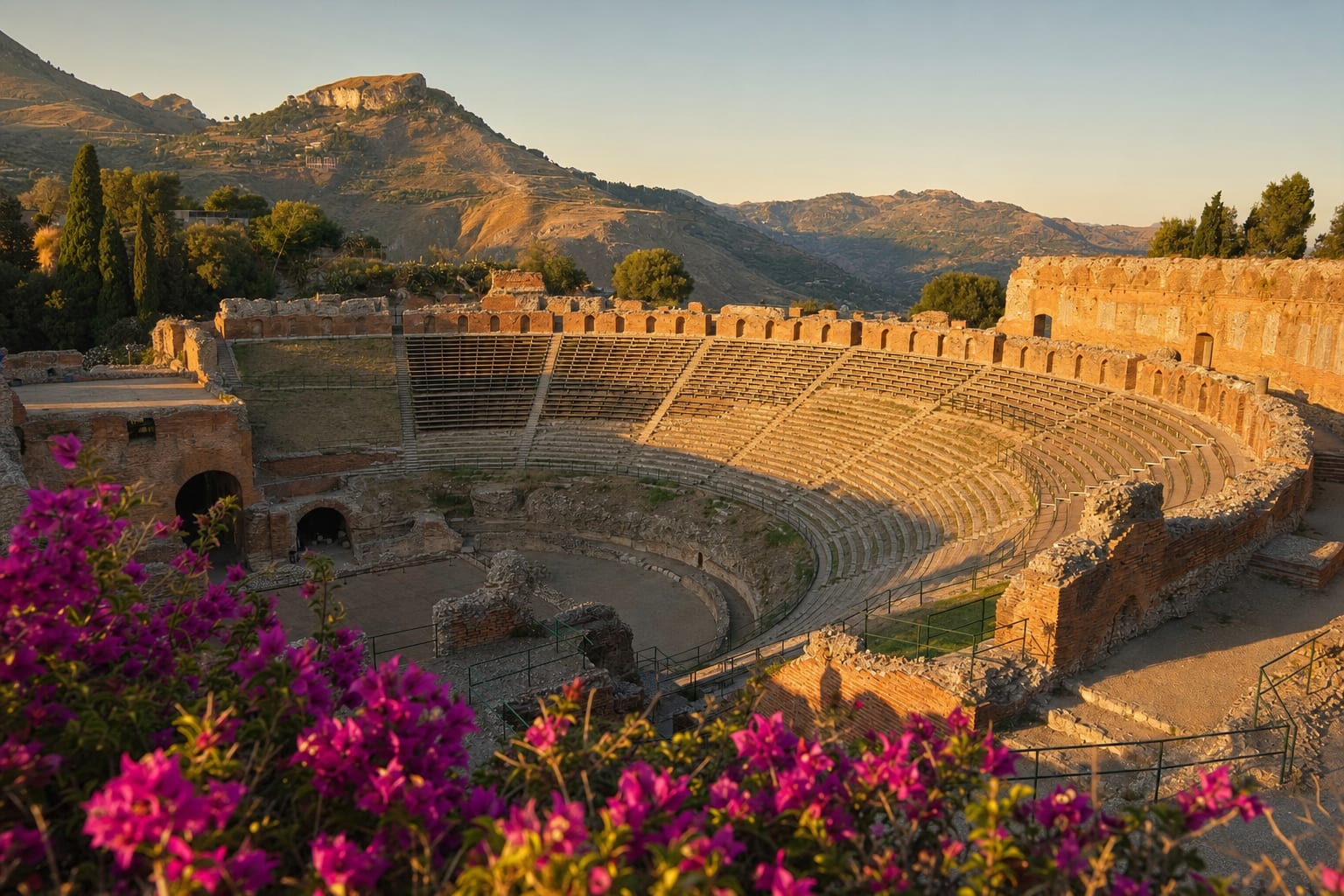
Greek theatre framing Etna, sea-and-volcano backdrop, summer festival stage, brick Roman scaena.

Photograph · Teatro Antico di Taormina

At a glance

Ancient Theatre of Taormina facts that matter

Names, makers, dates, and context before the story opens up.

Italian nameTeatro Antico di Taormina
What it isArchaeological site
WhereTaormina, Sicily
Known forGreek theatre framing Etna, sea-and-volcano backdrop, summer festival stage, brick Roman scaena

The story

What you're looking at

The Greeks aimed this theatre at Etna and the sea, and no stage set since has matched the view through its broken scaena. Concerts and film festivals still play to the horseshoe each summer.
Verified details

Each statement below is linked to the record or institution that supports it.

The Ancient Theatre of Taormina is an archaeological theatre on the crest of the hill at Taormina, within the Parco archeologico di Naxos e Taormina. It is a layered Greek and Roman monument, not a surviving Greek theatre in an unchanged state.1,2

The original layout is attributed to the 3rd or 2nd century BCE. The regional park identifies Greek-period evidence in an isodomic block wall incorporated into the stage building, inscribed cavea seats preserved in the western entrance hall, and remains of a small sacred building at the cavea's summit.1,2

The visible monument belongs chiefly to Roman reconstruction, especially a major rebuilding in the first half of the 2nd century CE, attributed by the park to the age of Trajan or Hadrian. The Roman enlargement overlaid the small sacred building at the top of the cavea.1,2

The cavea has a 109-metre diameter. The stage front retains the two lateral hospitalia openings, while the central regia opening has collapsed. The standing reconstruction of the scaenae frons columns is a 19th-century restoration, not intact ancient fabric.1

Between the 2nd and 3rd centuries CE, the theatre was converted into an arena through an annular corridor, a raised parapet, and an underground space used for equipment and possibly animal cages. The park treats cages as a possibility, not a certainty.1

The Casina degli Inglesi, formerly the theatre's 19th-century Antiquarium, houses Taormina's epigraphic collection. The park identifies mainly public Greek inscriptions dated between the 2nd and 1st centuries BCE, including strategists' and gymnasiarchs' tables and financial accounts.1

Sources and citations (2)
  1. Parco archeologico di Naxos e TaorminaTeatro antico di TaorminaOpening descriptionRead source
  2. Ministero della CulturaTeatro anticoDescriptionRead source

Plan your visit

Before you go

Booking
Walk-up friendly

Find it

Where to find Ancient Theatre of Taormina

Get directionsGoogle MapsApple Maps