

Skip to content

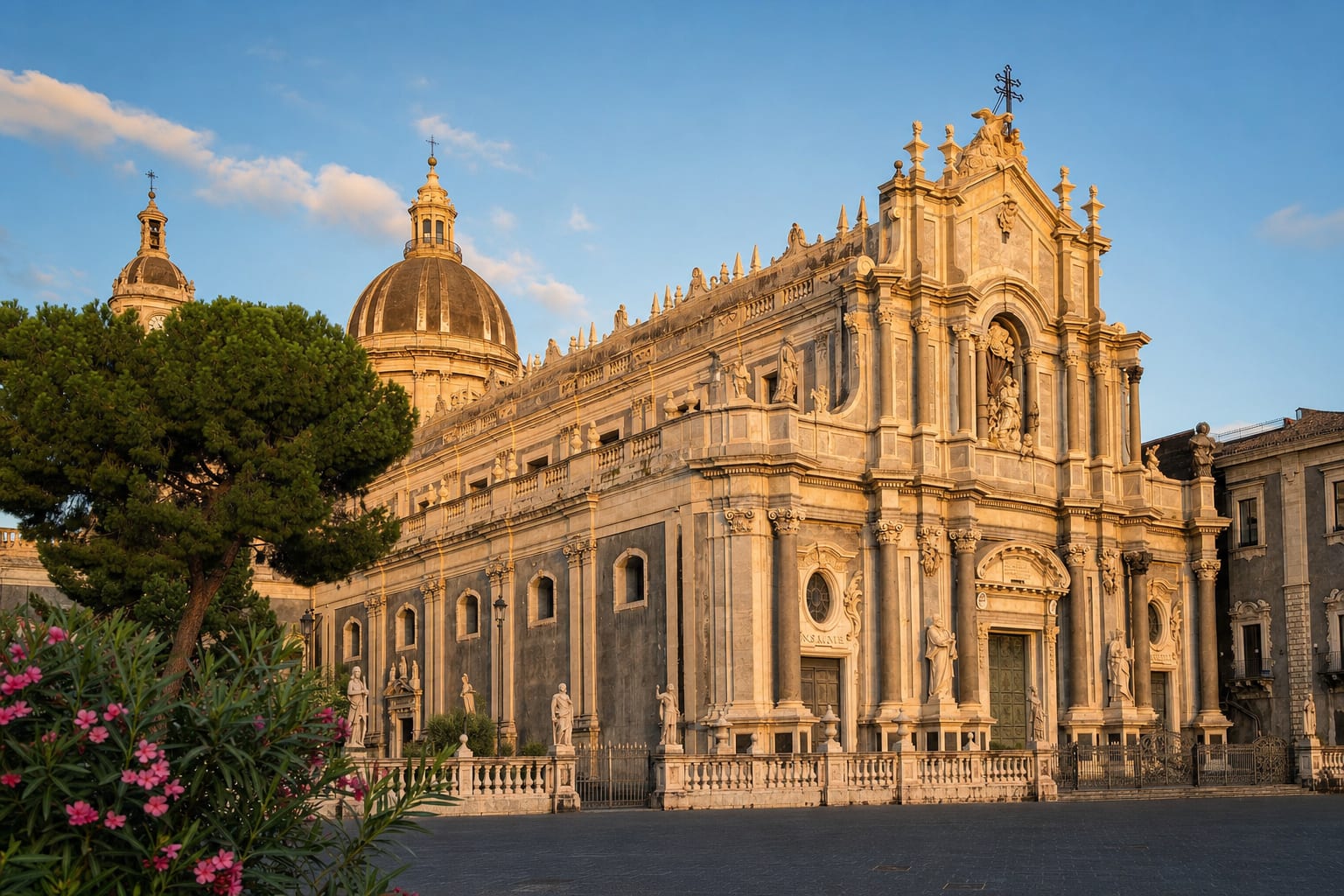
Cattedrale di Sant'Agata

Catania Cathedral

Saint Agatha's shrine, lava-and-limestone Baroque, Norman apses surviving quakes, Bellini's tomb.

Photograph · Cattedrale di Sant'Agata

At a glance

Catania Cathedral facts that matter

Names, makers, dates, and context before the story opens up.

Italian nameCattedrale di Sant'Agata
What it isChurch
WhereCatania, Sicily
Known forSaint Agatha's shrine, lava-and-limestone Baroque, Norman apses surviving quakes, Bellini's tomb

The story

What you're looking at

Catania's cathedral wears the city's two materials, black lava and white limestone, over Norman apses that have shrugged off earthquakes and eruptions alike. Bellini rests inside, and Saint Agatha's February festival fills the square beyond capacity.
Verified details

Each statement below is linked to the record or institution that supports it.

Catania Cathedral is the Cathedral of Saint Agatha on Piazza Duomo, an ecclesiastical monument whose documented fabric combines Norman survivals with major later reconstruction.1

The City records that Norman rulers built the Cathedral between 1092 and 1094. Its account treats the earlier-cathedral question as debated and notes that the area became strategically central with the Norman fortified church complex.1

The Cathedral sustained serious damage in the 1118 earthquake, including collapse of a high bell tower. The 1693 earthquake caused such extensive collapse that the building was almost wholly reconstructed; Bishop Galletti called Giovan Battista Vaccarini in 1729, and the cathedral reopened for worship in 1761.1

The rebuilding did not end with the 1761 reopening. Carmelo Battaglia Santangelo worked on the cathedral through 1804, and the present campanile was built between 1867 and 1869 to a design by Carmelo Sciuto Patti. The City also records further nineteenth- and twentieth-century changes to the interior.1

At the end of the three aisles, the presbytery marks the transition from the eighteenth-century part of the church to Norman apses. The City identifies their pointed lava-stone arches and notes that the three Norman apses are visible from Via Vittorio Emanuele II.2

Within the right apse is the Chapel of Saint Agatha, where the City identifies the sacred enclosure holding the patron saint's reliquary bust and reliquary chest. The municipal record dates the bust to 1373 and attributes it to Giovanni di Bartolo, while identifying later remaking of the chest.1,2

Sources and citations (2)
  1. City of Catania TourismLa Cattedrale di Sant'AgataIdentity, construction dates, and historical notesRead source
  2. City of Catania TourismDuomoL’area presbiterialeRead source

Plan your visit

Before you go

Booking
Walk-up friendly

Find it

Where to find Catania Cathedral

Get directionsGoogle MapsApple Maps