

Skip to content

Duomo di Siracusa

Syracuse Cathedral

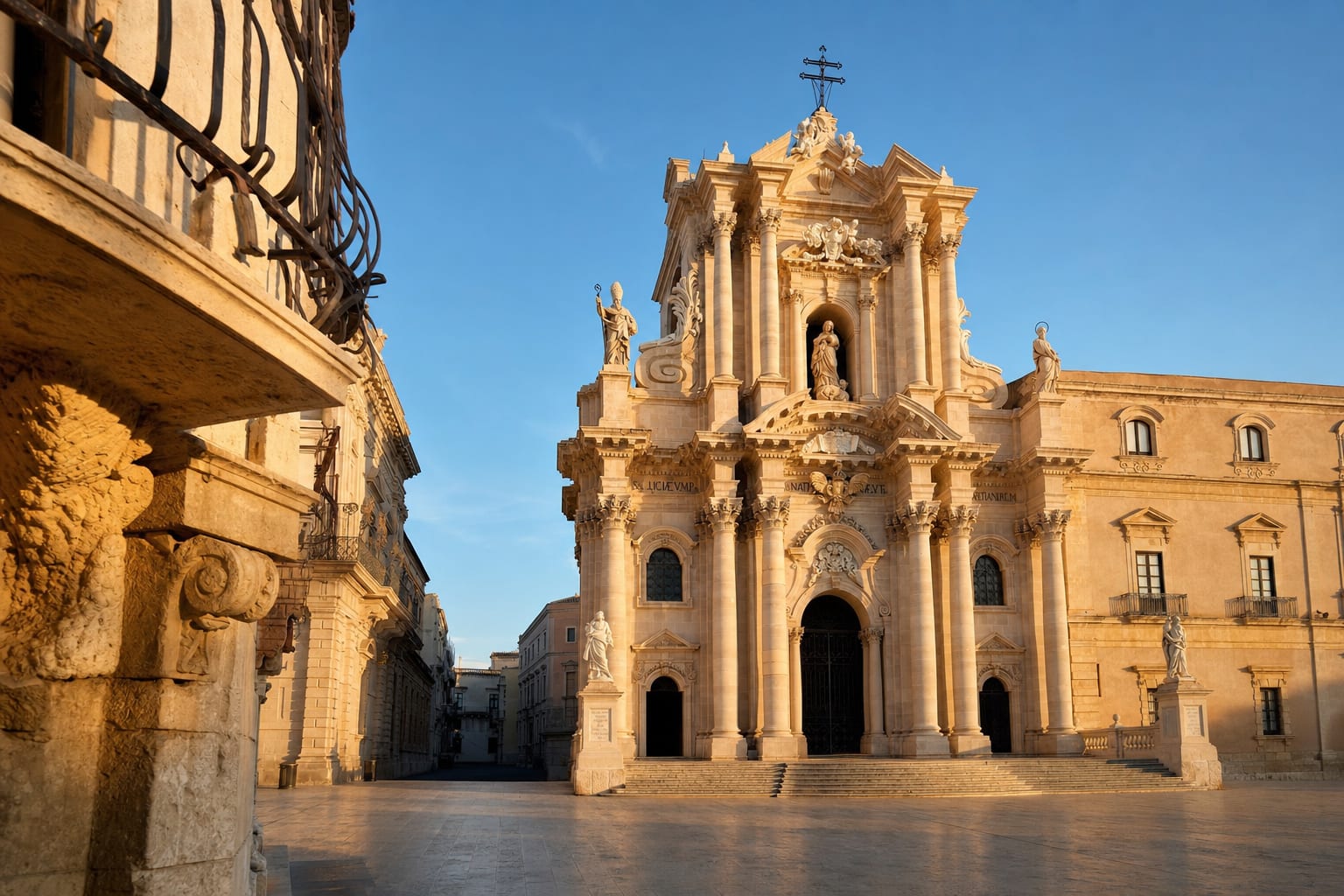
Doric columns inside the walls, temple of Athena conversion, Baroque facade, 2700 years of worship.

Photograph · Duomo di Siracusa

At a glance

Syracuse Cathedral facts that matter

Names, makers, dates, and context before the story opens up.

Italian nameDuomo di Siracusa
What it isChurch
WhereOrtigia, Sicily
Known forDoric columns inside the walls, temple of Athena conversion, Baroque facade, 2700 years of worship
UNESCOWorld Heritage setting

The story

What you're looking at

The Doric columns of Athena's temple still stand inside the cathedral's walls, doing structural work after twenty-five centuries. A swaggering Baroque facade was added after the 1693 earthquake, the newest layer on Sicily's longest-running sanctuary.
Verified details

Each statement below is linked to the record or institution that supports it.

Syracuse Cathedral, the Duomo on Ortygia, is an active cathedral formed through the adaptation of the ancient Doric Temple of Athena. It lies within the UNESCO World Heritage property Syracuse and the Rocky Necropolis of Pantalica, inscribed in 2005, but is not separately inscribed.1,2

The cathedral incorporates the Doric Temple of Athena, built in the early 5th century BCE. The Archdiocese describes it as a peripteral hexastyle temple with 36 columns, and its original Doric columns remain visible on the cathedral's north side and within the building.1,2

In late antiquity the temple was adapted to a Christian basilica: the intercolumniations were closed and eight arches were opened on each long side of the cella, creating a central nave and side aisles. UNESCO describes the Temple of Athena as reused as a church from the 6th century CE, while the Archdiocese dates the basilical church from the 7th century; evergreen copy should preserve the late-antique conversion without forcing one disputed century.1,2

The cathedral's later fabric includes Norman rebuilding after the Arab period, a new roof and portions of the central-nave walling, and Renaissance paintings on the exposed 14th-century trusses dated by the Archdiocese to 1518. Earthquakes in 1542 and 1693 damaged the building; subsequent Baroque work altered the apse configuration, presbytery, chapels and principal façade.1,2

Early-20th-century restoration under Bishop Bignami continued until 1927 and sought to recover the temple's underlying lines from later stucco. The cathedral was reconsecrated on 9 January 1927 and dedicated to Christ the King and Mary Born.1

These sources establish the building's layered history, surviving temple fabric, ecclesiastical identity and property-level World Heritage relationship. They do not establish current worship times, visitor entry, ticketing, security rules, accessibility, ceremonies, temporary closures, photography policy or media rights.1,2

Sources and citations (2)
  1. Arcidiocesi di SiracusaChiesa CattedraleHistorical introductionRead source
  2. UNESCO World Heritage CentreSyracuse and the Rocky Necropolis of PantalicaProperty description and inscription dataRead source

Plan your visit

Before you go

Booking
Walk-up friendly

Find it

Where to find Syracuse Cathedral

Get directionsGoogle MapsApple Maps