

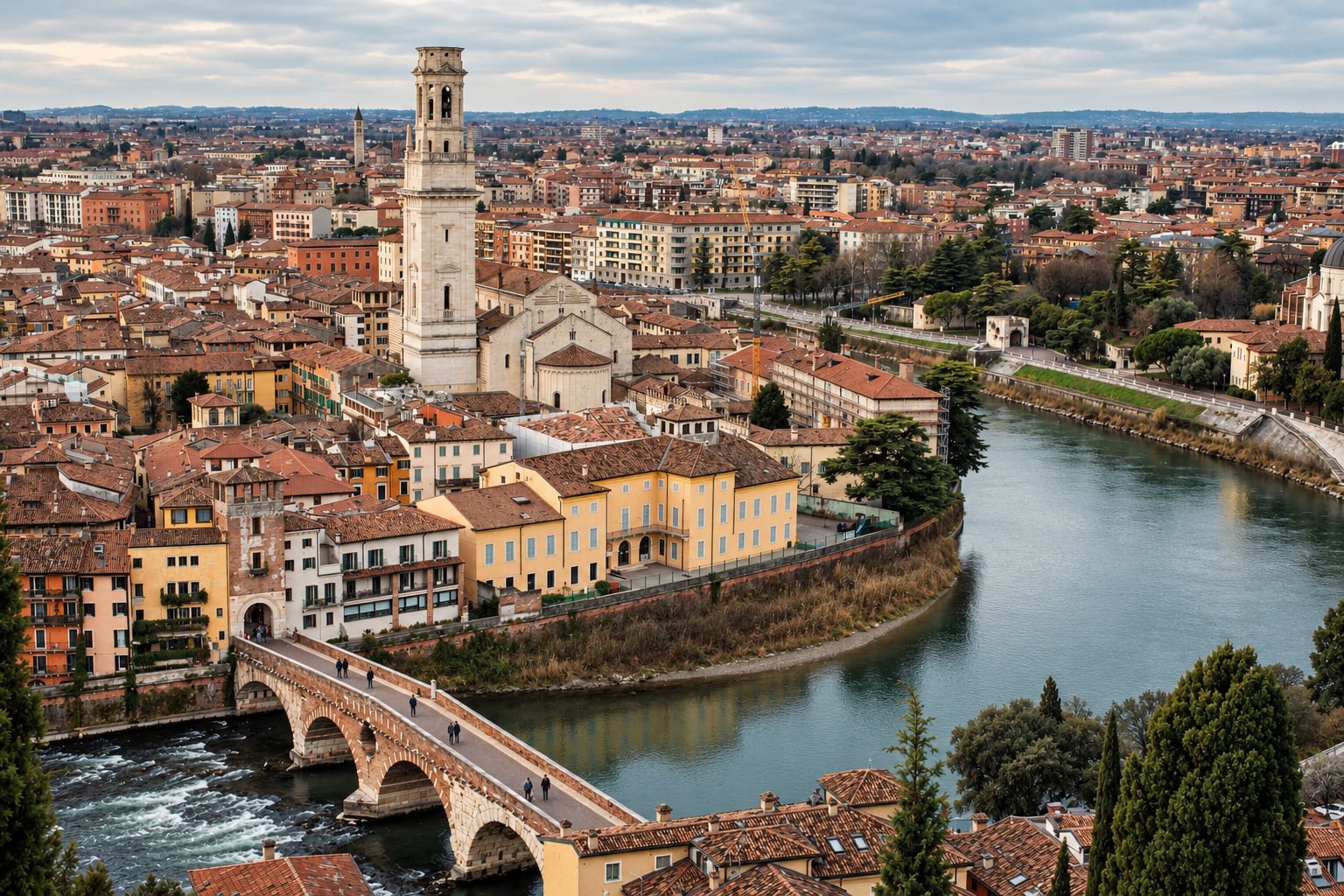
All the monuments, city by city
The landmarks and masterpieces worth planning a day around.
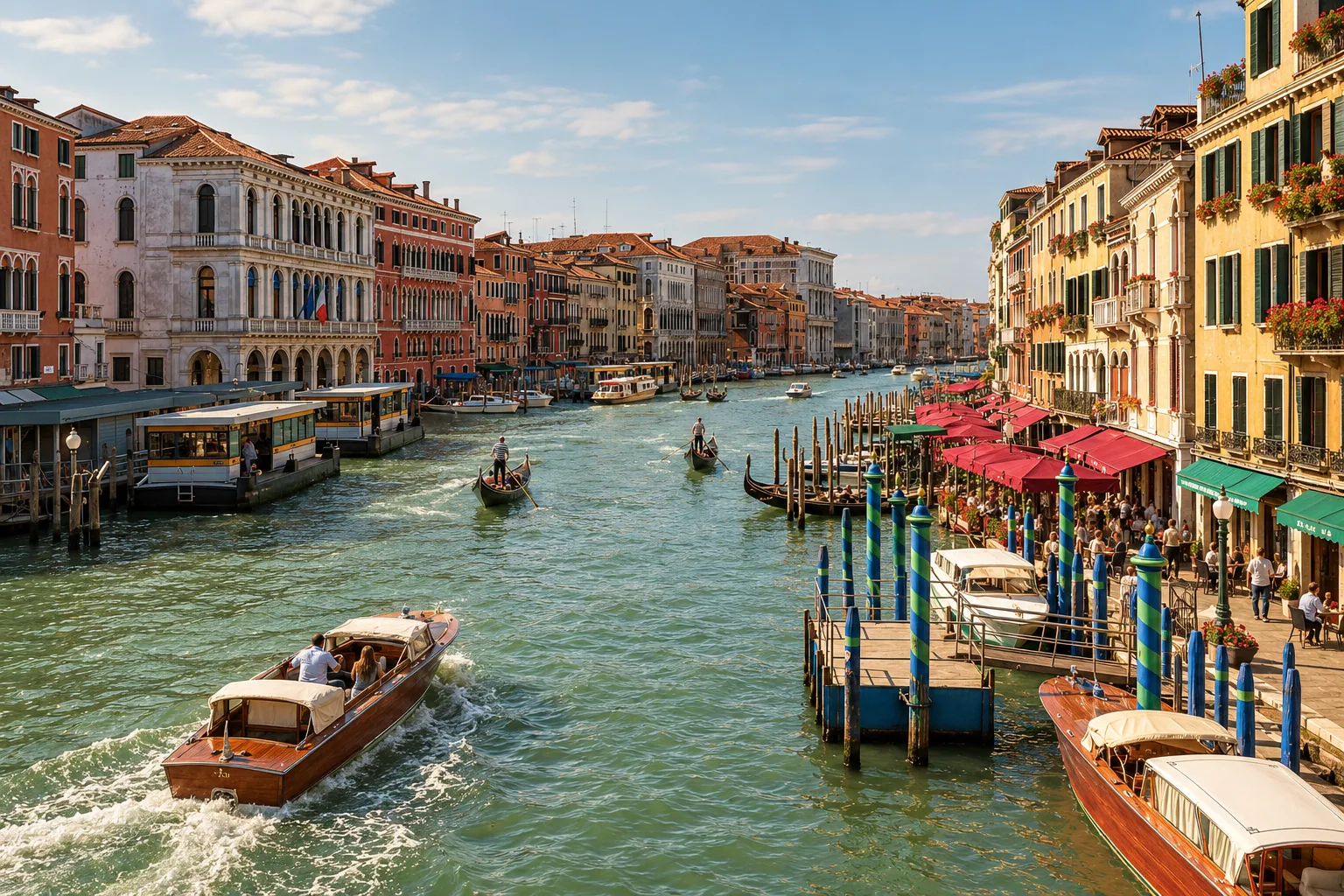 VeniceGrand CanalVenice's main street of water, palace facades, vaporetto Line 1, reverse-S sweepThe Grand Canal traces what was likely once a branch of the Brenta River, and it became Venice's central artery once the doge's seat moved to the Rialto area in the early ninth century. Its reverse-S curve runs about 3.8 kilometers from the railway station to St. Mark's Basin, lined by more than 170 palazzi built mostly between the thirteenth and eighteenth centuries as Venice's noble families competed to outbuild one another along its banks: Ca' d'Oro's Gothic lace facade and Ca' Foscari among the best known. For nearly a thousand years the Rialto Bridge was the only fixed crossing, and even now just four bridges span it, so most Venetians still cross by traghetto or simply walk to the nearest one. Mechanized public transport (the vaporetto) has run its length since 1881, though routes and fares always need checking on the day, since Venice adjusts them often.Plan the visit
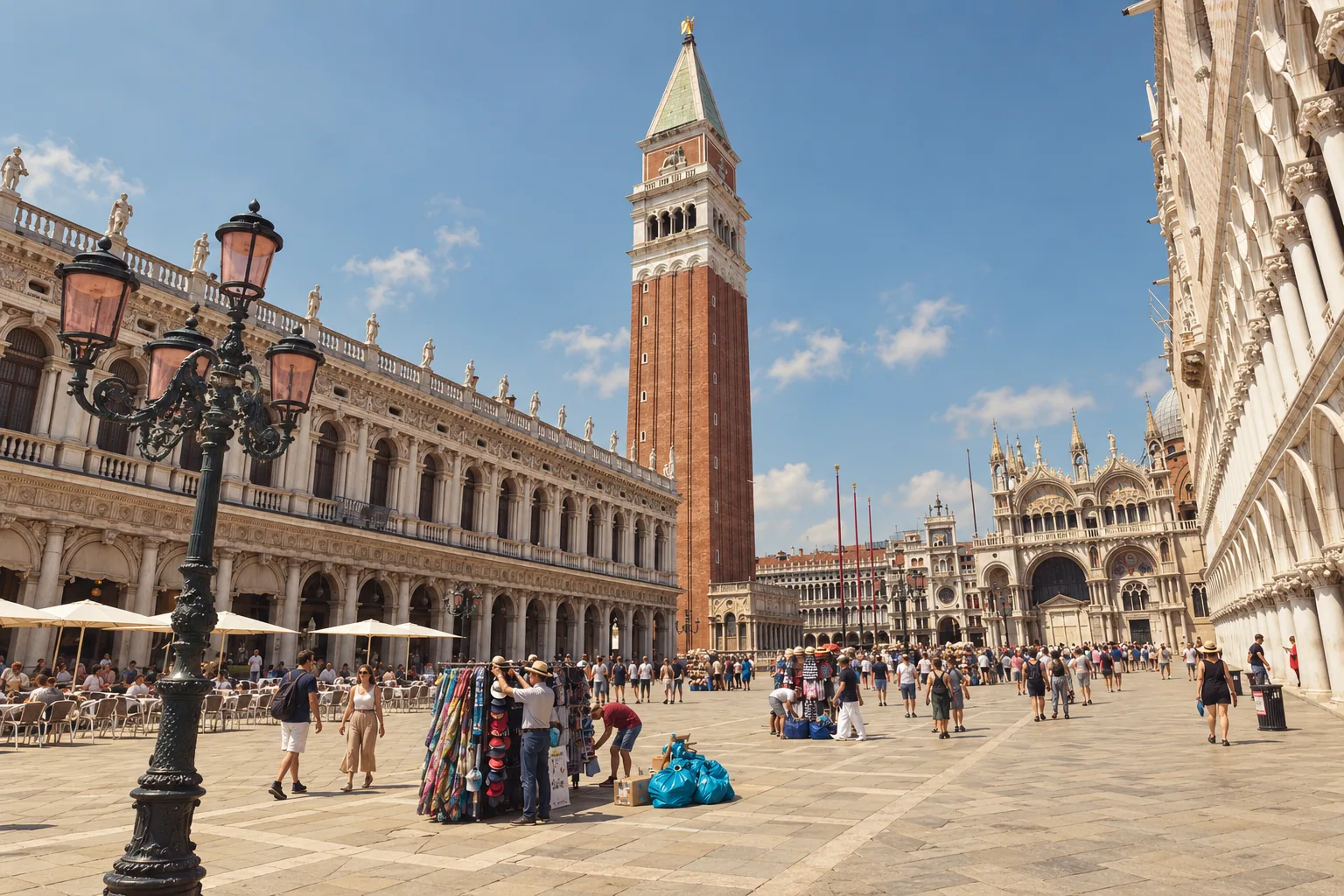 VeniceSt. Mark's SquareNapoleon's "drawing room of Europe," the Campanile, Procuratie arcades, acqua alta floodingVenetians call it simply la Piazza, since it is the only square in the city entitled to the word; everywhere else is a campo. Doge Sebastiano Ziani gave it its current footprint in the 1170s, filling in a canal and shifting a church to open the space in front of St. Mark's Basilica, whose four bronze horses (looted by Napoleon in 1797 and restored in 1815) still preside over the western end. The Clocktower dates to 1499, Sansovino redesigned the Biblioteca Marciana in the 1530s, and the long arcaded wings, the Procuratie Vecchie and Nuove, once housed the republic's chief magistrates and now shelter cafés including Caffè Florian, open since 1720. Low-lying and close to sea level, the square floods during acqua alta storm surges, when raised walkways appear overnight and the pavement briefly mirrors the basilica's domes.
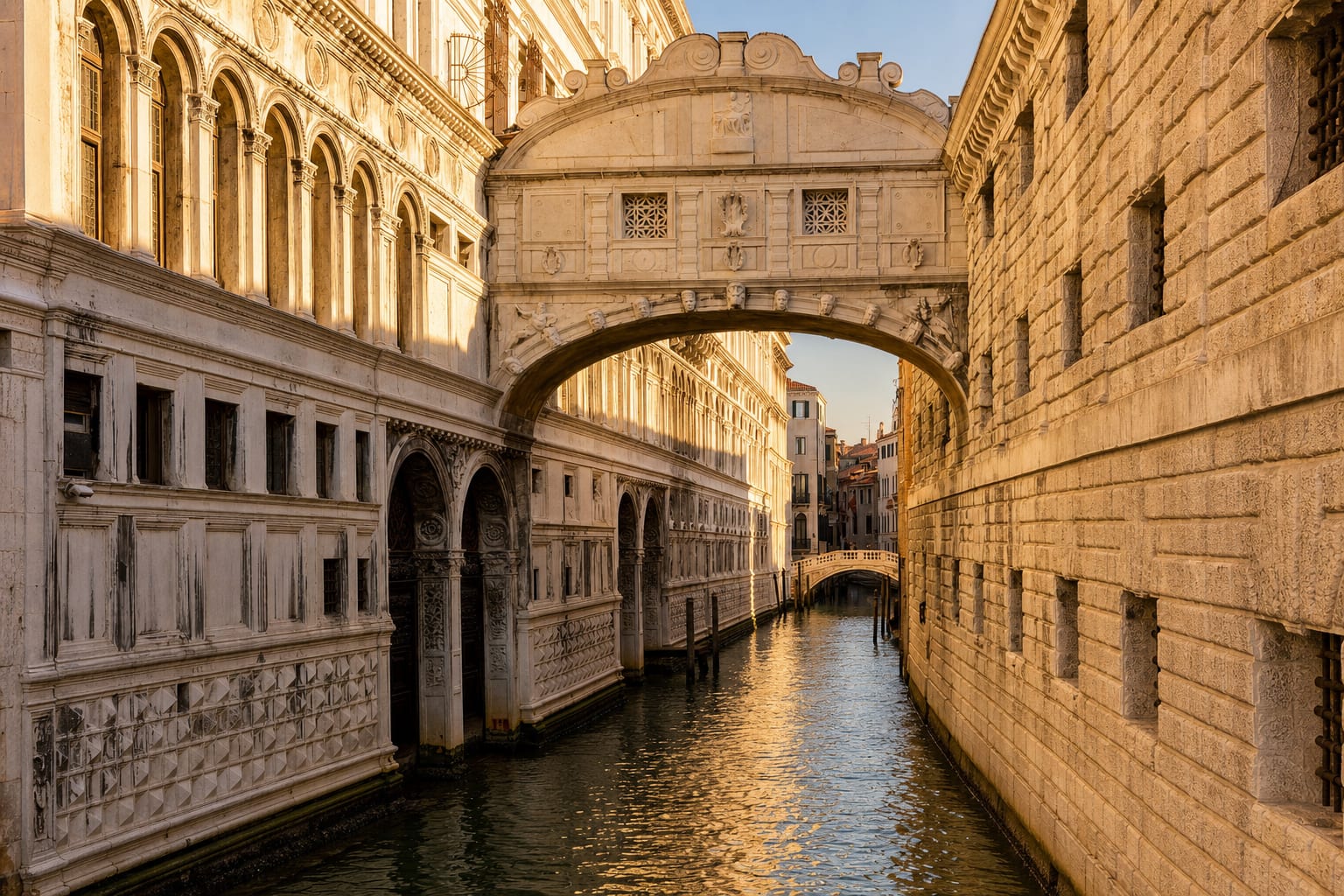 VeniceBridge of SighsEnclosed prison bridge, last view of the lagoon legend, Baroque limestone screen, gondola vantageVenice built this enclosed limestone crossing around 1600 to solve an overcrowding problem: the Doge's Palace dungeons, the pozzi, could no longer hold everyone awaiting trial, so architect Antonio Contin (nephew of Antonio da Ponte, who had built the Rialto) designed a covered bridge linking the interrogation rooms to a new prison across the Rio di Palazzo. Two separate corridors run inside, divided by a wall so prisoners walking each direction could never meet, lit only by small stone-grilled windows. Its wistful English name is a nineteenth-century invention, popularized by Lord Byron, who imagined condemned prisoners sighing at their last glimpse of the lagoon through the grille; Venetians of the time gave it no such name. Visitors can view it from the Ponte della Paglia or from a gondola on the canal below, or walk through its interior with a ticket to the Doge's Palace.
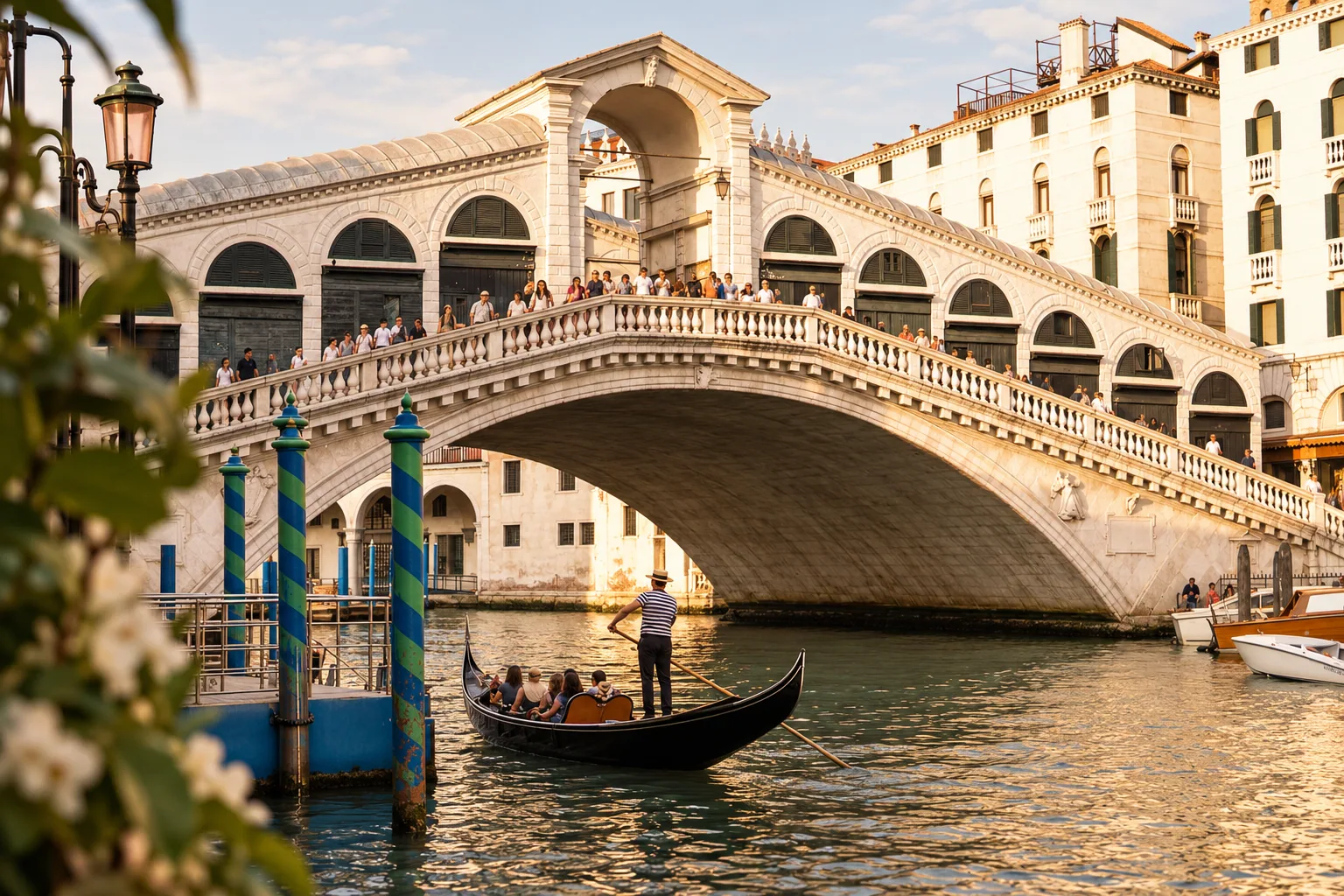 VeniceRialto BridgeSingle stone span of 1591, shop-lined arcades, Grand Canal crossing, market quarter gatewayA pontoon crossing built in 1181 was the first bridge at this narrow point of the Grand Canal, near Venice's main marketplace; it was rebuilt in wood, fitted with a drawbridge section, burned once in a 1310 conspiracy and collapsed twice more under crowds before the Republic finally commissioned a stone replacement. Antonio da Ponte won the commission over Palladio, Sansovino and Michelangelo's own former pupil Vignola, and his single-arch design, considered so daring at the time that architect Vincenzo Scamozzi predicted it would collapse, was built between 1588 and 1591 and has stood ever since. Two ramps rise to a central portico lined with shops on both sides, a commercial function the bridge has kept since it opened, and it remained the only fixed crossing of the Grand Canal until the nineteenth century. Shakespeare even has Shylock name it in The Merchant of Venice, written within a few years of its completion.
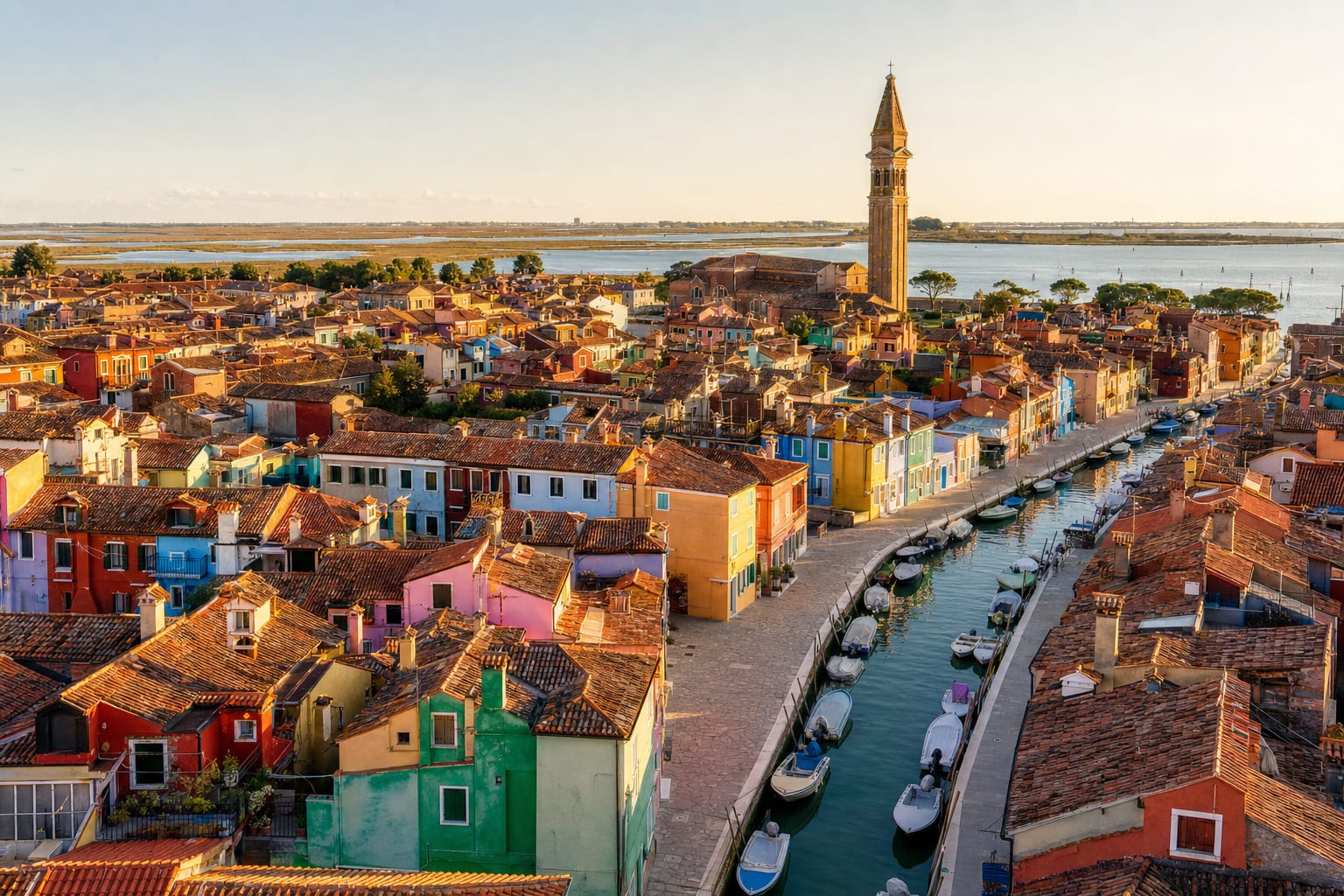 BuranoBuranoPainted fishermen's houses, lace-making tradition, leaning campanile, lagoon colorsFishermen on this lagoon island, administered for centuries from neighboring Torcello, are said to have painted their houses in bold, saturated colors so they could spot home through fog from far out on the water; whatever the origin, the tradition survives under a municipal rule that any repainting must match the shade already registered for that particular house. Burano rose to prominence in the sixteenth century when women here began making needle lace, a technique reportedly introduced through Venice's ties with Cyprus, that went on to dress European courts; a handful of lacemakers, and the Museo del Merletto, keep the tradition visible today, though most lace sold in shop windows now is machine-made elsewhere. The island's leaning campanile, tilted for so long that Galileo himself is said to have taken an interest, rises over a population of under 3,000 packed into one of the most densely built stretches of the lagoon.
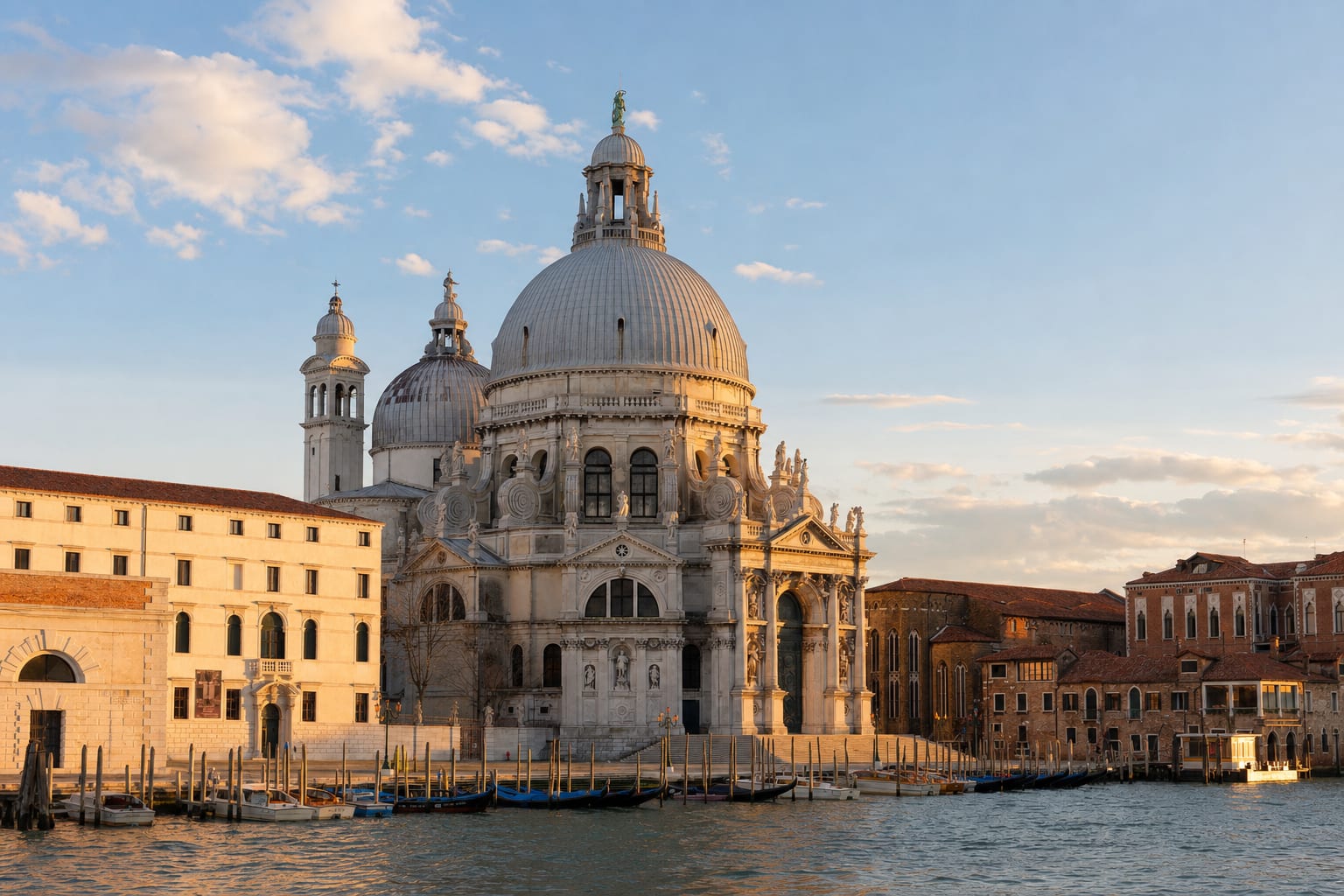 VeniceSanta Maria della SalutePlague-vow basilica, Longhena's octagon, scrolled buttresses, Punta della Dogana silhouetteThe Venetian Senate vowed to build this church in 1630, at the height of a plague outbreak that would eventually kill roughly a third of the city's population, promising the Virgin Mary a shrine in exchange for deliverance. Baldassare Longhena, still in his twenties and a student of Vincenzo Scamozzi, won the design commission and spent the rest of his career, decades, seeing it built: a broad octagon crowned by a great dome and ringed by dramatic scrolled buttresses, or volutes, that visually anchor the whole structure to the ground. It occupies the Punta della Dogana, the narrow spit where the Grand Canal meets the Giudecca Canal, making it one of the first things visitors see arriving from the lagoon and one of the most photographed skylines in Venice. Titian paintings hang in the sacristy, and every November 21, the Festa della Salute still sends a procession across a pontoon bridge of boats to the church's door, exactly as it has since the plague first lifted.
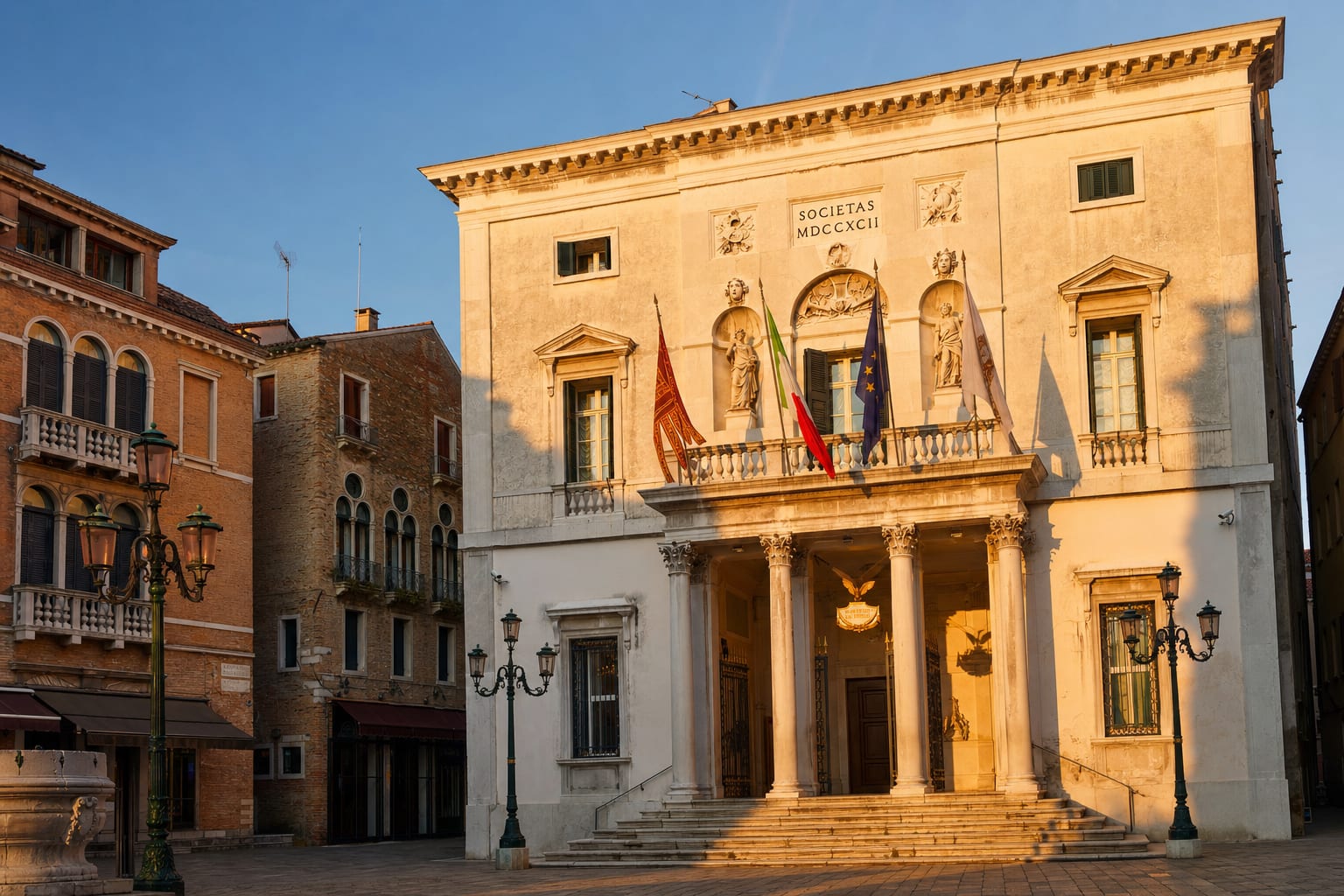 VeniceTeatro La FeniceThe phoenix opera house risen from three fires, Verdi premieres, gilded horseshoe hall, Maria Callas exhibitionVenice needed a new opera house after losing its leading theater to fire in 1774, and the replacement, opened in 1792, took the name La Fenice, the Phoenix, for its promise to rise again from any future disaster. It has had to keep that promise twice more: a second fire in 1836 saw the house rebuilt within a year, and a catastrophic arson fire in 1996 left only the exterior walls standing, with reconstruction, closely following the historic gilt-and-stucco design, finally reopening the theater in November 2004. In between disasters, La Fenice built a genuine claim to musical history, hosting premieres of Rossini's Tancredi, Bellini's I Capuleti e i Montecchi and Verdi's Rigoletto and La Traviata, and drawing conductors from Toscanini to Karajan and Bernstein onto its podium. Visitors can walk the horseshoe of boxes on a self-guided daytime tour, which also includes a permanent exhibition on Maria Callas's years performing here.
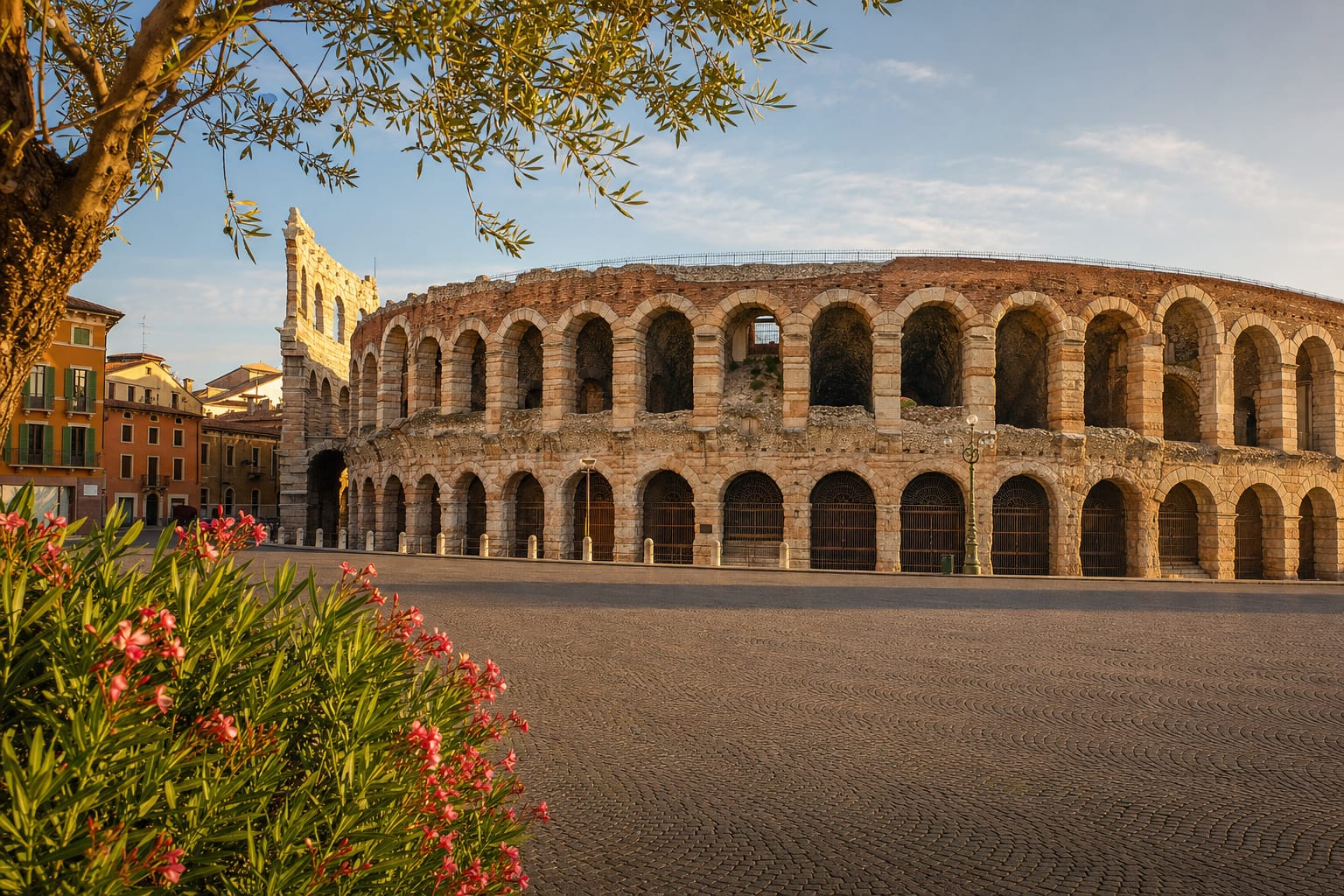 VeronaArena di VeronaFirst-century amphitheatre, summer opera festival, the ala arches, pink Veronese stoneVerona's Arena is a Roman amphitheatre from the first century CE, built of pink-and-white local stone on the edge of Piazza Bra for gladiators and public spectacles. The earthquake of 1117 brought down almost all of the outer ring, and the three surviving arches, called the ala, still stand as the monument's silhouette; the elliptical interior kept the tiered seating, restored across the centuries. In 1913 it staged its first opera, Aida, for the centenary of Verdi's birth, and it has become one of the most atmospheric opera houses in the world. It sits within, and is not a separately inscribed part of, the UNESCO property City of Verona.
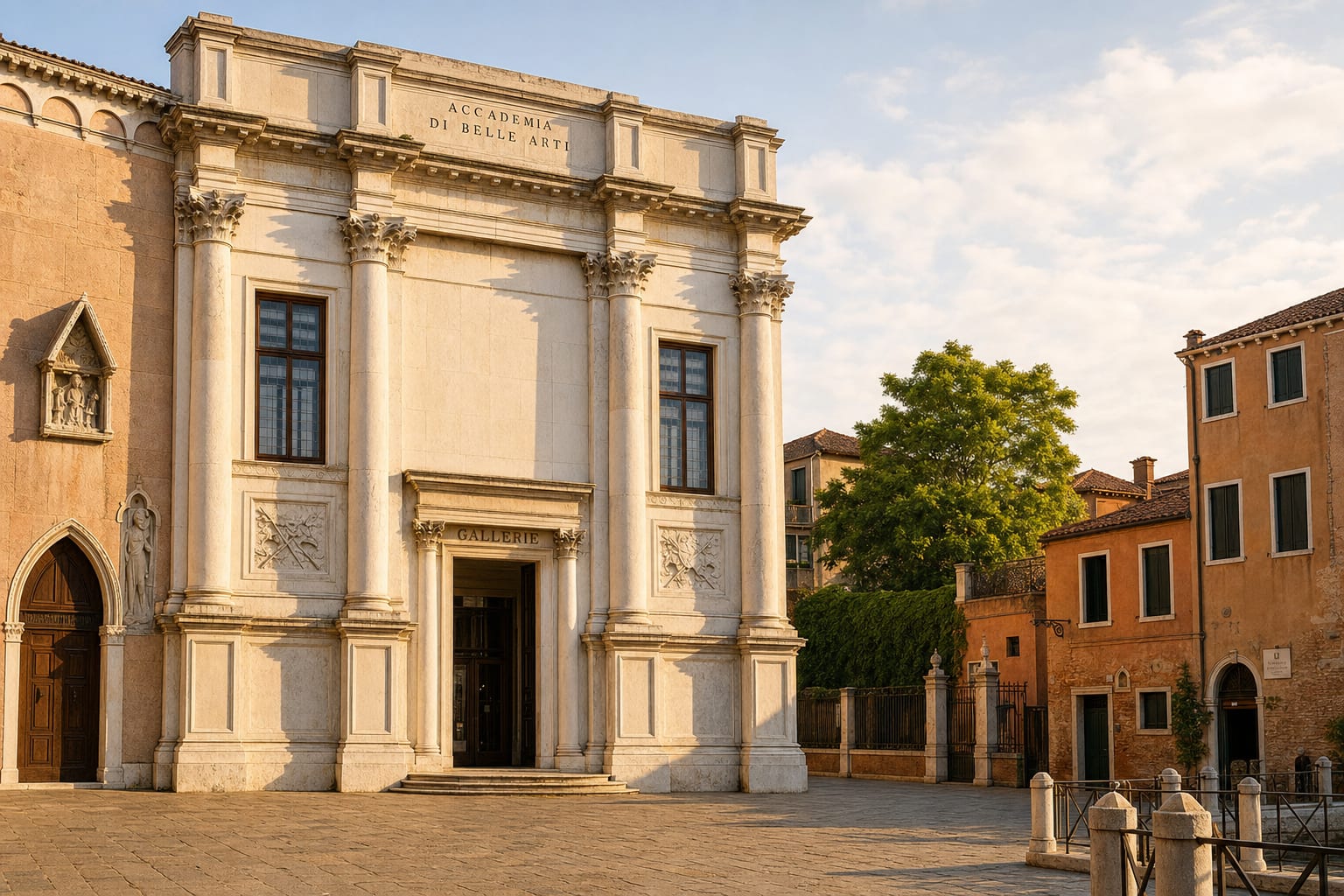 VeniceGallerie dell'AccademiaVenetian painting's full arc, Veronese's Feast, Giorgione's Tempest, Carpaccio's narrative cyclesNapoleon founded the Accademia di Belle Arti di Venezia in 1807, installing its gallery in the former Scuola Grande, church and convent of Santa Maria della Carità, and filled its early collection largely with paintings confiscated from suppressed churches and monasteries across the fallen Venetian Republic. What resulted is close to a complete survey of five centuries of Venetian painting under one roof: Giovanni Bellini's serene madonnas, Giorgione's small, still-unexplained Tempest, which has kept scholars guessing at its meaning for five hundred years, and Paolo Veronese's enormous Feast in the House of Levi, originally painted as a Last Supper and renamed only after the Inquisition objected to its riot of dwarves, drunkards and dogs. Vittore Carpaccio's narrative cycles round out the collection, painted panel by panel like an unfolding comic strip. The academy of art itself moved to separate quarters in 2004, leaving the museum to occupy the entire historic complex.
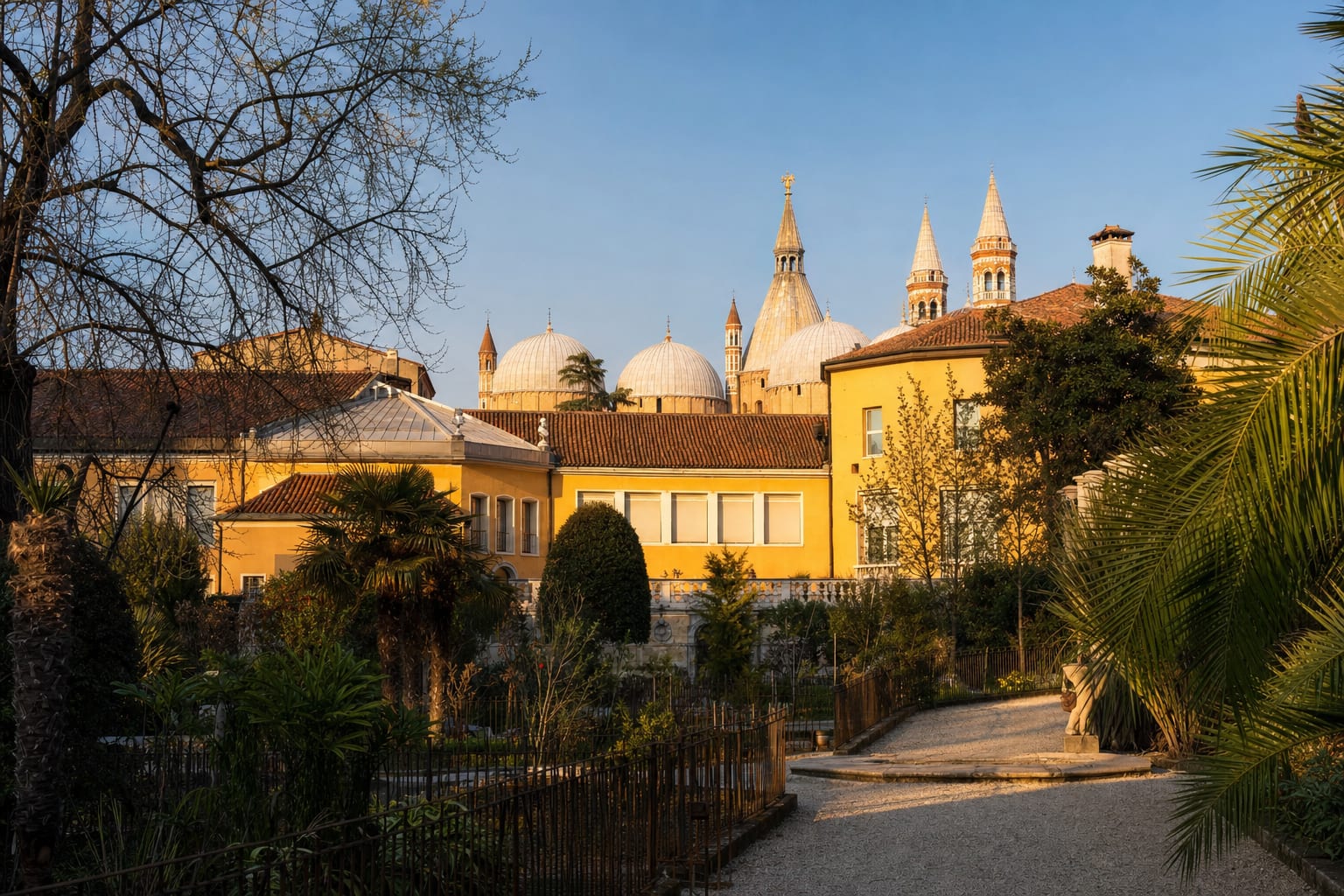 PaduaUNESCOPadua Botanical GardenWorld's oldest academic garden, Goethe's palm, circular Renaissance plan, medicinal plantsPadua's Orto Botanico was founded in 1545 by the Venetian Republic so that medical students could learn to tell real medicinal plants from dangerous look-alikes, and it has stayed in the same place ever since, making it the oldest academic botanical garden in the world still at its original site. Its layout is the point: a square inscribed in a circle 84 meters across, cut into four beds by paths to the cardinal directions, designed by the Venetian nobleman Daniele Barbaro. The oldest plant, Goethe's palm, a dwarf palm planted in 1585, grows in its own greenhouse; Goethe cited it in his essay on the metamorphosis of plants. UNESCO inscribed the garden in 1997, and today it grows some six thousand kinds of plants.
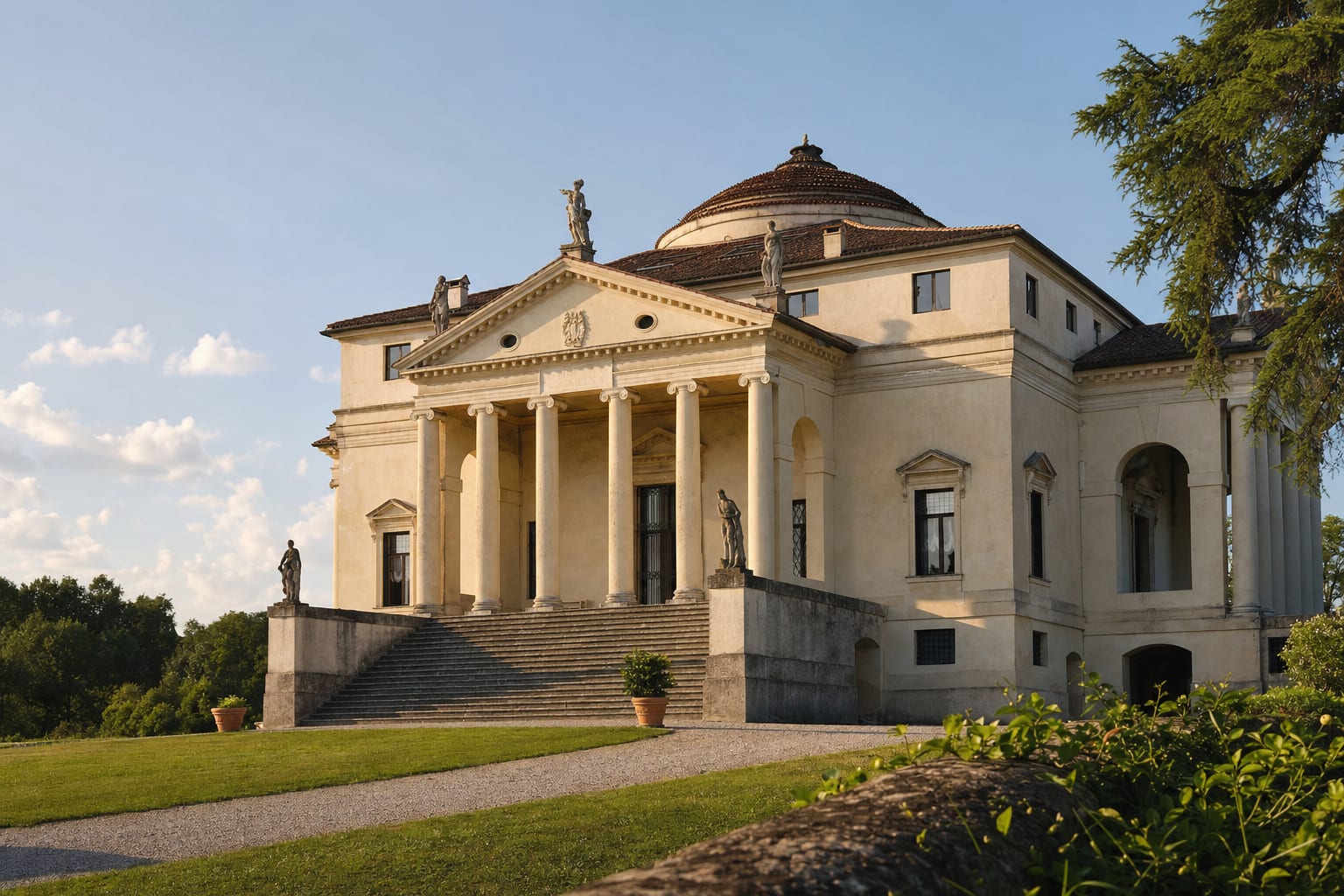 VicenzaUNESCOVilla La RotondaFour identical porticoes, central dome inspired by the Pantheon, template for villas and capitols worldwidePaolo Almerico, a papal clerk retiring to his native Vicenza, commissioned this villa in 1565 not as a working farmhouse but, unusually for its time, as a pure country retreat with no agricultural estate attached, and Andrea Palladio answered with a design that borrowed its dome and portico directly from the Pantheon in Rome. Four identical porticoed facades face the four points of the compass from a domed central hall, treating every approach as equally important rather than favoring a single grand front, a symmetry Palladio never repeated at this scale. Construction dragged on past Almerico's death, and the Capra brothers, who bought the unfinished property in 1592, completed it and gave the villa the alternate name Villa Capra by which it is also known. Its influence proved vast: Thomas Jefferson studied it in planning Monticello, and versions of its dome-on-cube formula turned up on capitols, banks and country houses across Europe and the Americas for the next three centuries.
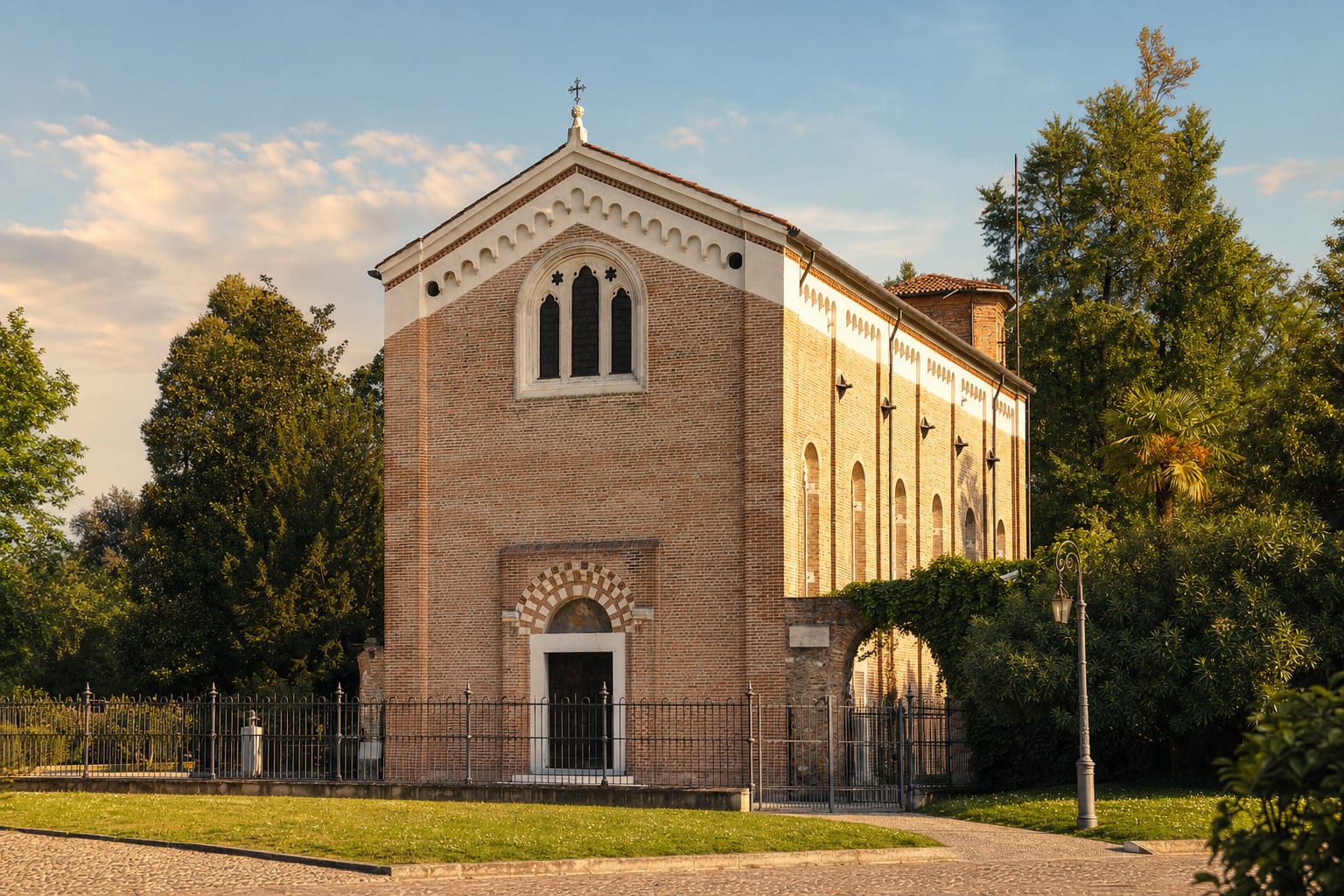 PaduaUNESCOScrovegni ChapelGiotto's fresco cycle, Last Judgment wall, star-filled blue vault, birth of modern paintingEnrico Scrovegni built this chapel partly to atone for his father's usury (Dante later placed Reginaldo Scrovegni among the damned in the Inferno), and between 1303 and 1305 he hired Giotto to paint it floor to ceiling. The result changed European painting: Giotto gave his figures weight and grief instead of Byzantine flatness, and the Judas kiss and the mourning angels over Christ's body still read as real human moments eight centuries later. The west wall's Last Judgment shows Enrico himself, kneeling, handing a model of the chapel to the Virgin. Conservation rules are strict: visitors wait in a climate-controlled anteroom before a timed visit beneath the lapis blue, star-filled vault. UNESCO listed the chapel among Padua's fresco cycles in 2021.
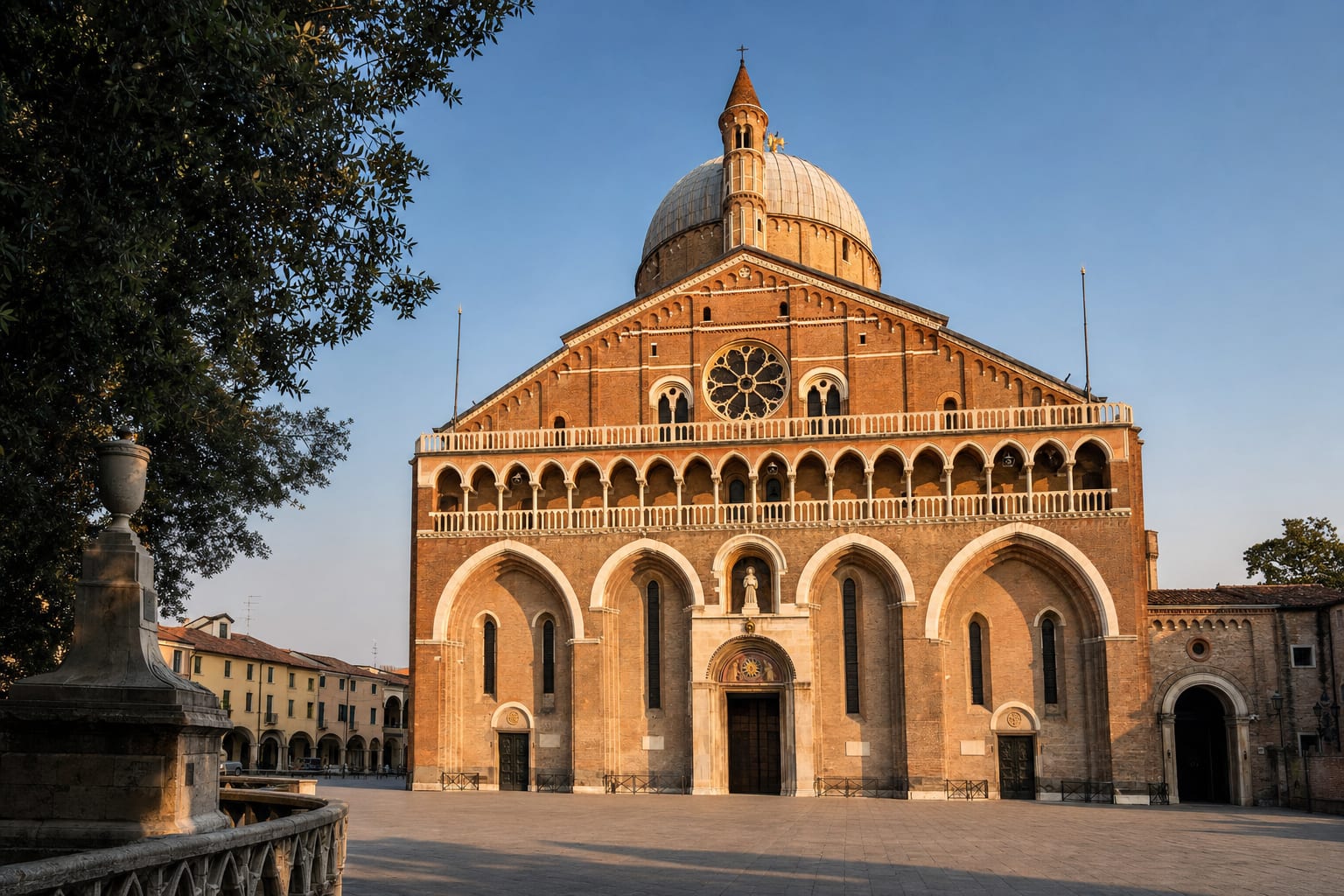 PaduaBasilica of Saint AnthonyPilgrimage basilica of the Saint, Donatello's high altar bronzes, Byzantine-influenced domes, the Gattamelata outsideConstruction began around 1232, just a year after Anthony of Padua's death, wrapping a growing basilica around the small church of Santa Maria Mater Domini where he had already been buried; the result, completed in essentially its present form by 1310, blends Romanesque, Gothic and Byzantine influences into a skyline of domes and slender towers that still locals simply call "il Santo." Pilgrims have never really stopped coming: the saint's tomb chapel, its walls carved with nine marble relief scenes of his miracles by multiple Renaissance sculptors, still draws a steady stream of visitors touching the marble in front of it. Donatello, working in Padua from 1443 to 1453, cast the bronze reliefs and statues for the high altar, then, in the piazza outside, created the Gattamelata, the first full-scale bronze equestrian monument since antiquity and a work that revived a form Roman sculptors had mastered a thousand years earlier. Two of the basilica's chapels also form part of a UNESCO-listed fresco cycle recognized in 2021.
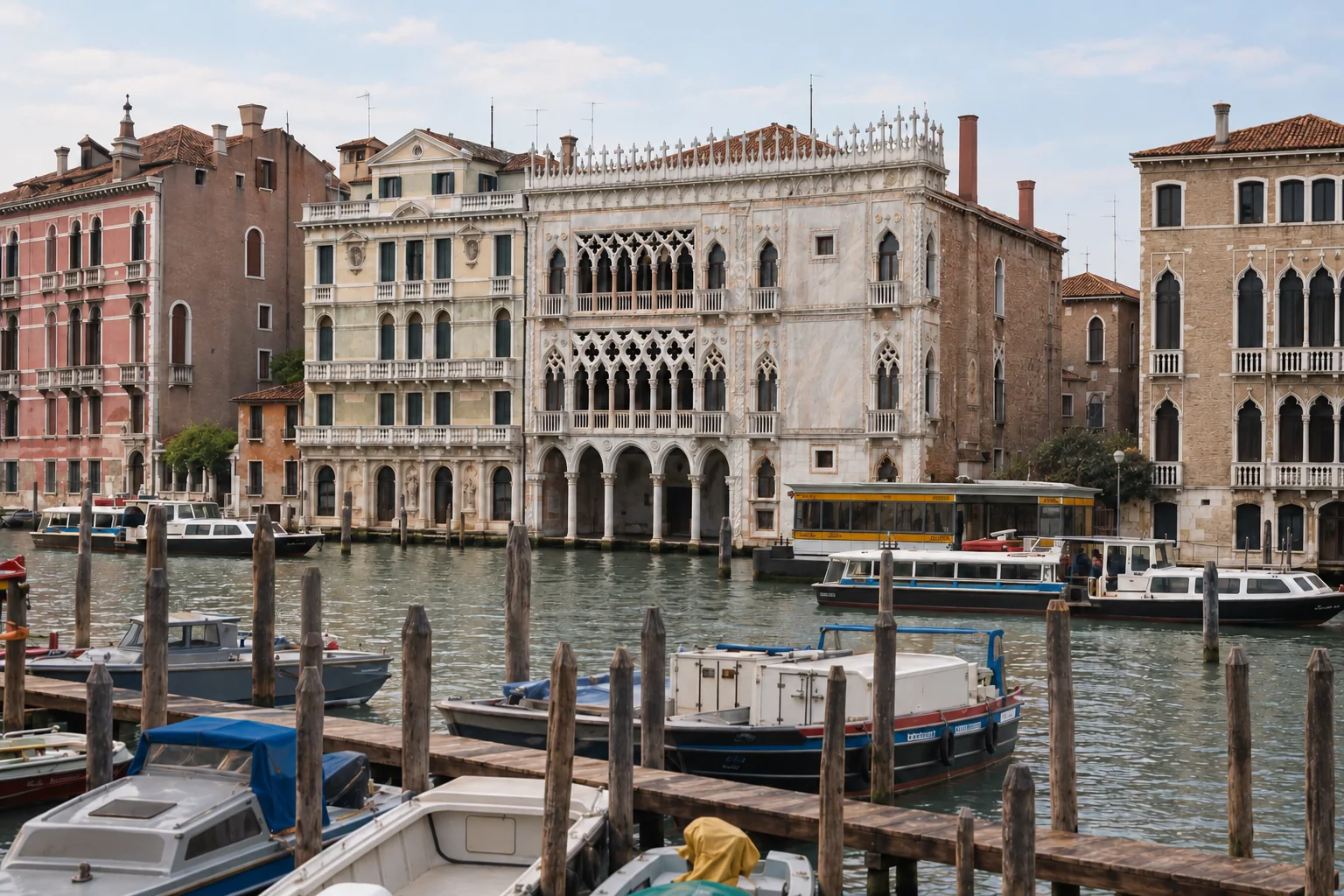 VeniceCa' d'OroIts openwork Gothic loggias, lost facade colors, Franchetti’s opus sectile floor and collection, and Mantegna’s Saint Sebastian.On the Grand Canal, the Ca’ d’Oro is both a Venetian Gothic palace and the setting of a museum shaped by its collector. Marino Contarini commissioned its construction between 1421 and 1440, bringing together Lombard craftsmen led by Matteo Raverti and Venetian sculptors Giovanni Bon and his son Bartolomeo. The French painter Jean Charlier, known in Venice as Zuane de Franza, worked color into the marble and carved details: red, ultramarine blue, black, white lead and gold once marked the facade and pinnacles. That palette is gone, but the openwork loggias still give the palace its lace-like silhouette. Our <a href="/en/attractions/grand-canal">Grand Canal guide</a> places the palace among the waterway’s historic buildings; continue with our <a href="/en/regions/veneto/venice">Venice city guide</a> to plan the wider visit.
Giorgio Franchetti bought the palace in 1894 and donated the building and the nucleus of his collection to the Italian state in 1916; the museum opened in 1927. In the porticoed entrance atrium, his geometric opus sectile floor brings antique marbles into a design inspired by Venetian basilicas and Cosmatesque patterns. His first museum intervention was the so-called Mantegna Chapel, a marble-clad room arranged around Andrea Mantegna’s Saint Sebastian, which Franchetti acquired in 1893. In the courtyard, a pointed-arch stair was reassembled partly from original fragments, while the marble wellhead carved by Bartolomeo Bon dates to 1427. Read together, facade, atrium and chapel show the Gothic palace alongside Franchetti’s later vision for its collection.
VeniceCa' d'OroIts openwork Gothic loggias, lost facade colors, Franchetti’s opus sectile floor and collection, and Mantegna’s Saint Sebastian.On the Grand Canal, the Ca’ d’Oro is both a Venetian Gothic palace and the setting of a museum shaped by its collector. Marino Contarini commissioned its construction between 1421 and 1440, bringing together Lombard craftsmen led by Matteo Raverti and Venetian sculptors Giovanni Bon and his son Bartolomeo. The French painter Jean Charlier, known in Venice as Zuane de Franza, worked color into the marble and carved details: red, ultramarine blue, black, white lead and gold once marked the facade and pinnacles. That palette is gone, but the openwork loggias still give the palace its lace-like silhouette. Our <a href="/en/attractions/grand-canal">Grand Canal guide</a> places the palace among the waterway’s historic buildings; continue with our <a href="/en/regions/veneto/venice">Venice city guide</a> to plan the wider visit.
Giorgio Franchetti bought the palace in 1894 and donated the building and the nucleus of his collection to the Italian state in 1916; the museum opened in 1927. In the porticoed entrance atrium, his geometric opus sectile floor brings antique marbles into a design inspired by Venetian basilicas and Cosmatesque patterns. His first museum intervention was the so-called Mantegna Chapel, a marble-clad room arranged around Andrea Mantegna’s Saint Sebastian, which Franchetti acquired in 1893. In the courtyard, a pointed-arch stair was reassembled partly from original fragments, while the marble wellhead carved by Bartolomeo Bon dates to 1427. Read together, facade, atrium and chapel show the Gothic palace alongside Franchetti’s later vision for its collection.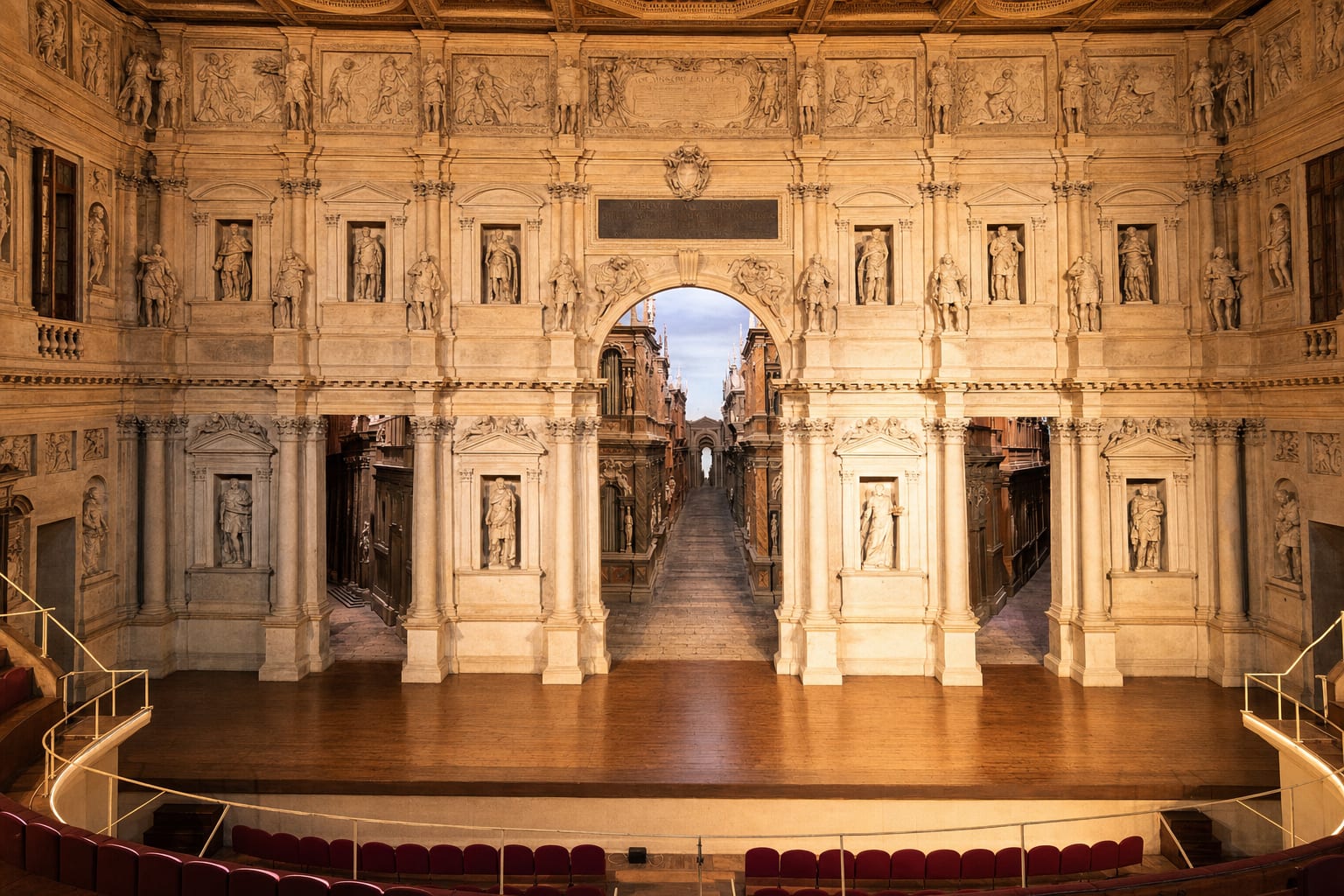 VicenzaUNESCOTeatro OlimpicoPalladio's last work, oldest surviving stage set, forced-perspective streets of ThebesAndrea Palladio drew the plans for Europe's oldest surviving indoor theatre in 1580 and died a few months later, so Vincenzo Scamozzi finished the job. His masterstroke is the stage: seven streets of Thebes in forced perspective, built in wood and plaster for the opening performance of Oedipus Rex in March 1585 and never taken down. It is the oldest surviving stage set in the world. Sit in the tiered semi-ellipse of the cavea, under a painted sky, and the little streets seem to run for blocks, though the whole set is only a few meters deep. A short light and sound show brings the scene to life.
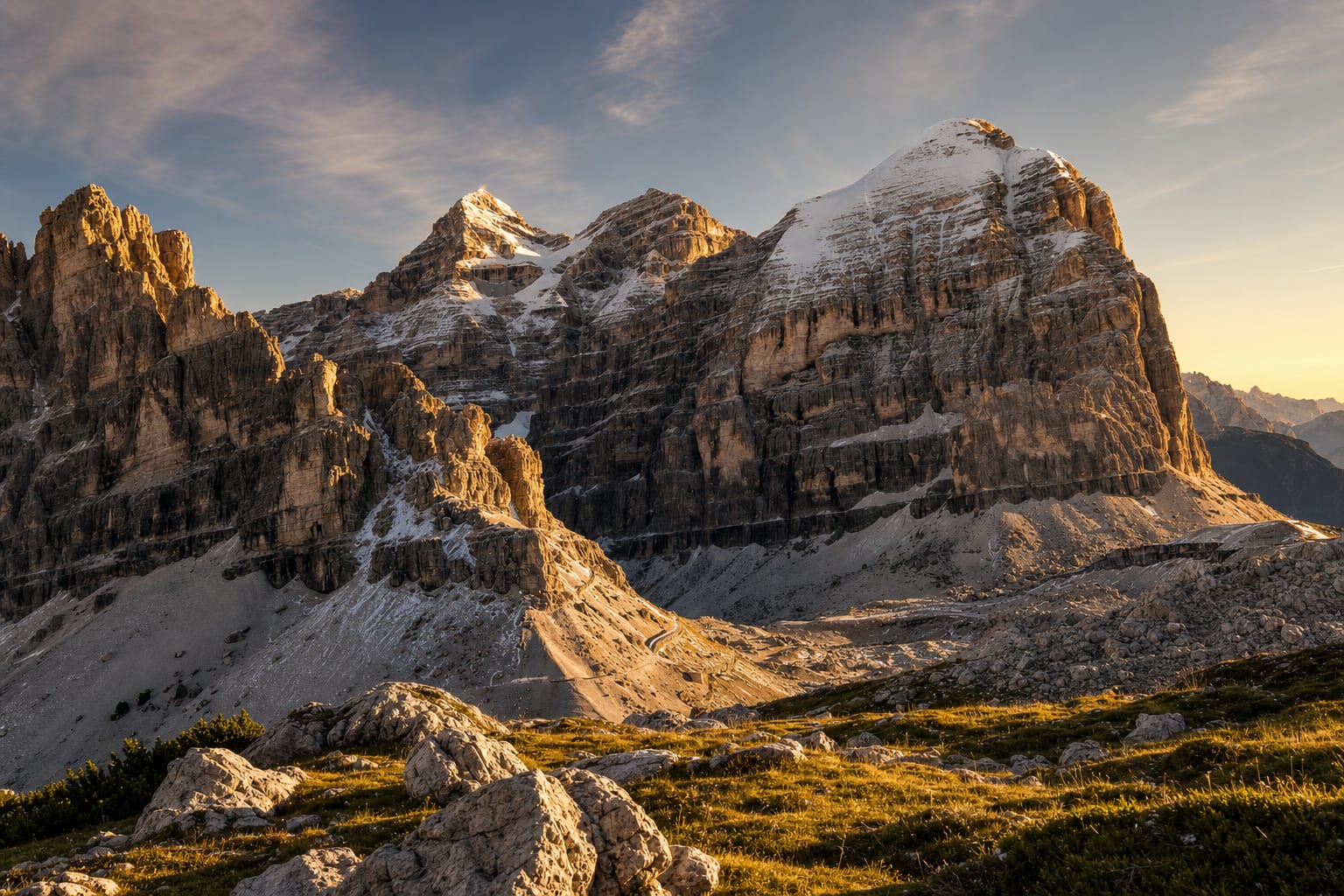 Cortina d'AmpezzoUNESCOTofaneTofana di Mezzo (3,244 m), Freccia nel Cielo cable car, 1956 Olympic slopes, enrosadiraThe Tofane are three Dolomite giants west of Cortina d'Ampezzo: Tofana di Mezzo at 3,244 meters, the third highest peak in the Dolomites, flanked by Tofana di Rozes and Tofana di Dentro. At dusk their pale rock turns rose in the enrosadira the Dolomites are loved for. The Freccia nel Cielo cable car climbs from Cortina almost to the summit in stages, so a panorama over the Ampezzo valley is available without a climb. The slopes are also a piece of sporting history: they hosted five of the six alpine skiing events at the 1956 Winter Olympics and the World Cup women's races that followed. Paul Grohmann made the first ascent of Tofana di Mezzo in 1863, with the local guide Francesco Lacedelli.
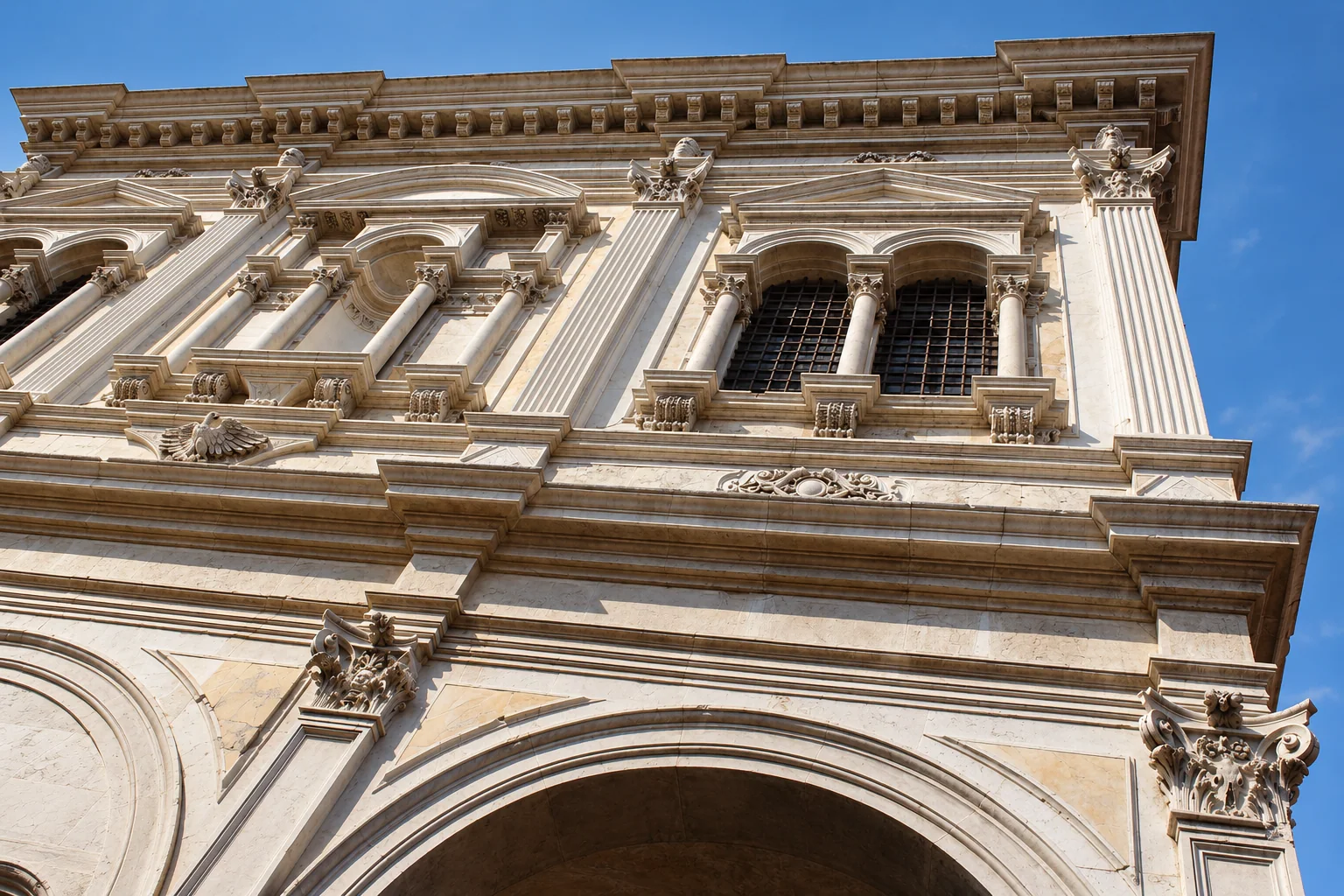 VeniceScuola Grande di San RoccoTintoretto’s more-than-two-decade pictorial cycle across the Scuola’s halls, the 1565 Crucifixion, and Scarpagnino’s imperial staircase.<p>Founded in 1478, the Scuola Grande di San Rocco grew around the cult of the saint whose relics the confraternity had held since 1485. In 1517 its governing body decided to build a monumental new headquarters. The plan still makes the institution legible: a broad, three-aisled hall at ground level; the Chapter Room above for plenary meetings; and the smaller Sala dell’Albergo, where the brotherhood’s governing boards met. Antonio Abbondi, known as Scarpagnino, later shaped the campo-facing facade with eight detached columns and designed the imperial staircase. Its project was approved in 1545; the work was completed in 1550 under Giangiacomo de’ Grigi after Scarpagnino’s death in 1549.</p><p>Jacopo Tintoretto’s cycle unfolded through these rooms over more than two decades, and more than sixty paintings remain in their original setting. The Sala Terrena turns to the Virgin’s life and Christ’s childhood; upstairs, Old Testament scenes on the Chapter Room ceiling join New Testament paintings on its walls; the Sala dell’Albergo centers on the Passion and the monumental 1565 <em>Crucifixion</em>. The staircase has its own later plague paintings by Antonio Zanchi and Pietro Negri. Follow the sequence of rooms to see how painting served the life of the confraternity. To follow the wider history of Venetian painting, continue to the <a href="/en/attractions/gallerie-dell-accademia">Gallerie dell’Accademia</a>.</p>
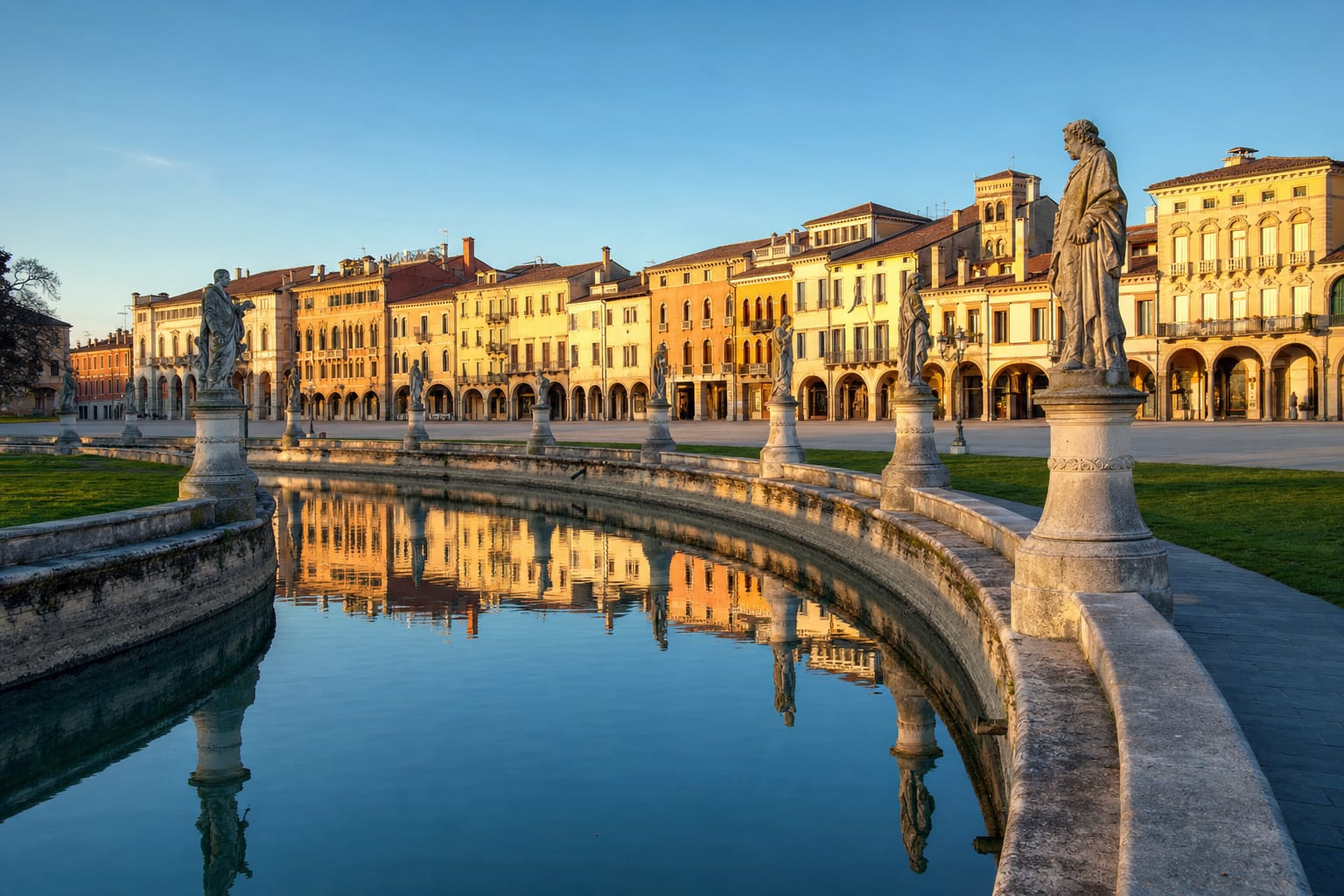 PaduaPrato della ValleElliptical canal and Isola Memmia, seventy eight statues, Saturday market, one of Italy's largest squaresPadua turned a swampy, largely unused stretch of ground into a theater for equestrian mock battles in 1636, then remade it entirely in 1775 under Andrea Memmo into the civic square that survives today. An elliptical canal, spanned by four bridges, rings the central Isola Memmia and is itself lined by two rows of statues, honoring poets, scholars and statesmen connected to Padua; of an originally planned 88, 78 still stand, carved from Vicenza stone between 1775 and 1883. At roughly 90,000 square meters it ranks among Europe's largest squares, though sources differ on whether it is the largest or second largest in Italy. Markets, student gatherings and evening strolls now fill the same ground that once staged horse races.
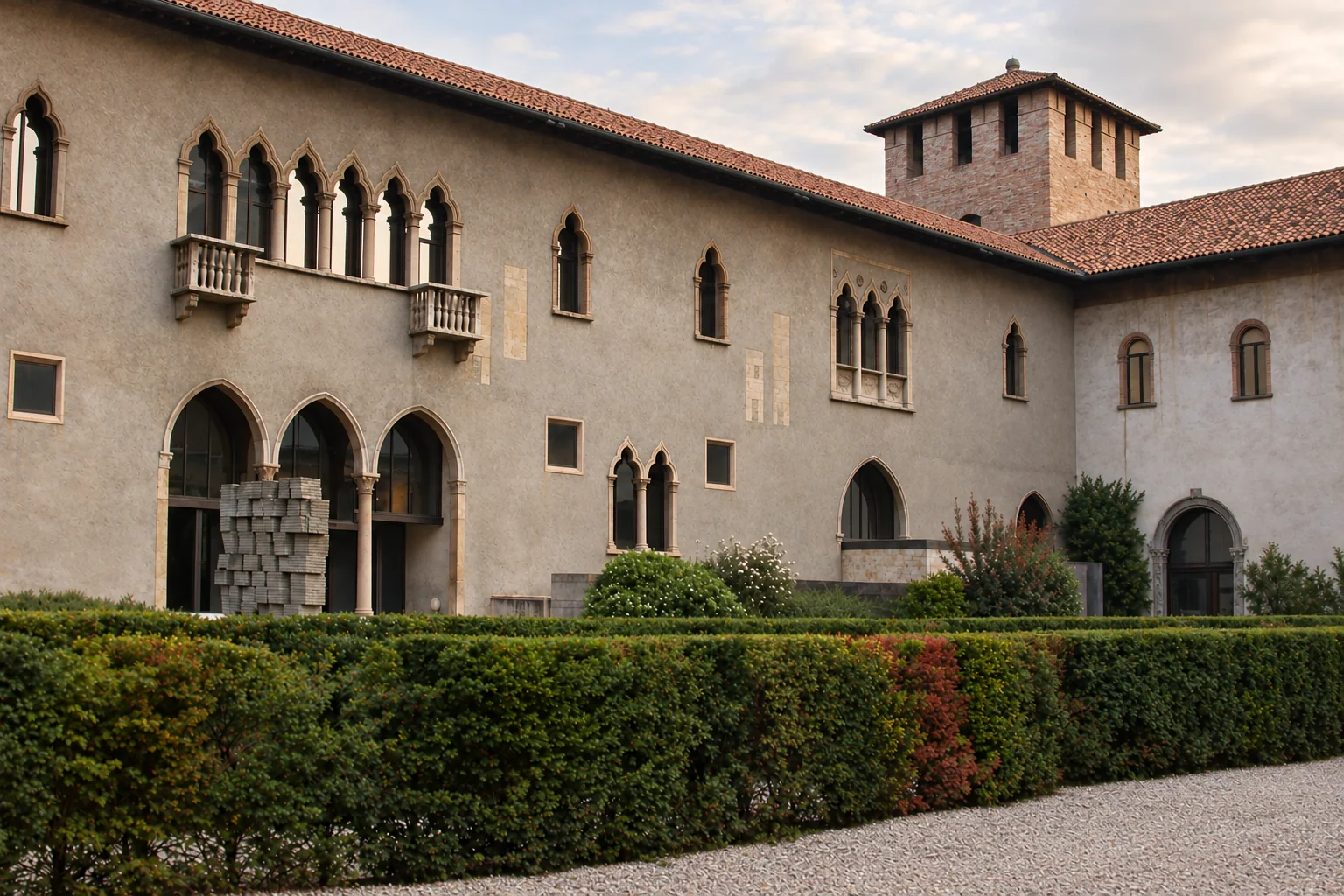 VeronaCastelvecchioScaliger castle, Carlo Scarpa design, Cangrande statue, Ponte Scaligero, Pisanello<p>Cangrande II della Scala had Castelvecchio built between 1354 and 1356 after the conspiracy led by his half-brother Fregnano, creating a fortified point to control the city’s northern access on the Adige. The complex has two distinct parts: the eastern court of arms is enclosed by high crenellated walls and seven towers, including the 42-metre Mastio, whose completion in 1376 is recorded by an inscription; the Scaliger residence, the Reggia, occupies the west. Three arches carry the fortified bridge to the left bank, with its longest arch spanning 48 metres. The remains of the earlier church of San Martino in Aquaro are visible in the court of arms, a reminder that the castle absorbed older layers as it grew.</p><p>After Verona came under Venetian rule, the castle served as barracks and armoury; it later housed a military academy. In 1923 its use passed to the city, and restoration work from 1924 to 1926 prepared it as a museum, inaugurated on 25 April 1926. The bridge was destroyed during the Second World War and rebuilt from 1949 to 1951. From 1958, Carlo Scarpa worked with museum director Licisco Magagnato on a reordering that continued in phases through 1975. Scarpa made the building’s history visible through floor openings and cross-sections to reveal its stratigraphy, and joined medieval stone and timber to exposed or bush-hammered concrete. The route moves between galleries and short outdoor passages, with works placed in visual conversation; it reaches a striking point at the equestrian statue of Cangrande I, set on a tall concrete support opposite the older Porta del Morbio.</p><p>The museum’s five connected sculpture rooms present medieval Veronese works from the tenth to fourteenth centuries, while its painting galleries hold more than three hundred works dating from the fourteenth century to the late eighteenth. The building and collection tell one story: a fortified crossing repeatedly adapted, first for military use and later for a civic museum. To continue through the same city, see the <a href="/en/attractions/arena-di-verona">Arena di Verona</a>.</p>
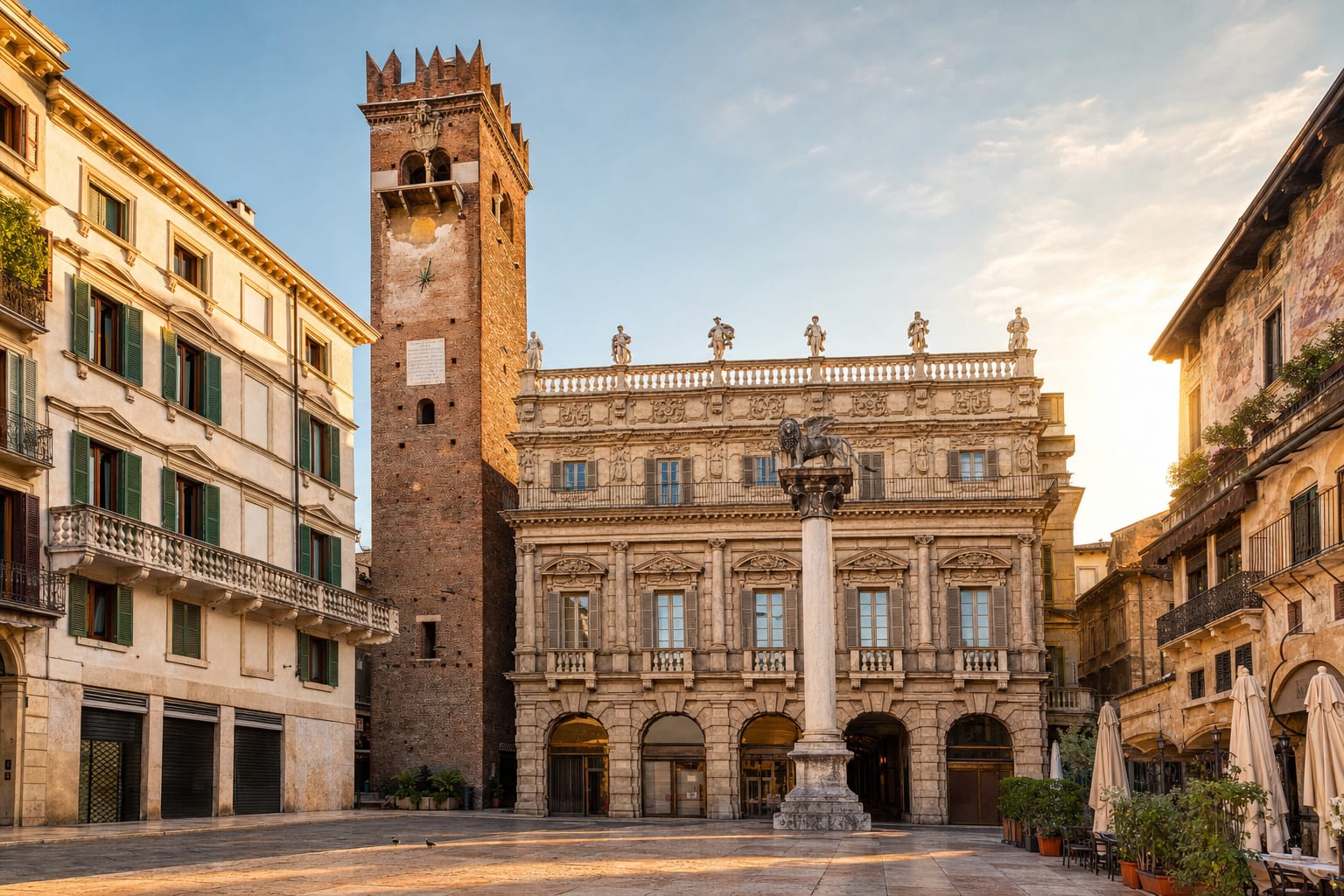 VeronaPiazza delle ErbeRoman forum site, daily market, Torre dei Lamberti, frescoed Case MazzantiVerona has sold vegetables, fish, and gossip on this stretch of ground since it was the city's Roman forum two thousand years ago, and the market stalls with their striped umbrellas have barely paused since. What ties the centuries together is stone: a fourteenth-century fountain topped by a Roman statue the Veronese call Madonna Verona, a thirteenth-century canopy called the capitello where mayors once took office, and the frescoed Case Mazzanti lining one side in faded color. The 84 meter Torre dei Lamberti climbs from one corner, and Palazzo Maffei closes the far end with a row of stone gods on its roofline. Sit at any of the surrounding cafes and you are watching the same transaction, produce for coin, that Roman Veronese made on this exact spot.
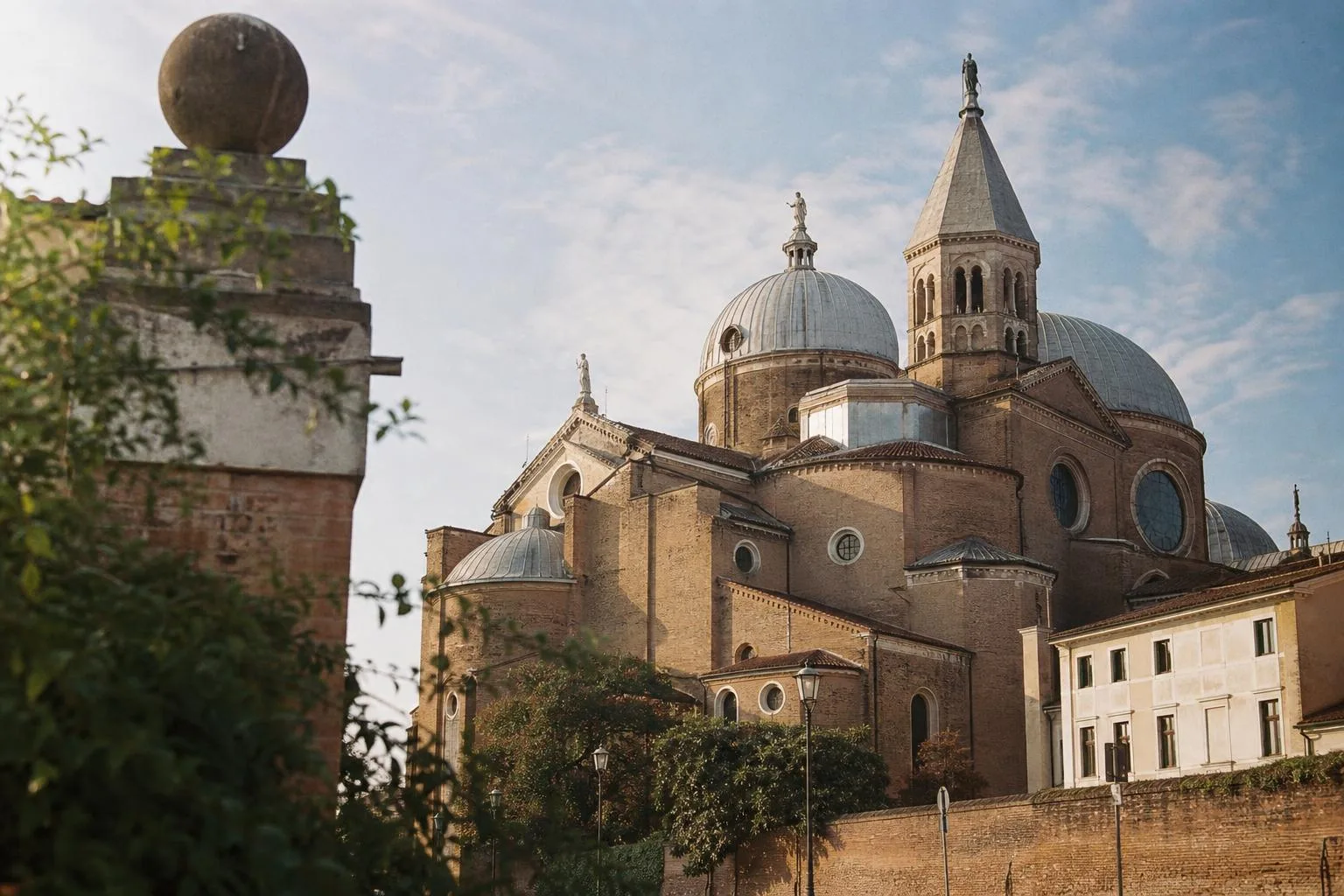 PaduaHidden GemAbbey of Santa GiustinaVeronese altarpiece, tombs of Saint Luke and Saint Matthias, huge dome, Benedictine cloistersSanta Giustina is one of the largest churches in Italy, a Benedictine basilica on the south side of Prato della Valle in Padua. A church for the martyr Justina stood here by the 520s, and the monks have lived on the site since 971. The present building was rebuilt from the 1500s and measures some 118 meters long, with a great central dome. Inside, Paolo Veronese’s altarpiece of the Martyrdom of Saint Justina (1576) dominates the apse. The basilica also keeps the relics of Saint Luke the Evangelist and Saint Matthias, and the Sanctuary of Prosdocimus, a rare sixth-century survivor. Napoleon’s forces suppressed the community in 1797; monks returned in 1917. Cloisters and the Martyrs’ Corridor are part of the visit.
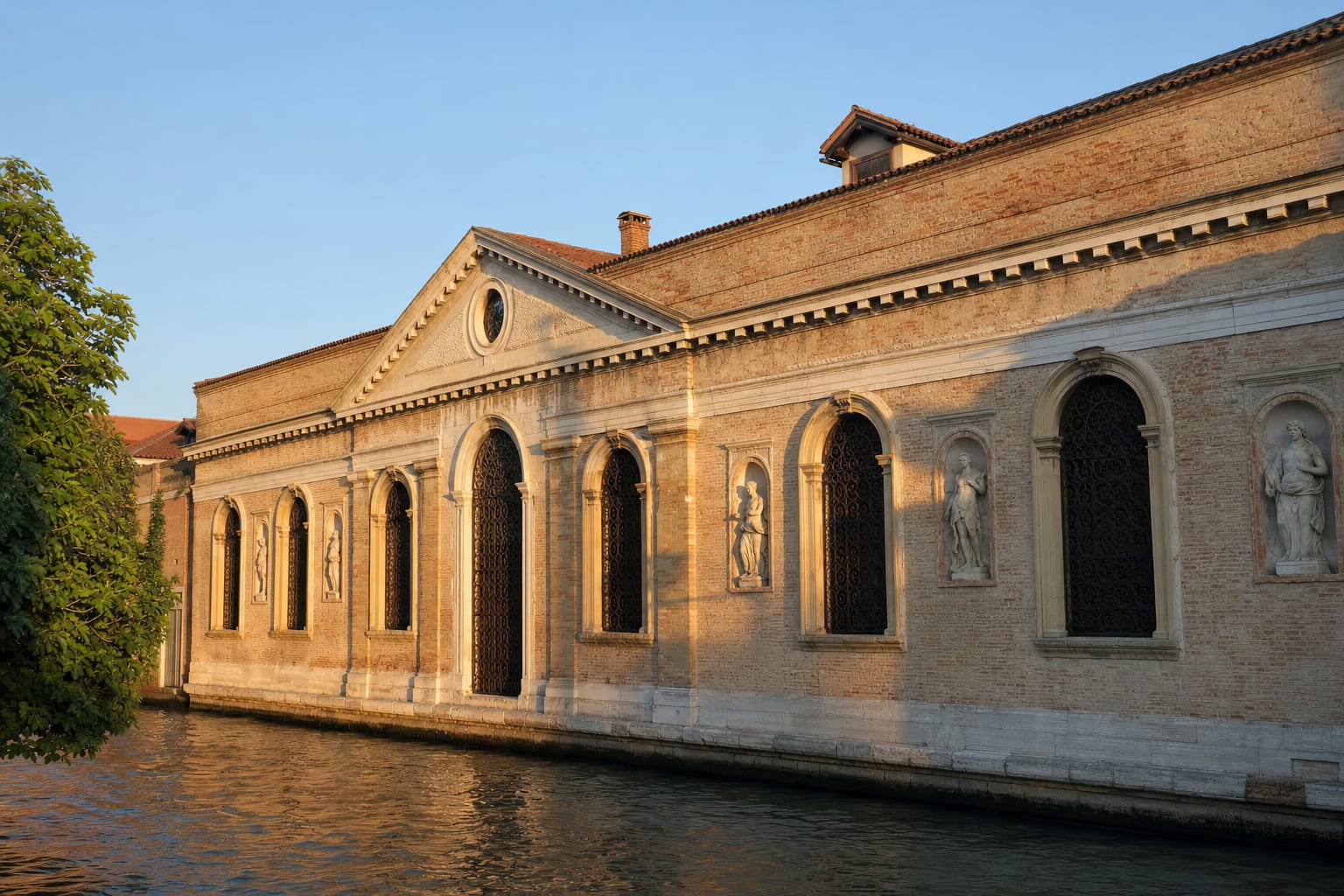 VeniceMurano Glass MuseumSeven centuries of Venetian glass, Barovier wedding cup, furnace island heritage, Palazzo GiustinianVenice exiled its furnaces to Murano in 1291, ostensibly to protect the wooden city from fire, and the island has blown glass ever since. Its museum occupies the Palazzo Giustinian, once home to the bishops of Torcello, and lines up seven centuries of the craft: Roman shards recovered from local digs, medieval beads, and the Barovier Wedding Cup of about 1470, an enameled blue glass piece so fine that it is usually named as the single greatest survivor of Renaissance Murano. Later rooms trace the island's slow reinvention through the 18th-century mirror trade and the modern designers, from Venini to Barovier & Toso, who turned old furnace skills into twentieth-century art. It's the clearest place in Venice to understand why this small island still matters.
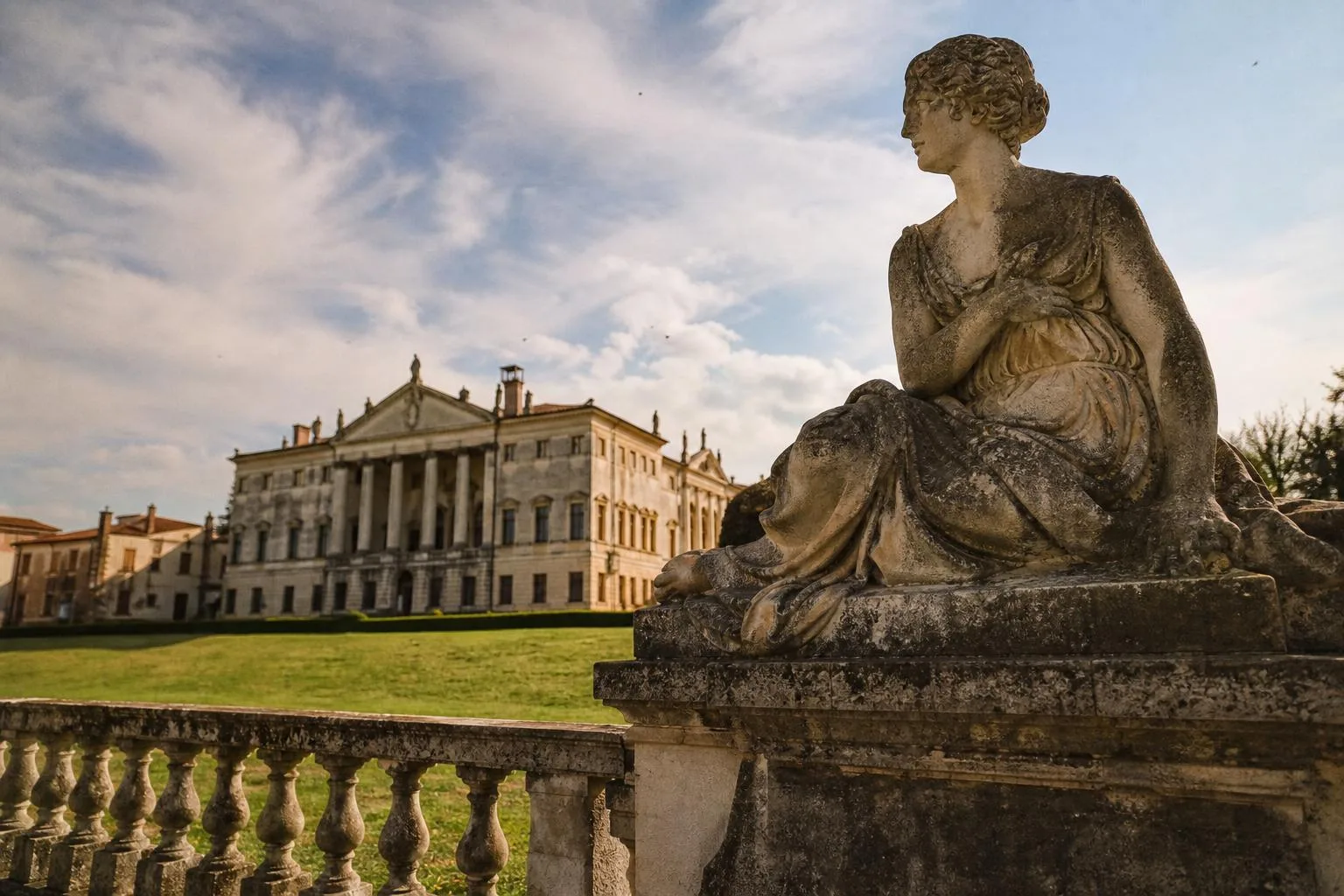 Piazzola sul BrentaHidden GemVilla ContariniBaroque villa, Music Room, shell room, 40-hectare park with lake and islandVilla Contarini is the great Baroque villa of the Veneto countryside, begun in 1546 for the Contarini family and enlarged between 1671 and 1676, set in some 40 hectares of parkland at Piazzola sul Brenta. It is administered today by the Fondazione Ghirardi and opened to visitors with a guided tour of the interior. Look for the Shell Room and the Well Room, and for the Music Room, whose sounding box is shaped like an inverted guitar and carries voices with unusual clarity. Outside, the park has flower beds, fish ponds, a lake with an island and long shaded avenues, and can be visited on its own. It makes an easy half-day from Padua or Vicenza.
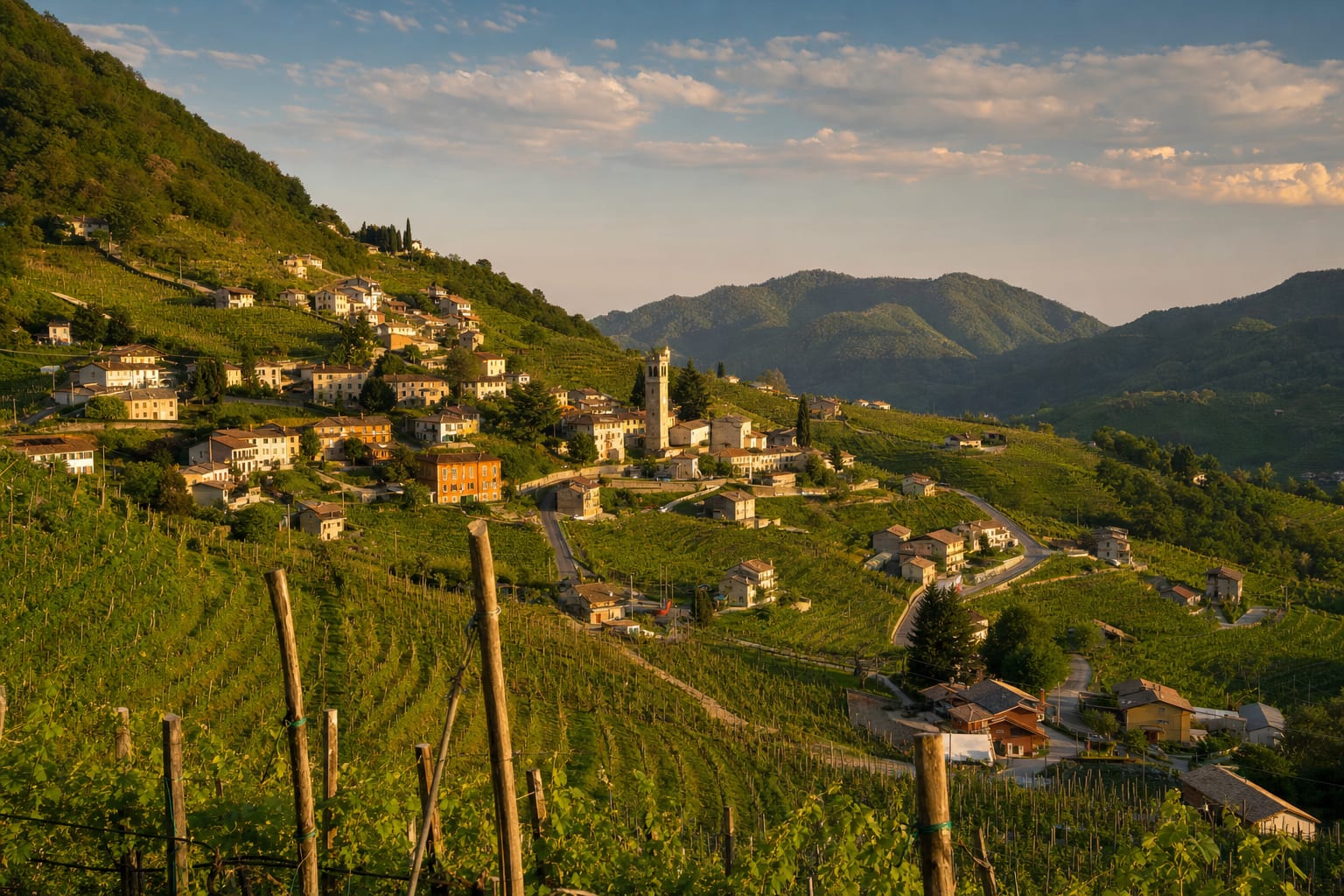 ValdobbiadeneUNESCOProsecco Hills of ValdobbiadeneHogback vineyard ridges, ciglioni terraces, Cartizze and Rive, Strada del ProseccoBetween Conegliano and Valdobbiadene the hills rise in narrow, steep ridges, called hogbacks, and vines run in tight rows across them. Growers have shaped this landscape by hand since the seventeenth century, building ciglioni, small grassy terraces that give the slopes a chessboard look. It grows Glera grapes for Prosecco Superiore, the sparkling wine of the Conegliano Valdobbiadene DOCG, with the steep Cartizze hill and the single-village Rive bottlings as the crown of the appellation. UNESCO listed the hills in 2019. You come to drive the Strada del Prosecco, Italy's first wine route, stop in family cantinas and walk a stretch of the 51-kilometer Prosecco Hills Trail.
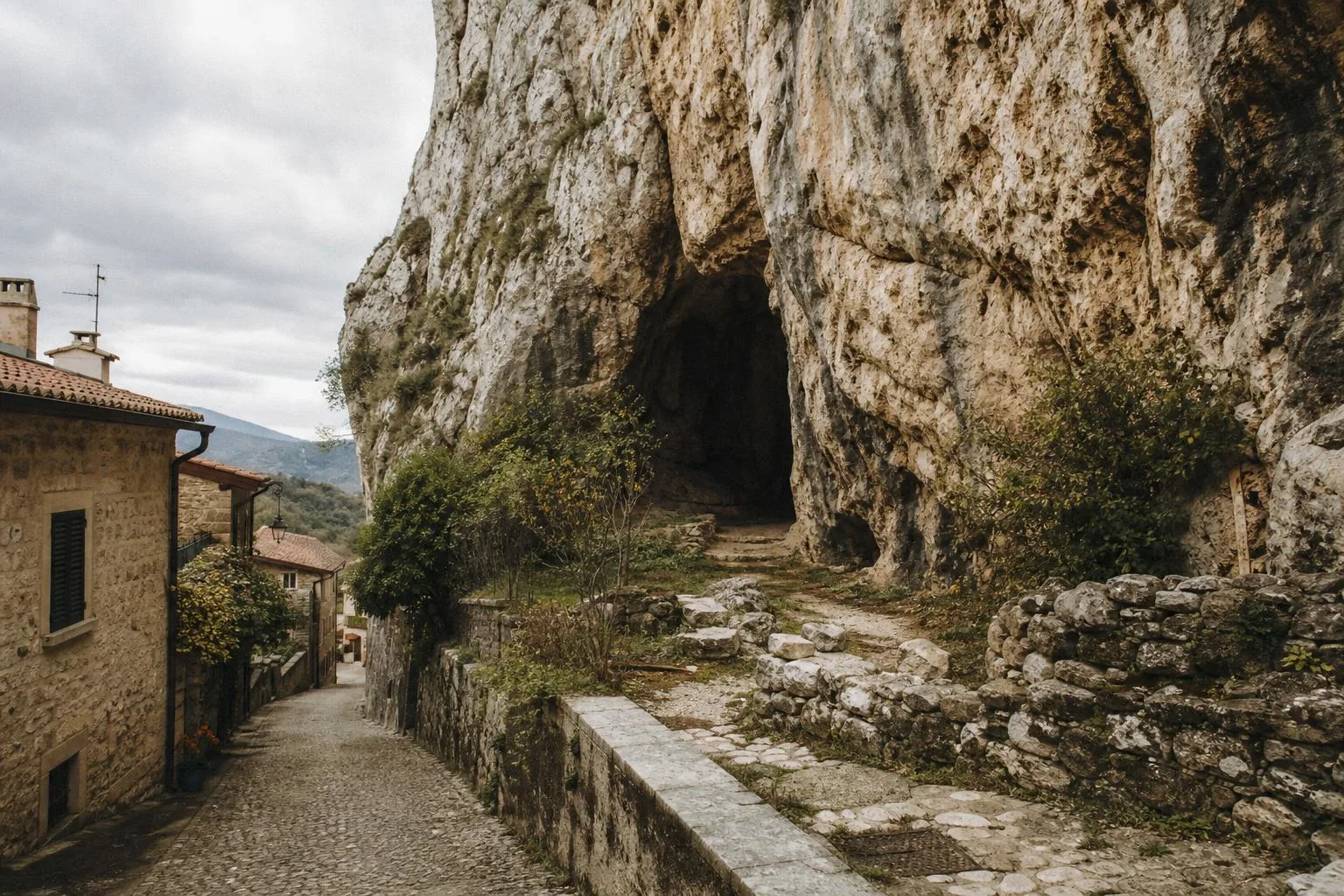 FumaneHidden GemFumane CaveOldest painted cave art in Europe, active excavation since 1988, ochre animal figures, PaleoCenterExcavators have been working the floor of this cave in the Lessini hills since 1988, and they are still finding things: layers left by Neanderthals, then by the Uluzzian culture, then by the first Homo sapiens to reach this part of Europe. The deepest painted stones here, marked with red ochre figures of animals and a horned shaman-like figure, date to somewhere between 32,000 and 36,500 years ago, among the oldest cave art found anywhere on the continent. A visit is really a guided walk with an archaeologist rather than a museum tour: you descend a short flight of metal steps into the excavation itself, see the actual stratigraphy the finds came from, then see the originals (reproductions stay in place; the real pieces sit nearby) in the attached PaleoCenter. The cave only opens on weekends, and only from March through October.
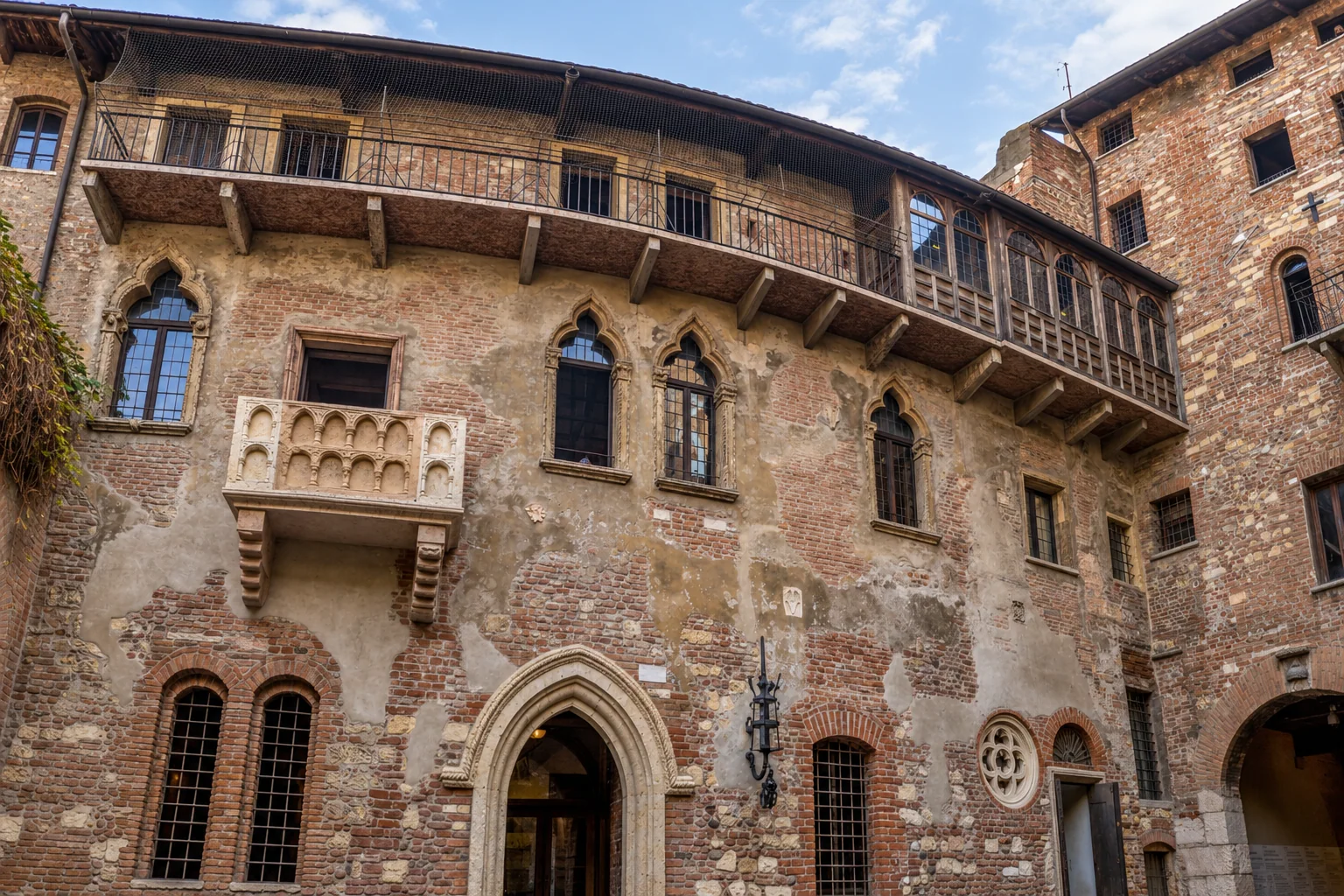 VeronaJuliet's HouseThe medieval tower-house and Cappello inn sign; a balcony added during Antonio Avena’s 1939–1940 neo-medieval refit; and the courtyard copy of Nereo Costantini’s Juliet sculpture.At Via Cappello 23, a medieval tower-house appears in documents by 1351 as an inn called Cappello; the city museum says the inn’s hat sign is still carved into the key of the courtyard arch. The building’s identification as Juliet’s House came much later, when travelers at the end of the eighteenth and start of the nineteenth century began making a romantic pilgrimage to sites linked with Shakespeare’s tragedy. That literary association is not evidence that a historical Juliet lived here.
Verona bought the house in 1905. Between 1939 and 1940, civic-museum director Antonio Avena recast its courtyard facade and interiors in a neo-medieval style, deliberately turning the house into theatrical scenery for the story; the balcony was added in that campaign. Its material history is more layered than the familiar image suggests: the balcony’s central slab is fourteenth-century Avesa stone reused from the Della Scala palaces, while the assembled balcony and its shaped brackets belong to the later staging. Licisco Magagnato completed the museum arrangement in the early 1970s, and the house opened to visitors on 1 June 1973.
The courtyard bronze is also a copy: Nereo Costantini’s original, modeled in 1968 and cast in 1969, is kept in the Sala del Balcone; a new cast replaced the worn courtyard statue in 2014. Today the visit begins in Teatro Nuovo, continues through its foyer and the courtyard, and reaches the house only on the €12 full route. From the Via Cappello exit, continue through Verona’s historic centre to our <a href="/en/attractions/piazza-delle-erbe-verona">Piazza delle Erbe guide</a>.
VeronaJuliet's HouseThe medieval tower-house and Cappello inn sign; a balcony added during Antonio Avena’s 1939–1940 neo-medieval refit; and the courtyard copy of Nereo Costantini’s Juliet sculpture.At Via Cappello 23, a medieval tower-house appears in documents by 1351 as an inn called Cappello; the city museum says the inn’s hat sign is still carved into the key of the courtyard arch. The building’s identification as Juliet’s House came much later, when travelers at the end of the eighteenth and start of the nineteenth century began making a romantic pilgrimage to sites linked with Shakespeare’s tragedy. That literary association is not evidence that a historical Juliet lived here.
Verona bought the house in 1905. Between 1939 and 1940, civic-museum director Antonio Avena recast its courtyard facade and interiors in a neo-medieval style, deliberately turning the house into theatrical scenery for the story; the balcony was added in that campaign. Its material history is more layered than the familiar image suggests: the balcony’s central slab is fourteenth-century Avesa stone reused from the Della Scala palaces, while the assembled balcony and its shaped brackets belong to the later staging. Licisco Magagnato completed the museum arrangement in the early 1970s, and the house opened to visitors on 1 June 1973.
The courtyard bronze is also a copy: Nereo Costantini’s original, modeled in 1968 and cast in 1969, is kept in the Sala del Balcone; a new cast replaced the worn courtyard statue in 2014. Today the visit begins in Teatro Nuovo, continues through its foyer and the courtyard, and reaches the house only on the €12 full route. From the Via Cappello exit, continue through Verona’s historic centre to our <a href="/en/attractions/piazza-delle-erbe-verona">Piazza delle Erbe guide</a>.
Tours worth booking in Veneto
Compared by our editors, across providers.
Booking through these links may earn Italia Magnifica a commission, at no cost to you.
- Viator
- 2h
- 5.0★ · 21 reviews
from €80Book this tour- Viator
- 2h
- 5.0★ · 61 reviews
from €85Book this tour- Viator
- 4h
- 5.0★ · 20 reviews
from €94Book this tour- Viator
- 2h
- 5.0★ · 5 reviews
from €25Book this tour- Viator
- 2h
- 5.0★ · 5 reviews
from €68Book this tour- Viator
- 2h
- 5.0★ · 20 reviews
from €70Book this tour


City by city
Where the monuments cluster in Veneto.