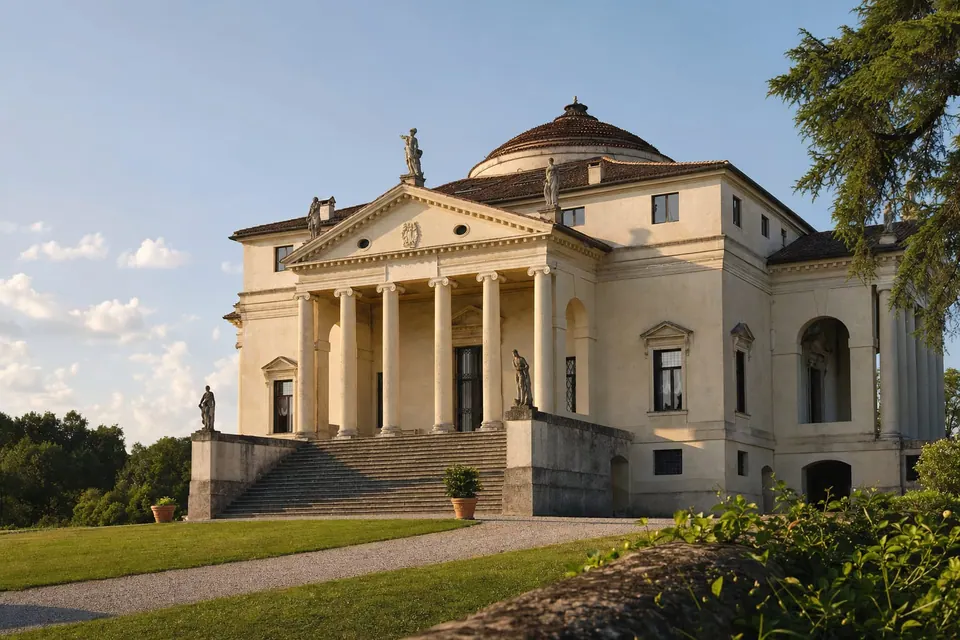
Paolo Almerico, a papal clerk retiring to his native Vicenza, commissioned this villa in 1565 not as a working farmhouse but, unusually for its time, as a pure country retreat with no agricultural estate attached, and Andrea Palladio answered with a design that borrowed its dome and portico directly from the Pantheon in Rome.
Four identical porticoed facades face the four points of the compass from a domed central hall, treating every approach as equally important rather than favoring a single grand front, a symmetry Palladio never repeated at this scale. Construction dragged on past Almerico's death, and the Capra brothers, who bought the unfinished property in 1592, completed it and gave the villa the alternate name Villa Capra by which it is also known. Its influence proved vast: Thomas Jefferson studied it in planning Monticello, and versions of its dome-on-cube formula turned up on capitols, banks and country houses across Europe and the Americas for the next three centuries.