Skip to content
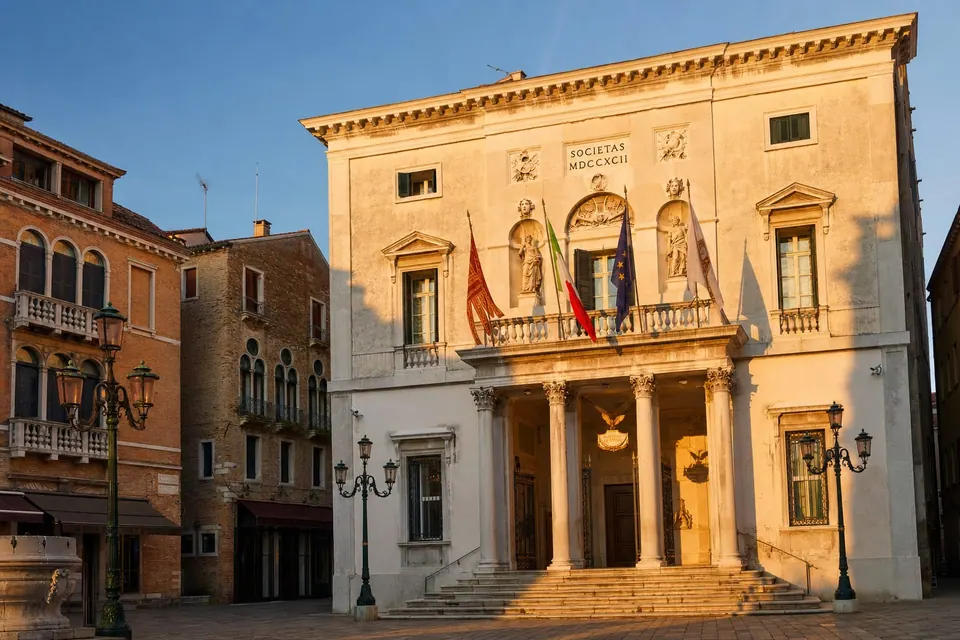
The porch of Teatro La Fenice on its Venetian campo, the thrice-reborn opera house

Teatro La Fenice

Step inside Venice’s La Fenice to read the five tiers of boxes, the decoration rebuilt after the 1996 fire, and the room where Verdi’s operas began.

  • Venice
  • Theatre
Where
Campo San Fantin 1965, Venice
Best for
Verdi premieres

La Fenice’s five tiers of boxes make the auditorium a room to look across as well as toward the stage. Built under Giannantonio Selva and inaugurated on 16 May 1792, the theatre opens onto Campo San Fantin in Venice. The reconstructed hall’s decorative work uses wood and papier-mâché, with its lost decoration recreated through photographic research.

From Verdi’s premieres to the rebuilt hall

Its musical history is equally tangible. Rossini’s Semiramide, Bellini’s I Capuleti e i Montecchi, and Verdi’s Rigoletto and La traviata all had their first performances here. La traviata premiered on 6 March 1853; it would return for the resumption of opera in November 2004 after the theatre’s latest reconstruction.

Fire destroyed the auditorium in December 1836, and it reopened on 26 December 1837. After another fire in 1996, the reconstruction project by Aldo Rossi brought back the five box levels and restored the old water entrance. In the Sale Apollinee, surviving fragments were conserved and lost portions reconstructed with traditional materials and techniques. An inaugural concert week opened in December 2003; work continued into 2004, before opera returned that November.

Visit between performances

The daytime visit offers another way into this working opera house. Its standard ticket includes an audio guide and the permanent exhibition on Maria Callas’s years of activity in Venice. Bring an identity document to collect the guide, and check the operator’s visiting calendar before setting out: technical or artistic needs can change the hours and route at short notice.

Five gilded tiers of theatre boxes above the red seats in the auditorium of Teatro La Fenice in Venice
Five tiers of boxes curve above the stalls at Teatro La Fenice, seen from beside the stage in 2024.

Three things worth finding

If you see nothing else, see these.

  1. Five tiers of boxes

    The rebuilt auditorium retains five tiers of boxes, with decorative work in papier-mâché and wood, following the ‘where it was, as it was’ reconstruction principle.

  2. Selva’s water entrance

    The reconstruction restored the auditorium’s historic entrance from the Rio, originally conceived by architect Giannantonio Selva.

  3. The Sale Apollinee

    Their restoration conserved surviving fragments and reconstructed lost portions with traditional materials and techniques.

Plan your visit

Standard daytime ticket
Buy at the theatre box office; no advance reservation.
Best time
Choose a time shown in the operator’s calendar for your date. The theatre’s artistic and technical work can change visiting hours and routes at short notice.
Getting there
The entrance is at Campo San Fantin 1965. From Piazzale Roma or Santa Lucia station, the theatre lists vaporetto lines 1 or 2 toward Rialto, San Marco and Lido. Its directions name Rialto or San Marco (Vallaresso) for line 2; line 1 also lists Sant’Angelo and San Samuele. Check current ACTV services before travel.
Accessibility
An elevator serves the box levels, and a stairlift reaches the stalls for performances. For a daytime tour, contact the theatre to agree the entrance, route and assistance available on your date; performance access arrangements may differ from the tour route.

The standard visit costs €12 and includes an audio guide while available. Buy at the theatre desk; ordinary individual visits do not take reservations. Check the day’s first and last entry times, which change around rehearsals and performances. Performance tickets and group visits are separate.

Bring an identity document to collect the audio guide. Check the visit calendar before walking to Campo San Fantin.

Get directionsGoogle MapsApple Maps

Campo San Fantin 1965, 30124 Venezia VE

Good to know

What does the standard visit cost?

The full standard visit costs €12. Reduced rates include €9 for over 65s and €7 for students aged 7–26.

Is an audio guide included?

Yes. Bring an identity document to collect the guide and ask which languages and formats are available.

Do I need to reserve a standard visit?

Buy the ordinary tour at the theatre desk on the day. Groups and schools book separately.

What is the story behind La traviata at La Fenice?

It premiered here on 6 March 1853. After the theatre’s reconstruction, opera returned in November 2004 with the same work. The premiere and the return are separate moments in the theatre’s history.

What accessibility arrangements are available for the daytime tour?

An elevator serves the box levels, and a stairlift reaches the stalls for performances. For a daytime tour, contact the theatre to agree the entrance, route and assistance available on your date; performance access arrangements may differ from the tour route.

What should I know about visiting hours?

Check the operator’s calendar for the day you plan to visit. Hours and routes can change at short notice for technical or artistic needs; there is no fixed year-round visiting schedule to rely on.

A letter from Italy, once a month.

Each month: one story, two recipes, an ingredient and a wine of the month, places worth the trip, and the month’s calendar.

One letter a month. Unsubscribe at any time. We never share your address. Choose your desks