

All the monuments, city by city
The landmarks and masterpieces worth planning a day around.
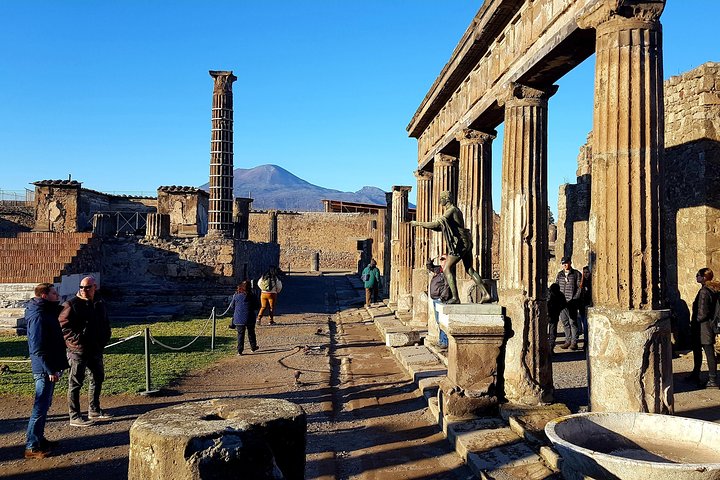
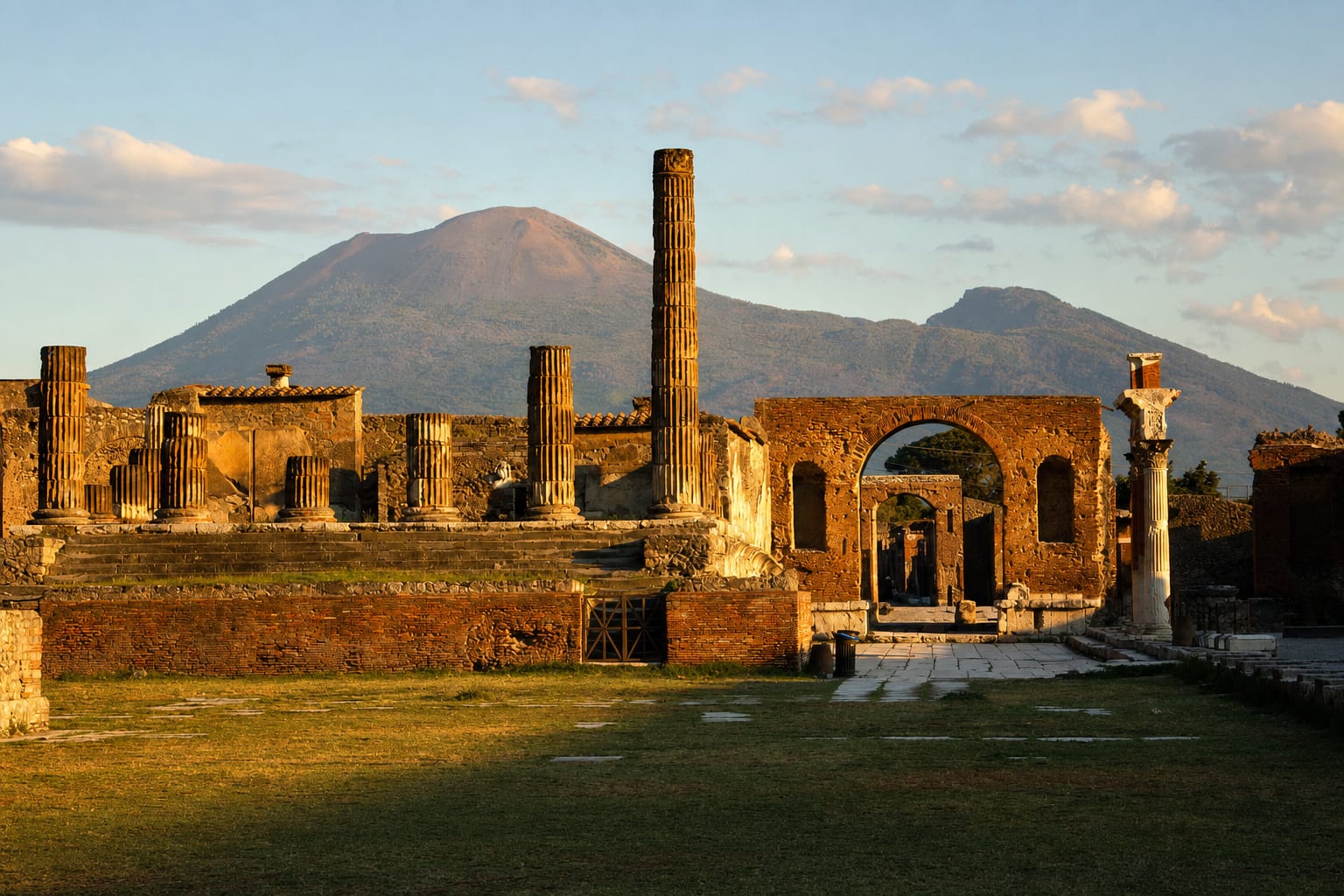 PompeiiUNESCOPompeii Archaeological SiteThe 79 CE eruption, plaster casts of victims, the Forum, Villa of the Mysteries, an amphitheatrePompeii is the Roman city that the eruption of Vesuvius sealed under ash and pumice on an August day in 79 CE, killing the residents who stayed and, in the process, freezing an entire town mid-life. The Ministry of Culture's park covers 66 hectares, with about 50 excavated: paved streets rutted by cart wheels, bakeries with their ovens intact, the Forum, two theatres, an amphitheatre older than the Colosseum, and houses still holding their frescoes and mosaics. Plaster casts taken from voids in the ash preserve the postures of people and animals at the moment of death. Bourbon excavators found the site in 1748 and it has been dug, studied and argued over ever since; new digs still turn up fresh rooms most seasons.Plan the visit
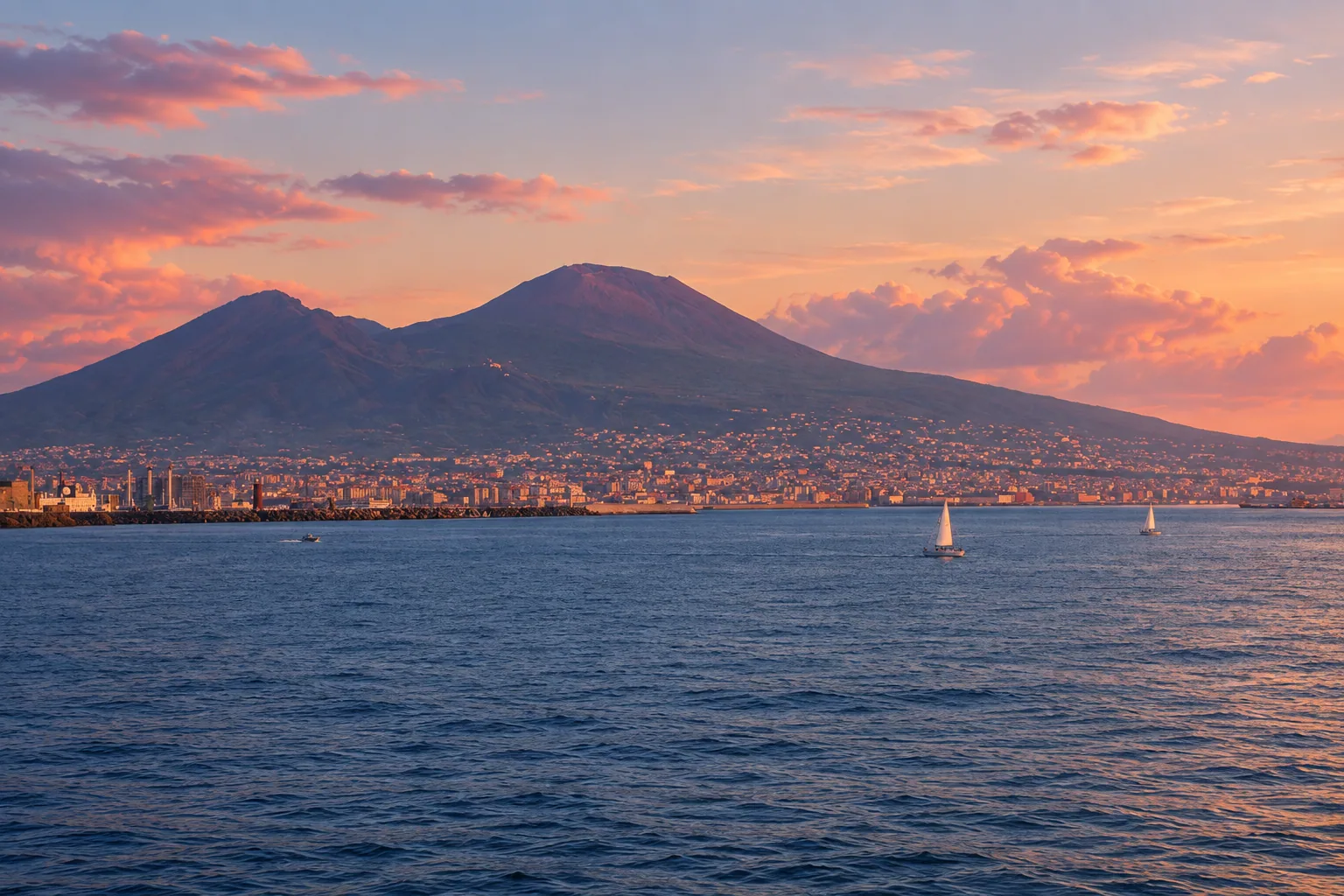 Torre del GrecoMount VesuviusThe 79 CE eruption, the Gran Cono crater trail, INGV monitoring, views over the Bay of NaplesVesuvius is the volcano that buried Pompeii and Herculaneum in 79 CE, and it still stands watch over the Bay of Naples from behind Torre del Greco. INGV, Italy's volcanological institute, classifies it as quiescent since its last eruption in 1944, with low seismic activity and fumaroles rather than open lava. The Vesuvius National Park manages trail number five, the Gran Cono, a steep walk of switchbacks up bare volcanic rock to the crater rim, where sulfur vents still smoke and the view stretches from Capri to the Sorrentine peninsula. Entry is ticketed and capped, with sales handled entirely online. It rewards an early start: the crowds and the heat both build fast once the tour buses arrive from Naples.
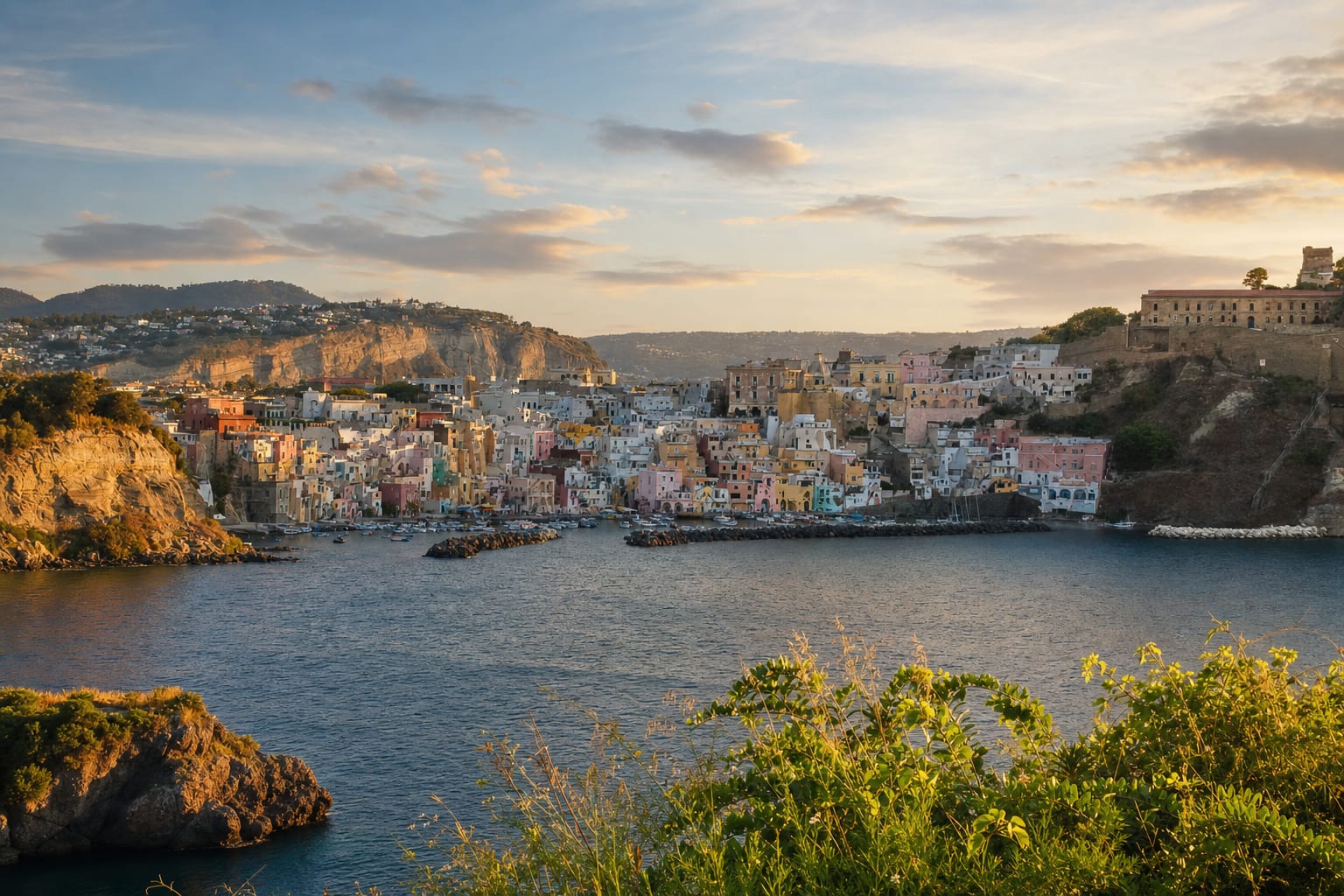 ProcidaProcidaTerra Murata, the pastel harbor of Corricella, Il Postino, Italian Capital of Culture 2022Procida is the smallest and least developed of the islands in the Gulf of Naples, a volcanic scrap of the Phlegraean Fields whose high tuff cliffs and small beaches move at a pace closer to a working fishing island than to glamorous Capri nearby. Its historic core splits into distinct contrade: Terra Murata, a fortified hilltop quarter built to shelter residents from pirate raids, and Corricella below it, a tumble of pastel fishermen's houses around a small marina that is one of the most photographed harbors in Italy without most people knowing its name. Massimo Troisi shot his last film, Il Postino, here in 1994, dying just hours after filming wrapped, and the island still trades gently on that quiet cinematic legacy. In 2022, Procida became Italy's Capital of Culture, an unusual honor for a place this small, which briefly focused national attention on an island that mostly still prefers to be left alone.
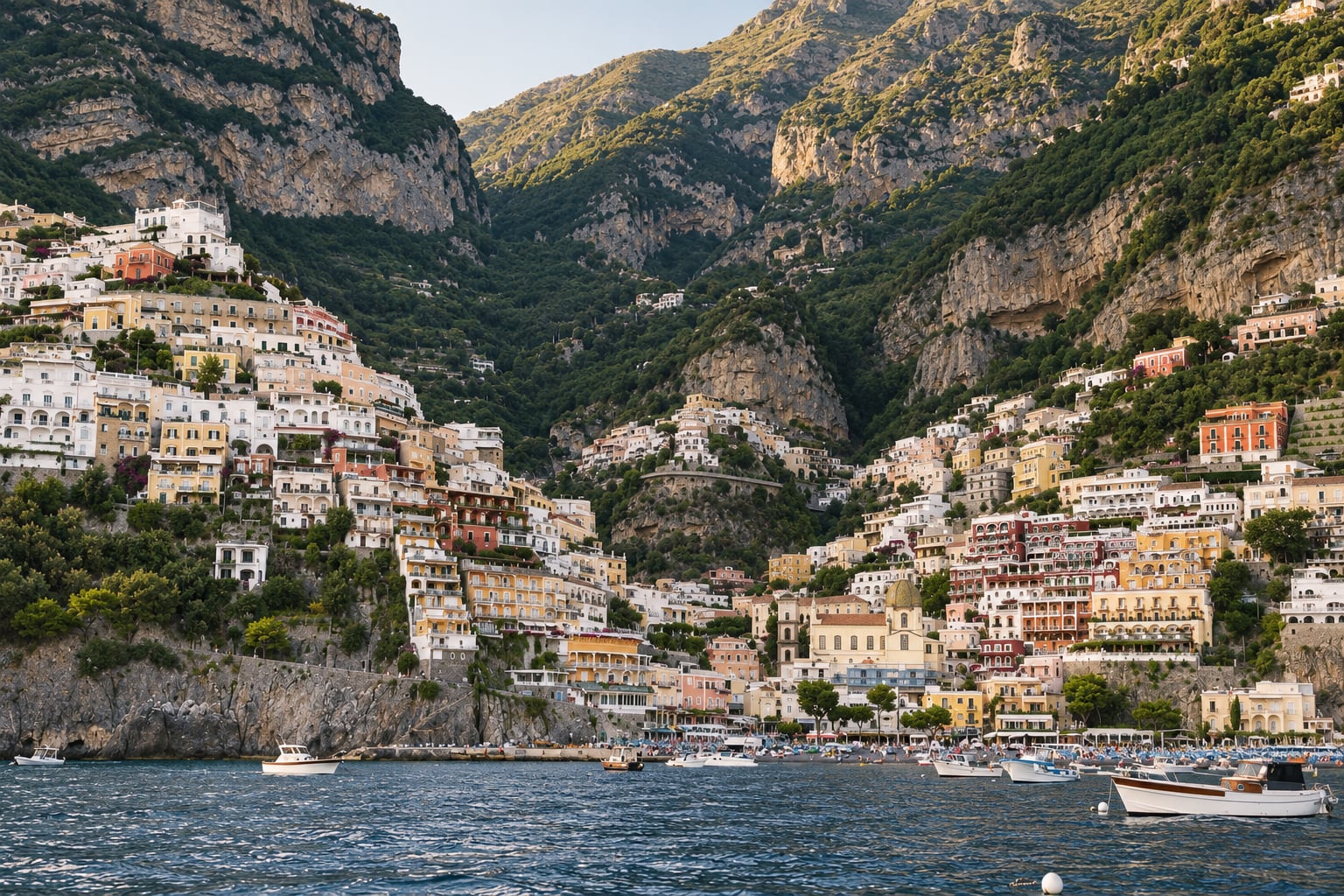
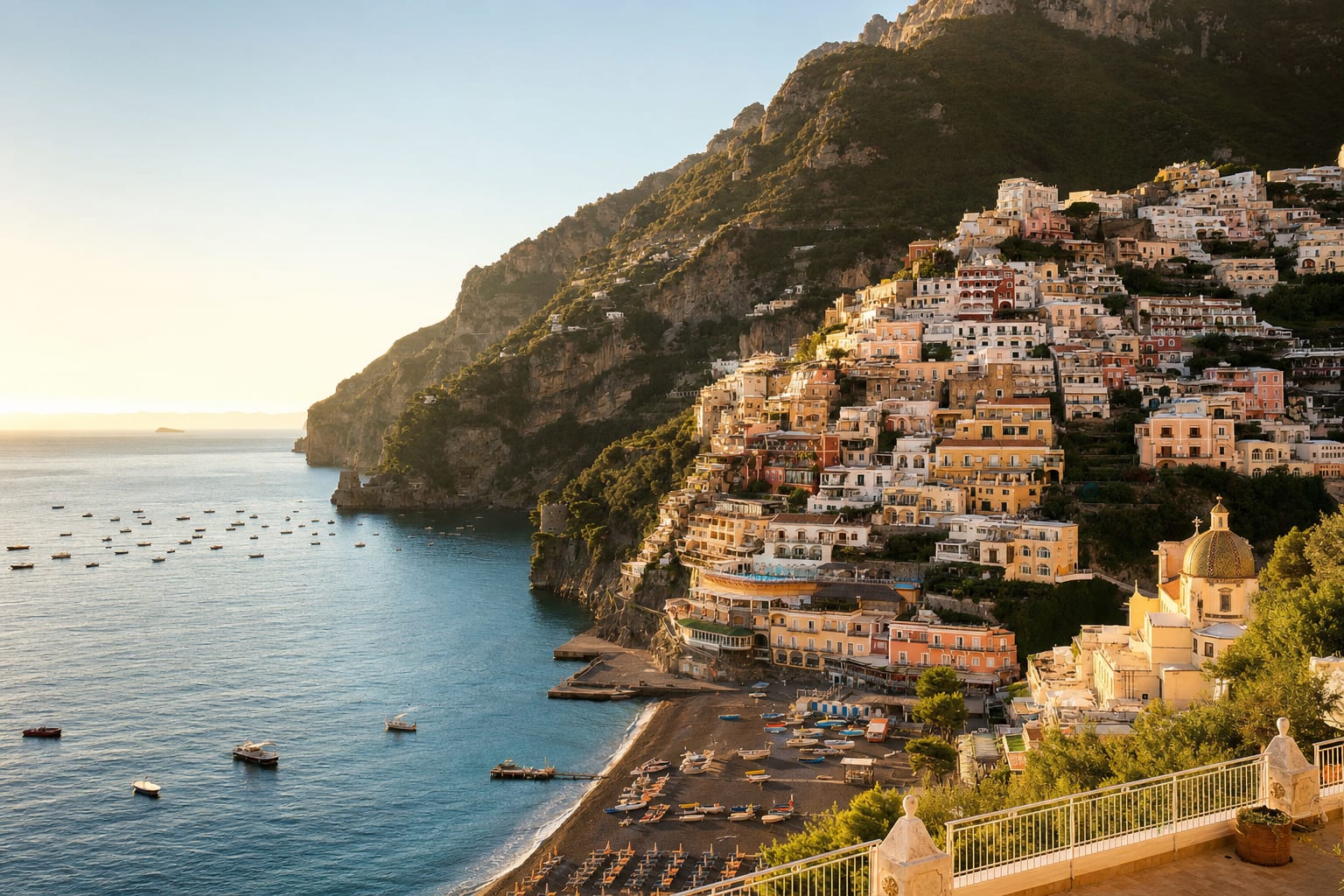 PositanoUNESCOPositanoIts stacked cliffside houses, the Amalfi Coast cultural landscape, Spiaggia Grande, its 1668 city statusPositano tumbles down a near vertical slope of the Amalfi Coast so steeply that its houses seem stacked rather than built beside one another, an arrangement UNESCO recognizes within the wider Costiera Amalfitana cultural landscape. Evidence at the local La Porta cave points to Palaeolithic and Mesolithic use of this coastline long before Rome existed, while the bay below the modern village holds the remains of a Roman villa of otium, a leisure residence developed from the late first century BCE. Three watchtowers built at Fornillo, Trasita and Sponda in the 16th century once warned of Saracen pirate raids, part of a defensive chain along the whole coast, and in 1668 Positano bought its own freedom from feudal control to become a città regia, answering directly to the crown rather than a local lord. Today the same steep geography that made it hard to conquer makes it hard to leave: nearly every view down toward the water looks like the one used to sell the whole coast.
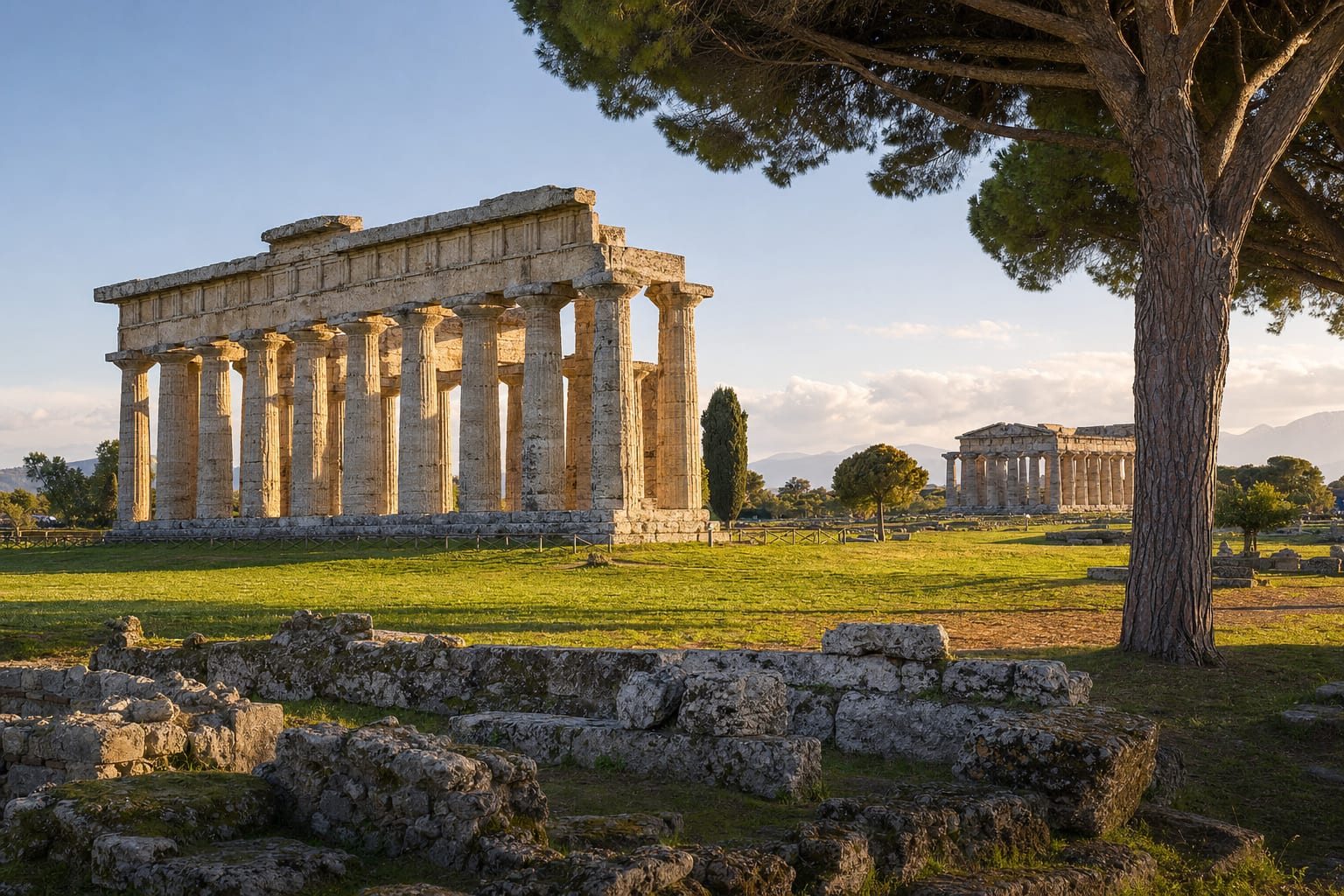 PaestumUNESCOTemples of PaestumThree Doric temples, Tomb of the Diver, Greek and Roman city walls, archaeological museumGreek colonists from Sybaris founded Poseidonia around 600 BCE on a plain south of Salerno, and its three Doric temples, raised between about 550 and 450 BCE, are among the best preserved anywhere outside Greece. The so-called Basilica and the Temple of Neptune, both actually dedicated to Hera, stand side by side in the southern sanctuary, while the Temple of Athena crowns the higher ground to the north, long mislabeled as a temple of Ceres. Lucanians took the city around 400 BCE and Rome renamed it Paestum in 273 BCE. It faded into malarial marsh rather than being destroyed, which is why the columns still stand. The on-site museum holds the Tomb of the Diver, a rare Greek painted tomb.
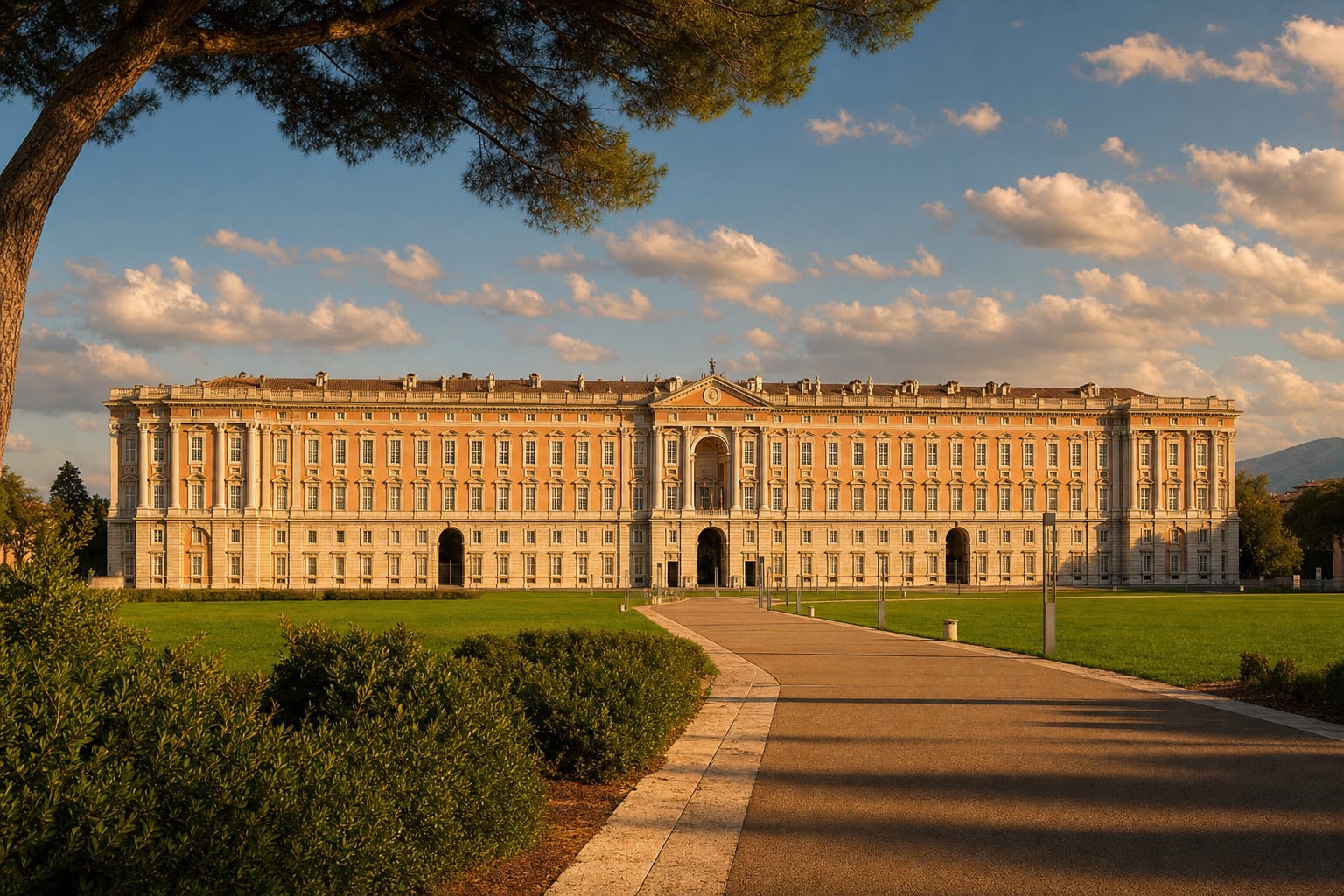 CasertaUNESCORoyal Palace of CasertaLuigi Vanvitelli, Royal Staircase, Royal Apartments, Court Theatre, Royal Park cascadesCharles of Bourbon commissioned the Royal Palace of Caserta in 1752 as the seat of a kingdom that wanted to rival Versailles, and Luigi Vanvitelli gave it a rigorous, theatrical plan: a vast rectangle organized around four courtyards, with a Royal Staircase that turns arrival into a performance. Vanvitelli died in 1773, when the structure was complete; his son Carlo and other architects went on decorating and furnishing the royal apartments well into the nineteenth century. The palace is only one piece of a larger territorial design that includes the Royal Park, with its three-kilometer run of cascades and fountains, the Aqueduct of Vanvitelli and the San Leucio complex, all inscribed together by UNESCO.
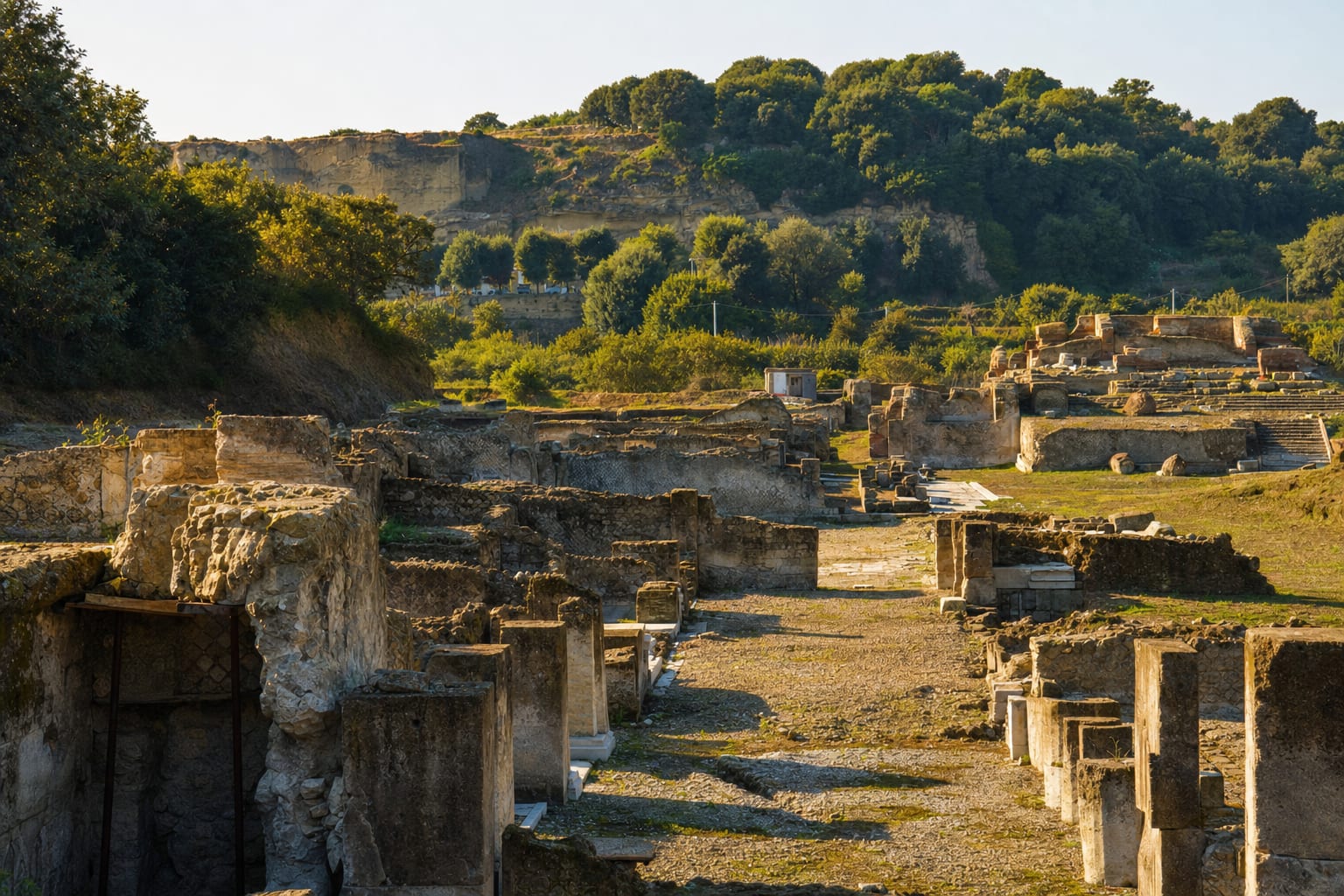 CumaCumae Archaeological ParkGreek acropolis, temples of Apollo and Jupiter, Cave of the Sibyl gallery, Virgil's AeneidCuma was founded in the second half of the eighth century BCE by Euboean settlers from Chalcis and Eretria, the first Greek colony on the Italian mainland, and it grew across the acropolis of Monte di Cuma and the lower city. On the upper terraces stand the foundations of the temples of Apollo and Jupiter, linked by a sacred way, with a belvedere over Lake Avernus and the sea. The park's famous trapezoidal tuff gallery, some 130 meters long and lit by side openings, is conventionally called the Cave of the Sibyl, though the archaeologists now read it as a Samnite military work, not securely the oracle of Virgil's Aeneid. The legend is better than the evidence, and worth visiting all the same.
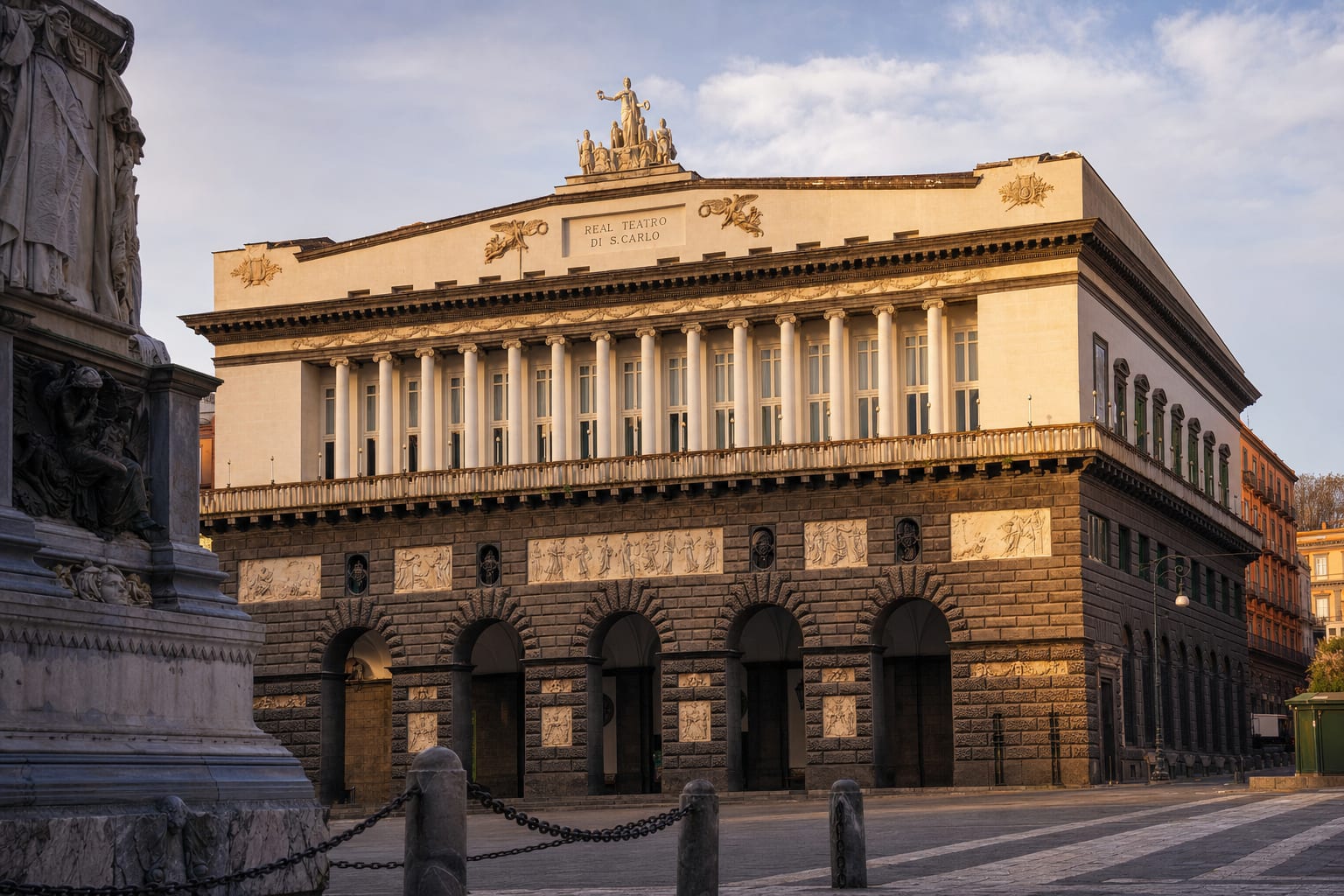 NaplesTeatro di San CarloIts 1737 Bourbon foundation, oldest opera house in continuous use, horseshoe-plan auditorium, royal boxKing Charles VII of Bourbon commissioned Teatro di San Carlo to replace Naples's aging Teatro San Bartolomeo, and it opened on 4 November 1737, his name day, decades before La Scala in Milan or La Fenice in Venice, which makes it the oldest opera house in the world still in continuous use. Architects Giovanni Antonio Medrano and Angelo Carasale gave it the horseshoe-shaped auditorium that became the template for opera houses across Europe; when a fire gutted the hall in 1816, architect Antonio Niccolini rebuilt it within a single year, keeping that same horseshoe plan and its proscenium arrangement. The house originally seated 3,285 people, since reduced to 1,386 for comfort and modern sightlines, and its gilded boxes and royal box, connected directly to the adjoining Royal Palace, still telegraph exactly who this theater was built to impress. The opera season runs from late November to July and ballet from December to early June.
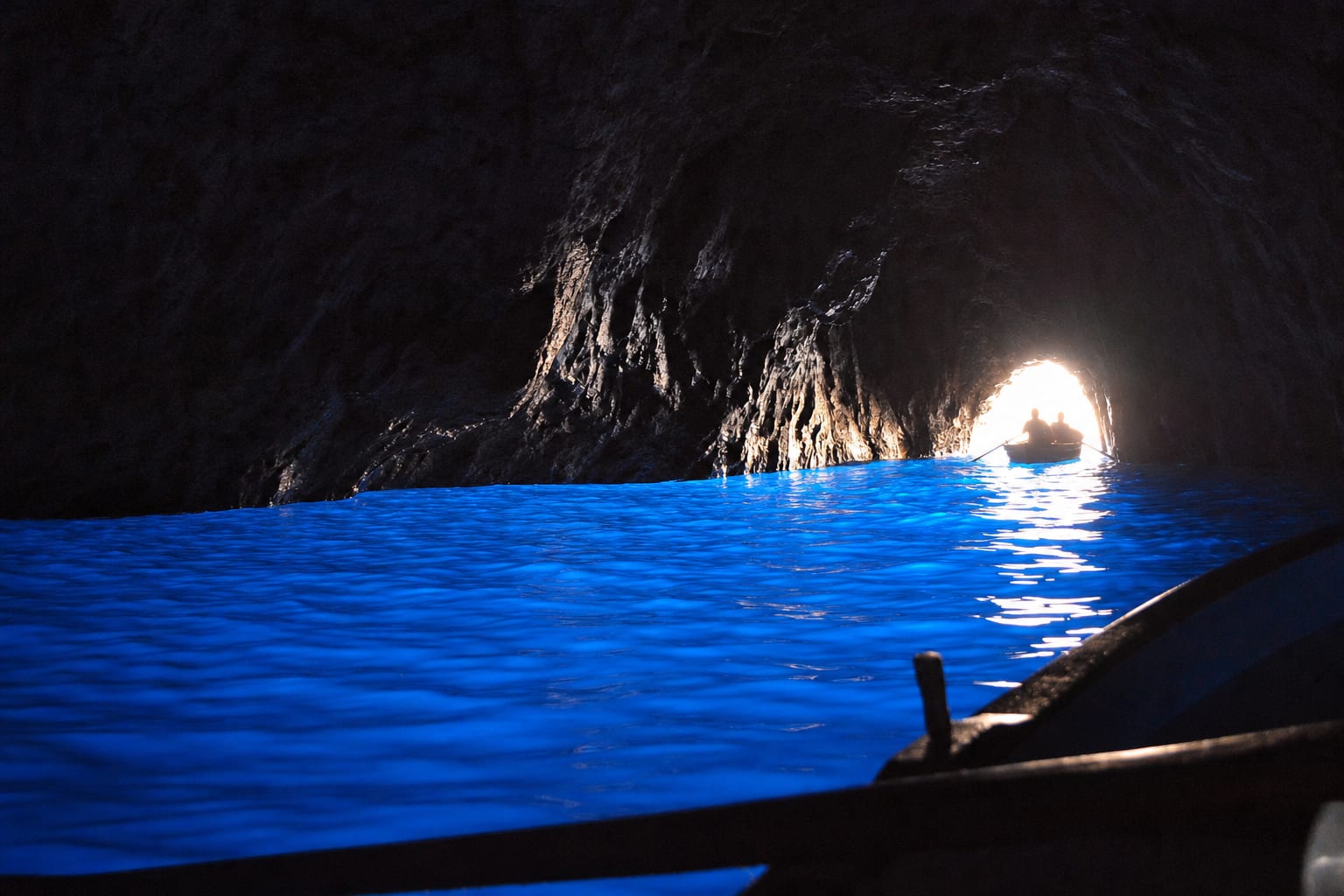 AnacapriBlue GrottoElectric-blue light, Roman maritime nymphaeum, rowboat entry, Villa di GradolaThe Blue Grotto is a sea cave on Capri's northwest coast, in the municipality of Anacapri, about sixty meters long and lit by sunlight entering through an underwater opening and reflecting off the sandy floor, which turns the water an electric blue. The way in is a fissure barely a meter high, so visitors lie back in a small rowboat while the boatman pulls them through the chain. Roman concrete niches under the water, once holding statues of Neptune and Tritons, show that this was a maritime nymphaeum belonging to the Villa di Gradola, associated with Tiberius. The cave was made famous again in 1826 by the German poet August Kopisch and the painter Ernst Fries, whose account drew Europe's travelers to Capri.
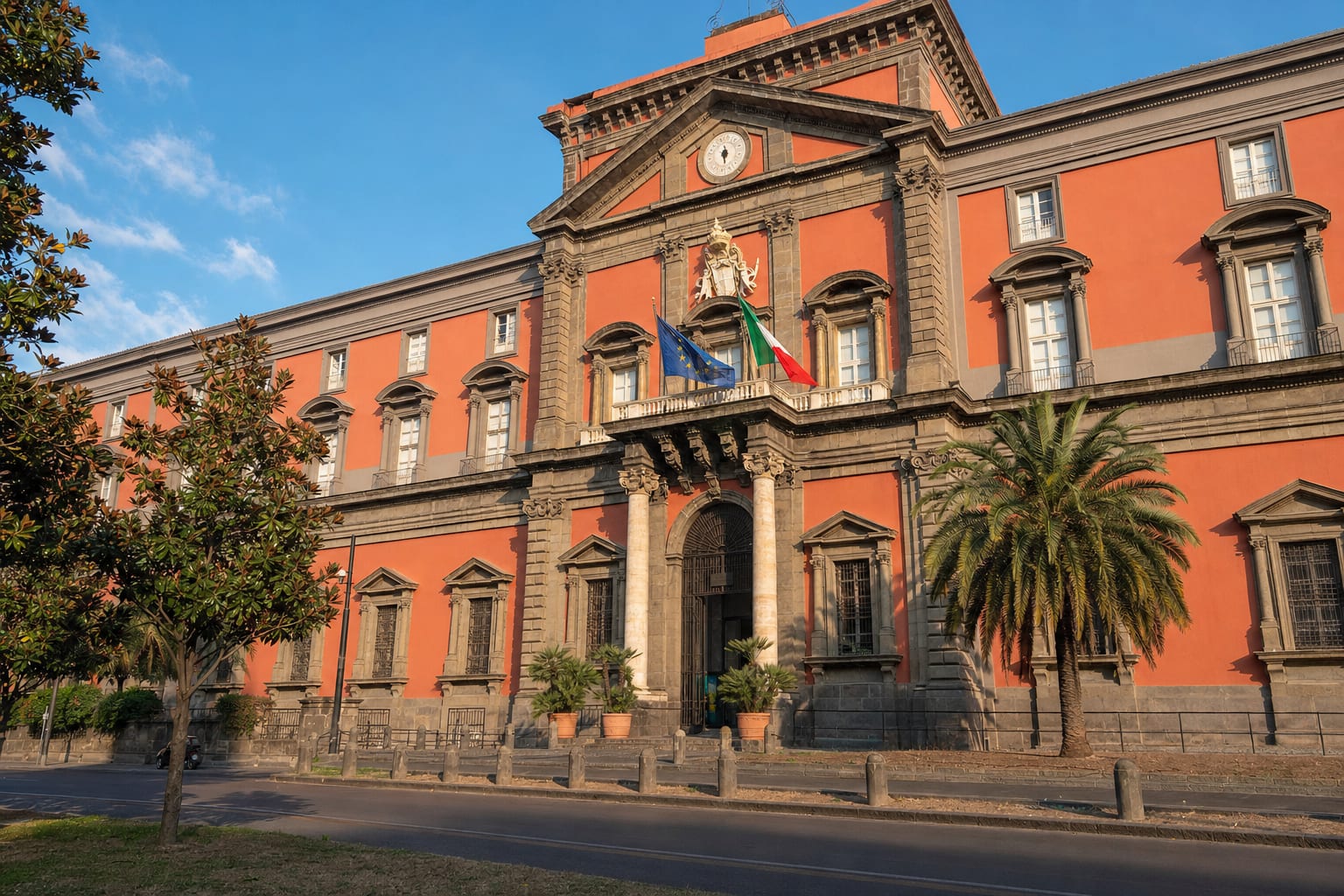 NaplesNaples National Archaeological MuseumFarnese Marbles, Alexander Mosaic, Pompeii and Herculaneum finds, Secret CabinetThe Museo Archeologico Nazionale di Napoli holds the finds that make sense of Pompeii and Herculaneum: wall paintings, bronzes, and the Alexander Mosaic, lifted whole from the House of the Faun in the 1840s. Its ground floor is anchored by the Farnese Marbles, Renaissance-era finds from Rome's Baths of Caracalla, including the colossal Farnese Bull, carved from a single block and the largest sculpture to survive from antiquity. The building has a long institutional life: raised as a cavalry barracks in the 1580s, it served as the University of Naples's seat for over a century before King Ferdinand IV opened it as the Real Museo Borbonico in 1816. Upstairs, the discreetly named Secret Cabinet holds the erotic art the Bourbons once locked away.
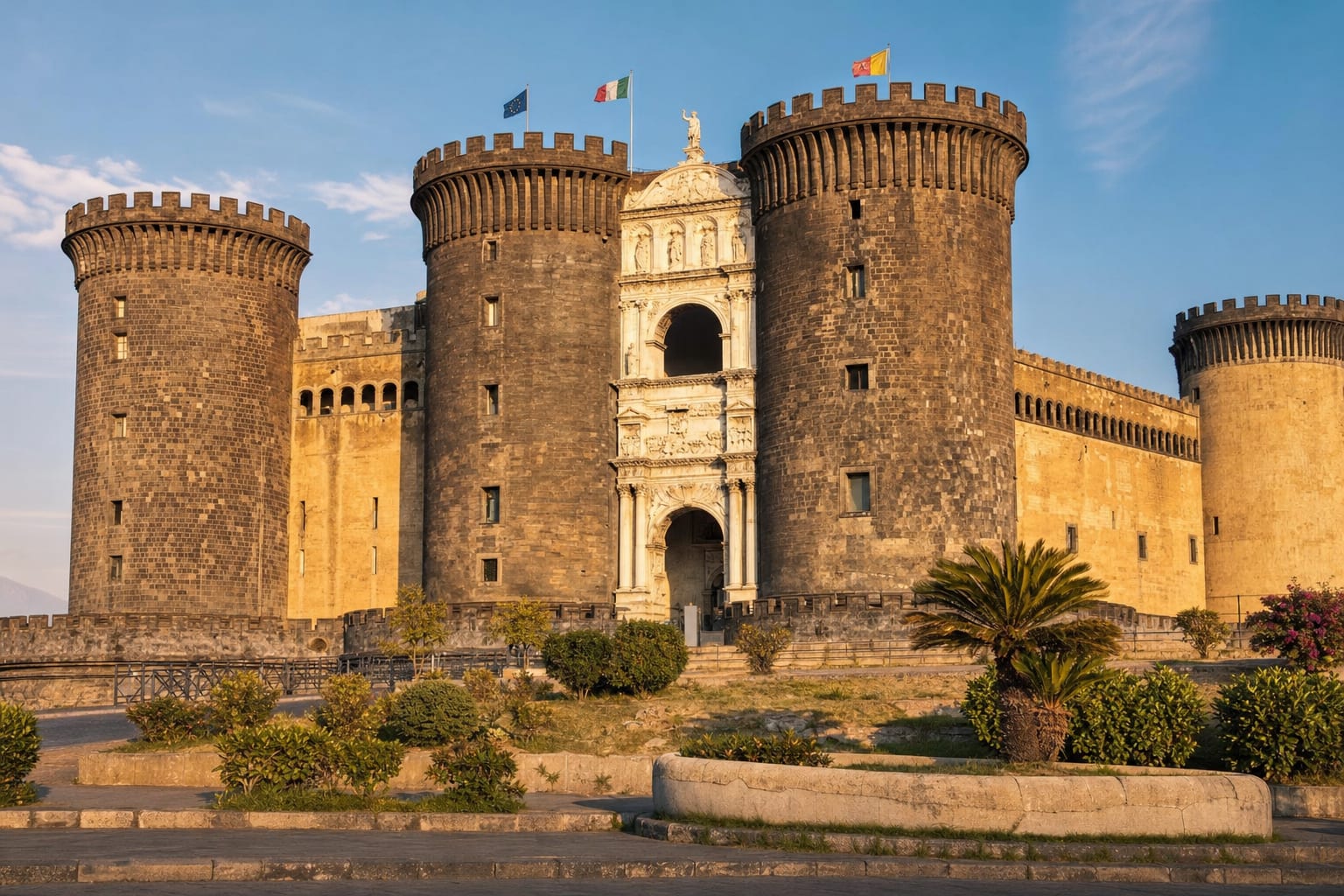 NaplesCastel NuovoIts Angevin foundation, Aragonese reconstruction, the Palatine Chapel, Sala dei Baroni and Civic Museum.Castel Nuovo, also known as Maschio Angioino, was begun for Charles I of Anjou in 1279. After Alfonso of Aragon's 1442 conquest, it was gradually reconstructed for the defensive requirements of the mid-fifteenth century, with Guillem Sagrera named by the Ministry of Culture. Since 1990, the complex has housed Naples' Civic Museum.
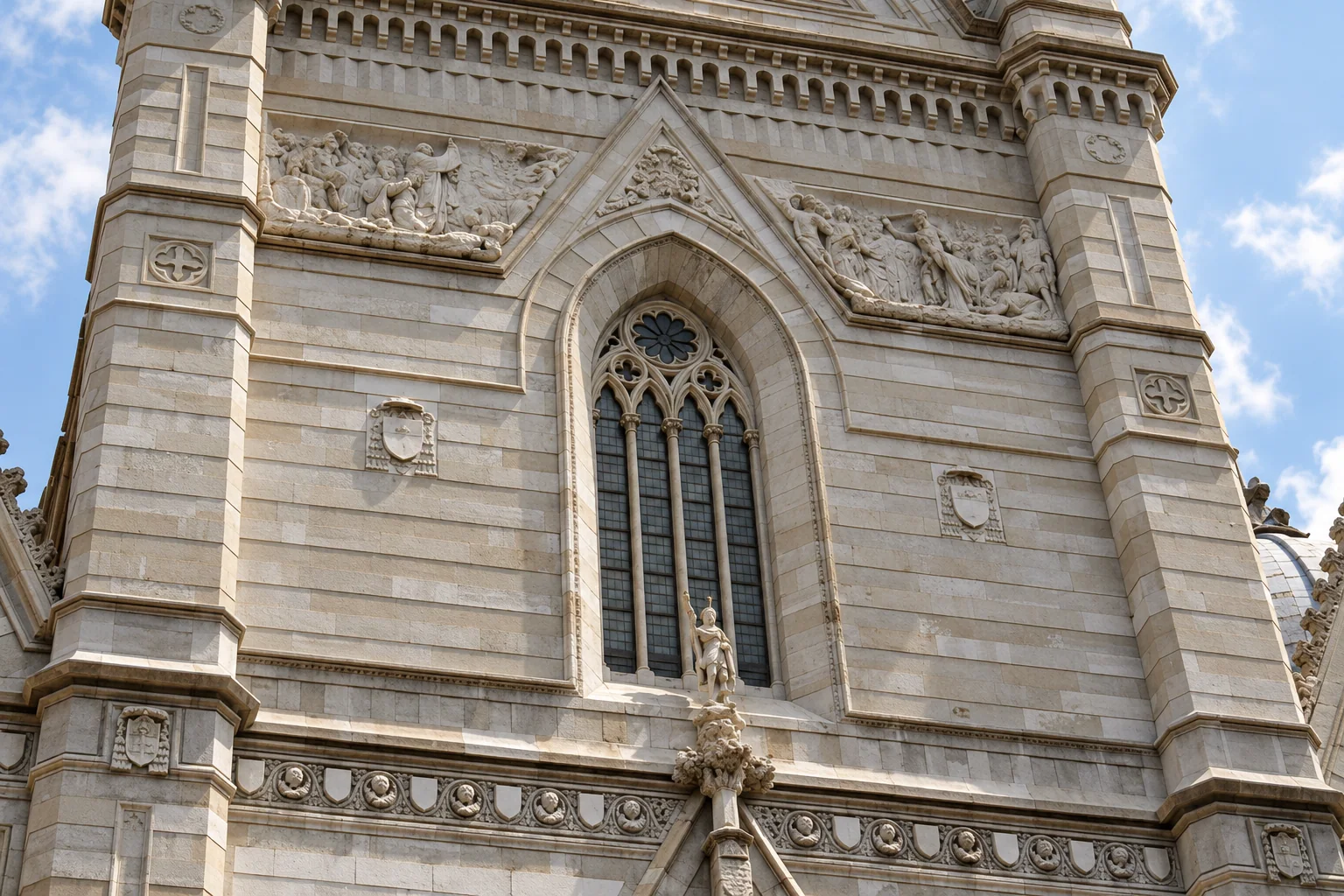 NaplesNaples CathedralIts Angevin Gothic architecture, early Christian spaces and the continuing devotional heritage of San Gennaro.Naples Cathedral brings together several layers of the city’s religious and architectural history. The Angevin project began in 1272 under Charles I and was completed in 1313 under Robert; Archbishop Umberto d’Ormont dedicated the Cathedral in 1314. Its Latin-cross interior has three naves, Gothic fabric, seventeenth-century ceiling gilding and ancient columns set against the piers, with a Baroque apse. Beneath the main altar, Cardinal Oliviero Carafa commissioned the three-nave Succorpo chapel between 1497 and 1508; the Cathedral credits Tommaso Malvito with its material execution and presents a Bramante design as a hypothesis without documentary proof.
The complex also preserves older Christian spaces. Santa Restituta is traditionally considered Naples’ first cathedral and retains a five-nave plan, a colonnade and mosaic-floor remains. The square, domed Baptistery of San Giovanni in Fonte preserves mid-fifth-century mosaics, including scenes from the New Testament. The New Treasury Chapel, built between 1608 and 1637 after Naples’ 1527 plague vow, remains a devotional space associated with San Gennaro. The blood ampoules and their ritual belong to living religious tradition: devotees gather in the hope of liquefaction, whose occurrence on a given occasion is not guaranteed. For the city’s September observance, continue with our <a href="/en/regions/campania/naples/festivals/festa-san-gennaro">Festa di San Gennaro guide</a>.
NaplesNaples CathedralIts Angevin Gothic architecture, early Christian spaces and the continuing devotional heritage of San Gennaro.Naples Cathedral brings together several layers of the city’s religious and architectural history. The Angevin project began in 1272 under Charles I and was completed in 1313 under Robert; Archbishop Umberto d’Ormont dedicated the Cathedral in 1314. Its Latin-cross interior has three naves, Gothic fabric, seventeenth-century ceiling gilding and ancient columns set against the piers, with a Baroque apse. Beneath the main altar, Cardinal Oliviero Carafa commissioned the three-nave Succorpo chapel between 1497 and 1508; the Cathedral credits Tommaso Malvito with its material execution and presents a Bramante design as a hypothesis without documentary proof.
The complex also preserves older Christian spaces. Santa Restituta is traditionally considered Naples’ first cathedral and retains a five-nave plan, a colonnade and mosaic-floor remains. The square, domed Baptistery of San Giovanni in Fonte preserves mid-fifth-century mosaics, including scenes from the New Testament. The New Treasury Chapel, built between 1608 and 1637 after Naples’ 1527 plague vow, remains a devotional space associated with San Gennaro. The blood ampoules and their ritual belong to living religious tradition: devotees gather in the hope of liquefaction, whose occurrence on a given occasion is not guaranteed. For the city’s September observance, continue with our <a href="/en/regions/campania/naples/festivals/festa-san-gennaro">Festa di San Gennaro guide</a>.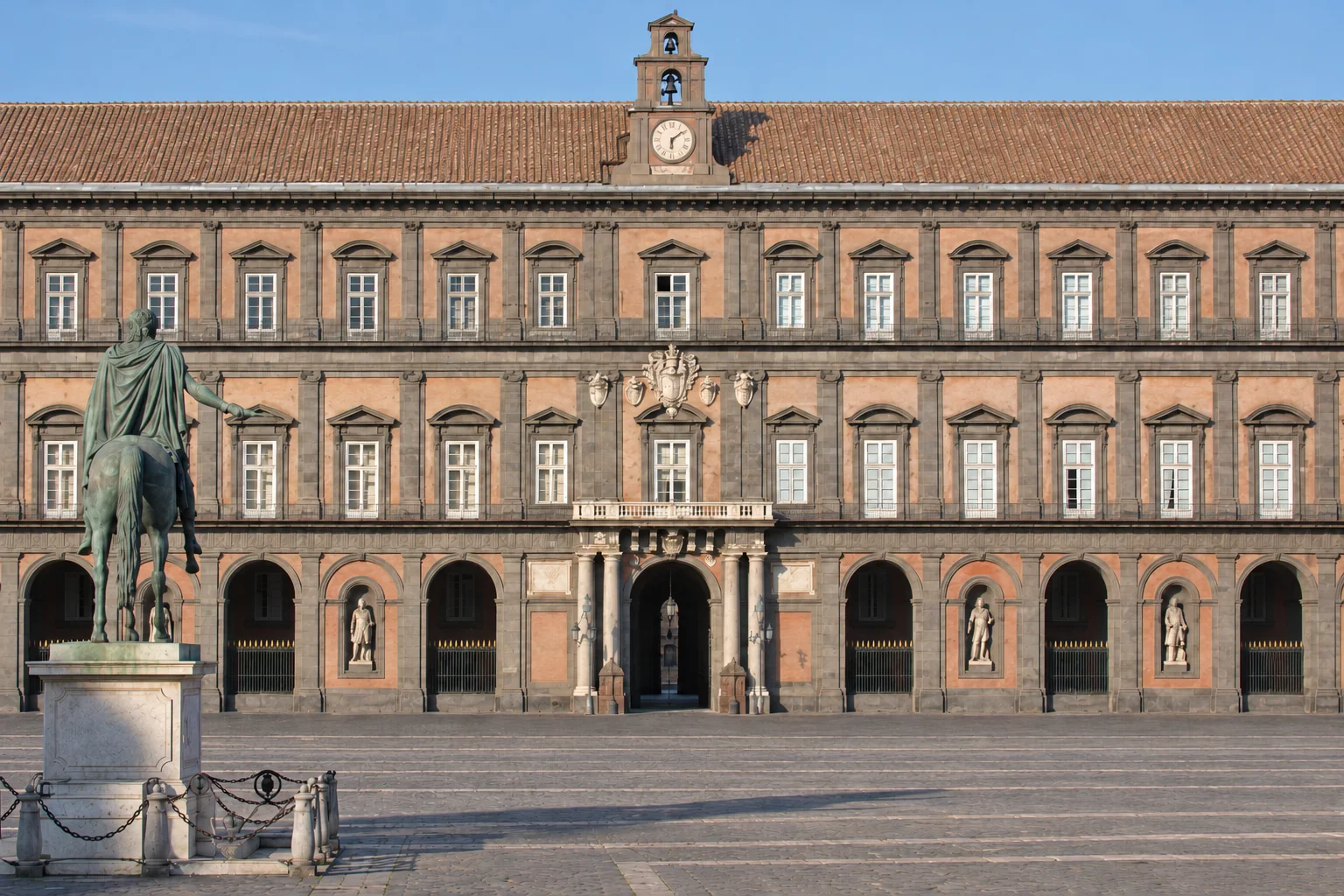 NaplesRoyal Palace of NaplesFontana's facade, the Scalone d'Onore, Teatro di Corte, Appartamento di Etichetta museum<p>The long gray-and-red façade on Piazza del Plebiscito presents Naples’ history as a line of rulers. Eight statues, commissioned under the House of Savoy, stand in niches that Luigi Vanvitelli created during eighteenth-century consolidation work; they run from Roger the Norman to Victor Emmanuel II. The building itself began in 1600, when viceroy Fernando Ruiz de Castro and vicereine Catarina Zuñiga y Sandoval commissioned Domenico Fontana to create a residence for Philip III of Spain. Its position beside the gardens of <a href="/en/attractions/castel-nuovo">Castel Nuovo</a> continued the royal quarter at the edge of the old city.</p><p>Inside, the square Courtyard of Honour preserves Fontana’s two-level loggia, with five piperno arches on each side. Look above the arch towards the Staircase of Honour for the Golden Fleece. The marble staircase retains Francesco Antonio Picchiatti’s mid-seventeenth-century design, modelled on Toledo’s Alcázar, beneath the later neoclassical decoration introduced after the 1837 fire. In the State Apartment, the Court Theatre tells a different story: Ferdinando Fuga converted the former Gran Sala for the 1768 wedding of Ferdinand IV and Maria Carolina. Its twelve papier-mâché figures include Apollo, the nine Muses, Minerva and Mercury. Bombing during the Second World War damaged the roof and destroyed the vault’s eighteenth-century decoration, which was later repainted in its original style. The central scene, the Wedding of Poseidon and Amphitrite, is based on Antonio Dominici’s original 1768 painting.</p><p>The palace now brings together the museum, the National Library of Naples and the neighbouring <a href="/en/attractions/teatro-di-san-carlo">Teatro di San Carlo</a>. Start with the Museum of the Factory for architectural models and the story of the building’s transformations, then allow about an hour for the State Apartment, with extra time for the Caruso Museum or Hanging Garden. The garden has its own ticket supplement and guided arrangements; check the <a href="https://palazzorealedinapoli.org/en/visitor-information/">official visitor information</a> before choosing your route.</p>
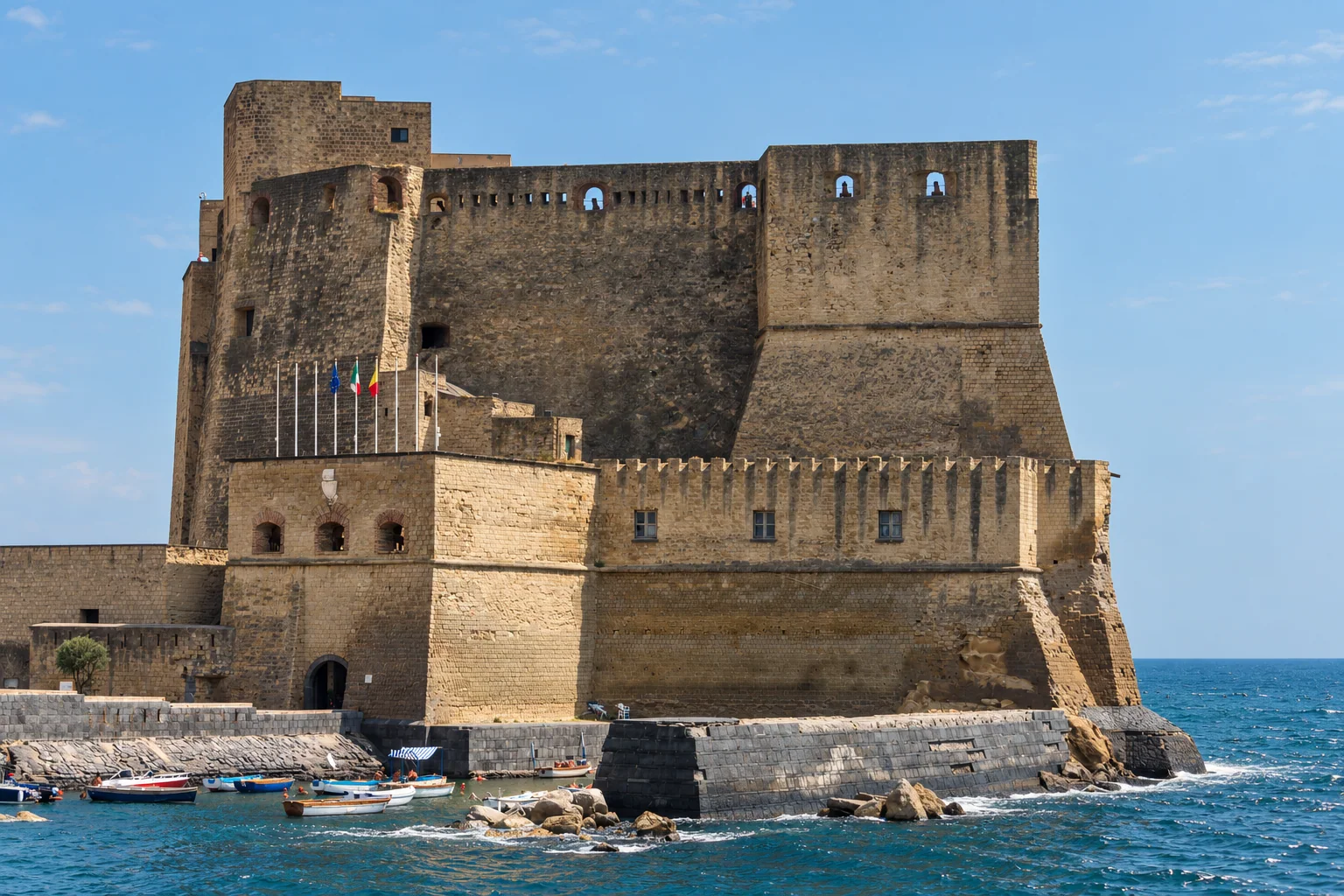 NaplesCastel dell'OvoIts Megaride setting, Norman-period remains, layered Greek and Roman landscape, and medieval Virgil-and-egg legend.<p>Castel dell’Ovo rises from Megaride at the edge of the Bay of Naples, opposite Via Partenope. The Ministry of Culture describes it as the city’s oldest castle. Its massive tufa walls belong to a much longer story than their present outline suggests: UNESCO identifies substantial Norman-period remains, remodelled repeatedly in later centuries.</p><p>Before the medieval stronghold, Megaride formed part of the coastal setting of Greek Parthenope, alongside Monte Echia. The Comune’s historical account then places the islet within the grounds of the Roman villa associated with Lucullus. Remains of hermitages linked to the Basilian nuns of Santa Patrizia add another layer, recorded by the Ministry’s regional office.</p><p>The name belongs to folklore. In a medieval legend, Virgil hides an enchanted egg in the castle, tying the safety of Naples to its survival. Read it as a story about the city’s imagined protection, rather than a documented explanation of how the fortress was built. Compare its waterfront setting with <a href="/en/attractions/castel-nuovo">Castel Nuovo</a>, then follow Naples’ later royal history at the <a href="/en/attractions/royal-palace-of-naples">Royal Palace</a>. For a visit inside Castel dell’Ovo, confirm current entry arrangements with the Comune before travelling.</p>
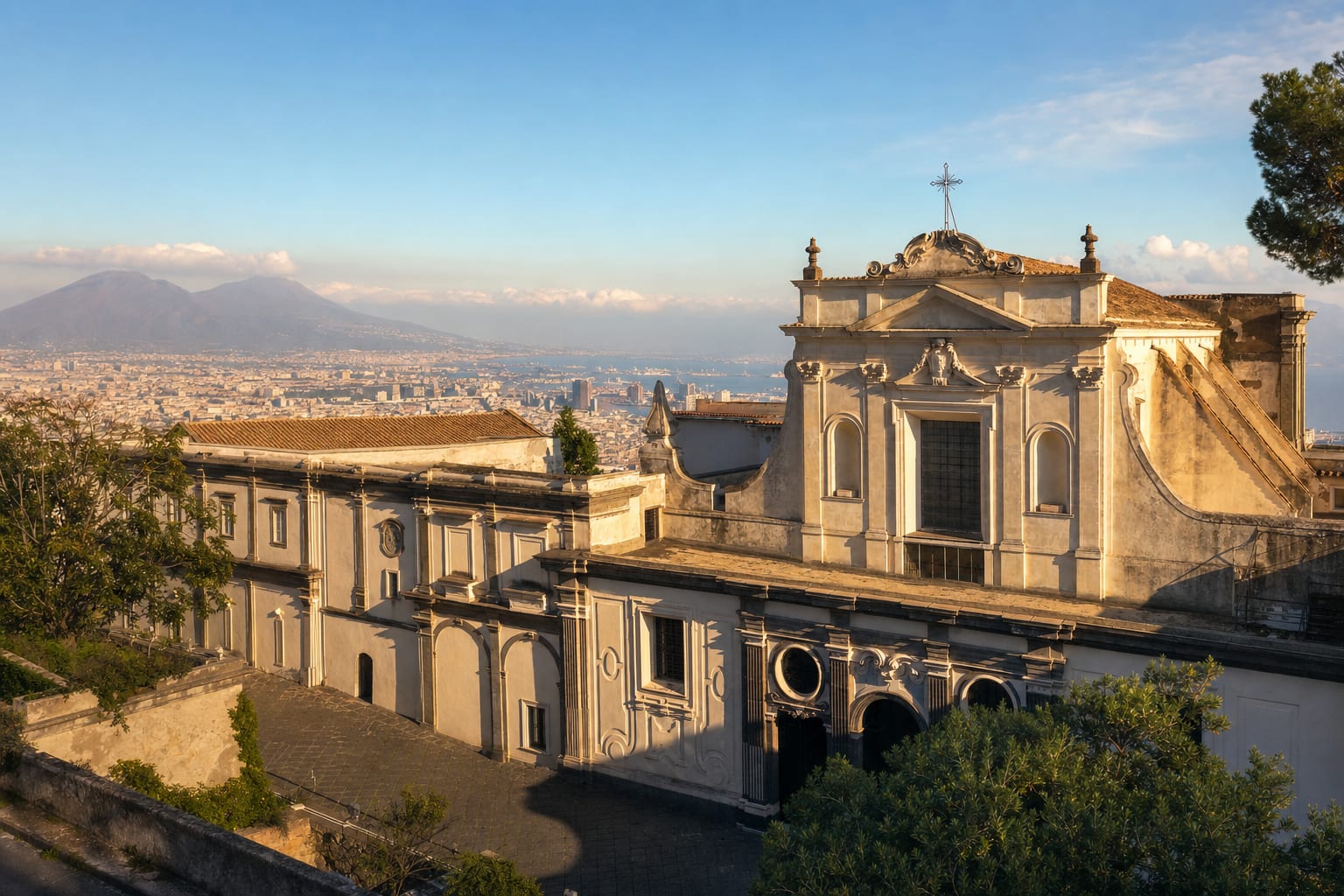 NaplesCertosa di San MartinoBaroque church and cloisters, Cuciniello presepe, city-history collections, Bay of Naples viewCarthusian monks founded the Certosa di San Martino in 1325 on the hill above Naples, and over four centuries they rebuilt it into one of the city's grandest complexes of Baroque and Rococo decoration, its marble-inlaid church a showcase for Neapolitan painters like Ribera and Giordano. Suppressed under Napoleonic rule and converted into a state museum in 1867, it now holds the city's history under one roof: naval models, royal carriages, and the Cuciniello presepe, an eighteenth-century nativity scene crowded with hundreds of painted figures across a mountainside backdrop. From the monks' former gardens, a terrace opens onto the best rooftop view of the Bay of Naples and Vesuvius, included in the entrance ticket.
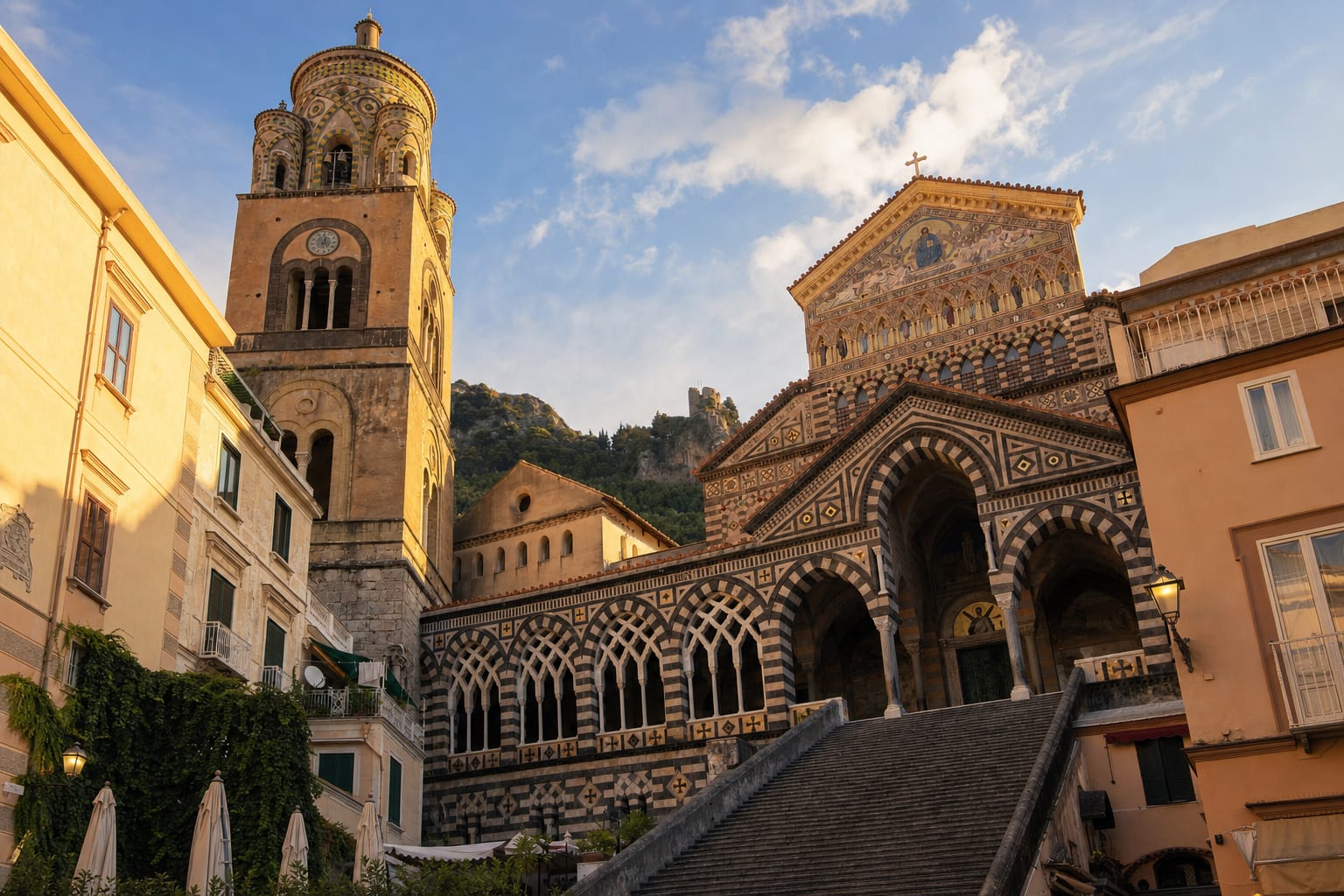 AmalfiUNESCOAmalfi CathedralSant'Andrea's crypt, Chiostro del Paradiso, Byzantine bronze doors, majolica bell towerAmalfi's cathedral, dedicated to Saint Andrew the Apostle, dates its foundation to 987, when the maritime republic was near its peak, with a major enlargement in the early thirteenth century tied to Cardinal Pietro Capuano, the Amalfitan who brought Andrew's relics from Constantinople in 1208 and laid them in the crypt below. The bronze entrance doors, cast in Constantinople around 1066, are among the oldest in Italy. What visitors see from the piazza, a striped Moorish-Byzantine facade with a green-and-yellow majolica bell tower, is largely a nineteenth-century rebuild after the original collapsed in 1861. Beside it, the Chiostro del Paradiso, built in 1266-1268 as a noble burial ground, wraps interlacing Arab-Sicilian arches around a garden of palms.
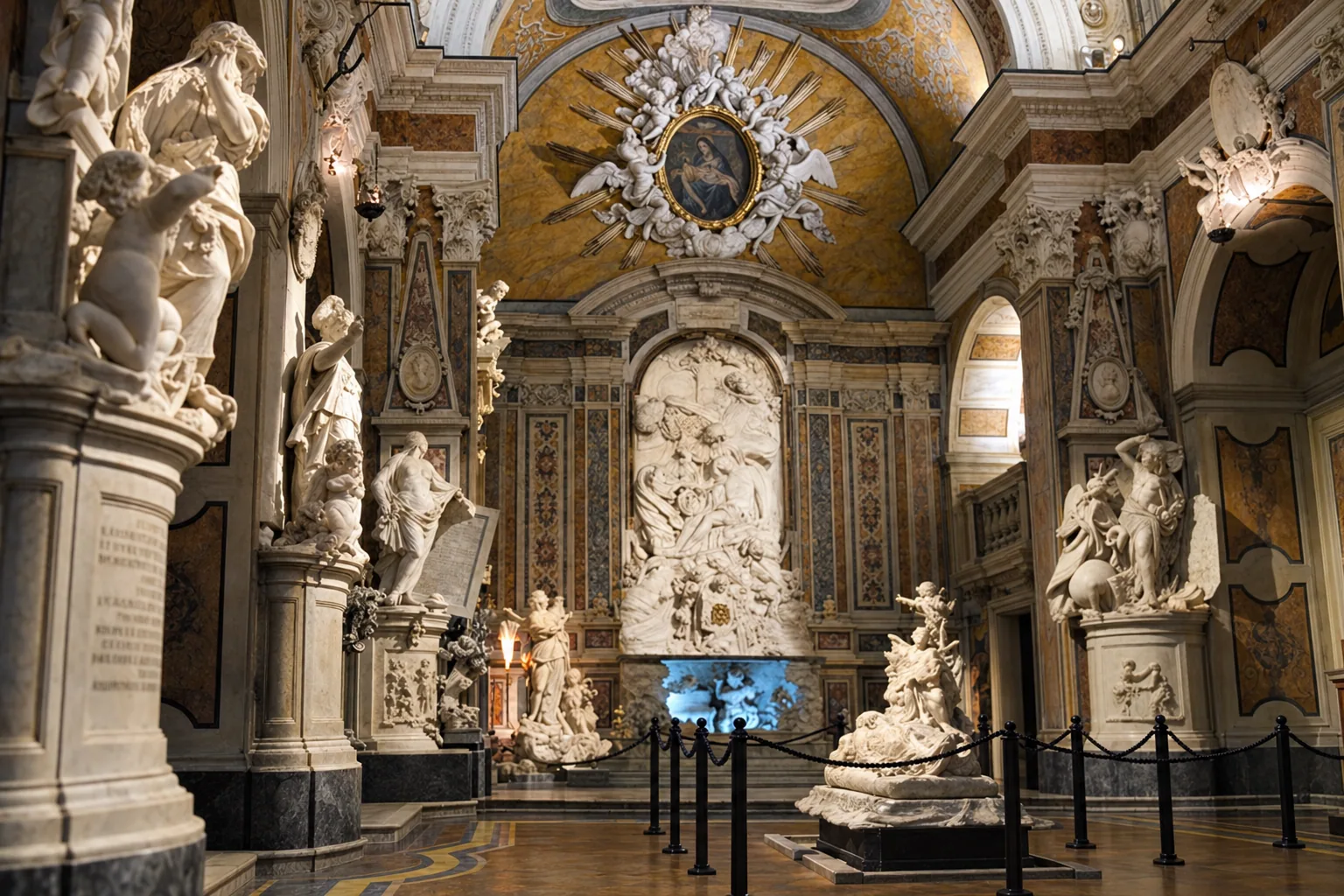 NaplesSansevero ChapelSanmartino's Veiled Christ, Corradini's Modesty, Queirolo's Disillusion, the Anatomical MachinesSansevero Chapel began in 1593 as the di Sangro family's private burial chapel, but Raimondo di Sangro, the eccentric seventh prince and a real scientist as well as a Freemason, rebuilt it in the 1740s into a single artistic and philosophical program completed by 1766. Giuseppe Sanmartino's Veiled Christ of 1753 anchors the room, a marble figure draped in a marble shroud so thin the body seems to breathe beneath it, carved entirely from one block despite centuries of rumors that Raimondo turned real cloth to stone by alchemy. Antonio Corradini's Modesty and Francesco Queirolo's Disillusion flank him in equally virtuoso marble, while the underground Cavea displays Giuseppe Salerno's so called Anatomical Machines, two skeletons with veins rendered in wax and wire, another Sansevero legend historians have since debunked.
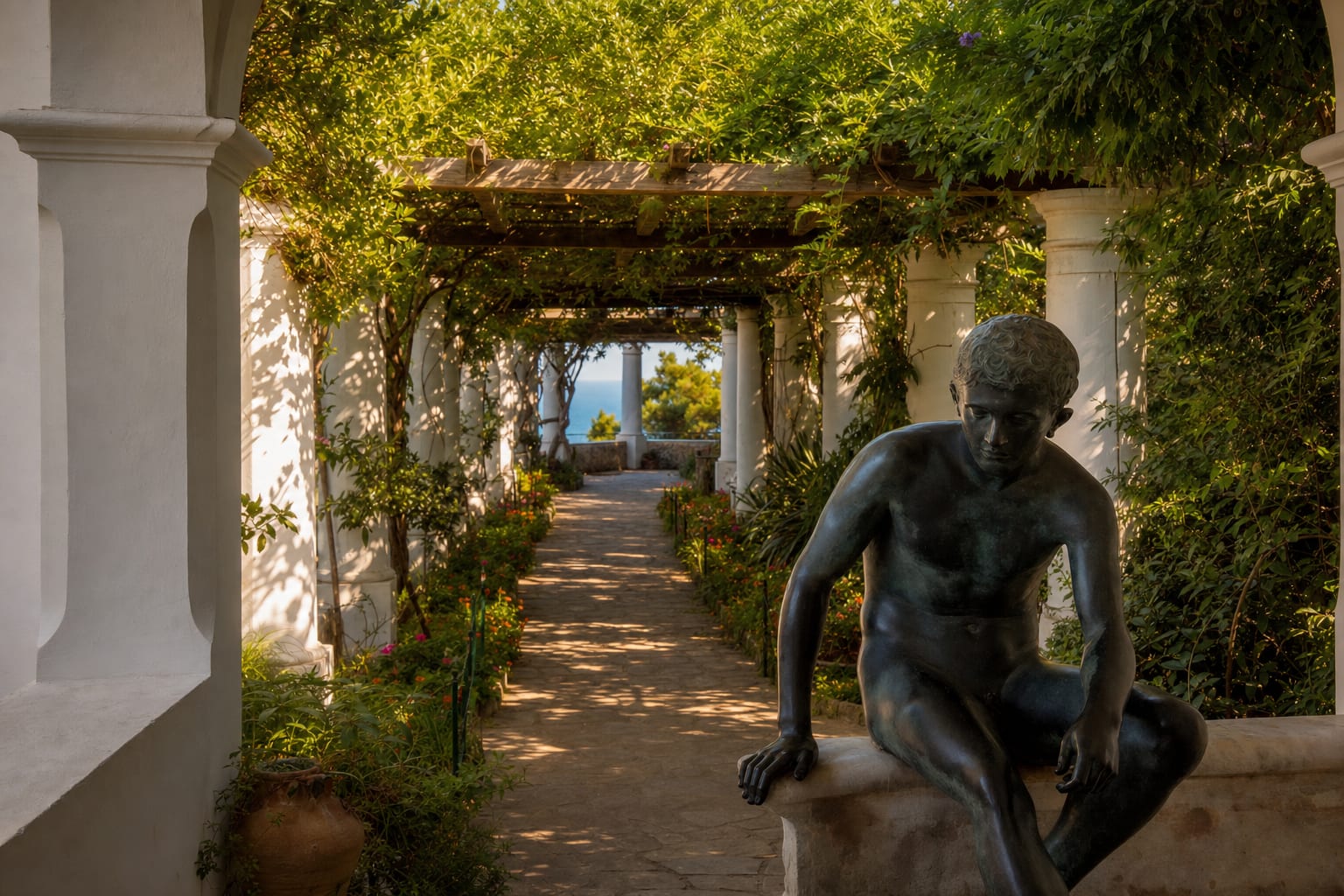 AnacapriVilla San MicheleAxel Munthe’s house museum, Roman-Etruscan-Egyptian collection, granite sphinx, Castello Barbarossa bird sanctuaryVilla San Michele is the life’s work of Axel Munthe, the Swedish physician and author who spent decades building this house and garden above Anacapri, then told its story in his 1929 memoir The Story of San Michele. The rooms and pergolas hold a collection that is largely Roman, Etruscan and Egyptian, gathered by Munthe himself; the granite sphinx facing the Bay of Naples is his single most cherished piece, and the museum dates it to roughly 3,200 years old. Munthe also bought the ridge above the villa, Castello Barbarossa, to stop local hunters trapping migratory songbirds there, and in spring it now serves as a bird observatory. The view from the loggia, across to Vesuvius, explains why he never left.
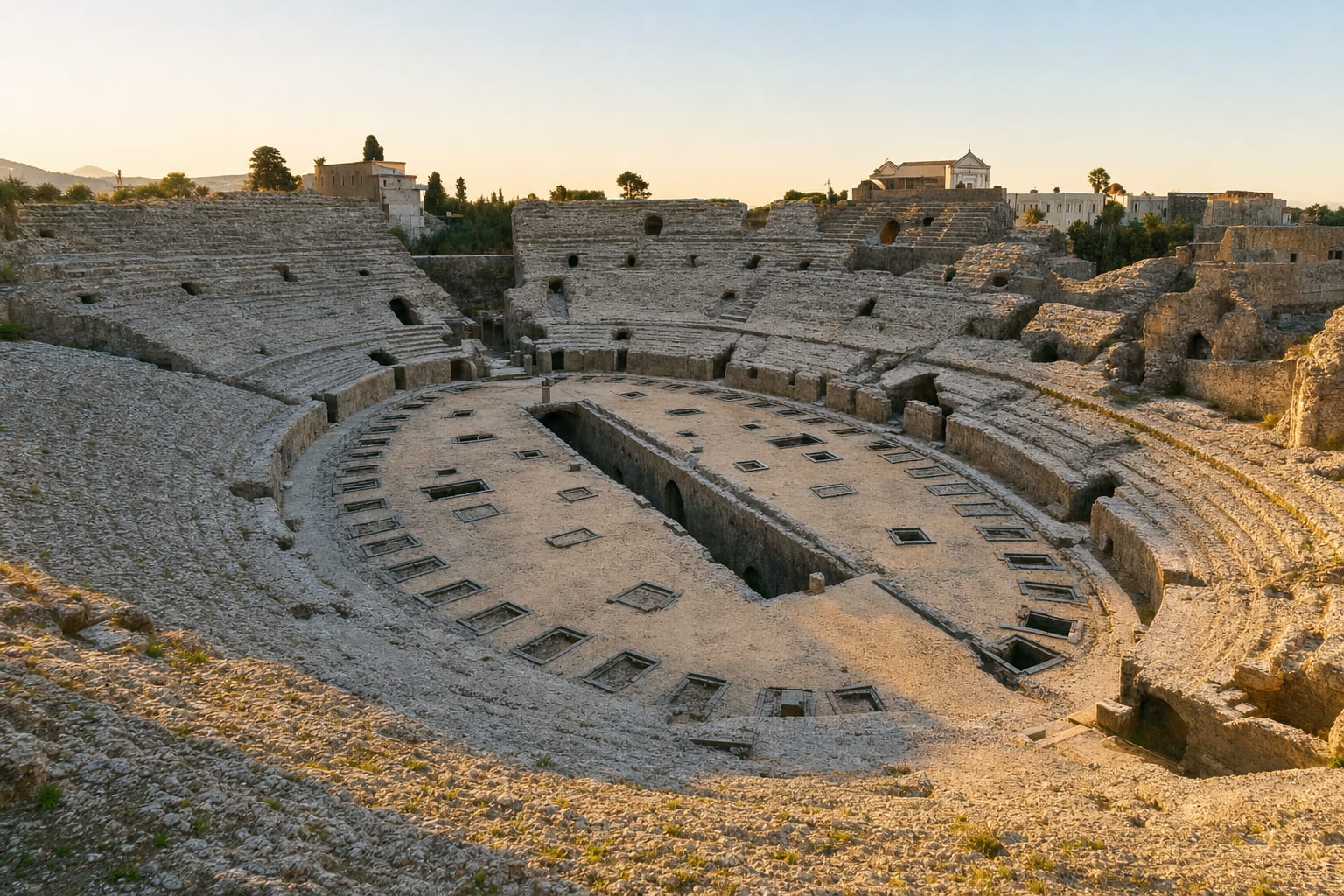 PozzuoliFlavian Amphitheatre of PozzuoliThird-largest Roman arena, intact underground animal lifts, Puteoli’s imperial-era wealthPozzuoli’s amphitheater ranks third in size after the Colosseum and Capua’s arena, and its history reaches back further than most Roman spectacle buildings: work likely began under Nero and continued through the Flavian dynasty as the colony of Puteoli grew rich on trade. What sets it apart lies beneath the arena floor. The underground galleries survive in exceptional detail, with the trapdoors, ramps and cage lifts that once hauled animals and scenery up into the arena still legible in the stone. Walk the corridors where keepers managed lions and bears, and look for the channels cut for stage machinery, a system no other Roman arena preserves so clearly. Earthquakes and the bradyseism of the nearby Solfatara have shaped the site nearly as much as its builders did.
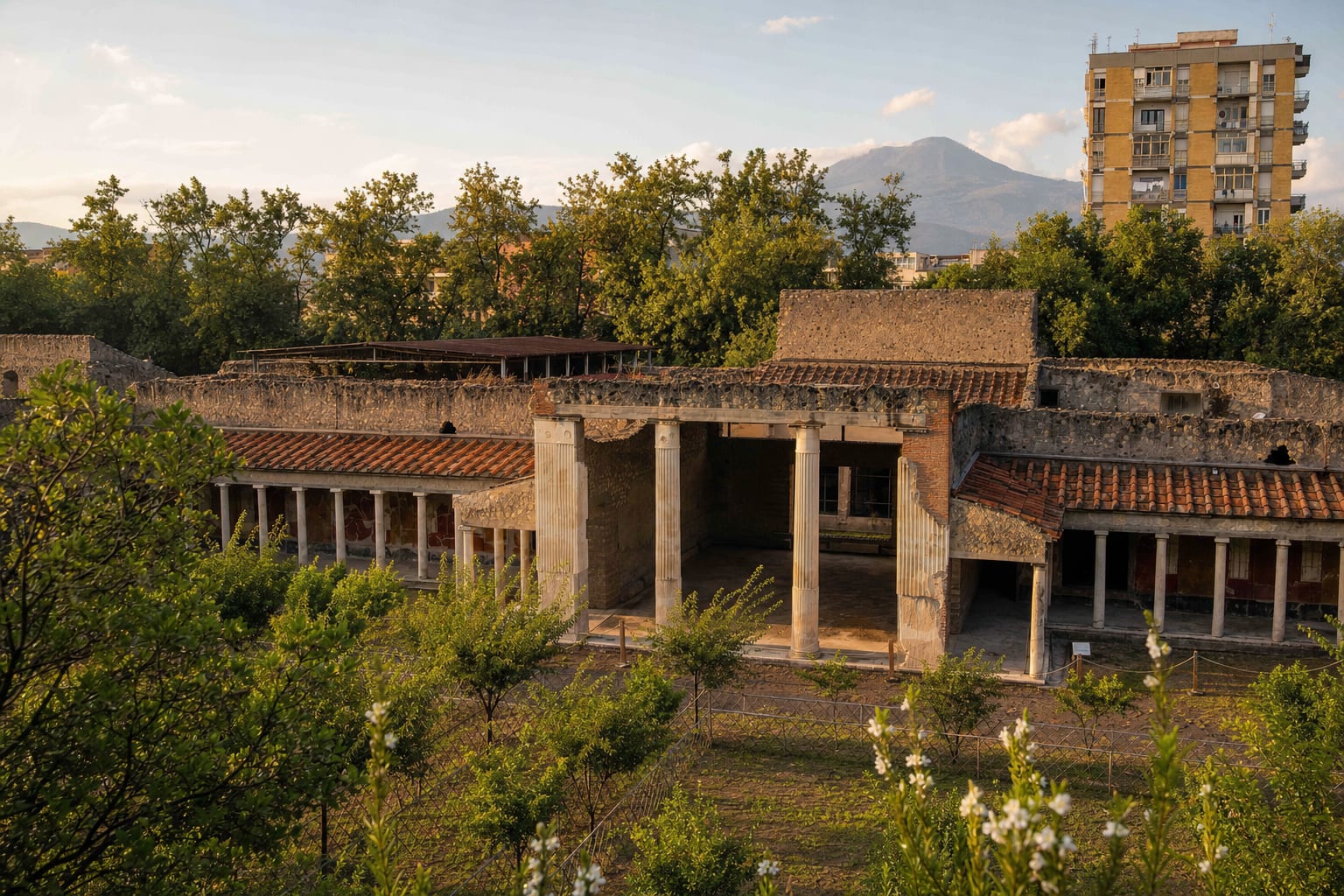 Torre AnnunziataUNESCOVilla OplontisVilla of Poppaea attribution, Roman wall painting, 61-by-17-meter pool, perspective-led gardensVilla A, known to everyone as the Villa of Poppaea, is a grand Roman residence at ancient Oplontis, in what is now Torre Annunziata. Its oldest rooms go back to the middle of the first century BCE, and the owners kept expanding it into the first century CE, when they added a pool 61 meters long and 17 wide, big enough to swim real laps. Perspective-painted gardens, sculpture, fountains and wall paintings spanning three centuries of Roman style, Second, Third and Fourth, still cover the walls. The Poppaea connection is more suggestion than fact: the archaeological park notes only that the villa may have belonged to her family's Campanian holdings, not that she herself lived here.
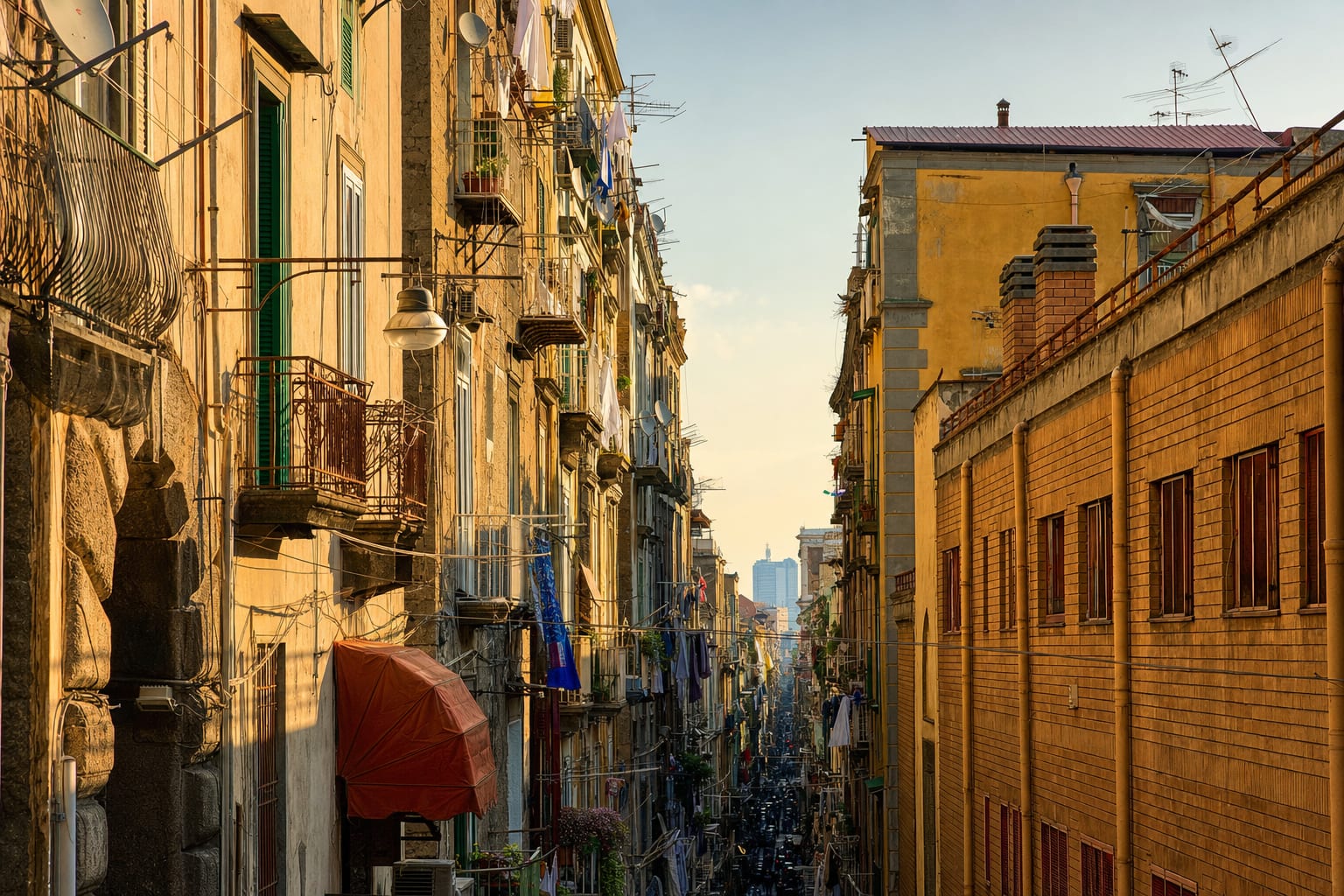 NaplesSpaccanapoliGreek decumanus grid, Via San Biagio dei Librai, Palazzo Diomede Carafa, historic-center street lifeSpaccanapoli is the local name for Via San Biagio dei Librai and the streets that continue it, the lower decumanus that Greek settlers laid out for ancient Neapolis more than two thousand years ago. Walk it end to end and the grid the Greeks planned is still legible under the noise of scooters, drying laundry and open shopfronts. Along the way, Palazzo Diomede Carafa shows the moment Naples traded Gothic pointed arches for the calmer lines of the Renaissance, one of the clearest such transitions in the city. The street has never stopped being used exactly as intended: a through route, not a monument, which is precisely why it feels so alive.
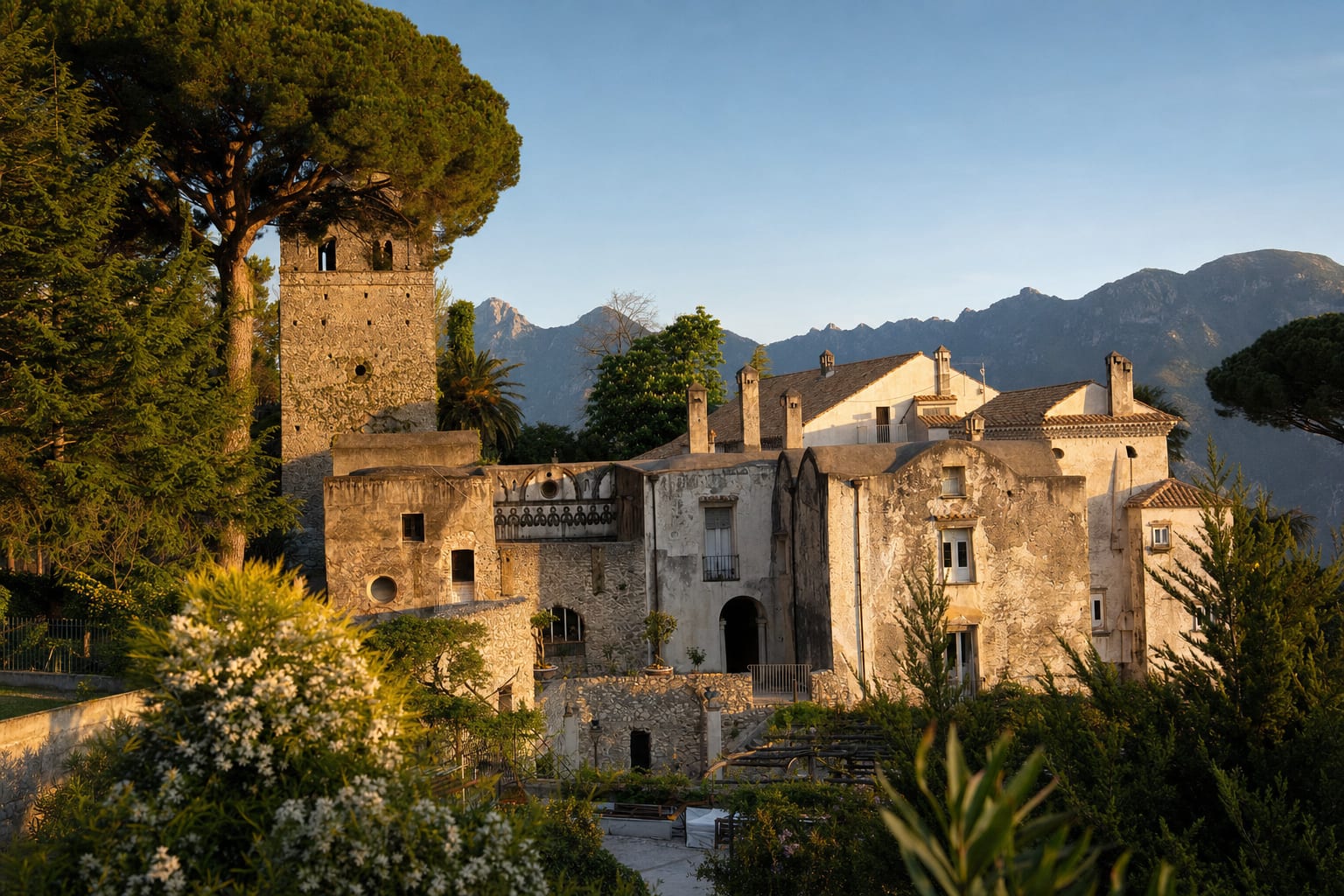 RavelloVilla RufoloMedieval Rufolo complex, Arab-Byzantine-Norman architecture, terraced gardens, Wagner and Parsifal, Ravello FestivalVilla Rufolo was built in the thirteenth century for the Rufolo family, Ravello's merchant dynasty grown rich on trade with North Africa and the Levant, and its cloister and tower still mix Arab, Byzantine and Norman details in a way found almost nowhere else on the Amalfi Coast. By the nineteenth century the complex had fallen into decline until the Scottish botanist Francis Neville Reid bought it and laid out the terraced gardens that now step down toward the sea. Richard Wagner visited in May 1880 while composing Parsifal and reportedly found the garden he had been imagining for the opera's Klingsor already built, a connection the town celebrates still. That link led directly to the first Ravello Festival concerts, staged on the same terrace in 1953 and still running every summer, with the coastline and the Gulf of Salerno as a backdrop no concert hall can match.
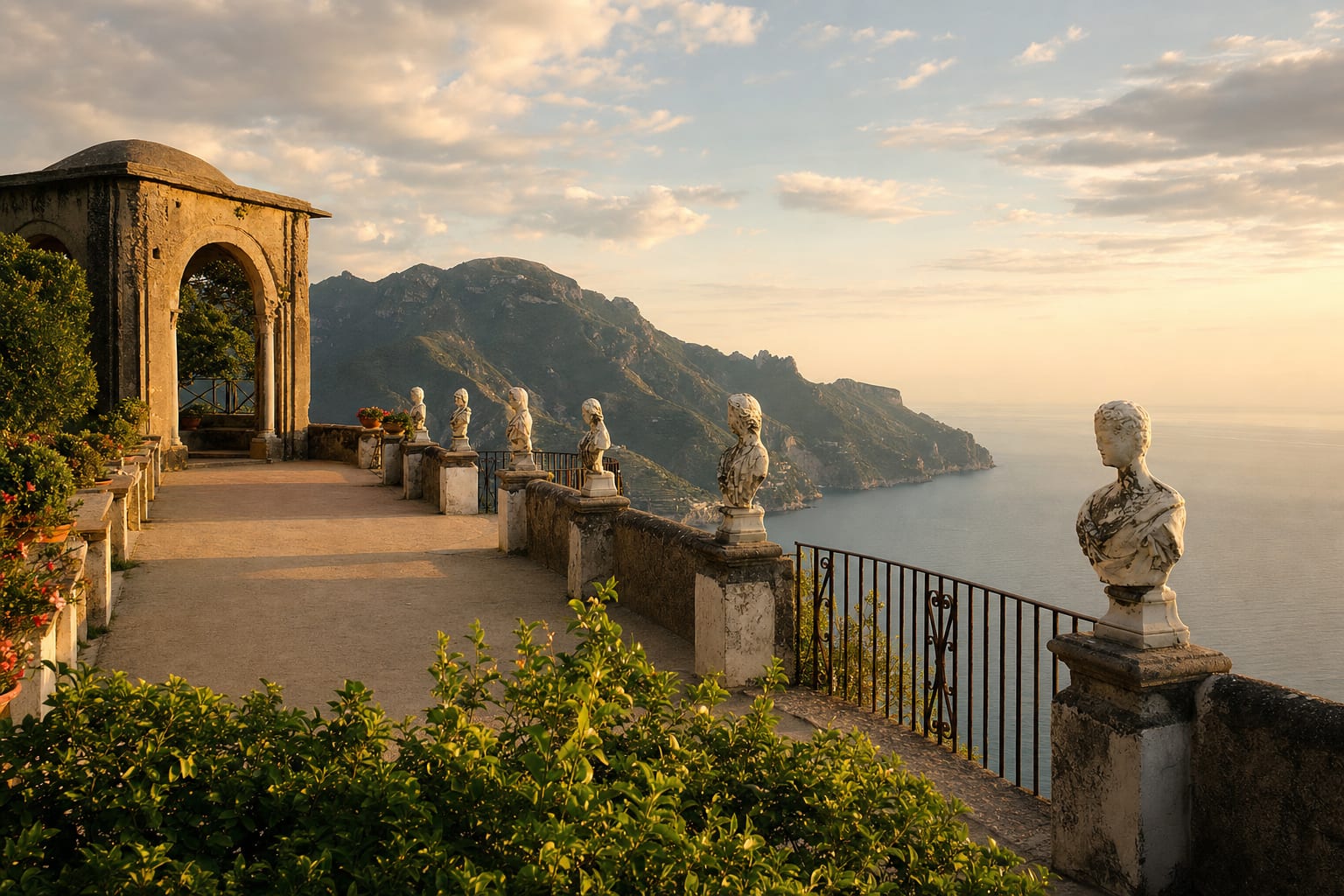 RavelloVilla CimbroneTerrace of Infinity, marble busts over the void, Bloomsbury connections, rose gardensVilla Cimbrone has stood on this Ravello ridge since the Middle Ages, but its gardens are the work of a Victorian: the English aristocrat Ernest Beckett, who bought the run-down estate in 1904 and shaped it into a Romantic landscape of terraces, temples and shady walks. The reason everyone comes is the Terrace of Infinity, a belvedere lined with marble busts that seem to float above 350 meters of open air, the Gulf of Salerno spread out below. The property was a retreat for writers and artists, with Bloomsbury connections, and part of it is now a hotel. It lies within the UNESCO-listed Amalfi Coast rather than being separately inscribed.
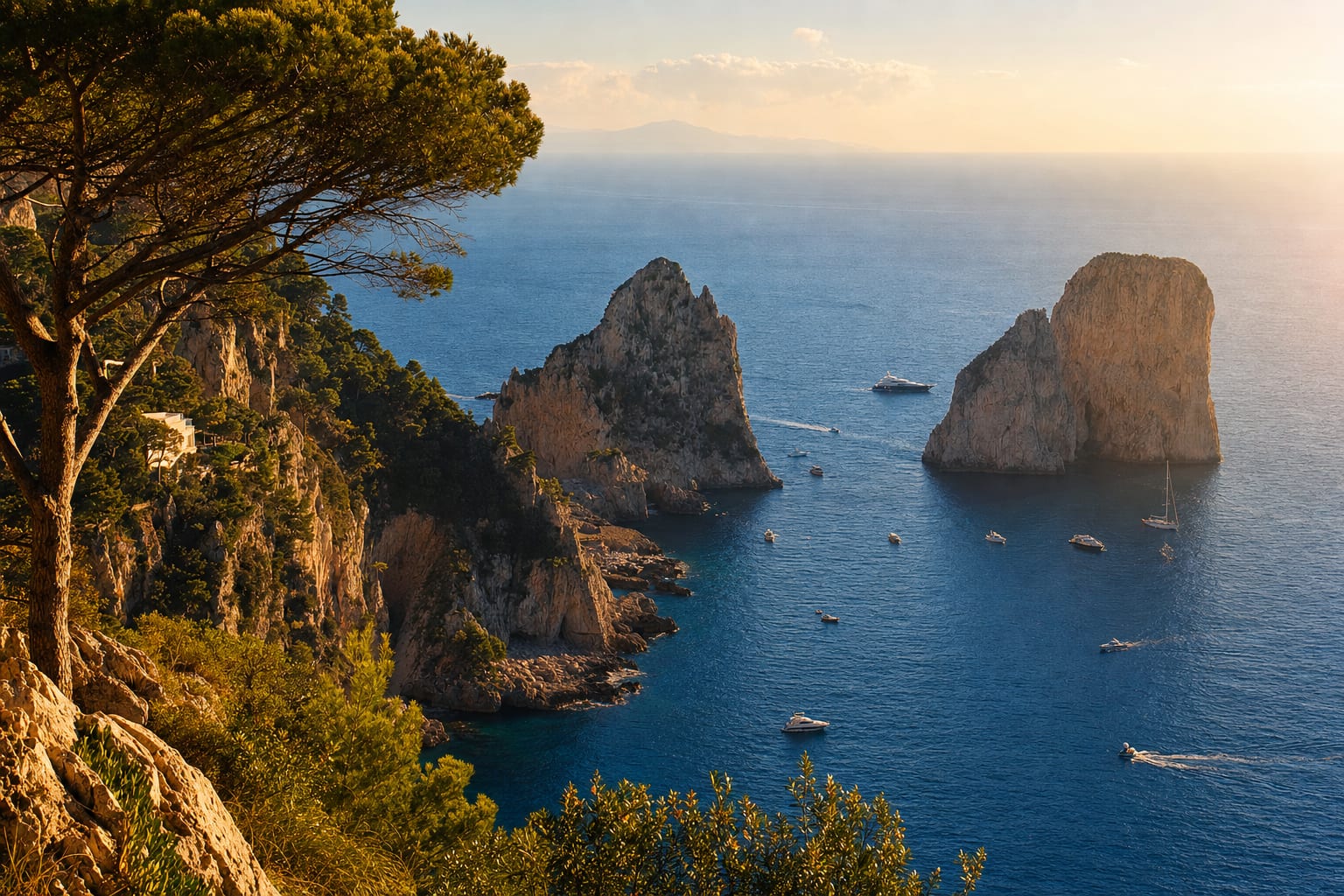 CapriFaraglioniThree sea stacks, boat passage through the arch, blue lizard, Belvedere di TragaraThe Faraglioni are three limestone sea stacks off Capri’s south-eastern coast: Stella, still joined to the island and the tallest at about 109 meters; Faraglione di Mezzo, pierced by a natural arch that small boats pass through when the sea allows; and Faraglione di Fuori, also called Scopolo, the outermost. Scopolo shelters the blue lizard, a Capri subspecies found almost nowhere else, and a smaller fourth stack, the Monacone, sits behind the group. The name probably comes from the Greek pharos, lighthouse. You can see them from the Belvedere di Tragara, at the end of Via Tragara, or from the water on a boat circuit of the island.
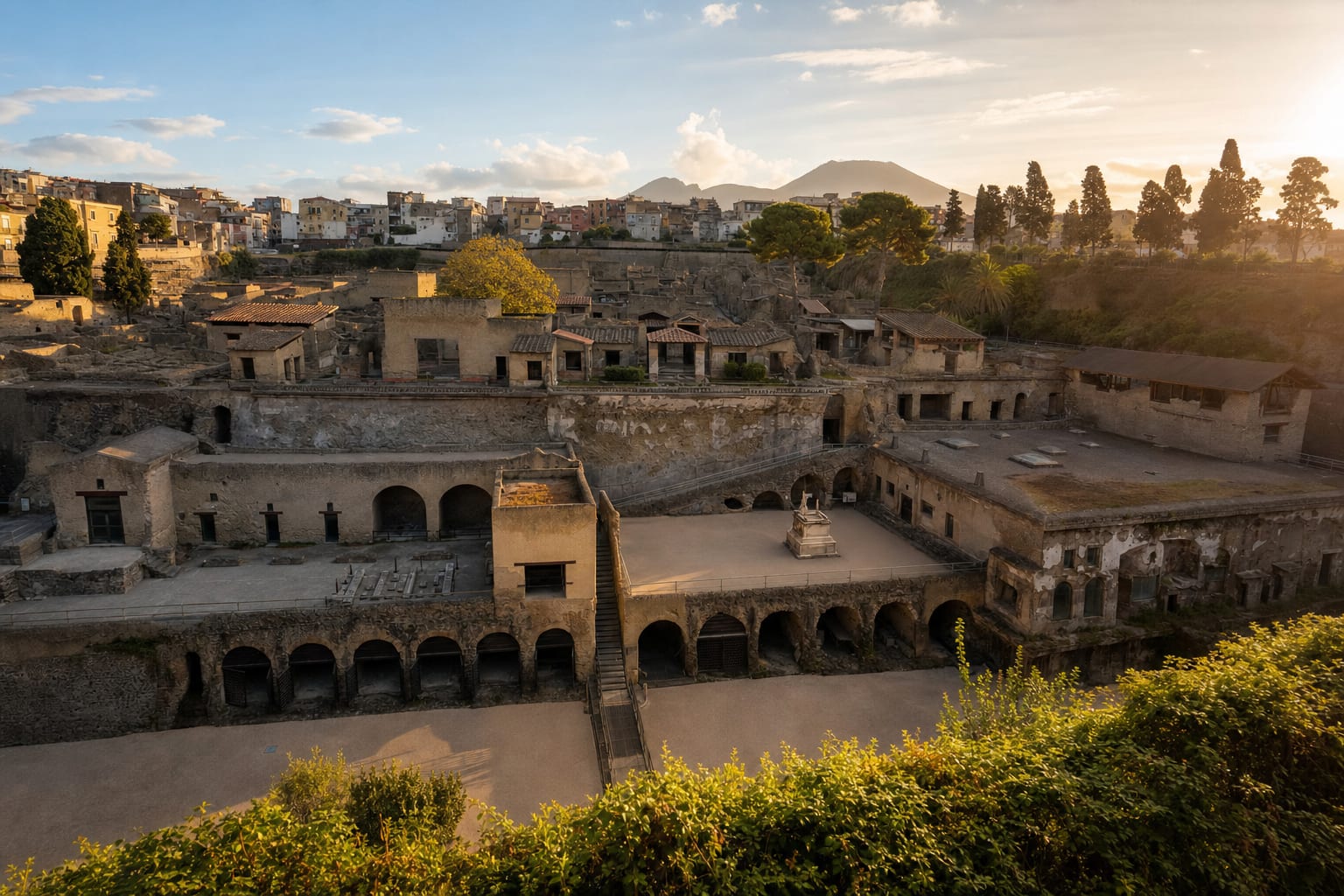 HerculaneumUNESCOHerculaneum Archaeological Park79 CE eruption, carbonized organic finds, ancient shoreline boat-arcades, upper stories and mosaics preserved in placeHerculaneum went under in 79 CE differently than its more famous neighbor Pompeii: rather than a slow rain of ash, waves of superheated pyroclastic surge and mudflow buried the town beneath some 20 meters of volcanic material, sealing it so completely and so fast that wooden beams, doors, furniture, food and even fishing nets survived carbonized rather than rotted away. That fluke of chemistry makes the excavated quarter unusually legible: full upper stories, an ancient shoreline lined with boat-storage arcades where hundreds of people sheltered from the eruption and died there, and houses whose painted walls and mosaic floors read almost as sharply as the day they were buried. Most of ancient Herculaneum still lies beneath modern Ercolano, unexcavated.
Tours worth booking in Campania
Compared by our editors, across providers.
Booking through these links may earn Italia Magnifica a commission, at no cost to you.
- Viator
- 2h 30m
- 5.0★ · 17 reviews
from €25Book this tour- Viator
- 2h
- 5.0★ · 11 reviews
from €170Book this tour- Viator
- 8h
- 5.0★ · 1 reviews
from €3,100Book this tour- Viator
- 8h
- 5.0★ · 1 reviews
from €2,700Book this tour- Viator
- 1h 15m
- 5.0★ · 8 reviews
from €30Book this tour- Viator
- 8h
- 5.0★ · 78 reviews
from €950Book this tour


City by city
Where the monuments cluster in Campania.