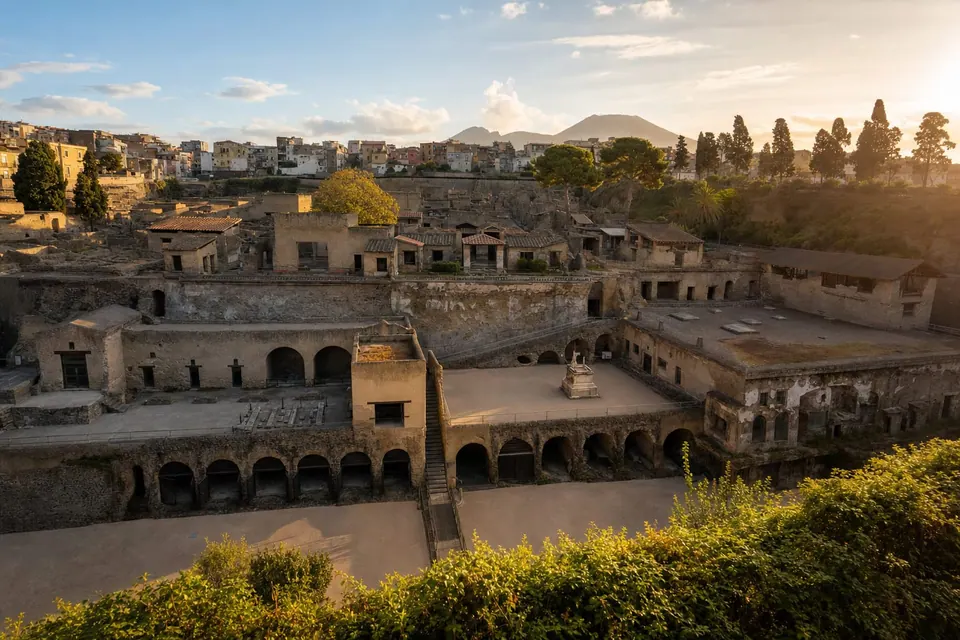
Herculaneum went under in 79 CE differently than its more famous neighbor Pompeii: rather than a slow rain of ash, waves of superheated pyroclastic surge and mudflow buried the town beneath some 20 meters of volcanic material, sealing it so completely and so fast that wooden beams, doors, furniture, food and even fishing nets survived carbonized rather than rotted away.
That fluke of chemistry makes the excavated quarter unusually legible: full upper stories, an ancient shoreline lined with boat-storage arcades where hundreds of people sheltered from the eruption and died there, and houses whose painted walls and mosaic floors read almost as sharply as the day they were buried. Most of ancient Herculaneum still lies beneath modern Ercolano, unexcavated.
A Roman town, and only part of one
Herculaneum Archaeological Park preserves an excavated portion of the Roman town overwhelmed by Vesuvius in 79 CE. It is not a miniature Pompeii, a single villa, or a museum of detached objects. UNESCO treats it as one part of a serial property that also includes Pompeii and the Villas at Torre Annunziata; within the Herculaneum component, the Villa of the Papyri is a related but distinct archaeological site west of the town.1
Herculaneum is smaller and better preserved than Pompeii, which was a broad commercial town. That does not make one more important than the other, and not every house, upper floor, room or object is complete and open. The visible park is also not the whole ancient city: extensive areas remain beneath modern Ercolano and are known in part through the eighteenth-century tunnel network.1
Streets, houses, public spaces, the ancient shoreline, domestic objects and carbonized organic materials all survive here, each in its own way, and each carries different conservation constraints. A legible wall or wooden object does not mean that an entire building or neighborhood remains unaltered.2,1
What the eruption did at Herculaneum
The eruption played out differently at Herculaneum. In 79 CE, fiery clouds hit the town at around 400°C and at more than 80 km/h; mudslides then buried it beneath about 20 meters of volcanic material. Burning surges traveled at about 10–20 meters per second, and the extreme heat carbonized organic substances.3
The site records a destructive event, but it also records different processes: fiery surges, heat, burial and later excavation all shaped what can be studied today.3
The ancient beach makes the old shoreline visible as archaeology rather than as scenery. More than 300 people were found in the arcades opening onto the beach during work in the 1980s, and a boat emerged from the volcanic mud in 1982. A proposed connection between that vessel and Pliny the Elder’s rescue fleet remains a theory, not a settled identification.3
Why wood, food and writing matter
Herculaneum’s most distinctive evidence is not simply “better preservation.” Carbonized furniture, doors, stairs, lintels, partitions, work tools, small boats, food remains, seeds, cereals, fruits, textiles and ropes all survive. These materials make domestic construction, craft, consumption and storage more tangible than at many archaeological sites, and they are fragile.2
Wood’s survival does not mean that every wooden element was recovered, or that a carbonized fragment retains its original color, texture or structural strength. The House of the Relief of Telephus has a remarkable, uncarbonized painted and gilded ceiling, quite different from the broader category of carbonized organic remains. “Wood at Herculaneum” is not one material condition.2
Writing changes the scale of the evidence again. Wax tablets from houses and papyrus rolls, chiefly associated with exploration of the Villa of the Papyri, join inscriptions and graffiti in documenting social, commercial and legal life. This evidence preserves the names of many free adult male residents and numerous women. It does not make the town’s population wholly recoverable.2
The beach arcades and the boat
The beach arcades are not a spectacle of disaster. They are a place where the archaeology brings visitors close to the human consequences of the eruption, and they call for a respectful visit.3
The boat was more than nine meters long, with three pairs of rowers and a helmsman, and was found near the Suburban Baths. The link to Pliny is a recent theory, supported by nearby military equipment, not a fact: nothing is known of a rescue crew, route or outcome.3
The beach is one layer of a town whose archaeology includes domestic spaces, public infrastructure, organic objects, texts and an altered coastline.3,2
Discovery created a second history
The site seen today is also the result of excavation, engineering and conservation. Systematic exploration began in 1738 under Charles of Bourbon through shafts and tunnels driven through approximately 20 meters of volcanic subsoil. The hardness of the material and the difficulty of underground excavation halted that enterprise after only a few decades.4
Limited open excavation followed in the nineteenth century. In 1927, new work under Amedeo Maiuri began to clear, restore and open much of the area that now constitutes the park. This sequence matters because an archaeological park is not a city simply returned to view: it is a selected, excavated and conserved portion of a city beneath a living modern town.4,1
Work in the 1980s revealed the ancient shoreline, the people found in its arcades and the boat. In the 1990s, further excavation reached several houses and part of the Villa of the Papyri. A late-twentieth-century conservation crisis saw many houses and streets close and temporary supports multiply. Exposing archaeology does not automatically preserve it and can create new vulnerabilities.4
Since 2001, the Herculaneum Conservation Project has worked alongside Italian cultural authorities and other partners; in 2016, the Archaeological Park became an autonomous institute.4
How to read the park
Begin with scale. Herculaneum’s streets and built volumes are best read as part of a fragment of a town, bounded by both ancient geography and the modern city above. Then move from urban form to material evidence: masonry, domestic thresholds and upper-level elements can lead to the different question posed by carbonized wood, textiles, food remains and documents.2,1
World Heritage
Herculaneum forms part of the UNESCO World Heritage property Archaeological Areas of Pompei, Herculaneum and Torre Annunziata, inscribed in 1997 under criteria (iii), (iv) and (v). UNESCO describes the property as three archaeological areas: the ancient towns of Pompeii and Herculaneum, together with named villas at Pompeii, Herculaneum and Torre Annunziata.1
Sources and citations (4)
- UNESCO World Heritage CentreArchaeological Areas of Pompei, Herculaneum and Torre AnnunziataProperty recordRead source
- Parco Archeologico di ErcolanoOrganic findsOrganic finds overviewRead source
- Parco Archeologico di ErcolanoThe EruptionEruption accountRead source
- Parco Archeologico di ErcolanoFrom discovery to archaeological parkDiscovery and excavations chronologyRead source