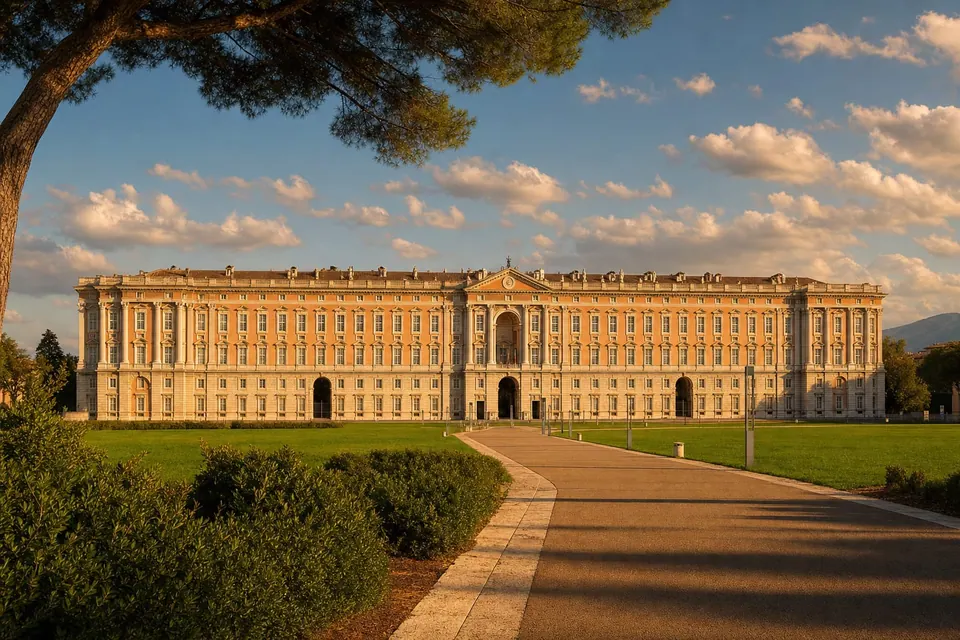
Charles of Bourbon commissioned the Royal Palace of Caserta in 1752 as the seat of a kingdom that wanted to rival Versailles, and Luigi Vanvitelli gave it a rigorous, theatrical plan: a vast rectangle organized around four courtyards, with a Royal Staircase that turns arrival into a performance.
Vanvitelli died in 1773, when the structure was complete; his son Carlo and other architects went on decorating and furnishing the royal apartments well into the nineteenth century. The palace is only one piece of a larger territorial design that includes the Royal Park, with its three-kilometer run of cascades and fountains, the Aqueduct of Vanvitelli and the San Leucio complex, all inscribed together by UNESCO.
A palace at the heart of a larger project
The Royal Palace of Caserta was commissioned by Charles of Bourbon and designed by Luigi Vanvitelli as a royal residence for the Bourbon kingdom.1,2
It is best understood as the centerpiece of something bigger. The complex was planned in the second half of the eighteenth century to rival Versailles and Madrid, and it takes in the palace, park, gardens and woodland, the Carolino Aqueduct and the San Leucio silk complex.3
Building it
King Charles acquired the site in 1750, including the San Silvestro woodland. The palace was conceived to tower over the surrounding territory, as the meeting point between the royal park and Caserta, the new Bourbon capital, and it was symbolically oriented toward Naples. Vanvitelli wrote that the king even dreamed of founding a whole new city on the spot.4
Construction began on 20 January 1752. Vanvitelli died in 1773, when the palace structure was complete but its rooms were still bare; his son Carlo and other architects carried the decoration and furnishing through the first half of the nineteenth century.2
Ferdinand IV and Maria Carolina moved to Caserta in 1780, when only the heir's apartment was habitable, and work on the wider complex, including the Carolino Aqueduct and the San Silvestro royal lodge, continued over some fifty years.4
A palace built like a small city
The palace covers 45,000 square meters over five floors above ground, stands 42 meters high and has about 1,400 chambers.5,2
Vanvitelli organized the rectangular building around four large courtyards, with interconnected stairways linking spaces from the basements to the attics. Three atriums complete the layout, and the palace was meant to be both a magnificent home for the royal family and court and an administrative center inspired by Spain's Escorial.2,3
Order outside, surprise inside
The exterior façade is orderly and uniform, which makes the interior all the more surprising: step through the door and you meet unpredictable perspectives and architectural forms.2
What was never built
Vanvitelli's first design included a central dome and corner towers that recalled fifteenth-century fortresses. King Charles and Queen Maria Amalia had them removed, wanting a civil building free of military and religious references. An equestrian statue of Charles and four allegorical statues of Magnificence, Justice, Clemency and Peace planned for the main façade were never built either.2
Rooms to look for
Notable interiors include the Royal Staircase and Upper Vestibule, the Cannocchiale gallery, the Court Theatre, the Throne Hall, the Astrea Room, the Four Seasons Rooms, the Palatine Library, Maria Carolina's Boudoir, the Palatine Chapel and the Royal Apartments.2
Water, axis and garden
The portico and the stream of water produced by the park's fountains lead to a waterfall that serves as a scenic backdrop. They are fed by the Carolino Aqueduct and lie along the palace's central axis, so water, architecture and landscape work as one composition.3
The grounds have three distinct parts: the Royal Park with its formal Baroque gardens, the natural San Silvestro Wood, and the English Garden, which includes the Bath of Venus and the Shepherd's Fountain. The channels of the Carolino Aqueduct feed a central axis about three kilometers long, whose Via d'acqua creates a spyglass effect ideally linking the palace to Naples.6
The Royal Park includes the Via d'acqua water channel, the Peschiera pond, the fountains of the Dolphins, Aeolus, Ceres, Venus and Adonis, and Diana and Actaeon, and the Bosco Vecchio.2
UNESCO calls the park the last of the great European formal gardens inspired by Versailles and by sixteenth-century Roman and Tuscan villas, and its English Garden one of the oldest and most important landscape gardens created in Europe.3
The English Garden
Queen Maria Carolina commissioned the English Garden on the advice of the British diplomat William Hamilton. Its perimeter wall was finished in April 1787, and the botanist John Andrew Graefer, recommended by the Royal Society of London, directed its creation alongside Carlo Vanvitelli.7
The garden covers 23 hectares and holds 228 tree species, with seemingly wild views, hills and streams, a Bath of Venus, a Gothic Chapel, a Ruined Temple, a Pyramid, an Obelisk and historic greenhouses. Mock ruins and statues of archaeological origin echo the discoveries at Herculaneum and Pompeii. It worked as both an ornamental space and a productive botanical garden, and won a diploma of honor at the Universal Exhibition in Vienna in 1873.7
San Leucio
San Leucio is part of the same World Heritage property. King Ferdinand IV of Bourbon transformed it into a silk mill and a community of workers who were guaranteed homes, schools, medical care and services. It became a symbol of a model society based on work and equality.3
World Heritage
Sources and citations (8)
- Reggia di CasertaLa Reggia di CasertaHistory overviewRead source
- Reggia di CasertaThe Royal PalaceThe face of Bourbon powerRead source
- UNESCO World Heritage Centre18th-Century Royal Palace at Caserta with the Park, the Aqueduct of Vanvitelli, and the San Leucio ComplexBrief synthesis (web.archive.org snapshot 2026-01-19)Read source
- Reggia di CasertaReggia di CasertaComplex history pageRead source
- Reggia di CasertaPalazzo RealePalace descriptionRead source
- Reggia di CasertaThe Royal ParkRoyal Park pageRead source
- Reggia di CasertaThe English GardenEnglish Garden pageRead source
- UNESCO World Heritage Centre18th-Century Royal Palace at Caserta with the Park, the Aqueduct of Vanvitelli, and the San Leucio ComplexProperty recordRead source