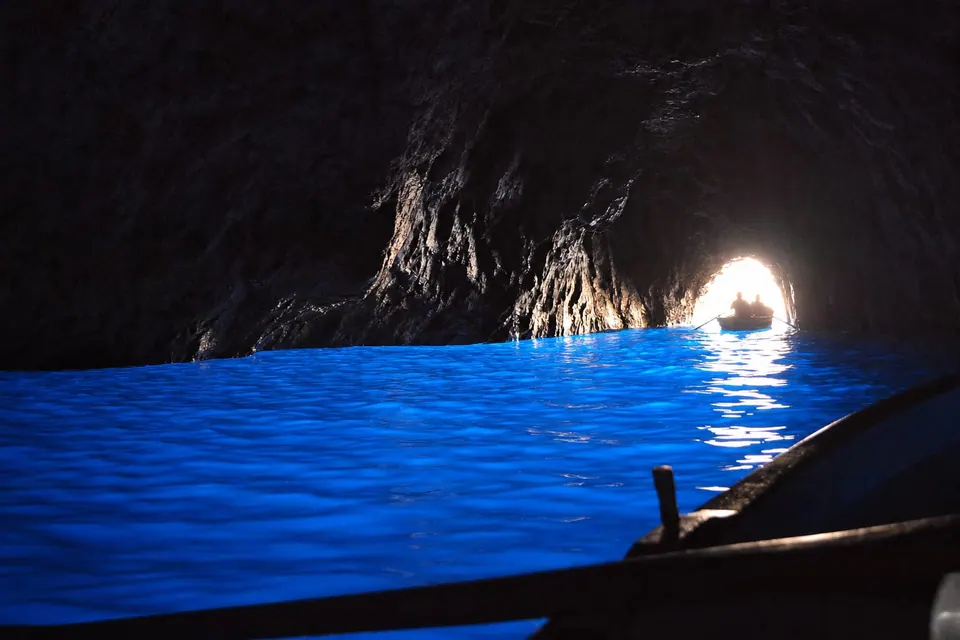
The Blue Grotto belongs to the coast of Anacapri, where a partly submerged opening connects the sea to a cave filled with blue light. Sunlight enters through an underwater aperture and reflects from the sandy floor, colouring the water and inner walls. The effect changes with the hour and atmospheric conditions; it is a natural light effect rather than a single fixed shade.
A small rowing boat carries visitors through the opening. The passage shapes the visit: CoopCulture asks passengers to lie back for entry and exit and follow the boatman’s instructions. Access depends on the sea and weather, and the museum limits visitor numbers. Reaching the entrance and entering the cave are separate parts of the journey.
The grotto also preserves a Roman story. Concrete remains stand above water, while submerged niches once held Neptune, two Tritons and a female figure in a peplos. Recovered between 1964 and 1975, the sculptures are now in Capri’s archaeological museum at the Certosa di San Giacomo. The villa remains above the cave are traditionally attributed to Tiberius.
Use our Anacapri guide to plan the approach. An overland route runs from Marina Grande through Anacapri, then continues by direct grotto bus; seasonal boat excursions provide another approach. Check current access before setting out and leave room for changing conditions and waiting.
CoopCulture dates the grotto’s modern rediscovery to 1826 and names August Kopisch and Ernst Fries. Anacapri’s municipal account also names the local fisherman Angelo Ferraro. These later accounts sit alongside the cave’s much older use as a Roman maritime nymphaeum.