

Skip to content

Templi di Paestum

Temples of Paestum

Its three Doric temples, the archaeological city of Poseidonia–Paestum and the Tomb of the Diver.

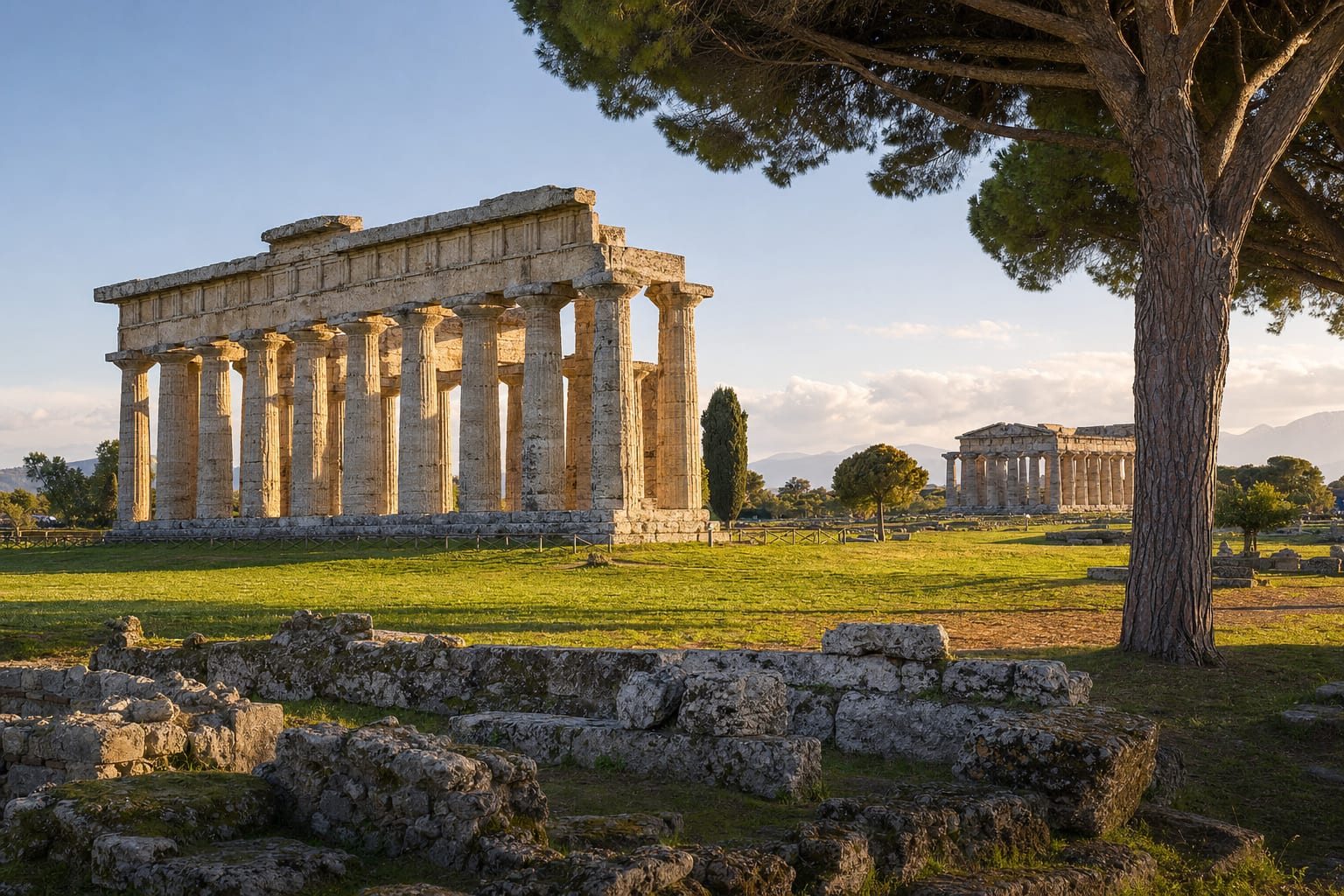
Photograph · Templi di Paestum

At a glance

Temples of Paestum facts that matter

Names, makers, dates, and context before the story opens up.

Italian nameTempli di Paestum
What it isArchaeological site
WherePaestum, Campania
Known forIts three Doric temples, the archaeological city of Poseidonia–Paestum and the Tomb of the Diver.
PeriodGreek Doric architecture
UNESCOWorld Heritage setting

The story

What you're looking at

Paestum preserves the archaeological city of Poseidonia–Paestum across sanctuaries, public spaces and residential remains. Its three Doric temples date from the sixth and fifth centuries BCE, while the on-site museum provides essential context, including the Tomb of the Diver.

A Greek, Lucanian and Roman archaeological city within the serial UNESCO cultural-landscape property.

Verified details

Each statement below is linked to the record or institution that supports it.

The archaeological area of Paestum covers approximately 27 hectares and preserves three great Doric temples, public monuments and part of the ancient residential city of Poseidonia–Paestum.1

The Park dates the Temple of Athena to an earlier building around 580 BCE, reconstructed around 500 BCE; the Temple of Hera to 560–520 BCE; and the conventionally named Temple of Neptune to about 460 BCE.2

The Museum of Paestum displays the Tomb of the Diver, discovered in 1968 at Tempa del Prete and dated to about 480–470 BCE. The Park calls it the only known fifth-century-BCE tomb in the Greek world decorated with figurative wall paintings.3

The diving image is on the inner face of the cover slab. The Park presents the common reading as symbolic, likely a metaphor for passage from life to death, not a literal scene.3

Paestum is part of the serial UNESCO World Heritage property Cilento and Vallo di Diano National Park with the Archaeological Sites of Paestum and Velia, and the Certosa di Padula, inscribed in 1998 under criteria (iii) and (iv).4

Sources and citations (4)
  1. Archaeological Parks of Paestum and VeliaArchaeological Area of PaestumSite overviewRead source
  2. Archaeological Parks of Paestum and VeliaThe Story of PaestumTemple chronologyRead source
  3. Archaeological Parks of Paestum and VeliaMuseum and Storerooms of PaestumTomb of the DiverRead source
  4. UNESCO World Heritage CentreCilento and Vallo di Diano National Park with the Archaeological Sites of Paestum and Velia, and the Certosa di PadulaProperty recordRead source

Plan your visit

Before you go

Booking
Walk-up friendly
Period
Greek Doric architecture

Find it

Where to find Temples of Paestum

Get directionsGoogle MapsApple Maps

Reading

Stories from Campania

Long reads from our writers on the ground.

  1. The magazineAmalfi Coast Travel Guide