Perugia, the hill city of painters
- Morning
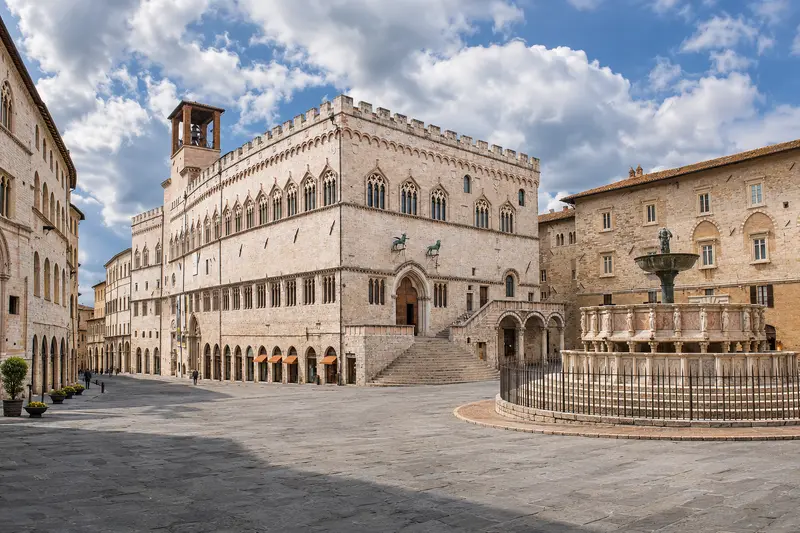
- Begin in Piazza IV Novembre, the stage of medieval Perugia, where the Fontana Maggiore stands between the cathedral and the Palazzo dei Priori. Its carved basins show the months, the labours of the seasons and scenes from the Bible and Roman history; water reached it through a pressurised conduit from Monte Pacciano with no pumps. Then climb inside the Palazzo dei Priori to the Galleria Nazionale dell'Umbria, for Perugino and Pinturicchio, Piero della Francesca's Sant'Antonio polyptych and Fra Angelico. Go early.
- Afternoon
- Step back onto Corso Vannucci, the long promenade of the old town, and find the Collegio del Cambio, the bankers' guild hall with its own door on the street. Perugino painted the room between 1498 and 1500. Then climb the steps from Piazza IV Novembre to the Sala dei Notari, painted with Aesop's fables and Bible stories in the late thirteenth century, and go down into the Rocca Paolina, the papal fortress of the 1540s built over the Baglioni houses, whose vaulted streets are now an underground walk.
- Evening
- Walk to the Etruscan Arch, a gate in the walls of the Etruscan city of the third century BC, with the Roman words Augusta Perusia carved above. Perugia was one of the great Etruscan cities, and parts of its walls, about three kilometres long, still stand. Then join the evening passeggiata on Corso Vannucci: the locals walk it end to end, stop for an aperitivo, and then sit for dinner.
Where to eat. Torta al testo, Perugia's flatbread cooked on a hot disc and filled with greens and sausage, is the local sandwich. Perugia also made the Bacio Perugina, the hazelnut chocolate wrapped with a slip of paper, in 1922, so bring a box home. In late January, for the feast of San Costanzo, ask for torcolo di San Costanzo, a ring bun with raisins and pine nuts.