

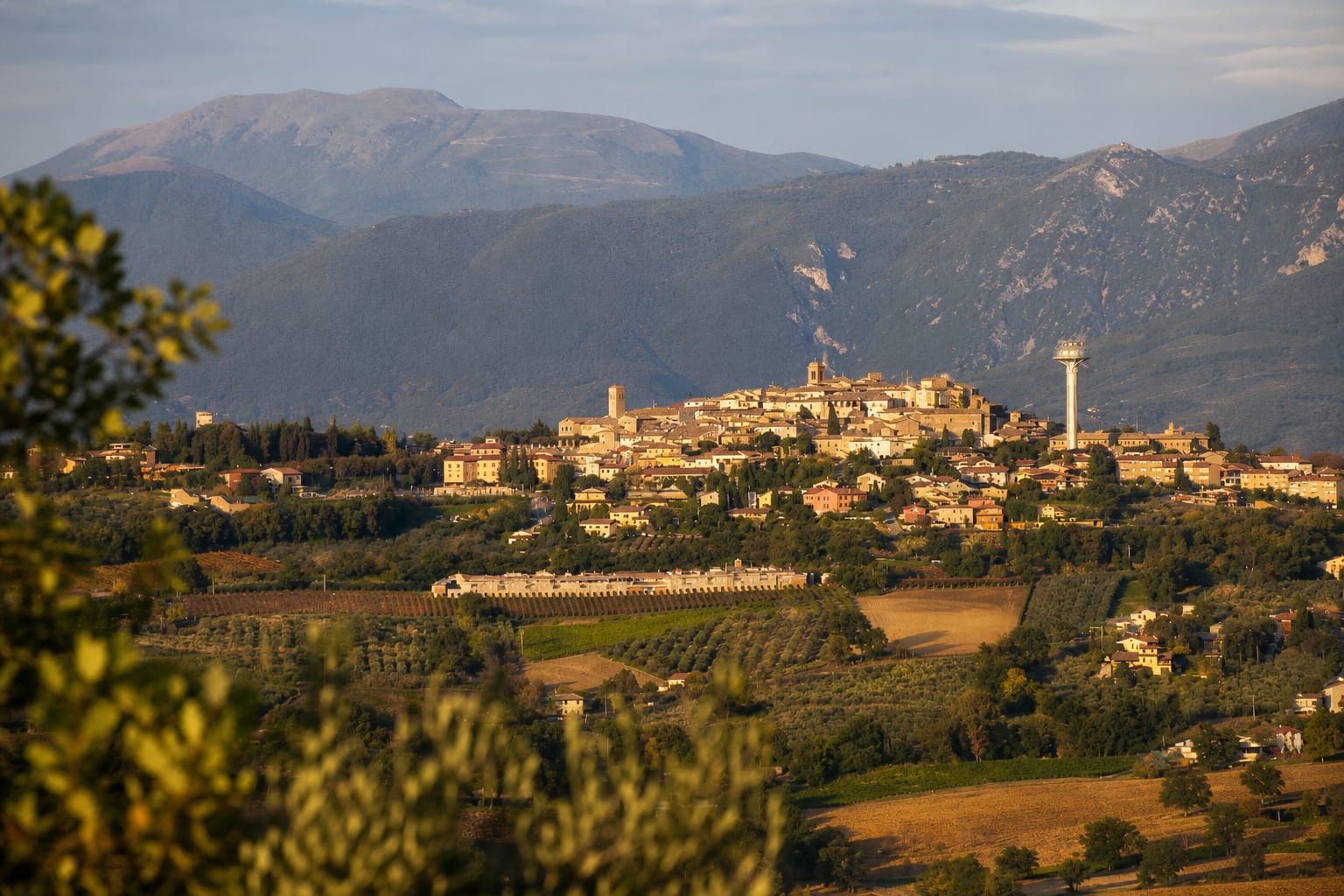
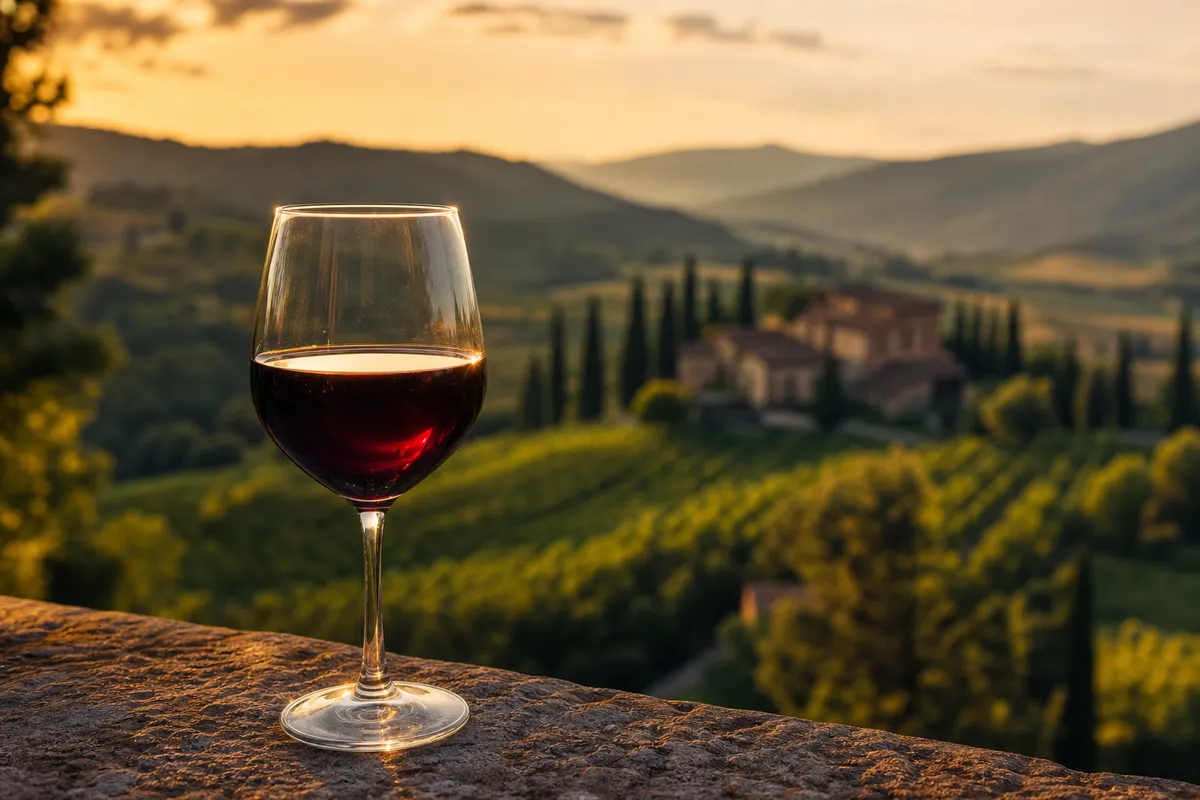
Known as the Ringhiera dell'Umbria (the balcony of Umbria) for its commanding views, this walled hill town gives its name to Sagrantino, one of Italy's deepest, most tannic red wines, grown on the slopes below.
Montefalco in brief
Montefalco sits on a hilltop above the Valle Umbra, in the Province of Perugia. Locals call it the Ringhiera dell'Umbria, the balcony of Umbria, and one look at the valley spread below in vines and olive groves explains why.
Three things put the town on the map: Sagrantino, the powerful red wine that carries its name far beyond Umbria; the frescoes Benozzo Gozzoli painted in the former church of San Francesco; and a compact walled centre that rewards slow wandering.
The municipality reaches well beyond the walls. Istat's 2021 count lists twelve inhabited centres and seventeen smaller inhabited nuclei scattered across the hills, among them Fabbri, Fratta and Turri, which is a good reminder that the real Montefalco is a landscape as much as a town.
The hill town and its vineyards
The historic centre crowns a hill and works as an orientation point over a much larger agricultural landscape. Most of that land, the vines, olive groves, farm buildings and watercourses, is working or privately owned ground rather than a scenic park, so think of it as countryside to drive through, taste and photograph from the edges.
It helps to read Montefalco at three scales. Inside the walls, streets converge on Piazza del Comune and link civic and sacred buildings. Beyond the walls, vineyards, olive groves, wineries and farms stretch across the municipality and into neighbouring ones. The wider Montefalco wine country includes parts of Bevagna, Castel Ritaldi, Giano dell'Umbria and Gualdo Cattaneo, each with its own administration.
Roman traces in the museum
Montefalco's Roman past is easiest to read in the archaeological section of the San Francesco museum. Its material, found around Montefalco and dating from the first century BC, shows that people were living here in Roman times. The oldest piece is a sandstone cremation-urn lid with a Latin inscription in Umbrian letters, dated between the second and first century BC, and a marble Hercules of the first century BC copies a Greek original of the fourth century BC.
Walls, piazza and civic centre
Piazza del Comune is where the main streets arrive. The Palazzo Comunale here was founded in 1270 on a modest scale; in the fifteenth century it gained a portico with octagonal pilasters and a Renaissance loggia topped by a terrace over the square, and a bell tower rises above it. Inside are the municipal offices, a library of more than 10,000 volumes with incunabula and manuscripts, and a council chamber that served as a theatre, the Teatro dell'Aquila, in the eighteenth century.
Sant'Agostino is a layered complex. The church was built in 1275 over an earlier church of San Giovanni Battista, at the wish of the Augustinian friar Blessed Angelo da Foligno, with a smaller aisle added in 1327 and a brick cloister in 1496. It keeps a Renaissance wooden crucifix, early fifteenth-century frescoes in the sacristy, works by Melanzio and Jacopo di Vinciolo, and the remains of Blessed Pellegrino and the Beate Chiarelle.
The former church of San Filippo Neri was built in 1705, a single-nave building with a semicircular apse and a triangular pediment. It became a theatre in 1895 and, after substantial changes inside, is still a multipurpose stage, so a performance is the best way to see it.
Santa Chiara belongs to a living community, not only to the sightseeing trail. Saint Clare of Montefalco was born around 1268 and died on 17 August 1308; an Augustinian, she became superior of her monastery in 1291 and was canonised in 1881. Her body rests in the church of the Augustinian nuns, which remains a place of prayer.
San Francesco: the museum and its frescoes
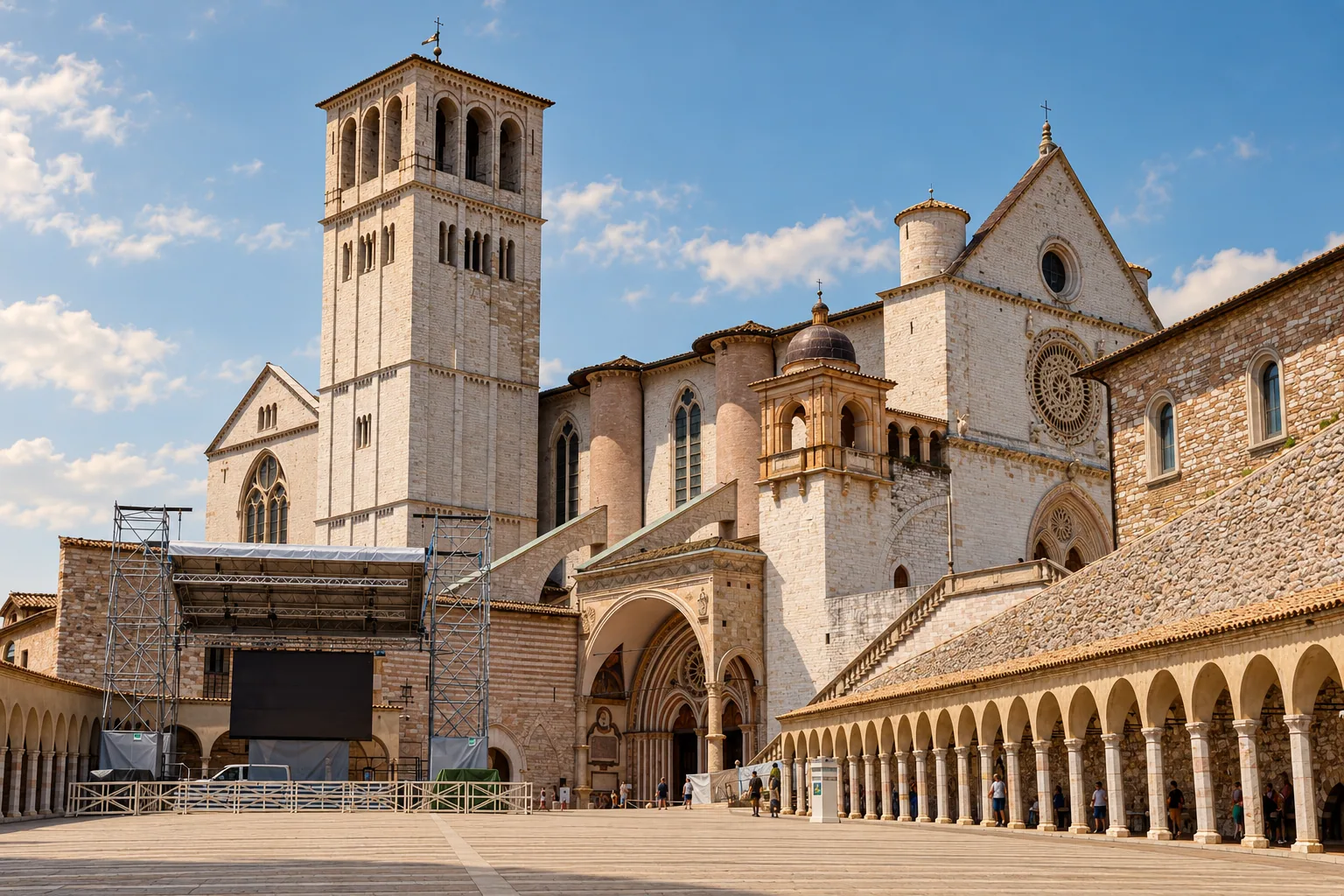
The Complesso Museale di San Francesco is Montefalco's cultural anchor. It brings together the former church, a picture gallery, an archaeological section and the friars' cellars. The Franciscan friars built the church between 1335 and 1338, with a central nave ending in a pentagonal apse and rectangular side chapels. It became the civic museum in 1895, and the picture gallery later moved into the renovated convent spaces around 1990.
The star is the apse. In 1452 Benozzo Gozzoli painted the life of Saint Francis here: twenty episodes in twelve scenes on three registers, commissioned by Fra Jacopo Mactioli and regarded as the first great proof of Gozzoli's standing as an independent master. The story reads from left to right and from the lowest register upward, with Franciscan saints and the Glory of Saint Francis in the vault. Look for the scene in which the saint blesses Montefalco, set among vineyards.
The Cappella di San Girolamo adds a second Gozzoli commission from the same year. Girolamo di Ser Giovanni Battista De Filippis paid for it in honour of his name saint, and on its end wall a gilded fictive polyptych joins late medieval convention to Renaissance illusion, with painted drapery and architecture that seem to stand out from the wall.
On the counter-facade, Perugino painted a composition with the Annunciation, the Eternal in Glory among Angels and the Nativity in 1503. It is a quieter companion to Gozzoli's narrative cycle and the work of a different master.
The picture gallery holds paintings on canvas and panel, detached frescoes, liturgical textiles, religious furnishings, a Saracino jousting target and civic clothing, mostly from religious corporations dissolved in the area and from churches across the territory. The museum names Antoniazzo Romano, Niccolò di Liberatore called L'Alunno, Cristoforo di Iacopo, Melozzo da Forlì and, with numerous works, the Montefalco-born Francesco Melanzio.
Wine lovers should not miss the friars' cellars, open to visitors since 2006. They preserve ancient vats for collecting and pressing grapes; a municipal statute of 1692 calls them the largest in Montefalco, and an inventory of 1798 lists the convent's vats, barrels and wine-making tools. Eighteenth- and nineteenth-century equipment from a private collection is displayed alongside.
Sagrantino and Montefalco DOC
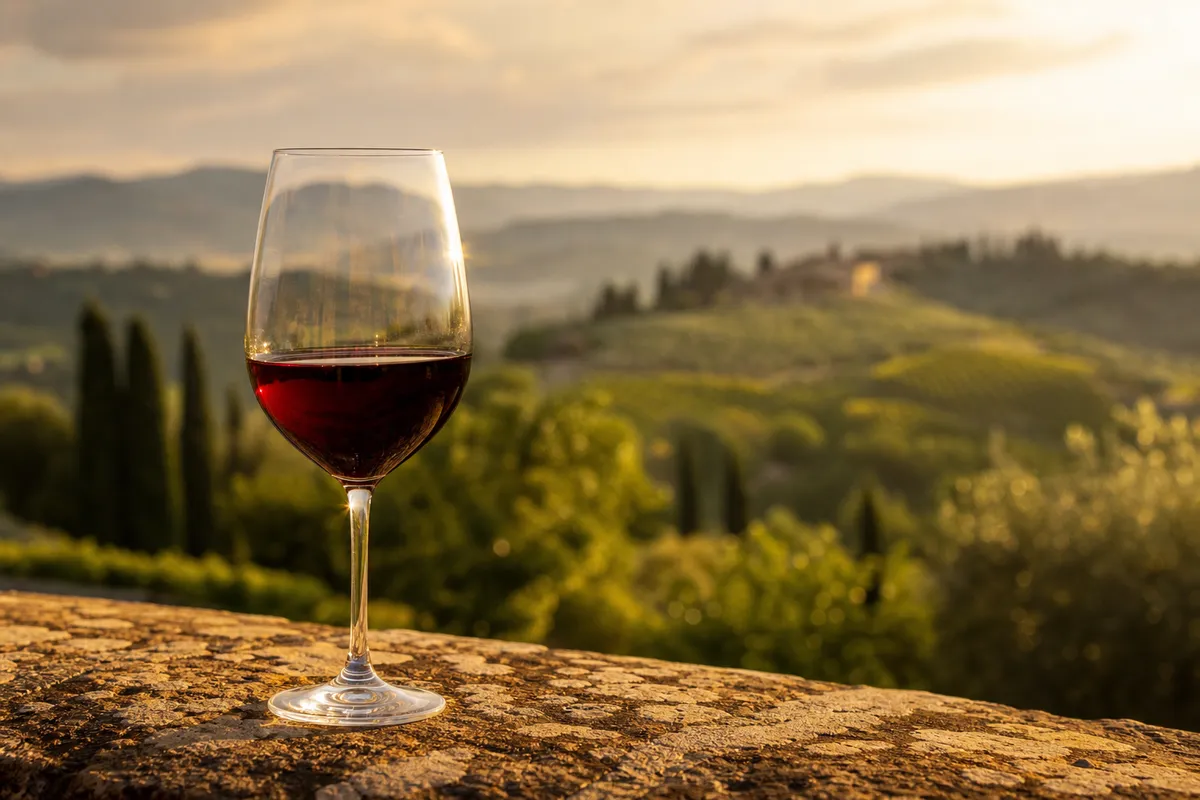
Montefalco Sagrantino is the protected wine name, and DOCG is the Italian traditional classification within the protected-designation system. It is a red wine made in two styles, Secco (dry) and Passito (from dried grapes), and the national specification requires 100 percent Sagrantino grapes.
The production area is wider than the town. The specification covers all of Montefalco and delimited parts of Bevagna, Gualdo Cattaneo, Castel Ritaldi and Giano dell'Umbria, all in Perugia province, so a winery's address does not always tell you where its grapes grew.
Montefalco DOC is a separate denomination with four types. Bianco requires at least 50 percent Trebbiano Spoletino and Grechetto at least 85 percent Grechetto, while Rosso and Rosso Riserva combine 60 to 80 percent Sangiovese with 10 to 25 percent Sagrantino, plus other permitted non-aromatic grapes. Its zone has the same five-municipality structure.
The numbers behind the glass are demanding. Sagrantino, in both styles, is limited to 8 tonnes of grapes per hectare and needs at least 33 months of ageing from 1 December of the harvest year; Secco includes at least 12 months in oak and both styles at least four months in bottle. For Montefalco DOC the maximum yield is 12 tonnes per hectare for Bianco and Grechetto and 11 for Rosso and Riserva; Rosso ages at least 18 months and Riserva at least 30, including 12 in wood.
Olive oil and traditional foods
Montefalco lies inside the production area of Umbria DOP olive oil with the geographical mention Colli Martani; the national specification lists it among fifteen territories for that mention. A label that carries the protected name has to follow the rules on varieties, production and packaging, which is the simplest way to tell a certified oil from one that is merely sold locally.
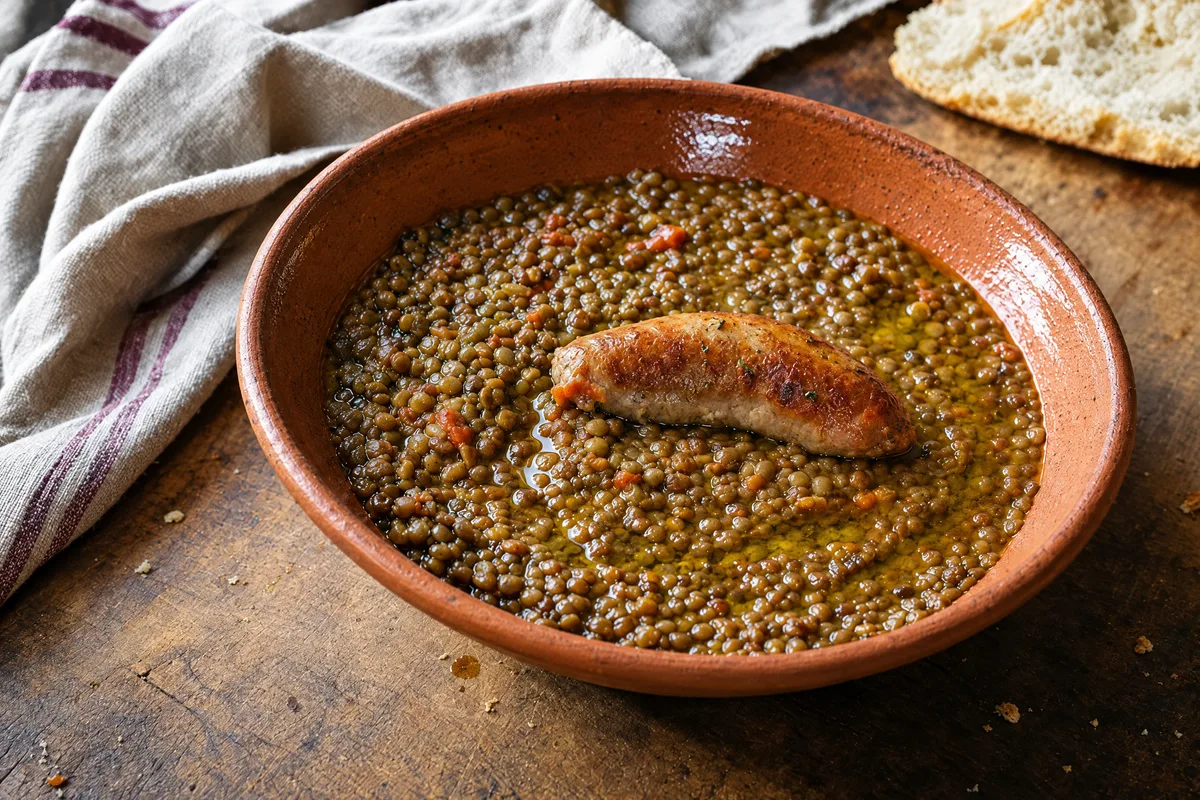
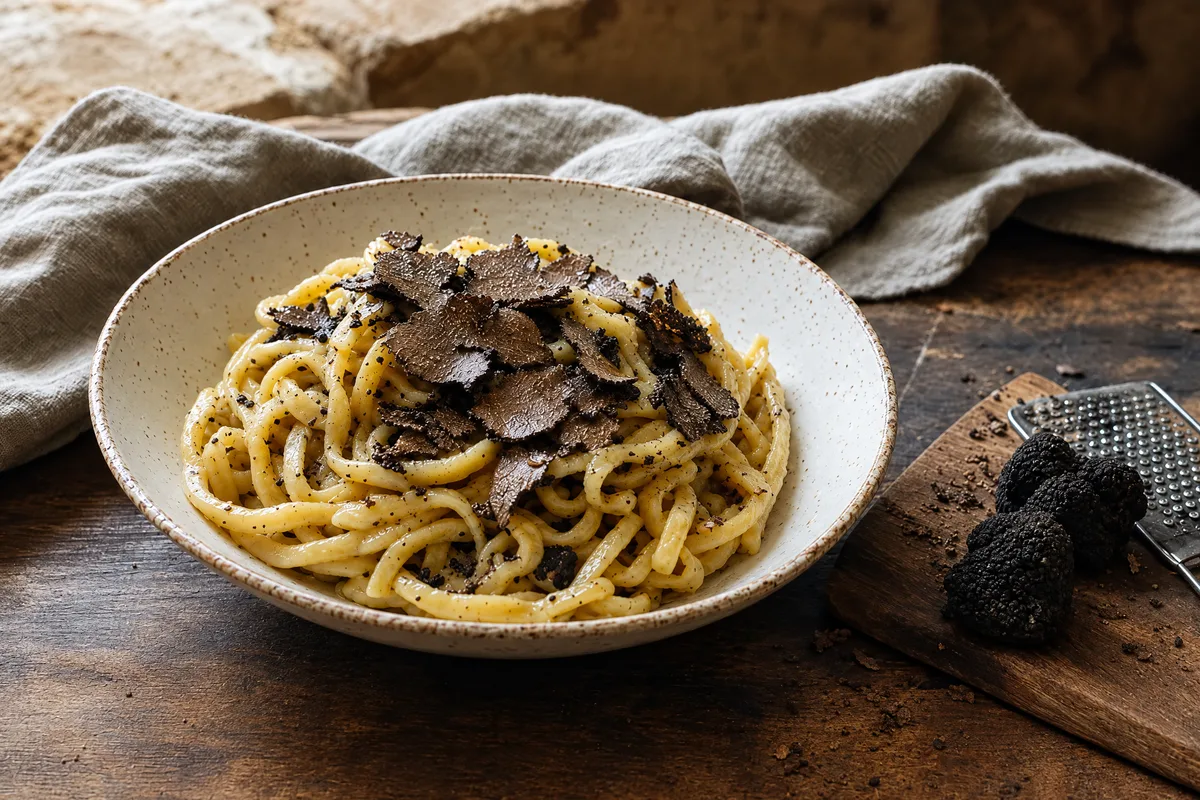
The regional register of traditional food products lists torta al testo for the Province of Perugia, and torta al formaggio or di Pasqua, tozzetti and mostaccioli for Umbria as a whole. Order them as regional classics: the register vouches for the recipes, not for any single kitchen's version.
Festivals: Agosto Montefalchese and Enologica
Agosto Montefalchese is the town's summer festival, a summer of music, dance, shows and historical reenactments. The Corsa dei Bovi, the ox race, is run by the Ente Fuga del Bove, and the feast of Saint Clare brings a lamp procession on the eve and a solemn Mass at her church on 17 August.
The Fuga del Bove, the staged flight of an ox through the streets, is a proud piece of local theatre rather than an ancient rite: the municipality credits Silvestro Nessi with inventing this modern reenactment, and a stable organising body keeps it going.
In September the Consorzio Tutela Vini Montefalco and the Strada del Sagrantino stage Enologica Montefalco, a wine weekend that pairs tastings of Montefalco Sagrantino DOCG, Montefalco DOC and Spoleto DOC with food, art, music, workshops and winery events. Participation is by advance booking, and the wineries involved span the whole designation territory, not only the town.
Planning your visit
A hill town built of stone asks for comfortable shoes: expect paving, slopes, steps and narrow streets inside the walls. Start with San Francesco, which is the anchor of the visit, then fit in Sant'Agostino, San Filippo Neri and the piazza.
Keep the vineyards for a separate day, with a designated driver or a booked transfer, and book tastings ahead. Because hours and access details change, confirm opening times and entrances with each site and winery before you set out.
More of Umbria
A letter from Italy, once a month.
The places, tables and makers we found worth your time. One email, no noise.
One letter a month. Unsubscribe at any time. We never share your address.