Skip to content
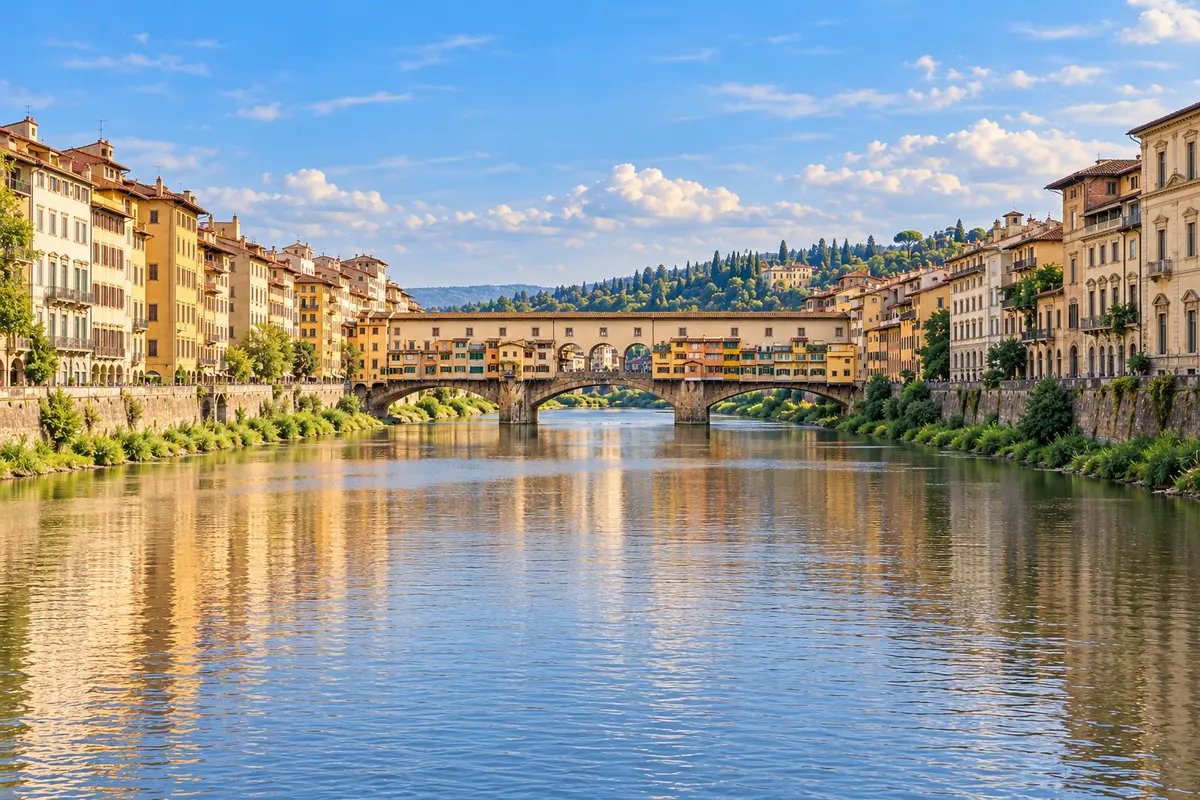
Ponte Vecchio and its three stone arches across the Arno in Florence

Three Days in Florence

The Uffizi and the old centre on day one, David and the Duomo on day two, then Oltrarno, Boboli and San Miniato at dusk on day three.

Florence rewards a slow first visit more than a fast one. This plan gives the Uffizi and the Galleria dell'Accademia separate mornings, leaves the Duomo complex an afternoon of its own, and spends a full day across the river in Oltrarno, where workshops, Brunelleschi's Santo Spirito and the Boboli Gardens sit apart from the main tourist current. It ends where the city is quietest and best: San Miniato al Monte at dusk, above the crowd gathered on the terrace below.

Day by day

The Uffizi and the old centre

Day 1 · mostly on foot

Morning
Start at the Uffizi with a reserved entry, as early as you can get one. Go straight to the Botticelli rooms for the Primavera and the Birth of Venus, then go on through Leonardo's Annunciation and Michelangelo's Doni Tondo to Caravaggio. The building is part of the show: a U of long corridors that Vasari designed for Cosimo I's magistrates. Pause at the windows at the river end for the view toward Ponte Vecchio, and do not try to see every room.
Afternoon
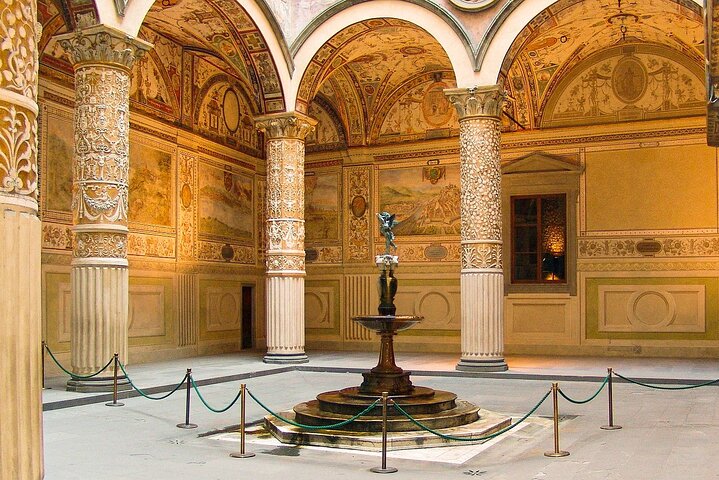
Walk into Piazza della Signoria, an open-air sculpture court: the Loggia dei Lanzi, Ammannati's Neptune fountain and Palazzo Vecchio's tower. The David by the door is a copy; the original stood here until 1873, and you meet it tomorrow. Then go to the Bargello for Donatello's bronze David and the 1401 competition panels in which Brunelleschi and Ghiberti vied for the Baptistery's north doors. End at Santa Croce, with the tombs of Michelangelo, Galileo and Machiavelli and Giotto's frescoed chapels.
Evening
Walk down to the Arno and along the embankment toward Ponte Vecchio as the light turns gold. The bridge has held goldsmiths and jewellers since the late sixteenth century, when the Medici cleared out the butchers, and it is the only bridge in Florence that was not blown up in 1944. Cross for the view back from the Oltrarno side, then have an aperitivo (the pre-dinner drink and snacks) and dinner. Keep your energy for the Accademia in the morning.

Where to eat. Lunch the Florentine way: a schiacciata (flat salted bread) sandwich or a plate at a bar near Santa Croce, with coffee drunk standing at the counter. The trattorie around the Sant'Ambrogio market, a short walk east, feed residents rather than tour groups, and suit dinner.

David, the Duomo and the market

Day 2 · on foot, with one long climb

Morning
Be at the Galleria dell'Accademia for your first reserved entry, so David is almost to yourself. Walk the hall of Michelangelo's four unfinished Prisoners first: made for Pope Julius II's tomb, they lead the eye down to the statue, which has stood under its skylight since 1882. Circle David slowly, back as well as front, before the room fills. The gold-ground paintings and Lorenzo Bartolini's plaster-cast gallery are worth a short look on the way out.
Afternoon
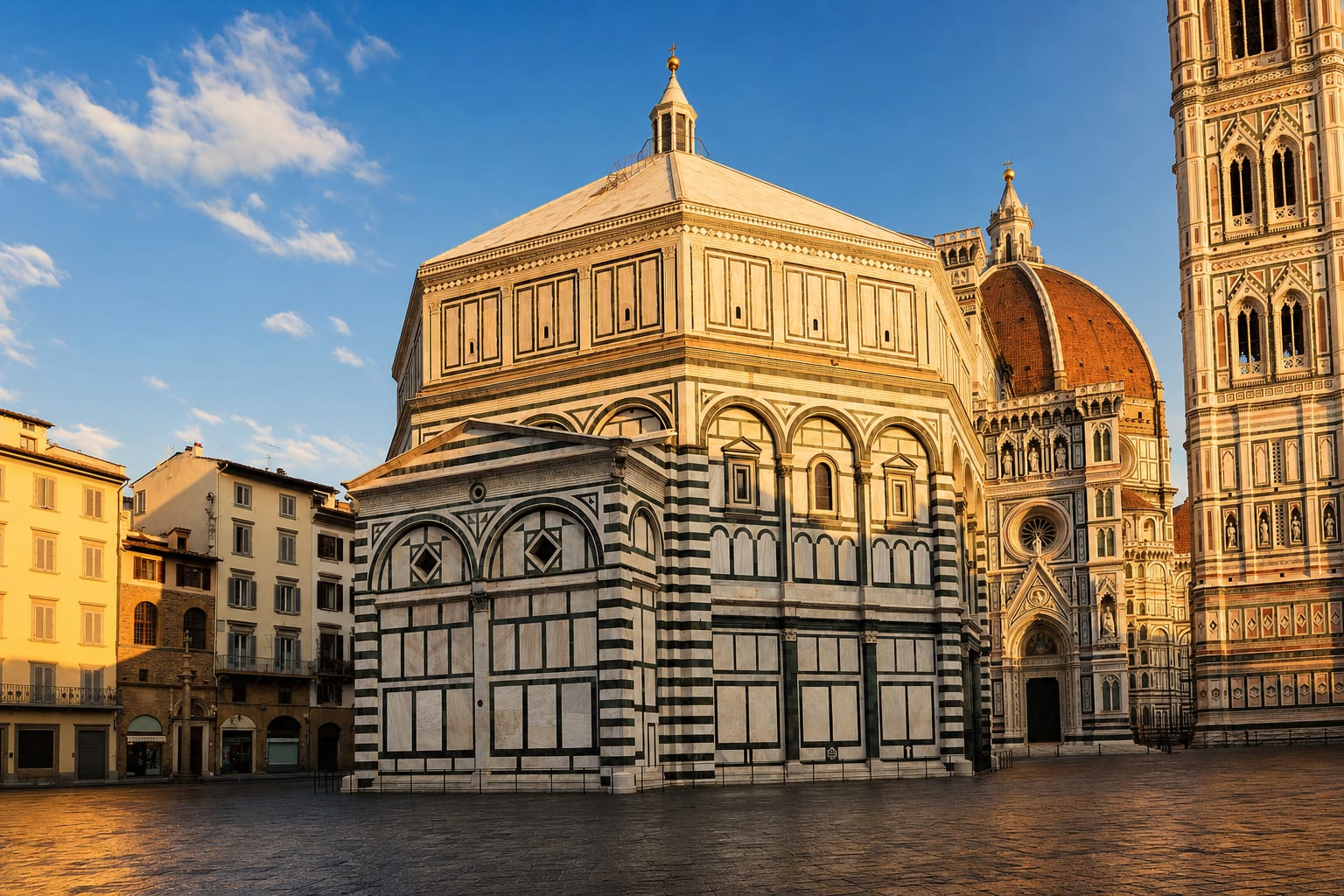
Walk to the Duomo complex. Enter the cathedral first to see Brunelleschi's dome from below, with the Last Judgement frescoed inside it by Vasari and Zuccari. Then climb at your reserved slot (463 steps, no lift) for the herringbone brickwork at arm's length, or take Giotto's Campanile for the view that includes the dome. Finish with the Baptistery's golden mosaic ceiling and the Museo dell'Opera for the original Gates of Paradise, Michelangelo's Bandini Pietà and Donatello's Magdalene.
Evening
Wander up to Piazza Santa Maria Novella, where Alberti's marble façade looks best once the tour groups have gone. Have dinner in the streets around Via de' Tornabuoni, then loop back past the Duomo, whose green, white and pink marble is at its warmest in evening light. Keep it an early night: tomorrow is the longest walking day of the three.

Where to eat. Lunch at the Mercato Centrale, the iron-and-glass market of San Lorenzo: traditional stalls on the ground floor and a food hall upstairs. The Florentine order is lampredotto (slow-cooked tripe, in a bun) or a boiled-beef sandwich; the leather stalls outside are for shopping, not eating.

Oltrarno, Boboli and San Miniato

Day 3 · long on foot, some hills

Morning
Cross to Oltrarno and begin at the Brancacci Chapel inside Santa Maria del Carmine, where Masaccio and Masolino painted the frescoes that changed Renaissance painting; it is entered separately from the church. Then wander the lanes of Borgo San Frediano, where artisans and restorers still work behind open doors, and on to Santo Spirito: Brunelleschi's plain-faced basilica, with Michelangelo's wooden crucifix in the sacristy.
Afternoon
Walk to Palazzo Pitti, the grand-ducal palace of the Medici, and enter the Boboli Gardens through its courtyard. See the Buontalenti grotto, where copies of the Prisoners stand; the amphitheatre cut from the hill for the palace's stone; and the Egyptian obelisk. Then climb to the Kaffeehaus pavilion on the high ground for the view across the rooftops. The palace's own galleries can wait for a longer stay.
Evening
In the late afternoon, climb the hill on foot to Piazzale Michelangelo and on to San Miniato al Monte. Choose the church over the terrace: the piazzale is the postcard crowd, while the Romanesque marble basilica, founded in 1018, sits higher and quieter, with the Cardinal of Portugal chapel and a zodiac floor from 1207. Ask when the monks sing vespers in Gregorian chant. Walk down to dinner in San Niccolò or Santo Spirito.

Where to eat. The Oltrarno trattorie around Santo Spirito and San Frediano do the Tuscan classics: ribollita (bread and vegetable soup), pappa al pomodoro and bistecca alla fiorentina (a thick T-bone, grilled rare, shared). Keep lunch to a bar sandwich so the afternoon stays unhurried.

If you have another day

Fiesole, the hill town above the city, makes an easy half day if you would rather not go far.

Siena
A day trip by bus or regional train to the medieval rival. Walk down into the shell-shaped Piazza del Campo, see the Palazzo Pubblico and the Torre del Mangia, and go inside the cathedral for its inlaid marble floor, much of it kept covered except for set weeks each year. Siena is a pleasure to wander slowly, so plan on little more than that.
Pisa and Lucca
Two towns west of Florence, linked to it and to each other by regional train. See the Piazza dei Miracoli in Pisa (cathedral, baptistery, Leaning Tower), then go on to Lucca to walk the tree-lined top of its intact Renaissance walls, which were never needed in a siege.
Chianti Classico
Between Florence and Siena, the Chianti hills suit a day with a car or a driver: the villages of Greve, Panzano and Castellina, a winery lunch among the vines, and the black rooster that marks Chianti Classico wine. Book the winery visit ahead.

Where to stay

Verified hotels, city by city.

Florence

Florence

  • Four Seasons Hotel Firenze
  • The St. Regis Florence
  • Porta Rossa Hotel Firenze
  • Hotel Calimala Florence
Check dates: Florence

Booking through these links may earn Italia Magnifica a commission, at no cost to you.

Where to eat

Verified tables in the cities on this route.

Florence

Florence

  • Trattoria Vecchia GrigliaA family-run trattoria beside San Lorenzo for fresh pasta and Florentine steak, a relaxed pause between the market and the Medici Chapels.
  • Osteria Cancello dei MacciA warm, family-run Sant'Ambrogio osteria for hand-rolled pasta and ember-grilled bistecca, cooked with produce from the market round the corner.
  • Ciro & sonsA Neapolitan family pizzeria near San Lorenzo with a dedicated gluten-free kitchen, so coeliacs can order proper pizza and pasta without worry.
  • Osteria San FiorenzoRight on the edge of Piazza Santa Croce, a straightforward osteria for Florentine standbys like ribollita, pappa al pomodoro and bistecca.
All tables: Florence

Tours worth booking

  1. 2-Hour Private Evening Walking Guided Tour of Florence Culture

    2-Hour Private Evening Walking Guided Tour of Florence Culture

    Begin your private tour with expert local guide in the cool and refreshing evening.

    • 2h
    • Viator
  2. The History of Florence: The Renaissance Era Private Tour

    The History of Florence: The Renaissance Era Private Tour

    It’s the history that made the city today. During this private tour, it’s time to discover Florence through the Renaissance.

    • 3h
    • Viator
  3. Florence Private Walking Tour

    Florence Private Walking Tour

    Discover the city’s highlights and its most fascinating monuments, learn the secrets of Florence in a fun walking tour with a professional tour guide.

    • 3h
    • Viator

Booking through these links may earn Italia Magnifica a commission, at no cost to you.

Getting around

Central Florence is compact and best on foot, and nothing in this plan needs a car. The Uffizi, the Bargello, Santa Croce and the Duomo are all a stroll apart, and Ponte Vecchio and the other bridges lead into Oltrarno. The climb to San Miniato is a pleasant uphill walk; a taxi back down is an option. If you drive, leave the car outside the historic centre: most of it is a limited-traffic zone (ZTL) with cameras, and a fine follows a wrong turn. For the day trips, the regional train and bus from the station area work well; Chianti is the one that wants a car.

Sources and citations (4)
  1. Gallerie degli Uffizi: The Uffizi
  2. Abbazia di San Miniato al Monte
  3. Visit Tuscany: Museo dell'Opera del Duomo, Florence
  4. Galleria dell'Accademia (Firenze), Wikipedia

A letter from Italy, once a month.

The places, tables and makers we found worth your time. One email, no noise.

One letter a month. Unsubscribe at any time. We never share your address.

Help us get it right

What is it about?