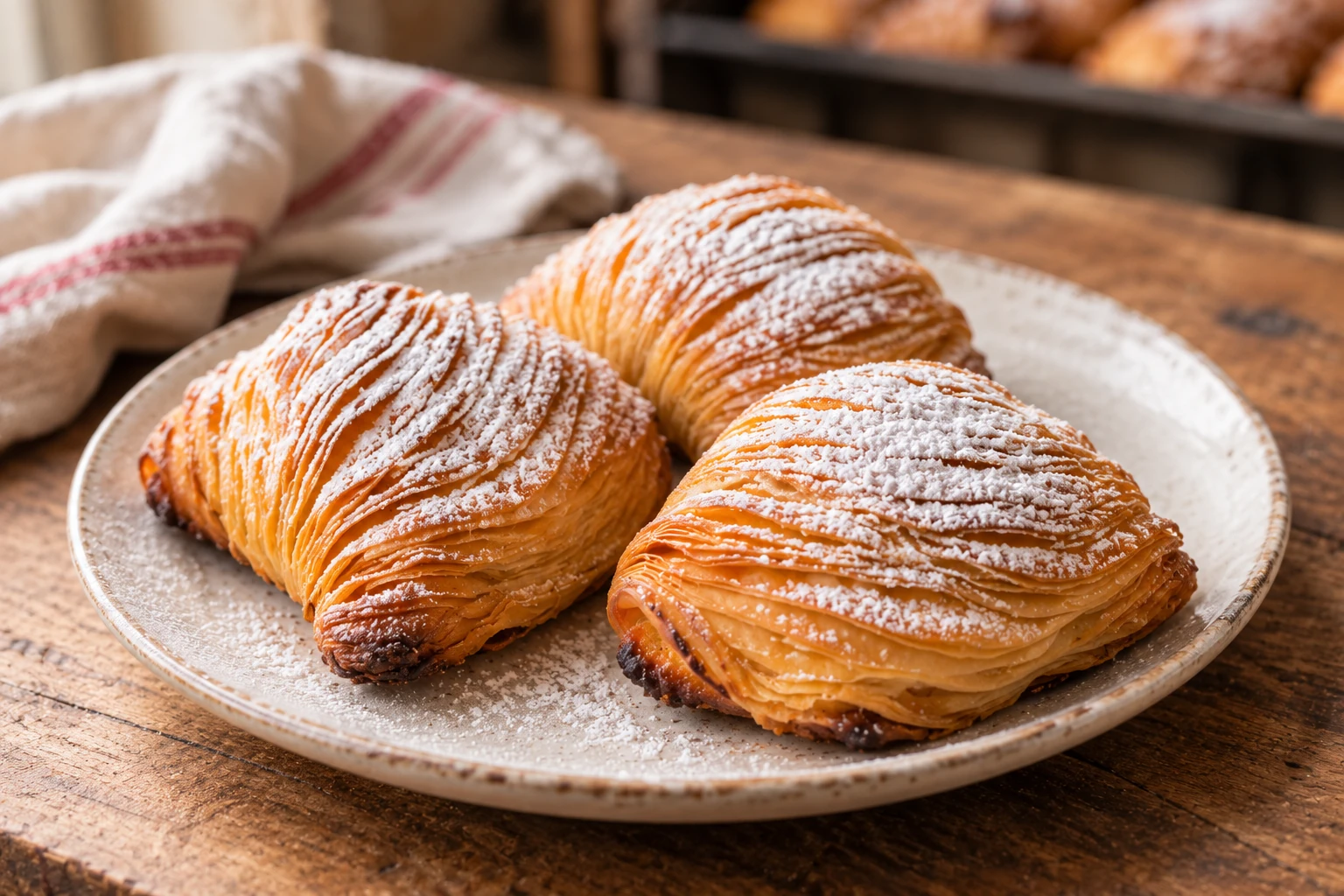
Start the pastry the day before. Stretch a narrow ribbon until almost transparent, grease it lightly and wind it tightly: the layers must slide apart when you open each shell. Keep the filling cold and thick enough to hold its shape.
Make ahead Prepare the pastry roll and filling the day before, cover separately and refrigerate. Shape and bake the following day. Dust with icing sugar after the pastries have cooled to warm.
Sfogliatella riccia
Prep 1 hr 40 min · Cook 1 hr 10 min · Rest 24 hr 55 min · Yield 12 sfogliatelle · Difficulty Hard
Method
Mix the shell flour, 5 g sugar, 5 g salt and 110 g water into a very firm dough. Knead for about 15 minutes, then pass small flattened portions through the widest setting of the pasta roller, folding and joining them until you have one smooth strip. Cover and rest for 30 minutes. Do not force a thick lump through the rollers.Mix the shell flour, 5 g sugar, 5 g salt and 4 oz water into a very firm dough. Knead for about 15 minutes, then pass small flattened portions through the widest setting of the pasta roller, folding and joining them until you have one smooth strip. Cover and rest for 30 minutes. Do not force a thick lump through the rollers.
Bring the 200 g filling water and 4 g salt to the boil. Whisk in the semolina, then stir over low heat for about 10 minutes, until thick and pulling away from the pan. Spread in a shallow dish to lose its heat, then refrigerate promptly. Once cold, work it smooth with the drained ricotta, 175 g sugar, candied peel, zests, cinnamon and vanilla. Cover and refrigerate while you finish the pastry.Bring the 7 oz filling water and 4 g salt to the boil. Whisk in the semolina, then stir over low heat for about 10 minutes, until thick and pulling away from the pan. Spread in a shallow dish to lose its heat, then refrigerate promptly. Once cold, work it smooth with the drained ricotta, 6 oz sugar, candied peel, zests, cinnamon and vanilla. Cover and refrigerate while you finish the pastry.
Pass the strip through progressively narrower settings. Support the length on a rolling pin rather than folding it onto itself. At the penultimate setting, cover and rest for 10 minutes. Unroll a short section at a time and gently stretch it sideways until almost transparent, without tearing it. Spread a very thin film from the 80 g lard allocation over the exposed ribbon and wind it tightly, continuing along the strip to make one compact roll.Pass the strip through progressively narrower settings. Support the length on a rolling pin rather than folding it onto itself. At the penultimate setting, cover and rest for 10 minutes. Unroll a short section at a time and gently stretch it sideways until almost transparent, without tearing it. Spread a very thin film from the 2¾ oz lard allocation over the exposed ribbon and wind it tightly, continuing along the strip to make one compact roll.
Gently lengthen the roll to about 13 cm, keeping it roughly 6 cm across. Coat it lightly with part of the remaining 7.5 g lard, wrap and refrigerate for 24 hours. Keep the covered filling refrigerated for the same overnight rest; its cooling time runs within this rest.Gently lengthen the roll to about 5 in, keeping it roughly 2¼ in across. Coat it lightly with part of the remaining ¼ oz lard, wrap and refrigerate for 24 hours. Keep the covered filling refrigerated for the same overnight rest; its cooling time runs within this rest.
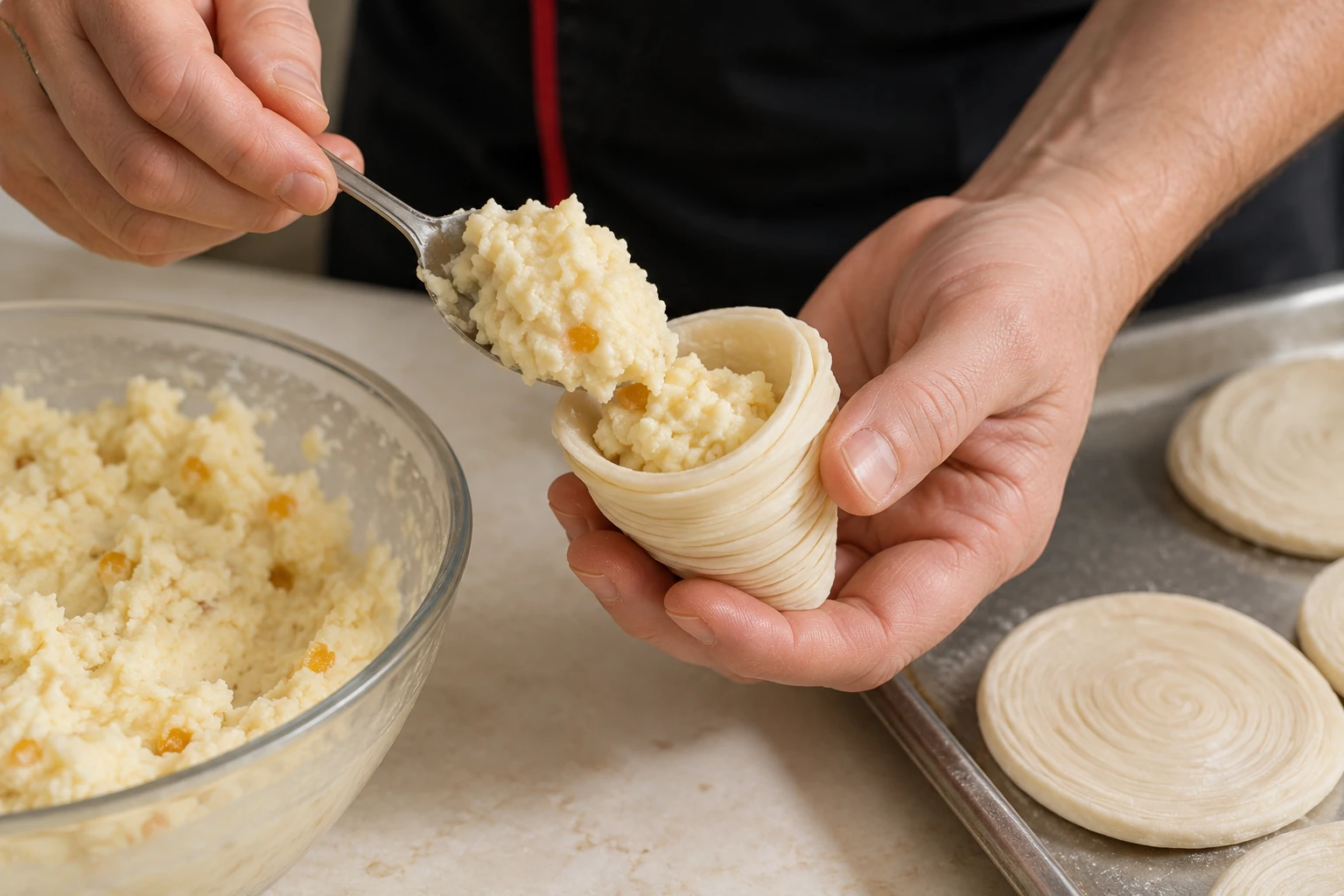
Heat a conventional oven to 220°C. Line both trays. Trim only the uneven ends of the cold roll, then cut 12 discs about 1 cm thick. Lightly grease the cut faces with the remaining lard. Working from the centre outwards with your thumbs, slide the layers apart to form a hollow cone. Keep the tip intact and avoid stretching holes in the shell. Keep waiting discs cold.Heat a conventional oven to 425°F. Line both trays. Trim only the uneven ends of the cold roll, then cut 12 discs about ½ in thick. Lightly grease the cut faces with the remaining lard. Working from the centre outwards with your thumbs, slide the layers apart to form a hollow cone. Keep the tip intact and avoid stretching holes in the shell. Keep waiting discs cold.
Weigh the finished filling and divide it evenly among the shells, about 55–60 g each after cooking losses. Fill without smearing the rim, then bring the open edges together into a triangular shell and press gently to close. Arrange six on each tray with at least 3 cm between them. Refrigerate the second tray while the first bakes.Weigh the finished filling and divide it evenly among the shells, about 2–2 oz each after cooking losses. Fill without smearing the rim, then bring the open edges together into a triangular shell and press gently to close. Arrange six on each tray with at least 1¼ in between them. Refrigerate the second tray while the first bakes.
Bake one tray at a time for 25–30 minutes, until deeply golden with dry, separated layers. Allow the oven to return to 220°C before the second tray. Transfer to a rack and leave for about 15 minutes, until warm rather than piping hot, then dust with the icing sugar. The two trays take up to 60 minutes of baking in total.Bake one tray at a time for 25–30 minutes, until deeply golden with dry, separated layers. Allow the oven to return to 425°F before the second tray. Transfer to a rack and leave for about 15 minutes, until warm rather than piping hot, then dust with the icing sugar. The two trays take up to 60 minutes of baking in total.