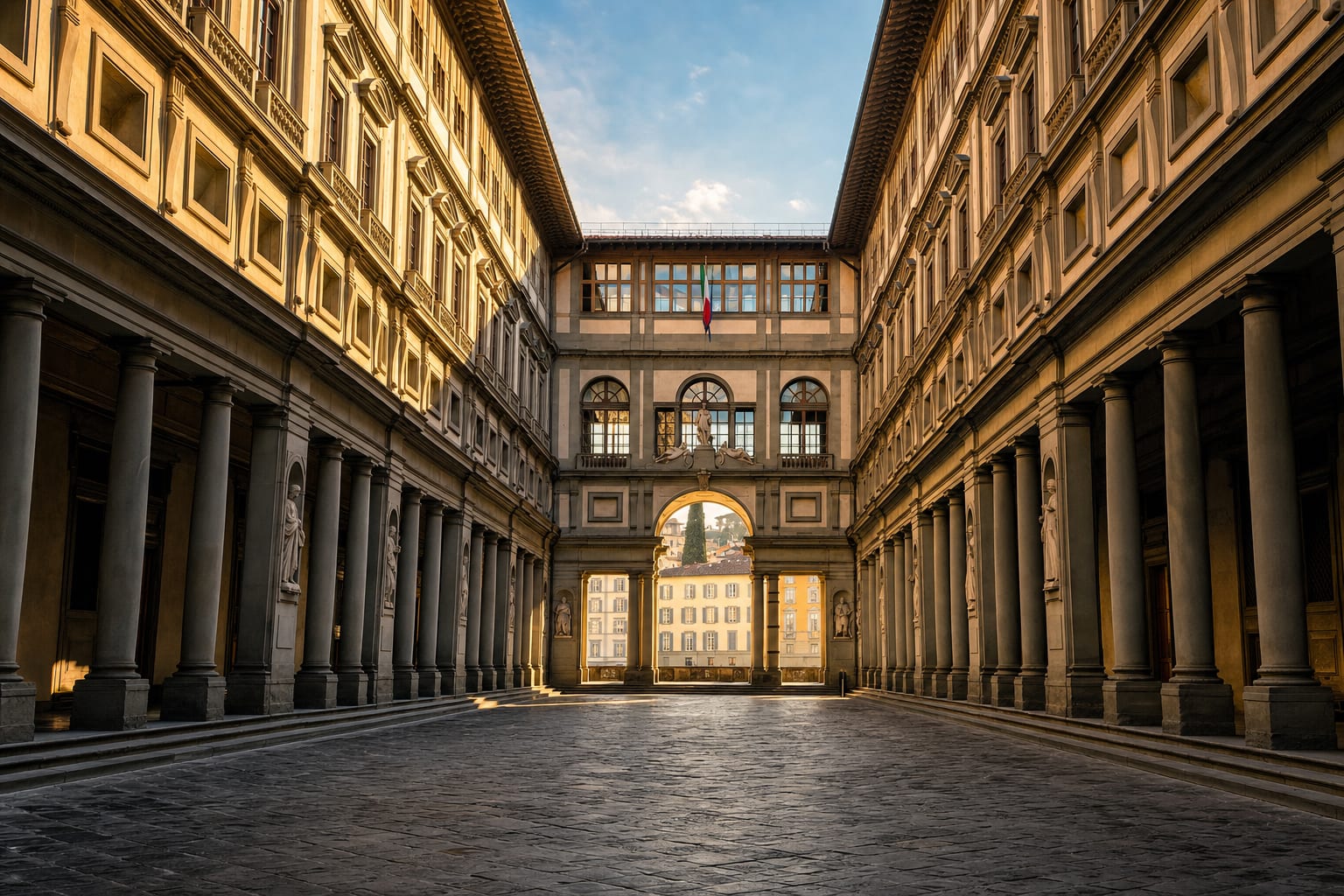
Gli Uffizi occupano il primo e il secondo piano dell'edificio di Giorgio Vasari, costruito tra il 1560 e il 1580, e custodiscono collezioni di scultura antica e dipinti dal Medioevo all'età moderna.1
La storia
Che cosa stai guardando
The Uffizi is not simply a museum with famous paintings. It is Florence's old machinery of power turned into a museum, a long Vasari building made for Medici administration and later filled with the art that helped define the city's idea of itself. Its corridors still feel ceremonial, lined with ancient sculpture from the Medici collection, while the rooms open into one of the world's densest sequences of medieval and Renaissance painting.
Most visitors come for Botticelli, and rightly so. But the Uffizi is more powerful when read as a progression: gold-ground altarpieces giving way to bodies with weight, perspective opening space, portraits sharpening into psychology, sacred scenes becoming human drama. Giotto, Piero della Francesca, Filippo Lippi, Botticelli, Leonardo, Raphael, Michelangelo and Caravaggio are not isolated trophies here. They form an argument about how Western art learned to see.
The practical challenge is emotional as much as logistical. This is a museum that can exhaust you by abundance. Book ahead, choose your priorities, and let a few rooms matter deeply instead of trying to conquer the whole collection. If you are pairing it with the Accademia or the Duomo, put the Uffizi first thing in the day, while your eyes are still fresh.
The Uffizi occupies the first and second floors of Giorgio Vasari's great building, constructed between 1560 and 1580. The official Uffizi Galleries describe its collections as spanning painting from the Middle Ages to the modern period, with 14th-century and Renaissance masterpieces by Giotto, Botticelli, Leonardo, Raphael, Michelangelo and Caravaggio, alongside ancient sculpture from the Medici collection.