

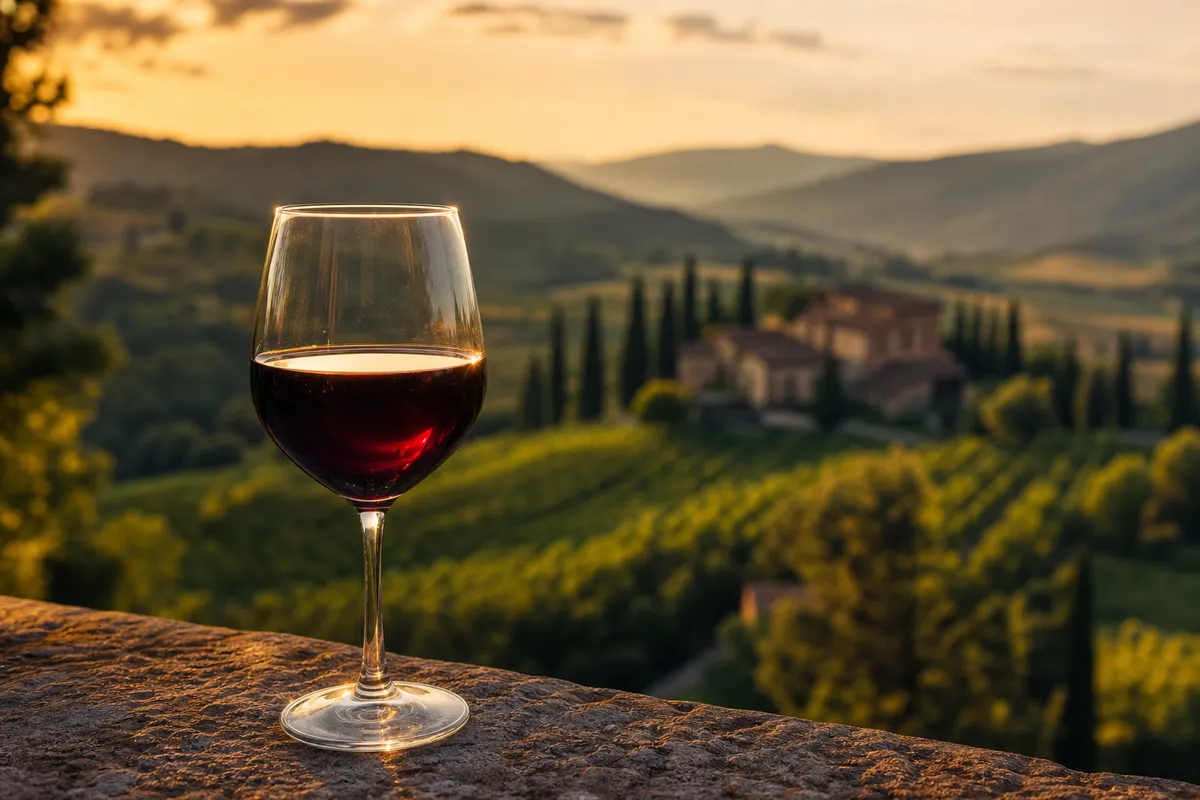
Valfabbrica on its hill
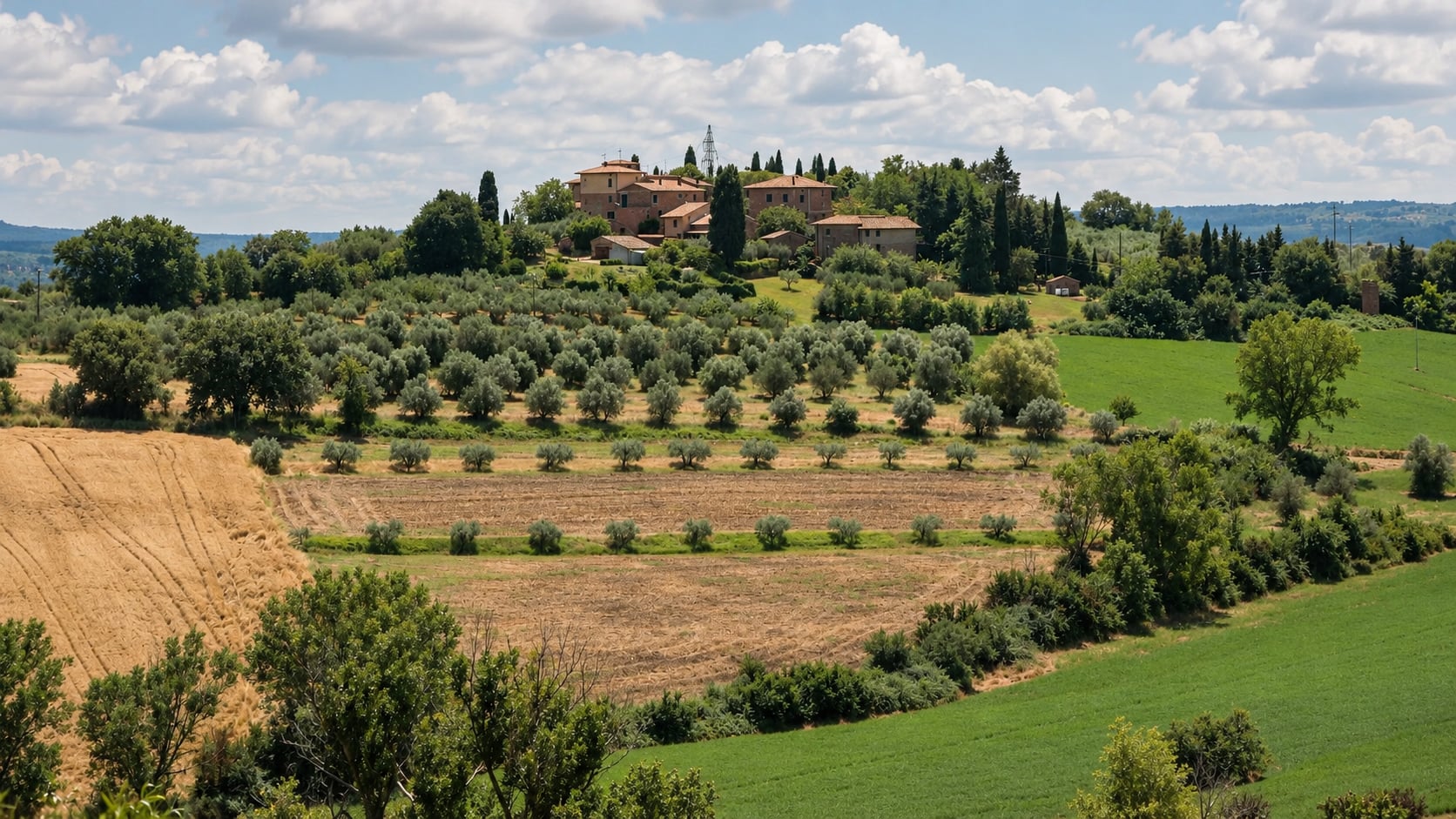
Valfabbrica sits on a hillside above the valley of the Chiascio. Its name joins the Latin vallis, valley, to fabrica, works, two words that appear separately in medieval documents from the archives of Assisi, Perugia and Gubbio.
Istat places the centre of Valfabbrica at 289 metres above sea level, while Casacastalda stands at 523 metres and Giomici and Monteverde, both above 560 metres, sit higher still.
Perugia destroyed the castle in 1209. In 1631 the territory passed to the Papal States, and in 1728 the boundary with neighbouring Assisi was formally drawn. After the Napoleonic era, in the early nineteenth century, Valfabbrica was constituted as a municipality and absorbed the suppressed municipality of Casacastalda.
The medieval district of Pedicino keeps two tall towers and long stretches of the surrounding walls. One of the towers was altered in 1907 and given a civic role, so the old quarter carries both its defensive profile and a later layer of town history.
The gate into the old town
A gate survives on Via San Sebastiano, reached from the main square along Via Castellana. In the Middle Ages, when the castle was ringed by defensive walls, it was the only way in, a deliberate choice since fewer entrances meant fewer risks of assault. Because it faces east, it carries the traditional name Porta Sole, the Gate of the Sun.
Santa Maria Assunta and the Benedictine abbey
The Benedictine abbey of Santa Maria Assunta dates to the early Middle Ages and was an outpost of the great abbey of San Silvestro di Nonantola in Assisi territory. Between about 1100 and 1130 its monks, under Prior Saluccio, drained marshland and made the plain fertile. A contract of 1101 links the monk Andrea with Leto, prior of San Rufino in Assisi. In 1168 Pope Alexander III confirmed Nonantola's possession by papal bull, in 1177 Frederick Barbarossa took the church and monastery under his protection, and in 1191 Pope Celestine III confirmed the abbey's control of its lands at Valfabbrica.
Local tradition places Saint Francis here in 1207, on his way to Gubbio. In 1272 Abbot Garzia stripped the priory of its movable goods and documents. In 1359 the Holy See ordered the monastery suppressed, and the church went on serving as a parish. In 1544 the canon Benzi transferred the monastery to the Bishop of Assisi.
The complex still shows its defensive perimeter wall around a courtyard, a cloister with a surviving well and a Romanesque church whose floor was lowered and whose apsidal area lies near the altar. Seventeenth-century works raised the structure, removed the tribune and opened windows that damaged some of the frescoes. Its best-known painting is the late thirteenth-century Compianto sul Cristo morto, presented by the municipality as the only example in Umbria of the school of Cimabue.
San Sebastiano and the Fedeli organ
San Sebastiano stands inside the old castle, near the ancient bell tower on the eastern wall. It began as a medieval chapel and is first documented as an oratory in 1525. In 1554 the community bought the neighbouring house to enlarge it. Two confraternities, the Santissimo Sacramento and the Buona Morte, formed around it in the sixteenth century, gathering before the Madonna del Rosario. A pastoral visit confirmed the church in 1608, a marriage is recorded there in 1617, and in 1633 a bishop's visit described its interior in detail. The building has always belonged to the municipality and is the civic museum.
Altars were added through the seventeenth and eighteenth centuries, among them the Sacra Famiglia attributed to Benedetto Bandiera and dated 1634, still in its original place. The church also held chandeliers, candelabras, chalices, monstrances and tabernacles, and its ceiling carries nineteenth-century painting of a starry blue sky.
Above the entrance, in the choir loft, stands a nineteenth-century organ. Its cartouche reads, in Italian, that Ferdinando Fedeli of Rocchetta di Camerino made the organ on 15 May 1829. Fedeli, who lived from 1773 to 1843, was an organ builder working across Umbria and the Marche, and this is a work of his maturity. The main windchest, slider chest, register mechanism and wooden pipes survive, along with a keyboard and pedalboard of nineteenth-century design. The bellows and most of the metal pipes are lost.
Paintings and frescoes
Among the paintings catalogued in Valfabbrica is a Madonna in trono col Bambino between Saint Michael Archangel and Saint Anthony Abbot, from the first half of the fifteenth century and attributed to the Maestro di San Verecondo. Stefano Amadei, the Perugian painter who lived from 1589 to 1644, is credited with a Madonna in trono col Bambino tra Angeli e Santi now tied to the church of the Madonna del Chiascio. In Santa Maria Assunta, the local painter Ennio Boccacci made three altarpieces: the Trinità, the Beatitudini and the Remissione dei peccati.
In Casacastalda, the parish church of Santa Maria Assunta holds a fine triptych by Matteo da Gualdo and a sixteenth-century bell. At Giomici, the fifteenth-century sanctuary of the Madonna dell'Olmo has frescoed walls with works attributed to Matteo da Gualdo as well.
At Giomici, the church of San Michele Arcangelo holds fifteenth-century frescoes, some attributed to Matteo da Gualdo, and a seventeenth-century polychrome ceramic by Francesco Biagioli, known as il Monina.
Casacastalda
Casacastalda has Lombard roots. Local tradition says that in 763 a Lombard named Erno, or Ernesto, Castaldo built a castle here, and that the name comes from Casa del Castaldo, the steward's house. The castle was rebuilt in 1433 in a diamond plan, with three towers that served as gates: Porta Perugina to the south, Porta del Giglio to the north and Porta Eugubina to the west. In the late twelfth century Frederick Barbarossa placed the territory under the Benedictine monastery of Santa Maria Assunta, in 1257 it was ceded to the commune of Perugia, in 1500 Cesare Borgia occupied it during his conflict with Perugia, and in 1528 Perugia granted it the status of independent commune. It entered the Roman Republic under French forces in 1798 and lost its commune status in the early nineteenth century.
Giomici
Giomici began as a tower on the Byzantine Corridor, guarding against Gothic and Lombard invasions, and its castle dates to the eleventh century. Documents spell its name Glomisso, Giomisci, Chiomiscio and Giomisce. In 1163 Frederick Barbarossa assigned the castle to the monastery of San Donato di Pulpiano, and in 1240 the monks ceded it to Monaldo di Suppolino. Gubbio acquired parts of it in 1258 after its war with Perugia. In 1378 Bishop Senso de' Gabrielli took possession while a castellan named Petruccio held out in the highest tower. In the fifteenth and sixteenth centuries it was a border holding of the Montefeltro, Dukes of Urbino, and it resisted an attack by Braccio da Montone in 1419. The Vagni family, from Lunigiana, acquired it in the seventeenth century, and Giomici joined the municipality of Valfabbrica in 1929.
Castles, villas and a protected landscape
Four cultural properties in Valfabbrica are directly protected under the regional landscape plan: the castle of Schifanoia, the church of the Ospedaletto, the Torre Castellana at Giomici and San Michele Arcangelo at Giomici. Seven villas and historic residences are singled out as well, among them Schifanoia, Il Palazzo, Palazzo Belmonte, a villa at Barcaccia, the Badia, Villa Vagni and Palazzo Bellini.
Part of the municipal territory falls inside the Natura 2000 special area of conservation IT5210075, known as Boschi e pascoli di Fratticiola Selvatica (Valfabbrica), the woods and pastures of Fratticiola Selvatica.
Hamlets and walking routes
The municipality's tourism portal groups Valfabbrica with Coccorano, Casacastalda, Giomici, Barcaccia, Forre del Rio Grande, Borgo Sambuco, Poggio San Dionisio, Poggio Morico and Monteverde. After Valfabbrica itself, Casacastalda, Giomici and Monteverde are the main villages, while Poggio San Dionisio, Collemincio, San Donato and Sospertole are smaller clusters, and the remaining houses are scattered across the countryside.
On the Via di Francesco, the walking route linking Gubbio and Assisi, Valfabbrica is where the stage from Gubbio ends and the stage to Assisi begins. The link with Saint Francis is an old one, since local tradition has him staying at the abbey in 1207 on his way to Gubbio.
The Rio Grande marks the boundary between Valfabbrica and Assisi, and its gorges, the Forre del Rio Grande, are among the wildest corners of the municipality. Mediterranean scrub dominates, with holm oaks, broom and red juniper, and the gorge sits between the cold and warm Lauretum zones, which creates an unusual microclimate for the pre-Apennine hills. The route crosses the stream repeatedly, so wear sturdy, water-ready footwear, and it passes the reconstructed Ponte delle Imposte, built for floating timber, and the ruins of a lazzaretto. The narrow sections prevent a loop, and walkers return the way they came.
Traditions and the table
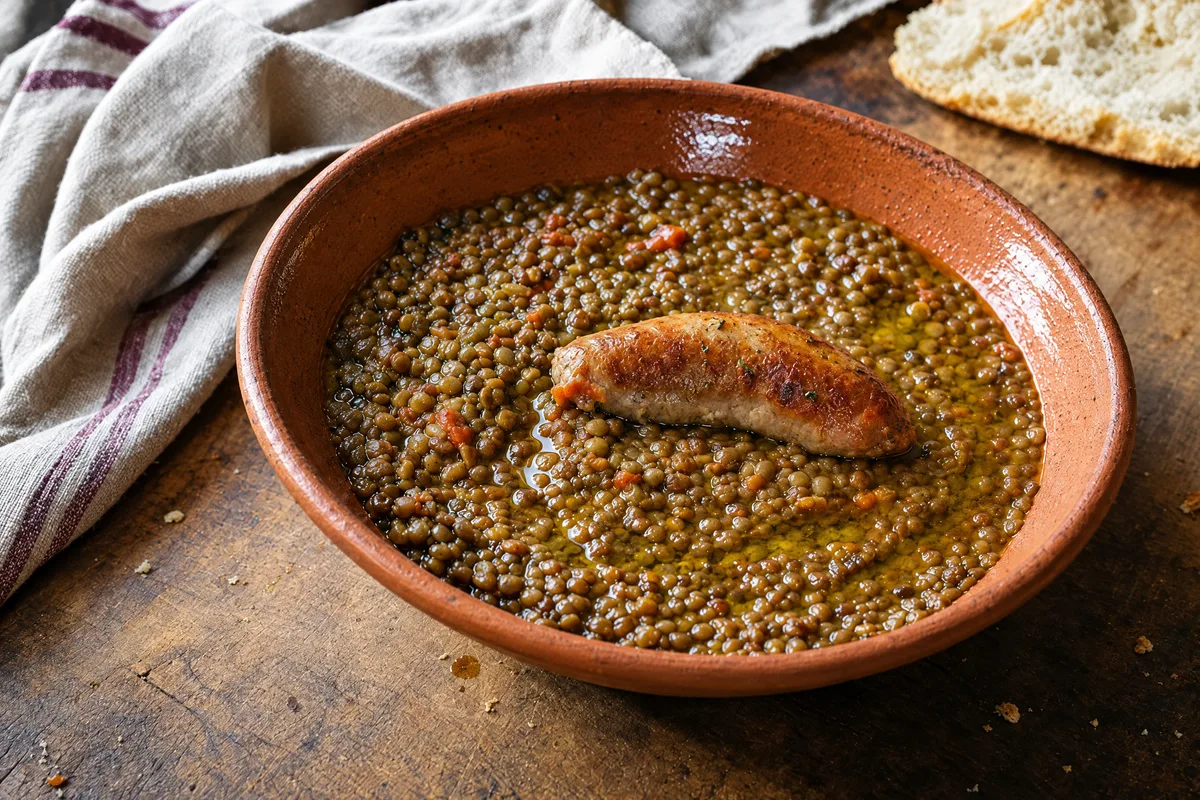
The Palio di Valfabbrica, the municipality's largest cultural event, grew from an earlier Festa d'Autunno and draws on the territorial divisions of the thirteenth century. It pits three rioni against one another: Badia, yellow and black with a wolf, for the abbey and its Benedictine monks; Pedicino, white and amaranth with a tower, for the castle quarter; and Osteria, red and black with an eagle, for the countryside of travellers. The celebrations run for ten days and always end on the first Sunday of September, with jugglers, acrobats, fire-eaters, drummers and flag-wavers, contests between the districts, open-air taverns serving local food, medieval reenactments and an equestrian tournament.
Every May, Casacastalda hosts the Cantamaggio, a folk festival of Umbrian spring song. Singers trade stornelli, rhyming verses, and sonnets on rural themes, often to the sound of accordions, and the evening comes with the simple country dishes of the area.
Valfabbrica lies within the Colli Assisi Spoleto subarea of the Umbria protected-designation olive oil, which makes the hills around the town part of an olive-growing landscape with a protected name.
Museum hours, bus services and festival programmes change from year to year, so check the municipality's tourism portal, Visit Valfabbrica, before you plan around them.
Archives and memory
Valfabbrica's municipal archive keeps the town's written memory, alongside the records of its churches, the Comunità di Casacastalda, the confraternities, the hospital of Sant'Antonio and the civil registry.
More of Umbria
A letter from Italy, once a month.
The places, tables and makers we found worth your time. One email, no noise.
One letter a month. Unsubscribe at any time. We never share your address.