

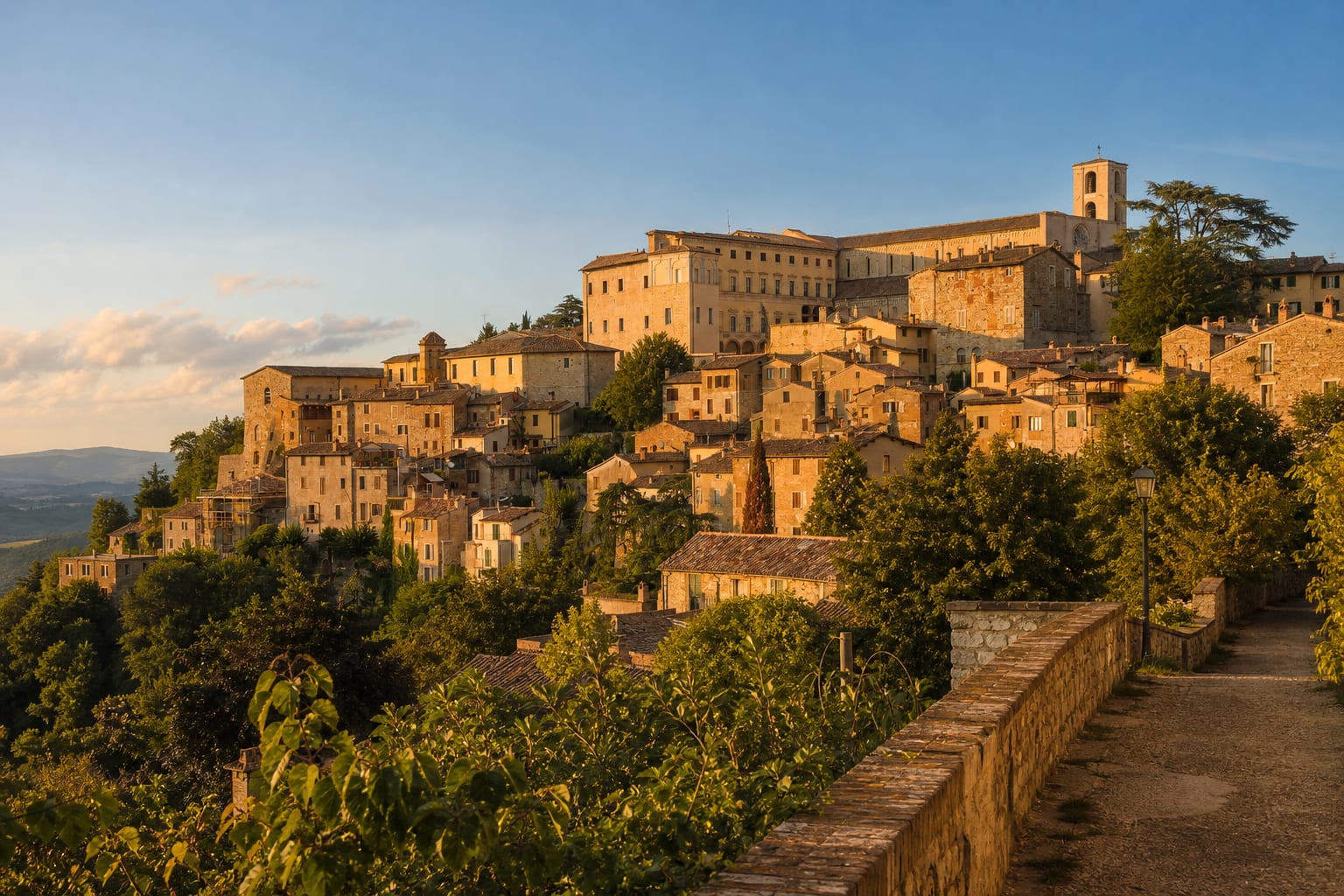
Crowning three concentric rings of walls (Etruscan, Roman, and medieval), Todi is often praised as one of Italy's most livable towns.
Its serene Piazza del Popolo and the Renaissance pilgrimage church below the walls reward an unhurried wander.
Todi at a glance
Todi sits on a hilltop at about 400 metres, looking down on the point where the Naia stream meets the Tiber. The town you see from the valley is only the capoluogo: the comune covers 222.01 square kilometres, and its statute names a long list of frazioni, from Pantalla, Pian di Porto and Pontecuti to Izzalini, Montemolino and Petroro.
Even the name comes with a story. Municipal history tells how the valley's early settlers had started building by the river when an eagle carried off the tablecloth from their meal and dropped it on the top of the hill, which they took as a sign to build there. The same account links the name to the word Tutere, meaning border, because the hill looks across the Tiber toward what was once Etruscan territory.
From Tuder to free comune
Ancient Tuder was probably Umbrian in origin, and its place on the frontier with the Etruscan world left a strong Etruscan imprint; the town struck its own coins inscribed Tutere. It became a Roman municipium during the Social War, and under Augustus a colony of veterans was settled here, giving the town the name Colonia Iulia Fida Tuder.
In 760 the Lombard king Desiderius and Pope Paul I agreed Todi's boundaries on the side of the Duchy of Spoleto, and by the early twelfth century Todi was a free comune. Its golden age ran from the eleventh to the fourteenth century: Todi subdued Amelia in 1208 and Terni soon after, and during the popes' exile in Avignon it even took Orvieto. After the popes returned, the city passed through a succession of lords, including a Malatesta of Rimini, Biordo Michelotti and Francesco Sforza, until Vitellozzo Vitelli, a captain of Cesare Borgia, demolished the comune's fortifications and ended its real independence.
Todi flowered again under Bishop Angelo Cesi, who promoted the Fontana della Rua, also called Fonte Cesia, and the church of the Crocifisso, and pressed on with the Consolazione, finished after his death. The Fonte Cesia dates to 1606, and the Crocifisso, another Greek-cross church, was begun late in the sixteenth century by Valentino Martelli and Ippolito Scalza.
Piazza del Popolo and its palaces
Piazza del Popolo owes much of its character to three medieval palaces. The Palazzo del Popolo, begun in 1213, keeps much of its rugged Romanesque character; the Palazzo del Capitano, from the end of the same century, adds Gothic touches, and a grand external stair both separates and joins the two. Across the square, the Palazzo dei Priori also dates from the late thirteenth century and was remodelled in the early sixteenth, while the Duomo stands on the same square.
The Museo Civico e Pinacoteca fills the top floor of the Palazzo del Popolo, also called the Palazzo del Podestà, and the Palazzo del Capitano; it was reordered and reopened in 1997. Look for a tenth- to eleventh-century marble slab showing Saint Fortunatus, Christ the Redeemer and Saint Cassian, a wooden model of the Consolazione probably from 1571 and attributed to Ventura Vitoni, and the saddle of Anita Garibaldi. The numismatic section holds 1,475 coins, of which the 130 attributed to the Tuder mint matter most for the city's story. In the picture gallery, Lo Spagna's Coronation of the Virgin shares the rooms with a whole section devoted to Ferraù Fenzoni, known as il Faenzone, whom Bishop Cesi brought to Todi.
Don't miss the old council hall of the Priori, now home to the museum's medieval and Renaissance ceramics. Despite its nickname, the Sala Affrescata is painted in wall tempera, not true fresco. The frieze of Todi's illustrious men and the view of the city with all its territory, painted in 1612 by the local artist Pietro Paolo Sensini, belong to the first phase; between 1719 and 1721 Ignazio Mei of Fabriano added the legend of the town's founding and the Emperor Trajan's entry into Todi.
San Fortunato and Jacopone
San Fortunato is Todi's great Gothic church. It is documented before 1198, work to rebuild it in the Gothic manner began in June 1292, stopped only for the plague of 1348, and the church was finished in 1465. The upper façade stayed incomplete after the death in 1458 of Giovanni di Santuccio da Firenzuola, who had taken over the works in 1415. Inside, three aisles lead to thirteen side chapels, and a 1643 statue of Saint Fortunatus, patron of the city, stands behind the high altar.
The three aisles rise to the same height, making San Fortunato a rare Italian example of a hall church. Look for Masolino's Madonna and Child, painted in 1432, and the carved choir by Antonio Maffei of Gubbio, dated 1590.
Down in the crypt is the tomb urn of Saint Fortunatus commissioned by Bishop Angelo Cesi in 1596, which also holds the remains of Jacopone da Todi. The diocese keeps his memorial on 9 May, the day in 1596 when Cesi moved his relics into San Fortunato.
Jacopone is Todi's most famous son. Born here in the 1230s, he seems to have practised law until the death of his wife in 1268 turned him to penance; he joined the Friars Minor in 1278 and sided with the Spirituals against Boniface VIII, which cost him prison and excommunication until Benedict XI freed him. He died at Collazzone in 1306. He left about ninety laude, whose masterpiece is the Pianto della Madonna, and the Latin Stabat Mater is generally credited to him.
The Duomo and the Consolazione
The Duomo, a Latin-cross church in the Lombard style, was built in the twelfth century over the ruins of a Roman temple. On the inside of the façade, il Faenzone painted a Last Judgment in 1596, inspired by Michelangelo's in the Sistine Chapel. The inlaid choir by Antonio and Sebastiano Bencivenni of Mercatello dates from 1521 to 1530.
Santa Maria della Consolazione is the silhouette everyone remembers. Built between 1508 and 1607, it has a central Greek-cross plan with three polygonal apses and one semicircular apse, where the high altar holds an older image of the Virgin and Child with Saint Catherine of Alexandria.
Who designed it is still an open question. A tradition already formed in the sixteenth century credits Bramante, and most scholars follow it, but the documented site masters were others: Cola da Caprarola from the start, then Ambrogio da Milano and Rocco da Vicenza, and later Valentino Martelli and Ippolito Scalza. The church belongs to ETAB, which in 2019 launched a research initiative on the theory that Leonardo shaped the original idea.
Smaller churches reward a wander: Santa Maria in Camuccia, a two-level church founded in the seventh or eighth century, reworked in the thirteenth and a Dominican convent from 1394 to 1810; San Carlo, first recorded in 1112 as a property of the monks of Farfa; and Montesanto, on a knoll near Porta Orvietana, whose old name Monte Mascarano may point to a sacred site of the ancient Umbrians.
Roman Todi under your feet
Beneath Piazza del Popolo lie two Roman cisterns from the second half of the first century BC, one under each side of the square, each divided into twelve chambers. Together they were the heart of the ancient water system and held up the forum above. The eastern cisterns were rediscovered in 1262 when the square was repaved, the western ones by chance in 1996. They measure 48 metres in overall length and about 7 metres in height, and each could hold around 2,500 cubic metres of water. In some chambers you can still see the prints of hobnailed boots left by the builders.
On Piazza del Mercato Vecchio stand the Nicchioni, a monumental Roman retaining structure of large travertine blocks from the late Republic or early Empire, with four great apses under a Doric cornice. In June 2025, archaeological work in the square, directed by the Soprintendenza, uncovered new remains of a mosaic floor.
Three rings of walls trace the city's growth: an inner circuit traditionally called Etruscan and dated to the third century BC, a Roman circuit, and the outer medieval ring begun in 1244. On that outer ring open Porta Perugina, Porta Romana, Porta Fratta, once called Amerina, and what little survives of Porta Orvietana.
The Museo Lapidario, opened in 2009 in the church of San Giovanni and rooms of the former Monastero delle Lucrezie, holds a municipal stone collection begun in the early sixteenth century. Highlights include a fourth-century Good Shepherd sarcophagus, three travertine coats of arms torn from the Palazzo dei Priori by Todi's Jacobins in 1798, a 1248 inscription recording the building of the bridge at Pontecuti, and a stone carved with the famous SATOR palindrome.
The Fontane di Scannabecco are medieval rather than Roman: the podestà Scannabecco dei Fagnani had the basins built in 1241 under a portico of seven columns carrying round arches.
The Mars of Todi
Todi's most famous ancient object lives in the Vatican. The Mars of Todi, a bronze warrior in armour leaning on an iron spear and pouring a libation from a shallow bowl before battle, was found in 1835 at Monte Santo, buried between travertine slabs, and bought by the papal government in 1836. It is now in the bronze room of the Museo Gregoriano Etrusco at the Vatican Museums.
The figure stands about 141 centimetres tall and dates from the late fifth or early fourth century BC. Its dedication is in the Umbrian language but written in a southern Etruscan alphabet, and records that one Ahal Trutitis gave it as a gift; the Vatican Museums think it was probably made in a workshop at Orvieto, ancient Volsinii.
Wine, oil and pampepato
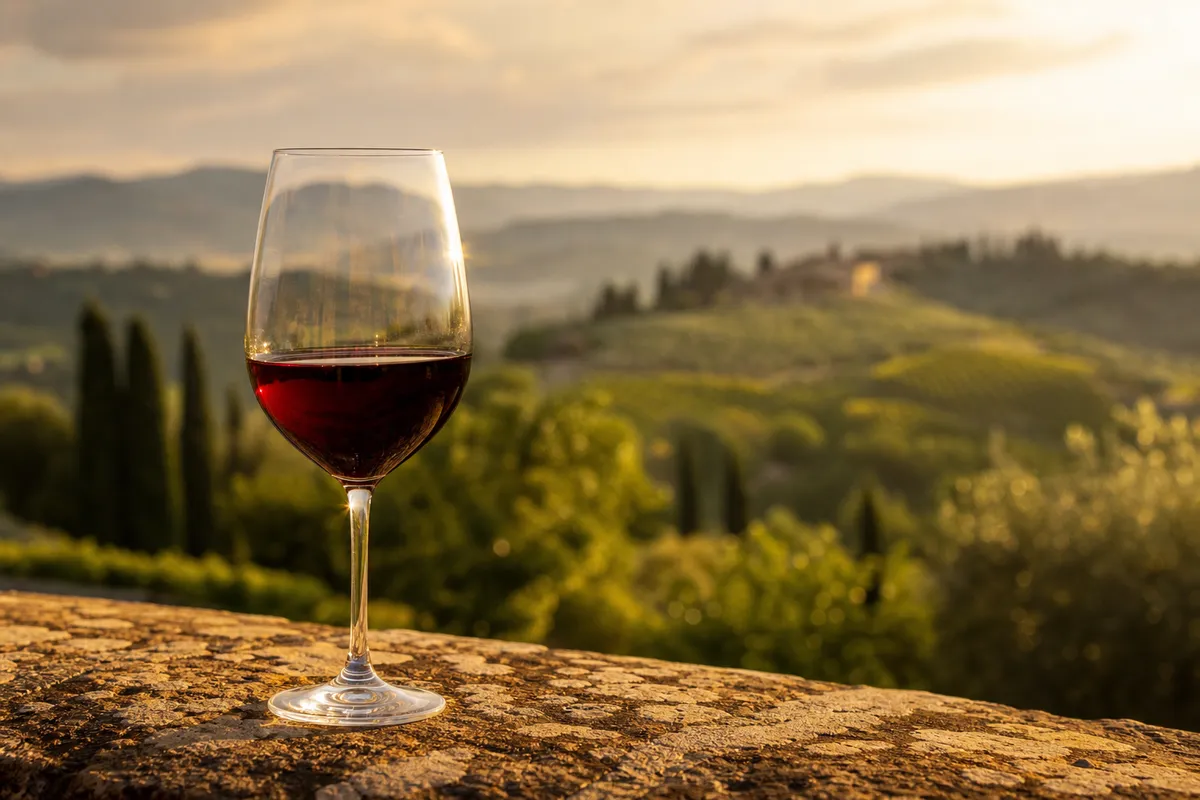
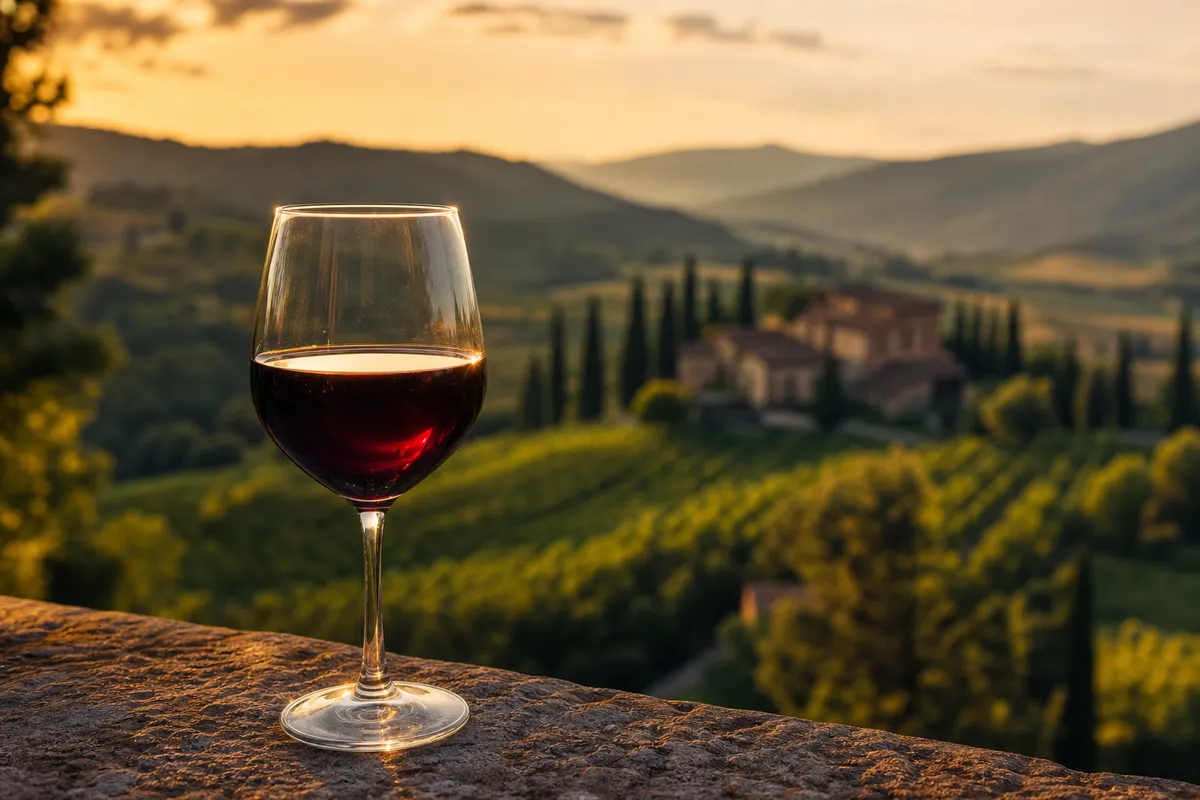
Todi DOC is the town's own wine denomination, and its production area covers the whole territories of Todi, Massa Martana, Monte Castello di Vibio and Collazzone, with several white, red and varietal types.
Olive groves are just as much a part of the landscape. The whole comune lies within the Colli Martani mention of Umbria DOP extra-virgin olive oil, on hills of conglomerates, sands and clays. Todi is also one of the Perugia-province towns in the production area of Pampepato di Terni IGP, the dome-shaped Christmas sweet of nuts, chocolate, raisins, candied peel, honey and spices.
At the table, look for pan caciato, also called nociato, a small round loaf made with nuts, cheese and raisins, and in winter palomba alla ghiotta: wood pigeon roasted on the spit and finished in a rich sauce of its giblets cooked with red wine, vinegar, garlic, olive oil, olives and herbs. According to the regional tourism board, it usually comes with a glass of Grechetto from the Todi DOC.
Beyond the walls
The frazione of Collevalenza is home to the Basilica Santuario dell'Amore Misericordioso. Its founder, Madre Speranza, was born at Santomera in Spain on 30 September 1893 and arrived in Collevalenza in 1951. In 1949 she had described the sanctuary she envisaged, with a house for the sick, a house for pilgrims and homes for the religious congregations she founded, and a pilgrims' house is part of the complex.
Down on the Tiber, Pontecuti guards its bridge with a thirteenth-century fortress and tower. In the frazione of Petroro, the Comune of Todi fortified the village in 1296, and in the fourteenth century its castle joined the chain of outposts guarding Todi's border with Foligno, Spoleto and Bevagna. The surviving walls and central keep follow a sixteenth-century layout by the Ridolfi family, whose coats of arms still mark them, and the gate is crowned by a stone coat of arms of Todi dated 1577.
Theatre and first steps
The Teatro Comunale, designed by the Arezzo architect Carlo Gatteschi, was built between 1868 and 1872 and opened on 14 August 1876 with Verdi's Un ballo in maschera. Its 499 seats make it the fourth-largest historic theatre in Umbria, arranged in a horseshoe with four tiers of boxes behind a neoclassical façade decorated with medallions of Metastasio, Alfieri, Rossini and Goldoni. Todi's stage tradition goes back to the Accademia dei Convivanti in 1450.
Porta Orvietana has a large car park, from which a lift or a footpath through the Giardini Oberdan leads up into the centre; the gardens' belvedere looks straight across to Montesanto. Inside the triple ring of walls, the streets are narrow, winding and mostly on a slope, with the old main axis running from Porta Romana to the central square, so comfortable shoes earn their keep. Check the comune's tourism pages for visiting details before you go.
More of Umbria

A letter from Italy, once a month.
The places, tables and makers we found worth your time. One email, no noise.
One letter a month. Unsubscribe at any time. We never share your address.