



A small Umbrian town with a long memory
Parrano is a municipality in the Province of Terni, in Umbria. Within one modest territory you find a castle-topped hill town, a steep limestone gorge, a thermal spring, caves that people used from the Stone Age onward, and woodland that belongs to a UNESCO biosphere reserve.
Its institutional story is long. Archival sources trace the community of Parrano from the twelfth century to 1860, when the modern municipality was established, with a medieval investiture by the bishops and several later feudal transfers. The town joined the Province of Terni in 1927.
The castle and its lords
The castle is the anchor of the historic centre. The Comune's history says it was built by the bishops of Orvieto around the year 1000, probably on Roman foundations, as a five-storey fortified building with a central tower and a corner tower topped with Ghibelline crenellations.
The borgo itself keeps a checkerboard layout typical of Roman camps. Some scholars place a Roman settlement here, and Roman-era remains came to light during the castle's restoration in the 1970s. Etruscan and Roman-era tombs have also come to light in the surrounding fields.
The feudal chapter opens in 1118, when Bishop Guglielmo granted Parrano to Bernardo di Bulgarello as feudal count. The Bulgarelli, a family of Lombard origin, went on to build a large domain in central Italy, and Parrano became its seat of power.
The castle took on its present character in the mid-eighteenth century. Marquis Francesco Ruspoli-Marescotti turned it from a fortress into a manor house, and the Comune credits the architect Andrea Selva with its spiral staircase. The works also moved the entrance from the church stairway to today's piazza, through a large rusticated portal that let carriages in. Later owners include Francesco Basevi of Milan, who bought the estate from Don Augusto Marescotti in 1873, and Vittorio Valletta, a director of FIAT, who acquired it in 1940.
Written law and local memory
Parrano has a statute of its own. The old statutes of the castle were rewritten in 1559 because the original had become hard to read; the feudal co-lords, among them Count Ercole di Marsciano, commissioned the revision, and a notary transcribed it in Italian rather than Latin. That Statutum Castri Parrani was recovered in 2018 and 2019, according to the regional archival authority.
Three hamlets, three characters
Beyond the capoluogo, the countryside is organised around a handful of small places, each with its own church and its own story.
Cantone stands a little above 500 metres on a rocky spur between two valleys, where the Vallone and Volpara streams, tributaries of the Chiani, run. The Comune says the hamlet was founded in the late seventeenth and early eighteenth centuries by the Marescotti, and that its restored houses keep their original structure. Its church of the Presentation of Mary is recorded as a subsidiary building of the parish, with seventeenth-century origins.
Pievelunga grew around the church of Sant'Erasmo, documented as the Villa or Piviere of Montelungo in the 1292 Orvieto cadastre. The church keeps a stone basin and a holy-water font of historical interest. Archival sources add that Sant'Erasmo was the church of a former parish, active from 1813 to 1861 and now tied to the parish of Santa Maria Assunta.
Frattaguida lies on the hill of Poggio del Comune. Its rural church of Madonna di Marocolo was built over the remains of fifteenth-century frescoes and holds an eighteenth-century Madonna and Child and votive offerings on its walls, according to the Comune.
The Tane del Diavolo
The Tane del Diavolo, the Devil's Dens, are the best-known archaeological feature of the territory. They are not a single cave but a group of cavities along the Fosso del Bagno, set in a steep gorge. A regional archaeological survey finds evidence running from the Upper Paleolithic through several Bronze Age phases, although the sequence differs from cavity to cavity and from layer to layer.
Scholars have looked more closely at two of them. Tana A sits about 20 metres above the valley floor and runs for roughly 100 metres, with an Upper Paleolithic layer beneath Bronze Age deposits. The material studied from Tana B belongs to the Apennine facies, a Bronze Age culture of the Italian peninsula.
A newer cave changed the picture. The Comune reports that the Grotta dei Conoidi was discovered in 2022 and announced after a first study in 2024. Its first explorations traced more than half a kilometre of labyrinthine development, with narrow passages, large chambers and several archaeological areas.
On the first descent three experienced speleologists vanished into the depths and came back after a long time to report several great galleries. Later investigations found narrow crawlways, chambers approaching 20 metres high and two separate entrances.
The discovery itself has a satisfying story. Speleologists of the Todi Speleological Group noticed a small fissure blowing strong air beside a path in the Fosso del Bagno area, and the first explorers descended through a steep debris chute. Inside, the sediment cones formed by infiltrating water, the conoidi, give the cave its name, and calcite formations line its walls.
Pottery from the cave has blackened interiors with carbonised residue, and analysis found burned remains of oak, laurel, ash and rosaceous plants. A first study of the vessels suggests use in the second millennium BC, with some material possibly reaching back to the late Neolithic. The Soprintendenza, the Comune and the universities of Bologna, Padua, Florence and Siena have taken part in the research.
The water that carved the caves
The same stream that shaped the gorge gives the Bagno del Diavolo its name. The water is described as hypothermal, bicarbonate and alkaline-earth, rising from a carbonate aquifer along the Fosso del Bagno. The Ministry of Culture adds that the caves themselves were carved by the thermal waters of the Bagno stream, which ties geology, archaeology and the old habit of bathing into a single story.
The territorial documentation centre
The town's small museum gives the landscape a narrative. It is a territorial documentation centre in four sections: the caves and prehistory, the material from Podere Soriano, local history, and documentation of the territory.
Its collections reach from the Upper Paleolithic to the modern town. Among the highlights are grave goods from an archaic tomb of the sixth and fifth centuries BC at Podere Soriano, which show the influence of Orvieto and Chiusi, along with medieval and modern municipal documents and historical photographs. A restoration laboratory is part of the centre.
Forest, reserve and protected waters
Parrano sits inside several overlapping layers of protection. The gorge of the Fosso del Bagno is the Natura 2000 site Bagno Minerale (Parrano), covering 78 hectares and designated as a Special Area of Conservation in August 2014, with six habitat types.
Regione Umbria places Parrano in STINA, a territorial system of 44,270 hectares across nine municipalities, within which three protected areas are named separately: Selva di Meana, Elmo-Melonta and San Venanzo.
The broadest frame is the Monte Peglia Biosphere Reserve, designated by UNESCO in 2018 and covering 42,342 hectares. Governance material names Parrano alongside Orvieto, Ficulle and San Venanzo. UNESCO describes it as an extensive forested area organised around an ancient extinct volcano, with the hill of Monte Peglia dominating its southern part and a rich natural pool of fauna, flora and fungi.
Parish churches and the table
Santa Maria Assunta is an active parish of the Diocese of Orvieto-Todi, and the small churches of Cantone and Pievelunga are connected with it. Together they show how a scattered rural community organised its worship across hill and valley.
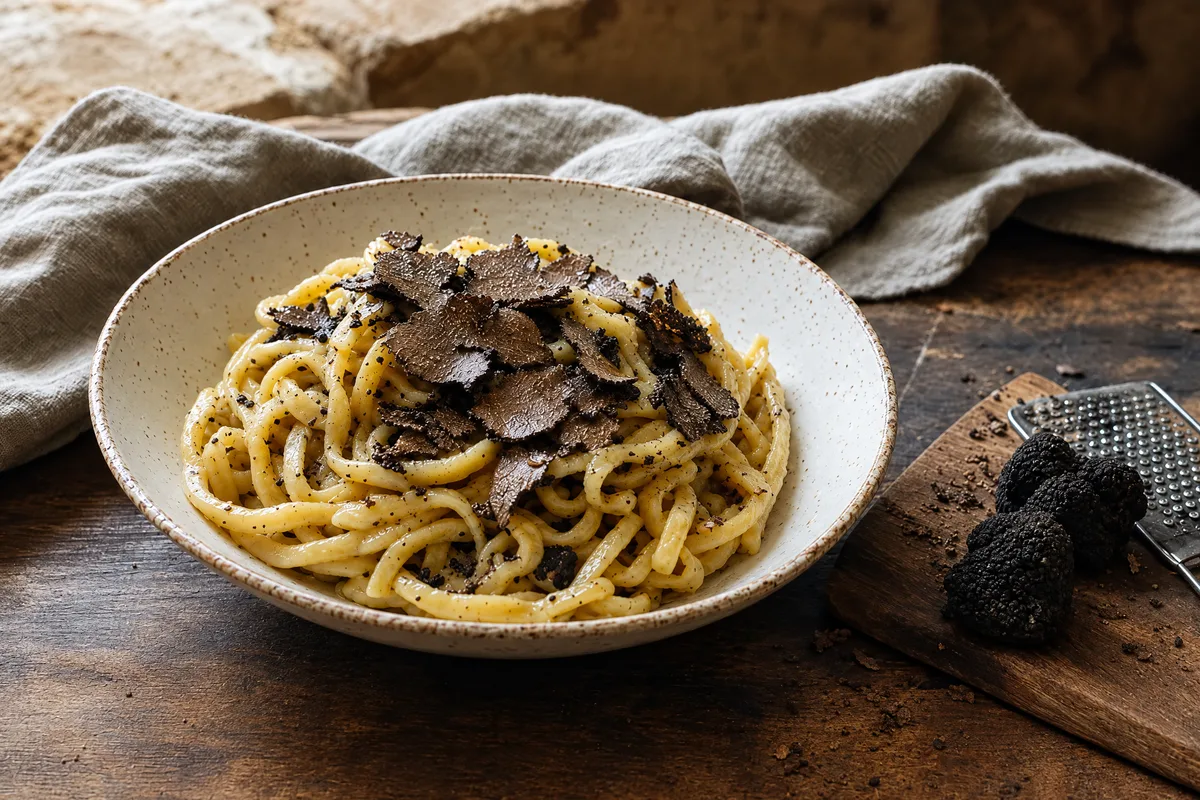
At the table, Parrano belongs to the Colli Orvietani production area of the Umbria DOP extra virgin olive oil, which ties its groves to the regional oil tradition.
Reading Parrano above and below ground
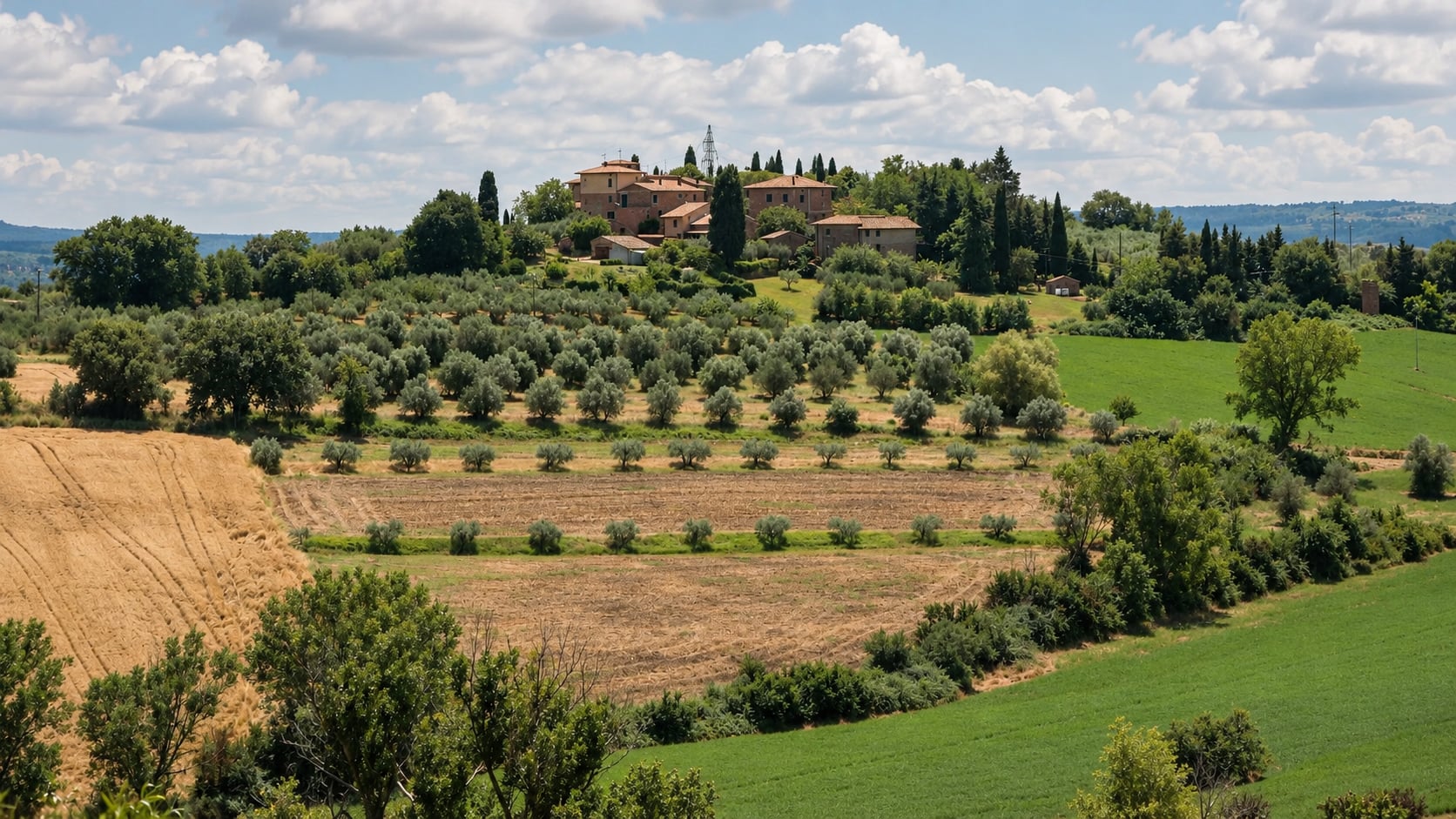
The best way to understand Parrano is vertically. On the ridge stand the castle and the old streets, the work of bishops and then of feudal families. Below them, the Fosso del Bagno cuts a gorge, thermal water rises, and a set of caves holds traces of people from the Upper Paleolithic onward.
Around both spreads a protected landscape of woods, streams and small hamlets, recognised at regional, European and UNESCO level. It is a quiet corner of Umbria, rewarding for travellers who like their history layered and their villages unhurried.
More of Umbria
A letter from Italy, once a month.
The places, tables and makers we found worth your time. One email, no noise.
One letter a month. Unsubscribe at any time. We never share your address.