

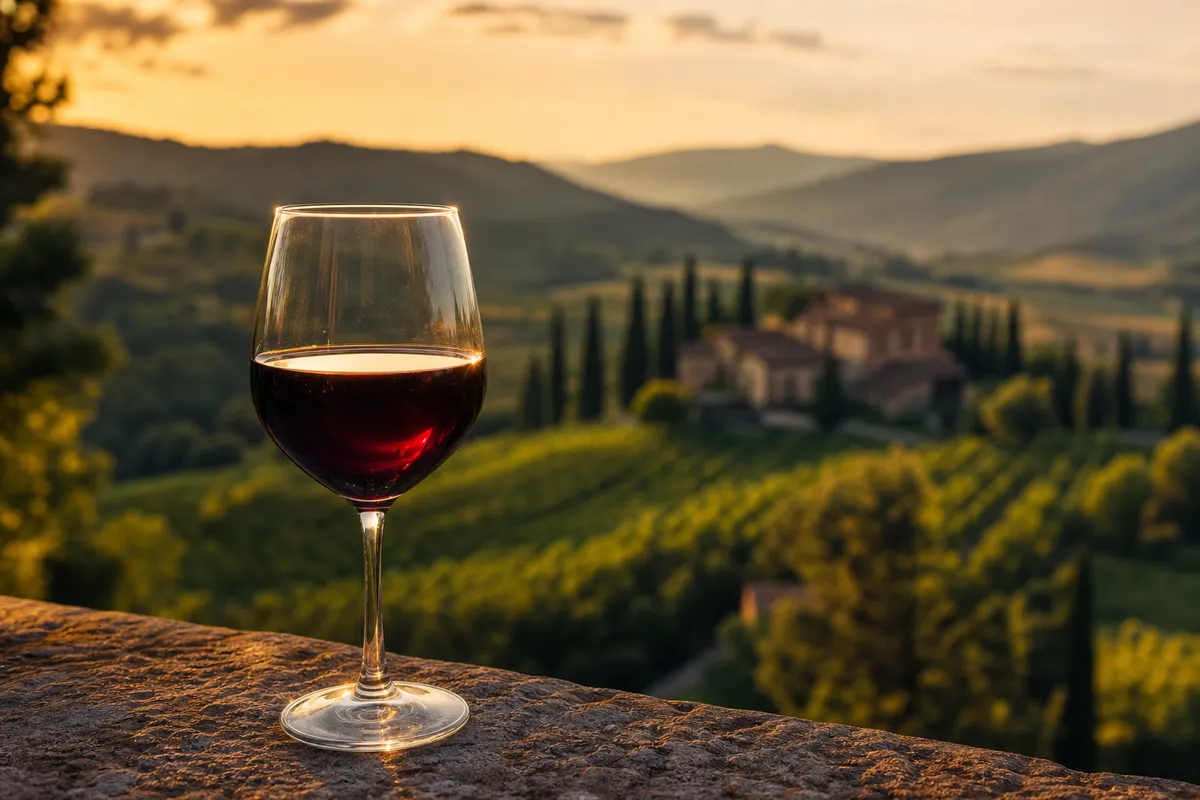
Panicale in one minute
Panicale is a municipality in Umbria, in the province of Perugia, and the hill town most visitors picture is only its seat. The municipal statute names Casalini, Missiano, Macereto, Colle Calzolaro, Colle San Paolo, Montali, Mongiovino, Colgiordano, Gioveto, Tavernelle and Panicale together as its frazioni and località, and it names Panicale itself as the capoluogo.
The Comune describes Tavernelle, down on the plain, as the economic, productive and commercial heart of the territory. That makes a useful mental map: the walled hilltop is the historic and artistic core, Tavernelle is where daily life and commerce gather, and the lake shore and oak woodland belong to the wider municipal landscape.
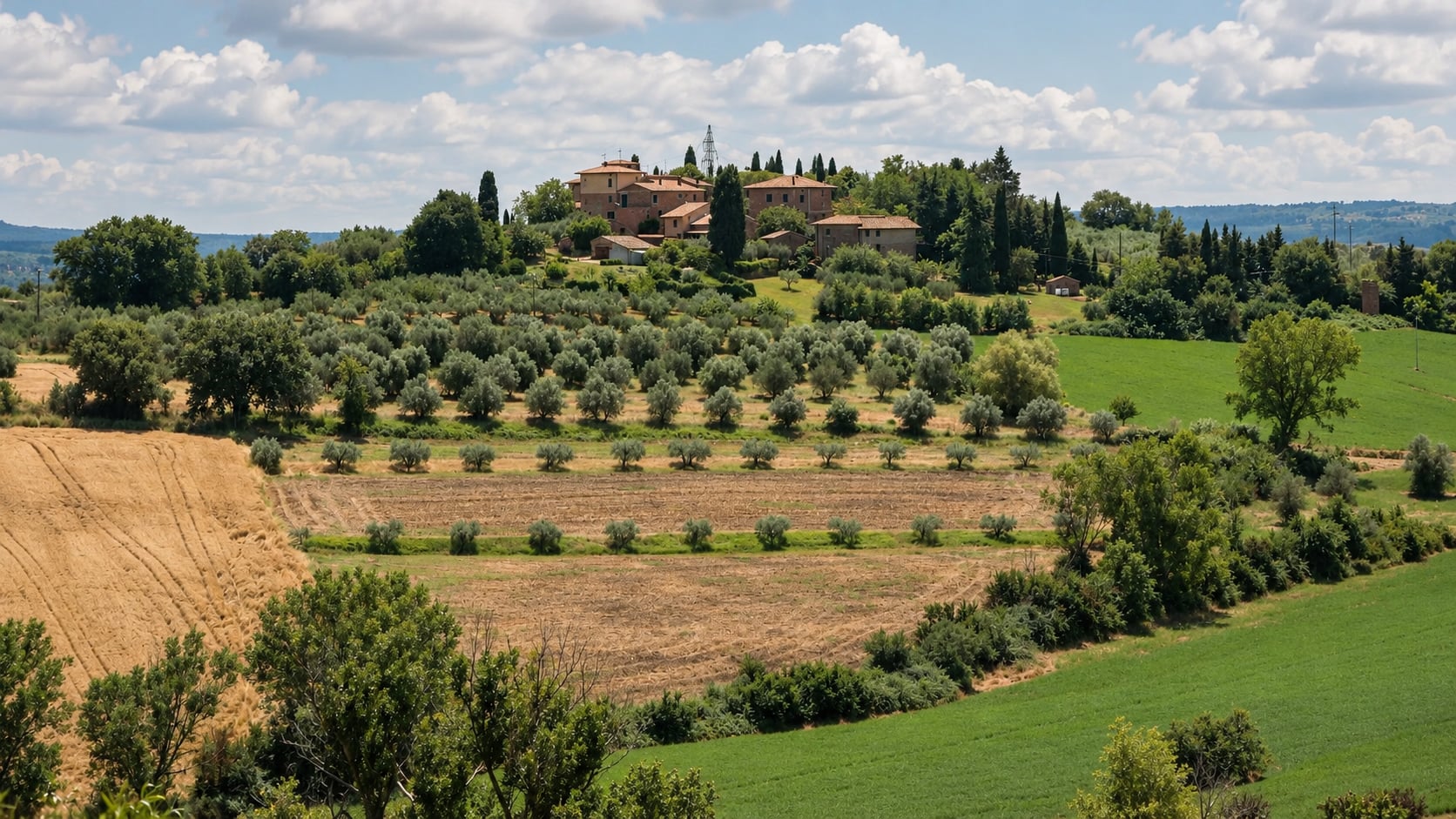
A terrace above Lake Trasimeno
Panicale sits on the eastern slope of Monte Petrarvella, and the Comune calls it the most beautiful natural terrace over Lake Trasimeno. The medieval castle was laid out as three piazzas inside concentric ellipses, once ringed by a moat and entered by two gates, one toward Perugia and one toward Florence. Porta Perugina and Porta Fiorentina still mark those approaches, and the curving, climbing streets give the town its compact, layered feel.
The travertine fountain beside Porta Perugina began as the town cistern and carries the date 1473. Higher up, the Gothic-Lombard Palazzo del Podestà, from the fourteenth century, holds the municipal and notarial archives, with records going back to 1312. Those archives are a reminder that Panicale was a place of notaries, statutes and civic pride long before it became a place to visit.
The written record is deep. The name itself is a puzzle the Comune enjoys: it may come from Pani calet, where altars burned to the god Pan, from pan colis, a place where millet is grown, or from the poetic Pan Kalon, where all is beautiful. Panicale's first municipal statute was compiled in Latin in 1316 by the notary Pietro di Vannuccio and rendered into Italian in 1484, and the Comune notes that in 1543 Pope Paul III named it a terra insigne, a distinguished land.
San Michele Arcangelo
San Michele Arcangelo is the parish church of the old town, with roots in the Middle Ages. The national register of Italian churches documents it as early as 1266, records its consecration in 1666, and dates the dome to 1687 and the façade to about 1690. The church you see grew in layers, a medieval core given its present seventeenth-century dignity.
San Sebastiano and the Perugino fresco
San Sebastiano is the town's great art stop. The church was remodelled in 1623. On its rear wall is Pietro Vannucci's fresco of the Martyrdom of Saint Sebastian, dated 1505.
Perugino set the saint in a calm, measured architecture opening onto a soft landscape, and the real lake and hills just outside the door make the painted view feel like a continuation of the place.
The church also shelters a detached fresco of the Madonna enthroned with angels, which was moved here in 1884 from the Sant'Agostino church, where it had hung on the right wall before humidity forced it to be shifted to an altar. The Comune attributes it to the school of Perugino, which makes it a lovely companion piece to the master's own fresco.
Teatro Cesare Caporali
The theatre tells a small-town Italian story of ambition. A dramatic society was active in 1694, a wooden Teatro del Sole followed in 1786, and Giovanni Caproni rebuilt the house as the Teatro Cesare Caporali, reopening it in 1858.
The main curtain is by Mariano Piervittori and shows Boldrino Paneri receiving the keys of Perugia, a civic scene that ties the stage to regional history.
Sant'Agostino and the Tulle Museum
Just outside Porta Fiorentina, the former church of Sant'Agostino was begun in the fourteenth century by hermit friars and finished in 1502, a date carved on the portal. Its central altar in pietra serena, by Giambattista di Cristoforo da Cortona, is dated 18 March 1513. The plan is a simple rectangle under a pitched roof carried on five wooden trusses, and the church originally held three altars.
Since 2001 the church has housed the Museo del Tulle Anita Belleschi Grifoni, owned by the Comune and devoted to embroidered tulle and the local tradition known as Ars panicalensis. The Comune's account of its museums notes that Anita Belleschi Grifoni made pieces for the Savoy royal family, which gives the craft a touch of court history.
Seeing this patient needlework inside a Renaissance church, under the same roof as that altar, is one of Panicale's most distinctive pleasures.
Restorers have also found traces of the church's past beyond the altar. Work in 1855 uncovered saints and a Madonna and Child around the portal, and a restoration in 1981 revealed sixteenth- and seventeenth-century fragments that show the whole interior was once frescoed.
Madonna della Sbarra
The church of the Madonna della Sbarra was built at the community's own request after a Madonna image said to be miraculous appeared in 1415. A papal brief from Paul V later passed its management from the clergy to the local community, and the town kept detailed accounts of the church through 1860.
The church originally had five altars furnished with liturgical objects from the seventeenth to the nineteenth centuries, and a museum of sacred furnishings and textiles now preserves part of that devotional wealth. The story shows how a small Umbrian town shaped its own devotion through community choices, not only clerical ones, and why the church is treasured as a civic as well as a religious landmark.
The Mariottini Collection
Palazzo Zucchetti is a working town hall and also home to the Mariottini Collection: 31 canvases commissioned by Francesco Mariottini between 1765 and 1780 for the council rooms. The showpiece is a canvas of 48 portrait medallions honouring people associated with Panicale, a kind of eighteenth-century civic family album.
The Comune calls it the Pinacoteca F. Mariottini and groups it with the tulle museum and the sacred furnishings museum of the Madonna della Sbarra as the three museums that make up the town's small but rewarding museum circuit.
Mongiovino
Below the old fortified settlement of Mongiovino Vecchio stands the Santuario della Madonna di Mongiovino, built to a Greek-cross plan in sandstone and crowned by an octagonal dome. Regional material links its construction, from 1524, with the architect Rocco da Vicenza, and the Comune records its consecration in 1646, so the sanctuary took well over a century to reach its final form.
Inside, the devotional centre is a fourteenth-century Madonna and Child. Around it are a Deposition by Arrigo Fiammingo, a Resurrection by Niccolò Circignani, called Pomarancio, and a Coronation of Mary in the dome by Mattia Batini, a compact tour of Mannerist painting in a rural church.
The lake, the park and the Panicarola woods
Separately, the Boschi e brughiere di Panicarola, about 274 hectares of heath, damp meadow and oak woodland near the southern shore, lies entirely within the municipality. The hilltop is not on the water, so the landscape works best as two scenes: the town above and the lake-and-woodland country below.
Olive oil and lake flavours
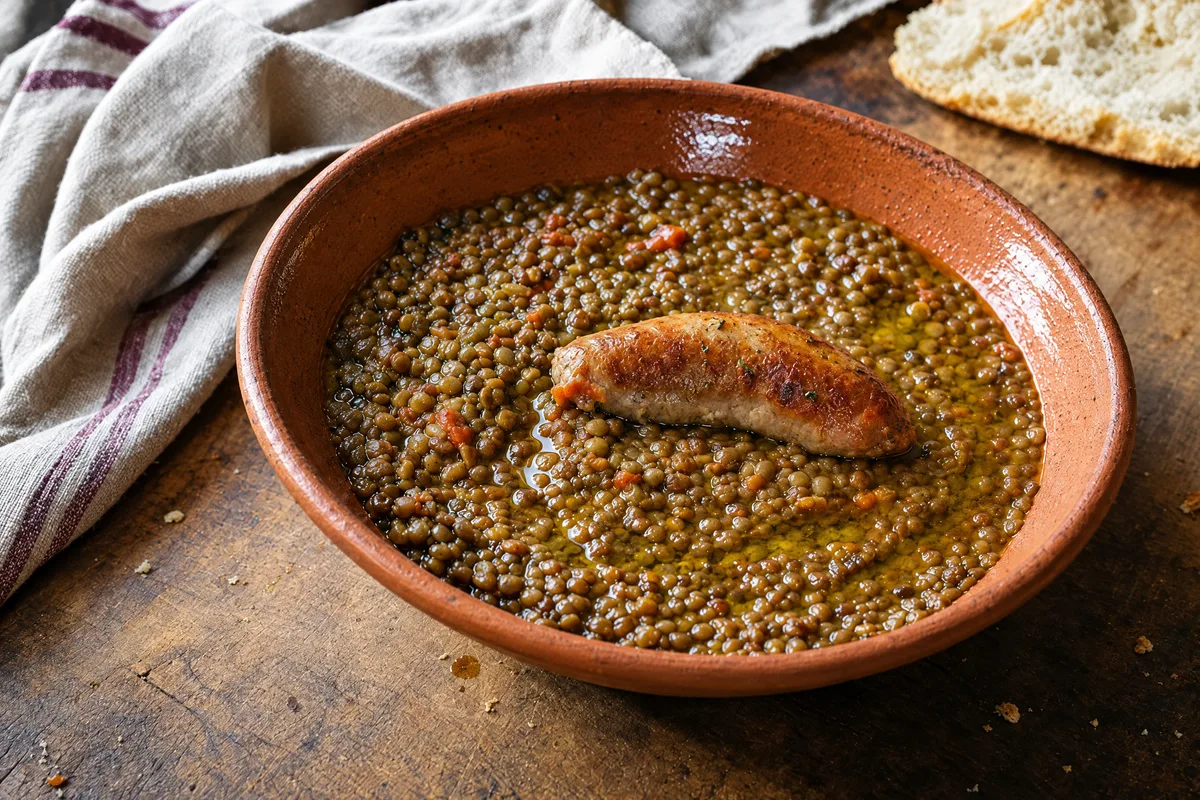
Panicale lies within the Colli del Trasimeno area of Umbria DOP extra virgin olive oil, which means the hills around the town are olive country. Regional food registers also record the lake's traditional fish, including eel, carp, tench, pike and perch, alongside Umbrian favourites such as torta al testo and umbricelli. They are regional traditions, but a good guide to what to look for.
More of Umbria
A letter from Italy, once a month.
The places, tables and makers we found worth your time. One email, no noise.
One letter a month. Unsubscribe at any time. We never share your address.