

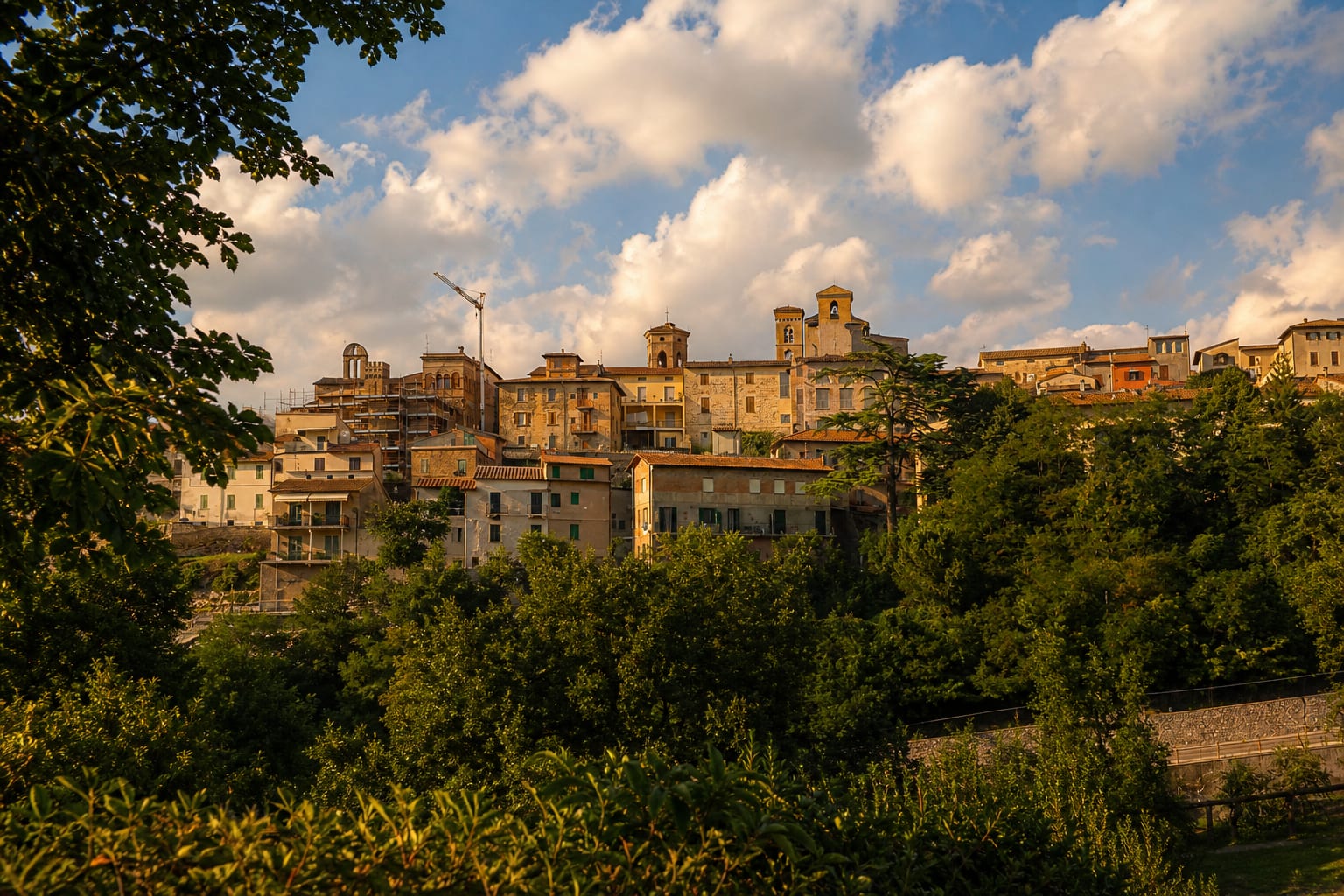
For more than five centuries Deruta has been Italy's capital of maiolica, the tin-glazed earthenware fired in its kilns and painted in cobalt, ochre, and copper green.
Workshops still line the old town, throwing and decorating by hand.
Deruta, the maiolica town of Umbria
Deruta is a comune in the Province of Perugia, and for centuries its name has been shorthand for painted Italian maiolica. Its fifteenth-century workshops added yellow, blue and orange to an older palette of copper green and manganese brown, and the town's finest pieces took on the shimmer of lustre.
The comune is more than its hilltop. The municipal statute defines it as the capoluogo plus six frazioni: Casalina, Castelleone, Pontenuovo, Ripabianca, San Nicolò di Celle and Sant'Angelo di Celle. Most of them have a part in Deruta's story, from a votive sanctuary to a natural-history gallery and a handful of village dishes.
Local tradition, as the Comune tells it, reads the name as the Latin diruta, "in ruins", and links it to Perugians who settled on this hill after Octavian burned their city in 40 BC during the war against Lucius Antonius. The hill was called Perugia Vecchia, "old Perugia".
The historic centre is entered through three gates: Porta Perugina, Porta Tuderte and Porta di San Michele Arcangelo. Come in through the last and you pass remains of the town walls and of old kilns, some already working in the sixteenth century, before Via Michelotti leads past the former church of San Michele Arcangelo and a polygonal fountain of 1848 into Piazza dei Consoli, the heart of Deruta.
A short history of Deruta maiolica
The earliest Deruta pottery, from roughly the twelfth to the fourteenth century, was made for daily use: jugs, basins and bowls decorated with geometric, floral and sometimes animal motifs in copper green and manganese brown. In the fifteenth century the new colours arrived and objects became decorative in their own right, painted with grotesques, flowering scrolls, crowns of thorns and the overlapping "petal back" pattern.
The most prized pieces used lustre, the iridescent metallic finish that made Deruta famous; the Comune names Giacomo Mancini and Francesco Urbini among its leading artists. Maiolica floors are another high point, and the Comune cites three: the church of San Francesco in Deruta, Santa Maria Maggiore in Spello and the sacristy of San Pietro in Perugia. Later centuries loosened the brushwork into the quick compendiario style and the calligrafico, a Moorish-inspired manner.
The museum describes the fifteenth and sixteenth centuries as the years when Deruta's potters and painters took a direct part in the Italian Renaissance, with around fifty kilns working in the sixteenth century. Deruta lustreware is held in more than a hundred museums around the world.
The trade later fell into deep crisis in the nineteenth century. By 1824 only three kilns were still firing, and the serious revival began in the 1890s at the Grazia kiln, with Ubaldo Grazia, Alpinolo Magnini, Enrico Pignatelli and Angelo Micheletti.
The Museo Regionale della Ceramica
The Museo Regionale della Ceramica began in 1898 as the Comune's "Museo per i lavoranti in maiolica", a museum for the town's working potters, and both the Comune and the museum call it Italy's oldest ceramics museum. In 1998 it moved from the town hall to the former Franciscan convent of San Francesco, and it holds more than 6,000 works.
The visit climbs from the ground floor through two upper floors, opening with a teaching section and then following Deruta maiolica period by period, from archaic wares to the twentieth century. Themed areas break up the chronology: a reconstructed old pharmacy (spezieria), maiolica floors, lustre and votive plaques. An archaeological section gathers Greek, Italiote, Etruscan and Roman pottery, and a contemporary section draws on the Multiplo d'Artista in Maiolica and the Premio Deruta.
What makes the museum unusual is its storage. A four-storey metal tower, linked to the convent on every level, holds the reserve collection in glass-fronted cases and is open to visitors, so the reserves stay in plain sight instead of being hidden away. The reserves include more Deruta work from the fourteenth to the twentieth century, Apulian pottery from the former Magnini collection and contemporary pieces from the Premio Deruta competitions of 1954 to 1972.
Beside the entrance halls sits a specialist library of more than 1,500 volumes on the history of ceramics, which also keeps the Fondo Magnini.
The San Salvatore kilns
The museum's most vivid room is underground. In 2008, work on a public car park inside the old walls uncovered a potters' quarter on the site where the church of San Salvatore stood until the early twentieth century. The excavation, completed in 2010, exposed structures ranging from the late thirteenth to the early eighteenth century and recovered a large quantity of maiolica, slip-decorated and sgraffito wares and glazed terracotta.
A stretch of late-thirteenth-century wall survives on the north side, with a brick room built against it that probably held clay and raw metals before becoming a dump for waste. Two kilns with well-preserved stoke-holes date from the late fourteenth to the early fifteenth century. The main workshop, active from the later fifteenth to the early eighteenth century, has two kilns at its centre, a basin for settling clay and the remains of a melting furnace. The smaller, square kiln sits higher than the round main one and was, in the museum's judgement, very probably the lustre kiln.
Since 2013 the site has been part of the museum visit, reached through an underground tunnel that runs from the kilns to the historic collections.
Piazza dei Consoli and the Pinacoteca
Piazza dei Consoli is overlooked by the fourteenth-century Palazzo dei Consoli, home to the town hall, with a tower lit by Romanesque mullioned windows. Roman and medieval archaeological finds are set out in its atrium.
Inside, the Pinacoteca Comunale forms the town's museum circuit together with the ceramics museum. Its headline works are Perugino's fresco of God the Father with Saints Romanus and Roch, dated 1476, which includes a view of Deruta and was brought here from San Francesco; two works by Niccolò di Liberatore, known as l'Alunno, the Madonna dei Consoli and the double-sided Gonfalone di Sant'Antonio Abate of about 1465 to 1470; and a Franciscan missal on parchment from the last quarter of the thirteenth century.
The upper floor shows the Lione Pascoli collection, about forty paintings that came to the Comune by donation in 1931. They are a textbook of Roman collecting in the late seventeenth and early eighteenth century, with canvases by Baciccio, Francesco Trevisani, Sebastiano Conca, Marco Benefial, Placido Costanzi and Giovanni Paolo Panini, among others.
San Francesco and Sant'Antonio Abate
San Francesco faces the town hall across the piazza. It may date back to 1008, when it almost certainly belonged to Benedictine monks as Santa Maria dei Consoli, and by the early fourteenth century it was dedicated to Saint Francis. It was reconsecrated in 1388 after an earthquake brought down the vault, given a Baroque makeover in 1652 and stripped back in 1908 and 1909, when a restoration led by the architect Dante Viviani of Arezzo uncovered the medieval and Renaissance layers. The Franciscans stayed until the 1860 suppression of religious houses.
Inside is a single nave under a timber roof, with fresco fragments along the walls. Look for a large fresco of 1390 showing Saint Catherine of Alexandria presenting the donor Tommaso di Orlando to the Virgin. Beneath it hangs a bell cast in 1228 for the canonization of Saint Francis, the oldest in the diocese of Perugia. Nearby, a lustred maiolica panel by Americo Lunghi, 1919, shows the same Saint Catherine, patron of ceramists. Outside, the fourteenth-century bell tower by the apse, with three tiers of paired windows, is a form rarely seen in Umbria.
Close by, Sant'Antonio Abate was built between 1361 and 1439, and its confraternity commissioned its art in the fifteenth and sixteenth centuries. In a niche, Bartolomeo Caporali's Madonna della Misericordia spreads her cloak over the people of Deruta against the arrows of plague, and the fresco includes a detailed view of the town. Behind the altar, Giovanni Battista Caporali painted scenes from the life of Saint Anthony around a terracotta statue of the saint, possibly by Perugino's pupil Giannicola di Paolo.
Ex-votos: Madonna del Bagno and Madonna delle Piagge
The Santuario della Madonna del Bagno, a small popular sanctuary beside a sulphur spring near Casalina, grew up in the seventeenth century. Its walls carry more than 700 maiolica votive tiles made by Deruta potters for the faithful who had received a grace. They show illnesses, accidents and misfortunes that ended well, and the Comune calls them an almost unique example and a key document of everyday life in the past.
The sanctuary's founding story is told as a legend. In 1643 a Franciscan friar found a small drinking cup on a path, painted inside with the Virgin and Child, and set it between the branches of a young oak; over the years it broke until only the painted fragment was left. In 1657 a merchant named Cristofano prayed before it for his dying wife and came home to find her healed. A tile dated 1657 inside the church records the event.
Closer to town, beside the Tiberina road and the Grazia maiolica works, the Madonna delle Piagge was built in 1601 by the magistrates of Deruta to protect a wayside shrine. Copies of seventeenth- and eighteenth-century maiolica ex-votos line its walls, and some of the originals are kept in the ceramics museum. A maiolica panel of the enthroned Madonna and Child by Americo Lunghi, painted in 1929, was set on the facade in 1952, and the name comes from the steep slope beside the church.
Antica Fornace Grazia and the living craft
Inside the historic centre, the Antica Fornace Grazia is one of the few old kilns in Deruta that survives intact. The Grazia family was making maiolica by the early sixteenth century, Bastiano Grazia bought this kiln building in 1769, and his heirs kept it working. In 1924 the family built a larger factory at the foot of the hill with a wood-fired kiln of the same design. The Comune has restored the old kiln as a museum and exhibition space.
The building shows how a traditional firing worked. Wood burned in the ground-floor combustion chamber, and square holes in its barrel vault let the heat rise into the chambers above, where the pieces were stacked on three further floors. Every opening was bricked up except a single brick-sized spyhole, through which the kiln master drew test pieces with iron tongs and, it is said, judged the temperature by the colour of the flame alone.
Deruta's craft also has legal standing. Italian Law 188 of 1990 protects artistic and traditional ceramics and quality ceramics through the CAT and CQ marks, and Deruta is one of the comuni the Consiglio Nazionale Ceramico recognises as a zone of established ceramic tradition. The marks belong to registered producers and their products, so look for them on the piece rather than assuming them from the town's name.
Casalina, Perugia Vecchia and the Deruta table
In Casalina, the Galleria di Storia Naturale occupies the former tobacco factory. It shows the ornithological collection of Orazio Antinori, about 800 specimens and one of the oldest natural-history collections in the region, and the collection of Monsignor Giulio Cicioni, more than 6,000 minerals, rocks, fossils, plants, animals and ethnographic objects gathered from around the world, which was long kept at the natural-science museum of Perugia's archiepiscopal seminary.
For walking, the hill of Perugia Vecchia rises beyond Castelleone on the border of Deruta, Torgiano and Bettona. Volunteers have cleared old cart tracks and hunters' paths into a network used for hiking, mountain biking and trail running, and one walk from Castelleone runs through woodland along a forest track to a small stream.
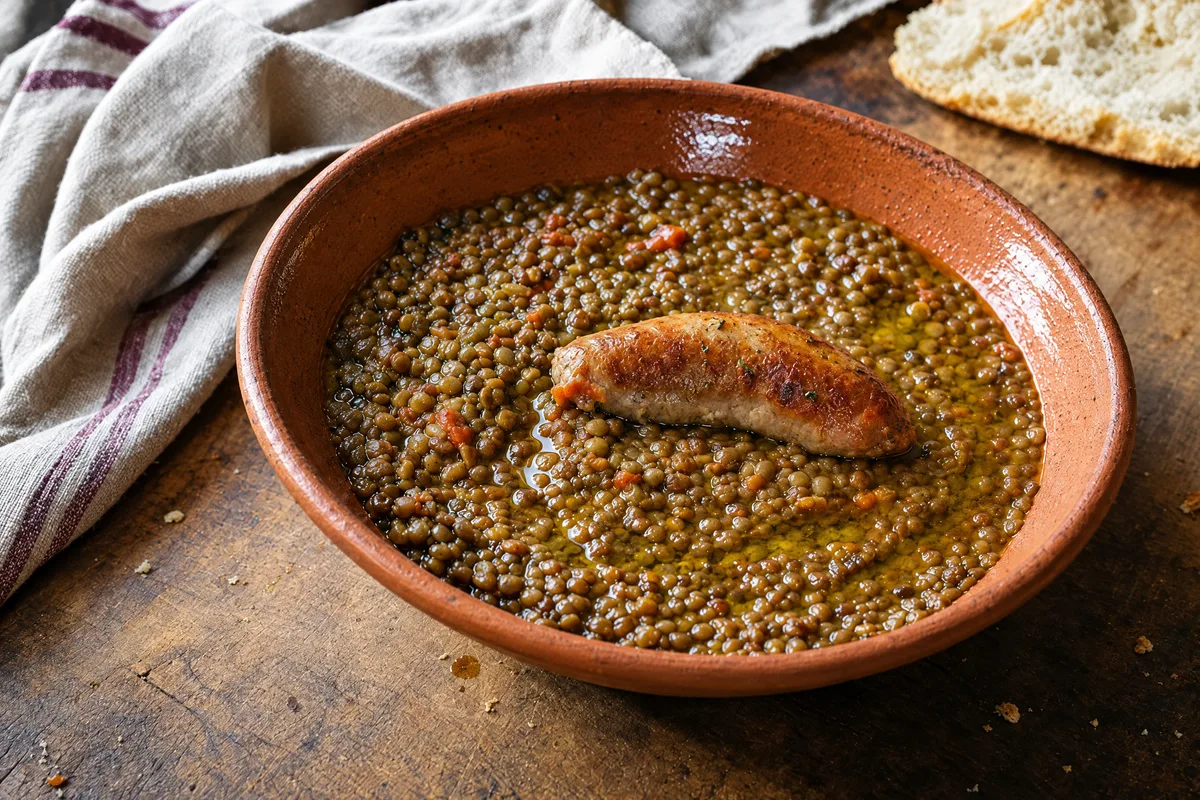
The frazioni also keep their own dishes. At the Castelleone sagra there is Cannibale, pork marinated and cooked with juniper, and at Sant'Angelo di Celle's Festa del Grano there are Birbanti, a short pasta of flour and water. San Nicolò di Celle is known for torta al testo filled with cured meats and greens, and Ripabianca for lamb coratella. Easter brings the Torta di Pasqua al formaggio made with Parmigiano, Pecorino Romano and Gruyère, and Christmas the Torciglione, an almond cake coiled like a serpent.
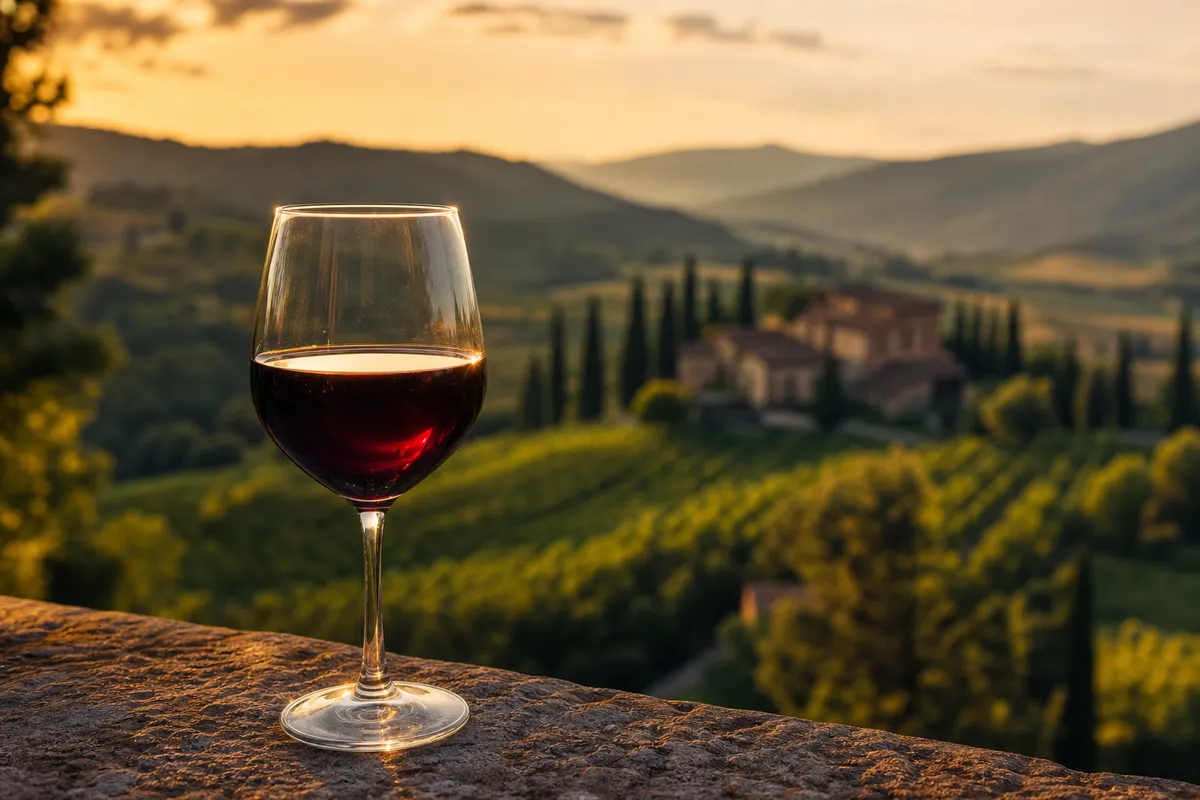
Parts of the comune fall within the Colli Martani and Colli Perugini wine denominations, and Umbria DOP olive oil includes a Colli Martani geographical mention.
More of Umbria
A letter from Italy, once a month.
The places, tables and makers we found worth your time. One email, no noise.
One letter a month. Unsubscribe at any time. We never share your address.