

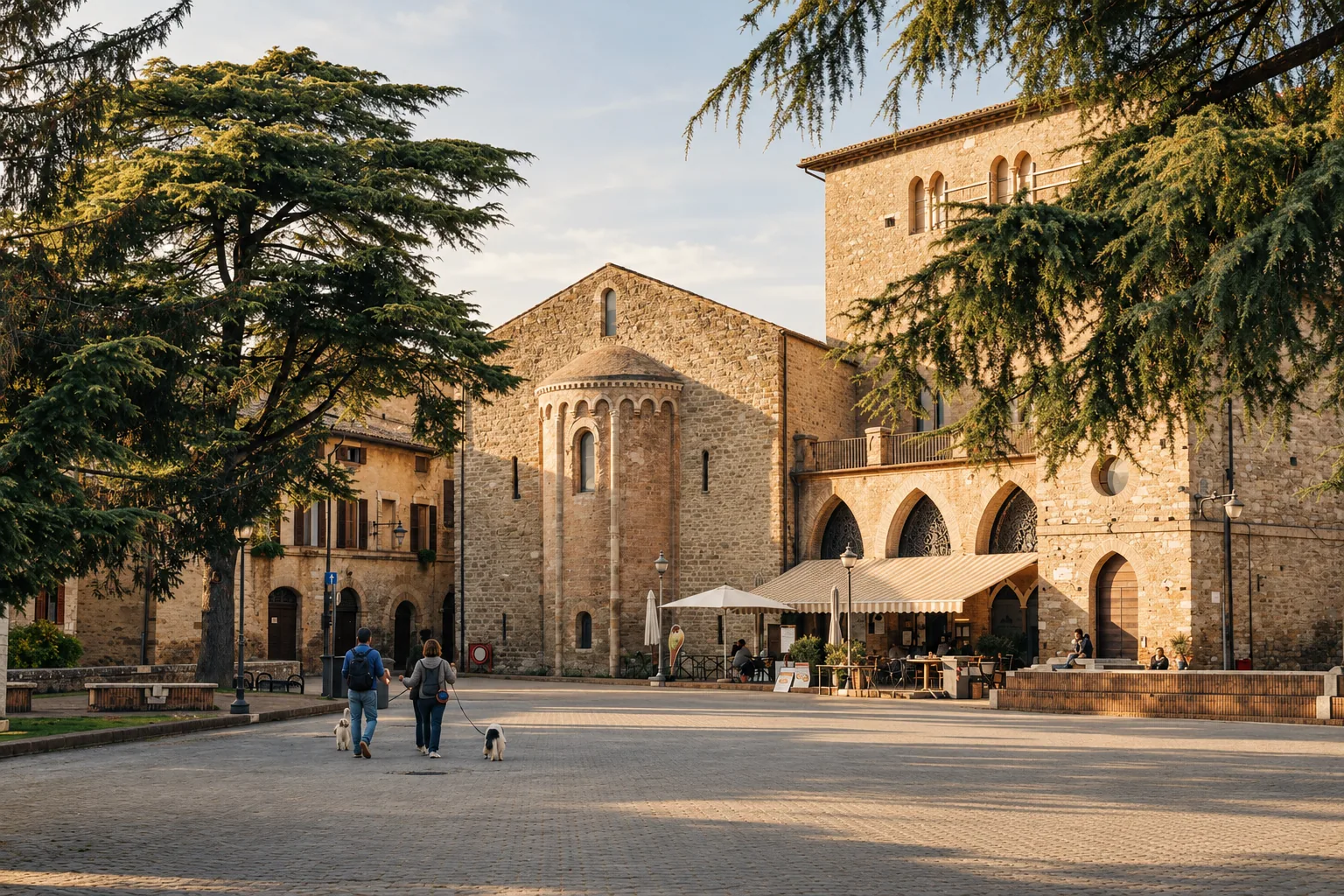
A flat-set medieval town on the old Via Flaminia, Bevagna keeps a near-intact circle of walls and a quiet stone piazza.
Each June its Mercato delle Gaite returns the streets to the Middle Ages, with craftsmen working in period workshops.
Bevagna at a glance
Bevagna lies on the floor of the Valle Umbra in the Province of Perugia, a walled town whose circuit of towers and bastions opens through medieval gates. Step inside and, despite later changes, the look is overwhelmingly medieval: narrow lanes lined with craft workshops, a run of fine monuments and, above all, a splendid main square.
The comune reaches well beyond the walls. Its 56 square kilometres take in the villages of Cantalupo, Castelbuono, Gaglioli, Limigiano and Torre del Colle, so the historic centre is only one part of the story.
Most of the territory is flat, rising in the southwest toward Monte delle Civitelle at 713 metres. Water shapes everything here. The Topino marks the boundary with Spello; near town the Clitunno joins the Teverone and becomes the Timia, while the Attone threads the valley to the west.
The tidy, well-drained plain you see today is the result of centuries of work. Reclaiming the marshy lowland began in 1456, showed real results in the second half of the sixteenth century and reached its lasting form in the 1700s and 1800s. From above, the plain reads as a patchwork of wheat, maize and tobacco, with vines for DOC wine and olive groves on the hills.
Mevania: Umbrian roots, Roman town
Soon after the Social War, around 90 BC, Mevania became a Roman municipium. The Via Flaminia, laid out in 220 BC, and traffic on the rivers kept it prosperous until the third century AD, when the branch of the Flaminia through Terni and Spoleto took over. Saint Vincent, a martyr of the early Christian era, is remembered as the first bishop and remains the town's patron.
Bevagna then passed to the Duchy of Spoleto and, from 774, to the Papal State. After the year 1000 it became a free comune governed by consuls, and through the long tug-of-war between Church and Empire it stayed broadly loyal to the Church until Italian unification.
Reading the Roman town in today's streets
The ancient plan is still easy to trace. The urban stretch of the Via Flaminia, today Corso Matteotti, was the decumanus maximus, while the cardo maximus ran along Piazza Garibaldi, Via Crescimbeni and Via Santa Margherita. The forum lay at the crossing known as the Trivio, and remains of many Roman buildings survive in the cellars of present-day houses.
The temple once faced the forum. It was a pseudoperipteral building whose cella still stands, and its surviving side and rear walls are faced in opus mixtum and dressed with half-columns and pilasters. It dates to the second century AD.
The theatre is the monument you sense rather than see. Houses built over its ruins follow its curve, and inside private homes long stretches survive of the two ambulacra, the vaulted corridors that carried the seating. The ambulacrum measures about 90 metres across.
Of the baths, three rooms remain, one floored with a refined black-and-white mosaic of sea creatures. Scholars date it to the early second century, the age of Hadrian.
Walls, gates and the Clitunno mills
The medieval walls largely sit on the Roman ones and run a complete circuit of about 1,700 metres, and walking them is one of the nicest ways to understand the town. Porta Foligno, once Porta San Vincenzo, is where the Via Flaminia leaves. Porta Cannara, once Porta San Giovanni, is the best preserved: a stout tower with arrow slits and coats of arms outside and an eighteenth-century painted sundial on its inner face.
Porta Molini is small but full of charm, with a crenellated walkway and machicolations; the arms of Pope Innocent VIII date it to around 1484. Stretches of Roman wall in small squared blocks show along this side, and a basin on the Clitunno has long powered the mill and fed the public washhouse.
Piazza Silvestri
The heart of town is Piazza Filippo Silvestri, laid out in the twelfth and thirteenth centuries. Its civic palace and churches stand at deliberately uneven angles to one another, a set piece that captures the balance between communal and church power.
Palazzo dei Consoli went up in 1270 as the seat of town government. Its travertine and sandstone front carries two tiers of Gothic twin windows over a broad cross-vaulted loggia, and an external stair climbs to the upper floor. Since 1886 that floor has held the Teatro Francesco Torti, decorated by Domenico Bruschi and Mariano Piervittori and one of the smallest theatres in Umbria.
San Silvestro, the oldest church on the square, was built in 1195 by Maestro Binello, as the inscription beside the door records. It was never finished, which is why it has no bell tower, and its facade is travertine below and white and pink stone above. Take a moment with the portal frieze: a mountain stands for Christ, four streams for the Gospels, the vine and animals for the Church and the faithful, and a dragon for the devil. Inside, Corinthian columns divide three naves, and the presbytery rises over the crypt.
Across the square, San Michele was built a few years later by Binello together with Rodolfo, its portal framed by capitals and three orders of friezes. It also has three naves and a presbytery raised over a large crypt, and it keeps a fifteenth-century Crucifix with wooden figures of the Madonna, Mary Magdalene and Saint John attributed to Providoni, a silver statue of Saint Vincent made by Peter Ramoser in 1785 and the saint's processional image of 1638.
The third church, Santi Domenico e Giacomo, rose in 1291 on an oratory the Comune gave to the Blessed Giacomo Bianconi in thanks for rebuilding Bevagna after the siege by Frederick II. Its single nave has eighteenth-century altars with scagliola frontals and paintings by the local artist Ascensidonio Spacca, known as il Fantino, along with a fourteenth-century fresco cycle and late thirteenth-century wooden sculptures of the Madonna and Child and a Crucifix. Giovan Battista Pacetti painted the cloister with scenes from the Blessed's life.
Palazzo Lepri, the museum and San Francesco
On Corso Matteotti stands the town hall, the former Palazzo Lepri, designed by the architect Andrea Vici at the end of the eighteenth century and home to the municipal archive and library. Roman friezes, capitals, inscriptions and the remains of a colossal statue line its staircase. The picture gallery includes il Fantino's painted wooden chest of the Blessed Giacomo Bianconi from 1589, Dono Doni's Madonna and Child and Corrado Giaquinto's Holy Family, and a corridor holds the diplomas and honours of the Bevagna-born entomologist Filippo Silvestri.
The Museo di Bevagna opened in the palazzo on 30 March 1996. It is arranged in three sections: archaeology from the archaic, Republican and imperial periods; medieval parchment documents; and paintings from the sixteenth to eighteenth centuries gathered from the town's many churches, by Dono Doni, Corrado Giaquinto, Joseph Esperlin and the Bevagna painters Andrea Camassei and Ascensidonio Spacca.
San Francesco crowns the highest point of town. It was built at the end of the thirteenth century over an older church of San Giovanni Battista, on the spot where a Roman temple once stood. Behind the gabled front and its many-shafted round-arched portal, the single nave was remodelled in the eighteenth century and holds paintings by Dono Doni and Spacca. Beside the altar is the stone on which Saint Francis is said to have stood to preach to the birds at Pian d'Arca, and the second chapel on the right, perhaps by Galeazzo Alessi, has a small dome of glazed terracottas attributed to Santi Buglioni.
Villages, sanctuaries and the Aiso
The hills around Bevagna are crowned with castles raised around the year 1000 to defend its territory, and with sanctuaries. Across the Timia from Porta Todi, the Madonna delle Grazie, begun in 1583 to a design by Martelli, holds paintings attributed to il Fantino and a venerated image over the high altar. Higher up, among chestnut and oak woods, the Madonna della Valle is ancient in origin but was entirely rebuilt in 1934.
Gaglioli is a fortified village still ringed by walls and guarded by a mighty tower, looking over the Attone valley. Torre del Colle, once Torre San Lorenzo and a fief of the counts of Antignano, is entered through a pointed sandstone arch. The Attone's waters were prized for treating the famous tele di Bevagna, the town's cloth, and inspired an eighteenth-century essay by the lawyer Alessandro Aleandri. Castelbuono was a free comune in the Middle Ages, and Limigiano, documented since 1058, looks out toward Collemancio and the remains of ancient Urvinum Hortense.
Near the Limigiano turn, a wayside shrine at Pian d'Arca marks where Saint Francis preached to the birds. Heading back toward town, the convent of the Annunziata, founded by the monks of Sassovivo, keeps a glazed terracotta altarpiece attributed to Santi Buglioni.
Close by lies the Aiso, or Abisso, a small round spring-fed lake of cold, deep water. It is a karst resurgence like the Fonti del Clitunno and a Site of Community Importance. A votive bronze of an Umbrian warrior from the fifth or fourth century BC, since lost, was found on its shore in 1774. Local legend says the farmer Chiarò sank here with his house for threshing grain on Saint Anne's Day, 26 July.
Mercato delle Gaite
Bevagna's great festival grew out of a Sagra della Porchetta that the Pro Loco started in the early 1970s. A medieval market was added in 1983, and the Associazione Mercato delle Gaite was formally founded on 26 April 1989. The name comes from the Lombard word waita, a division of the town into zones. The festival recreates Bevagna between 1250 and 1350, drawing on the town's statute, written down in the sixteenth century but largely made of fourteenth-century rules.
It fills the last ten days of June with a contest among the four gaite: San Giorgio, San Giovanni, Santa Maria and San Pietro. They compete in crafts, cooking, the market and archery. Juries of university experts judge the first three, and the archery, usually staged in Piazza Silvestri, closes the festival before the Palio is awarded.
The crafts are the real showstopper. Working from old texts, the gaite have rebuilt machines such as a human-powered twisting frame and a water-driven multi-hammer mill, and revived trades from bell founding, coin striking and glassblowing to dyeing, rag-paper making and silk and hemp working. The Gaita San Giovanni recreates a mill for carta bambagina, and the Circuito culturale dei mestieri medievali gathers four permanent reconstructions where the trades are shown from raw material to finished piece.
Sagrantino country and olive oil
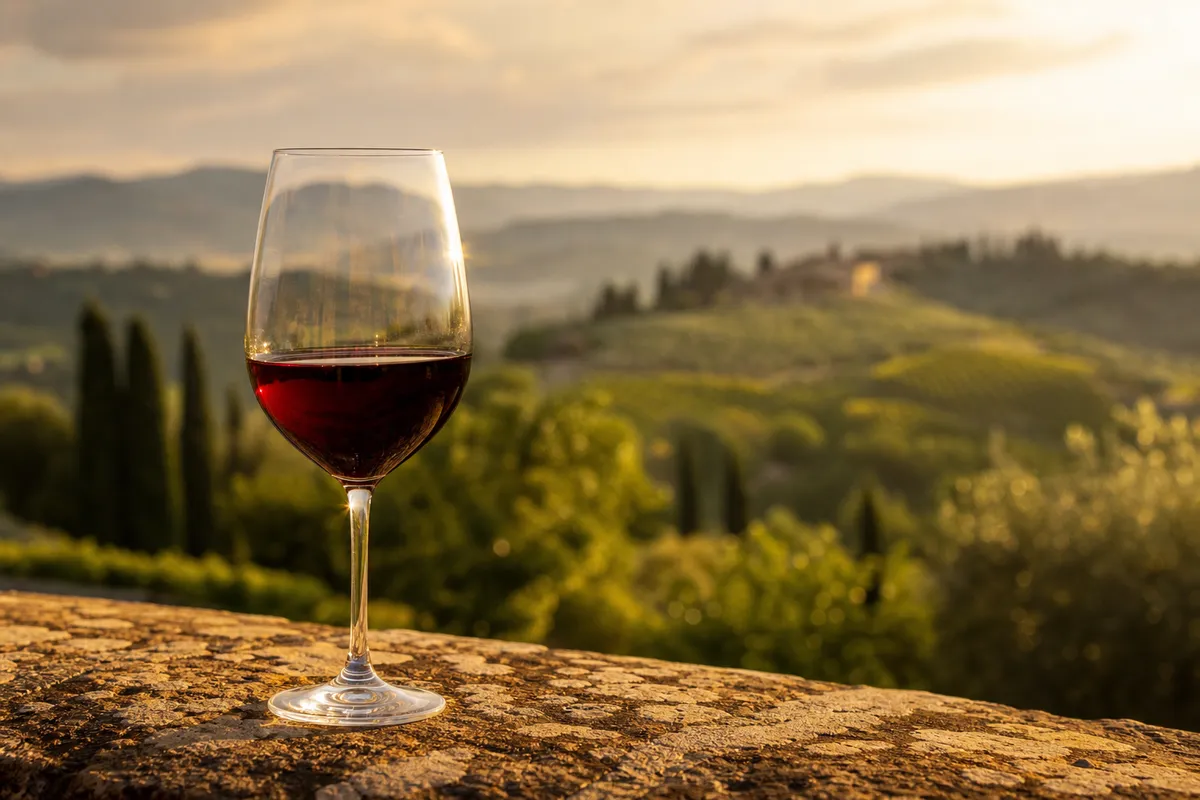
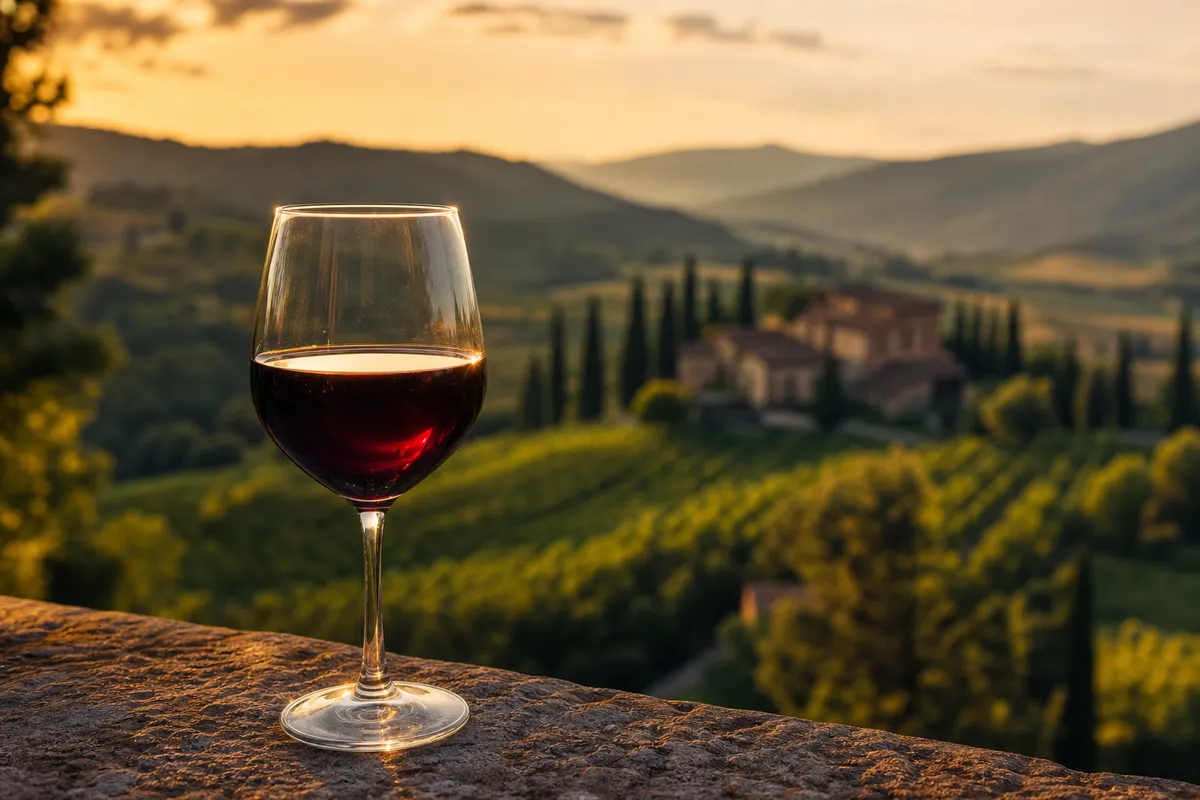
Bevagna is Sagrantino country. Delimited parts of its territory fall within the zone of Montefalco Sagrantino DOCG, made from 100 percent Sagrantino in two styles, the dry Secco and the sweet Passito.
Delimited areas also belong to the separate Montefalco DOC, with its own Bianco, Grechetto, Rosso and Rosso Riserva styles.
For olive oil, Bevagna lies within the Umbria DOP with the geographical mention Colli Martani, so look for that wording on the label when you want certified oil from these hills.
More of Umbria
A letter from Italy, once a month.
The places, tables and makers we found worth your time. One email, no noise.
One letter a month. Unsubscribe at any time. We never share your address.