

A young municipality with a much older landscape
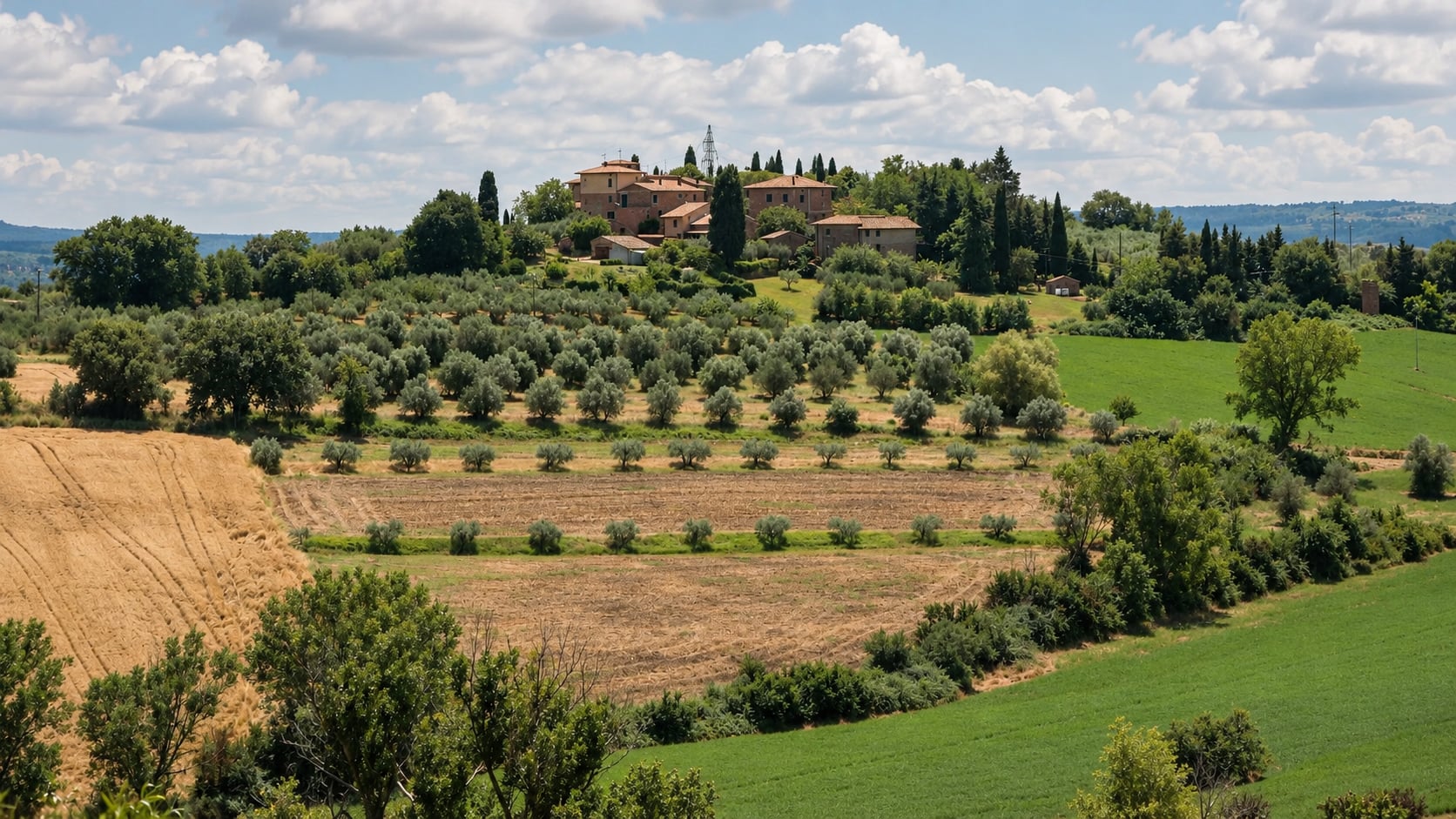
The municipality itself is unusually young. Regional Law 20 of 2 April 1975 created it from five former Montecastrilli frazioni, Avigliano Umbro, Toscolano, Dunarobba, Sismano and Santa Restituta, following a consultative referendum on 27 October 1974. Besides the capoluogo, SIUSA names four frazioni: Dunarobba, Sismano, Santa Restituta and Toscolano.
Istat counts ten localities in the municipality: five centres, three nuclei, one productive locality and one scattered-houses group. Together they show a municipality of small clusters set among hills and woods.
Dunarobba is preserved wood, not a stone forest
The Foresta Fossile di Dunarobba is the municipality's defining scientific site, but its most familiar shorthand can be misleading. The upright trunks are not a uniform forest of wood converted to stone. The dominant preservation is mummified fossil wood that keeps its organic structure, though some specimens are partly mineralized. The trees still stand rooted in growth position within fine lake sediments, and about forty of them remain visible, dating to about 3 to 2 million years ago.
The trunks came to light towards the end of the 1970s inside a clay quarry worked for brick-making. The forest grew in a climate significantly warmer than today's and was buried gradually in a marshy area on the banks of a broad lake basin that was slowly subsiding, which left the wood almost entirely intact. The Soprintendenza then began documentation and protection work, and the Centro di Paleontologia Vegetale was created at the end of the 1990s to explain the ancient environment through specimens, panels and models. The Comune calls the site a natural monument unique in the world and of great scientific importance.
The fossil site is a fossil-bearing deposit, listed as a geosite, whose exposed area is visited on a guided route, and a small palaeontological museum sits alongside the Centro di Paleontologia Vegetale.
In the Pliocene, about two and a half million years ago, vast bodies of stagnant water stretched from Città di Castello to Spoleto and the Terni basin and formed Lake Tiberino. The Dunarobba forest, presumably close to the lake, was hit by heavy flooding that buried the trunks bit by bit, first at the base and then completely, under ten metres of clayey mud. The waterproof consistency of the clay then preserved the wood for millions of years, a sort of palaeontological Pompeii, and recent studies attribute the trunks to a species of the Taxodiaceae family.
Conserving the trunks
Because the wood is largely organic rather than stone, Dunarobba is an active conservation site. CNR research tested the natural durability of the fossil wood against fungal and insect attack in a laboratory study in 2003, and has used 3D digital scanning since 2007 to track how the trunks deform as the climate changes around them. Today the Soprintendenza, ISCR and CNR-IBE cooperate on monitoring, experimentation, maintenance and restoration, and work on individual trunks is targeted rather than a treatment of the whole forest.
Planning a Dunarobba visit
A visit combines the Centro di Paleontologia Vegetale, which stands at Voc. Pennicchia 46 in Dunarobba and from which the guided visits depart, with its exhibits, panels and models, and the outdoor route to the exposed trunks. Days, times and booking arrangements are best confirmed with the operator before you set out.
Geosite and protected area
The 2024 regional geosite sheets list Dunarobba as entry 20, in Avigliano Umbro, for its palaeontological and geological interest.
The former fossil-forest Natura 2000 site, IT5220009, was merged into the ZSC IT5220012, called Boschi di Farneta (Monte Castrilli), which covers 769 hectares across Avigliano Umbro and Montecastrilli and was designated a Special Area of Conservation in August 2014.
The capoluogo: history, theatre and parish church
The Comune's account suggests that Avigliano began as a Roman military encampment, which would explain its regular street grid, on a territory crossed by the ancient Via Amerina. The earliest written mention dates to 1074, when a bishop of Todi consecrated the altar of the church of Santa Maria in Foris. A Farfa Abbey register of 1112 places Avigliano in the territory of Todi, and Todi's army destroyed it in 1237, rebuilt its walls about two centuries later and in 1294 built the nearby Castel dell'Aquila to control the area.
A medieval cylindrical tower with decorative windows and short stretches of the defensive walls still stand in the town, and the crenellated water tower with a clock, a familiar landmark, was built in 1948.
The Teatro comunale has a rich history. A group of 118 members of the Volontà ed Azione circle built it specifically as a theatre, and it opened on 9 September 1928. It was conceived as a complete theatre, with an entrance hall, stalls, a gallery and a stage equipped for scenery, and its facade carries terracotta medallions, bas-reliefs and door and window frames in Liberty style. The circle donated the building, in Via Roma, to the municipality in 1978.
The Santissima Trinità is the town's parish church. The present church, on Piazza Don Giuliano Pazzaglia, was built between 1605 and 1639 and consecrated in 1728; the Italian Bishops' Conference census notes earlier structures on the site between 1074 and 1112 and in 1467, and a complete restructuring in 1938-1941.
The church of Santa Maria delle Grazie in Via delle Campane, Avigliano, began as a shrine in the fifteenth and sixteenth centuries, was completed as a building in 1563 and was enlarged in the seventeenth century. Sant'Egidio, in Via Sant'Egidio, dates from the twelfth and thirteenth centuries and was comprehensively restored between 1987 and 1992.
The frazioni and their churches
The church of Sant'Andrea Corsini at Sismano, a subsidiary of the parish of Santi Vittorina e Andrea Corsini, was built between 1640 and 1643 in the borgo below the castle; its baptismal font is documented in 1674, and the church was restored in 1946 and again in 1985.
The church of Sant'Apollinare at Toscolano has medieval origins and was renovated throughout in the seventeenth century, and at Santa Restituta the church dates from the sixteenth and seventeenth centuries, was consecrated in 1627, received its portal in 1650 and was restored in 1929 and again in 2012. At Dunarobba the church of the Madonna delle Grazie began as a small shrine in the seventeenth century and became a complete building in the eighteenth, while the parish church of San Giuseppe Lavoratore was built in 1961-1962.
Santa Restituta has a body of its own: the Dominio collettivo di Santa Restituta, an active public territorial body with a long history of collective land rights.
Grotta Bella
Grotta Bella opens on the north-eastern side of Monte l'Aiola, roughly 2 kilometres south-east of Santa Restituta. Specialist research describes a fenced entrance, a large collapse chamber, secondary passages, abrupt level changes and fully dark interior sectors.
The cave's importance comes from a discontinuous human story extending for roughly six millennia, and a project in 2019-2021 reopened systematic speleo-archaeological documentation after a long gap.
The Soprintendenza's excavations of 1970-72 showed that the cave was used from the Neolithic (5000-3000 BC) to the Final Bronze Age (1200-1000 BC). After a gap of four centuries, from the end of the sixth century BC to the beginning of the first, it became a place of worship, as the votive deposit in its upper layers shows. The oldest offerings are mostly bronzes of human figures, male and female, along with bronzes of Mars charging with shield and spear, bronzes of animals, chiefly sheep and cattle, and a terracotta model of a temple derived from Etruscan-Latial examples. Black-glaze pottery, bronzes of worshippers and Roman Republican coins show worship at its height in the third century BC, and the cave was abandoned, like every Umbrian sanctuary, at the time of the Social War of 90-89 BC.
Olive oil from the Colli Amerini
The Umbria DOP extra virgin olive-oil specification includes Avigliano in the Colli Amerini production area, which gives the municipality a territorial link to a protected oil.
More of Umbria

A letter from Italy, once a month.
The places, tables and makers we found worth your time. One email, no noise.
One letter a month. Unsubscribe at any time. We never share your address.