In this article
Christmas in Italy is not a day. It is a month, give or take, that opens on 8 December with the Immacolata and closes on 6 January with the Befana, and in between it moves through markets, a meatless Christmas Eve, a lunch that runs into the evening and a run of feast days most of the world doesn’t celebrate. Here is how the season unfolds, and where to go to see it at its best.
When Christmas starts and ends in Italy
The season opens on 8 December, the Feast of the Immaculate Conception, a national holiday and the day many Italian families put up the tree and set out the presepe. It closes on 6 January, Epiphany, when the Befana comes. Italians have a line for it: l’Epifania tutte le feste porta via, Epiphany carries all the holidays away.
In between sit Christmas Eve, Christmas Day, Santo Stefano on 26 December, New Year’s Eve and New Year’s Day, and, depending on the region, Santa Lucia on 13 December or San Nicolò on 6 December. Another saying covers the etiquette: Natale con i tuoi, Capodanno con chi vuoi, Christmas with your family, New Year with whoever you like.
The Christmas markets
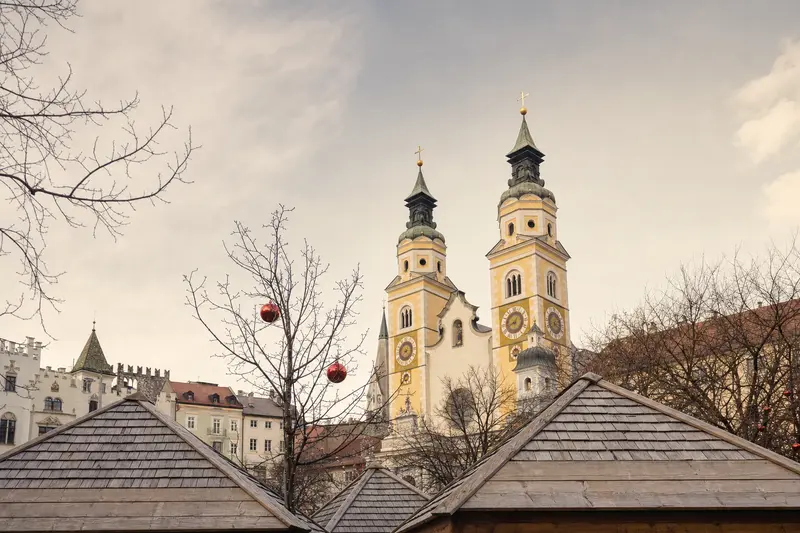
Italy’s market tradition is strongest in the Alps. In Alto Adige and Trentino, where German and Italian are both spoken, the markets follow the Christkindlmarkt pattern: wooden huts in the main square, carved ornaments, wool, speck and mountain cheese, and mulled wine you drink standing up in the cold. Bolzano, Merano, Bressanone and Trento are the classics, and smaller towns like Bruneck and Levico Terme are worth the train ride.
Further south the tradition changes shape. In Naples, Via San Gregorio Armeno is less a market than a street of workshops making nativity figures by hand, open most of the year and at full tilt in December. In the hills above Pesaro, the village of Candelara switches off its electric lights twice an evening and runs on candles alone.
Our list of the Christmas markets of Italy has the ones worth planning a trip around, with this season’s dates.
The presepe comes before the tree
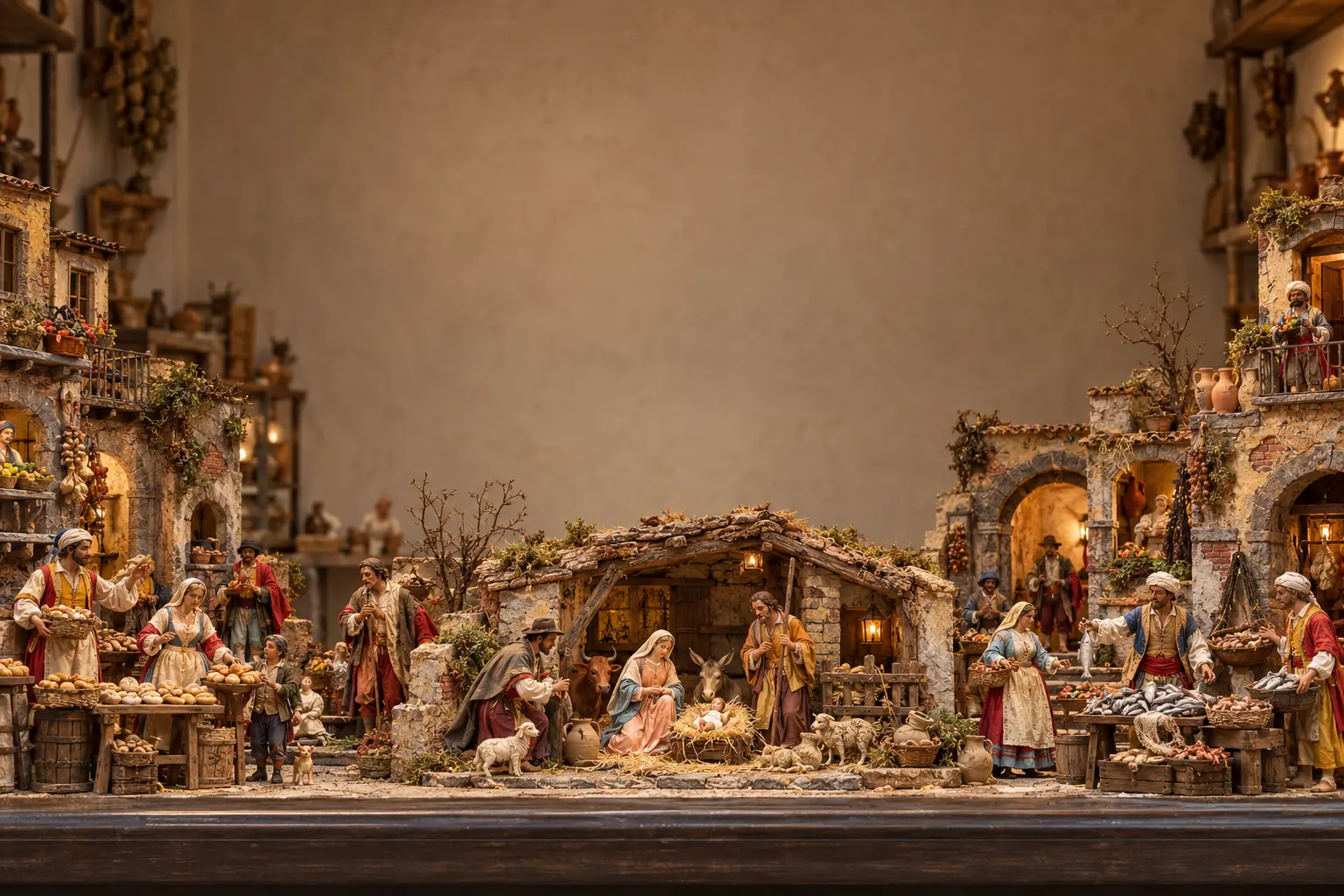
The nativity scene, the presepe, is the heart of an Italian Christmas, older and more beloved than the tree. Tradition traces it to Francis of Assisi, who staged a living nativity in a cave at Greccio, in the hills of Lazio, on Christmas Eve 1223. Greccio still reenacts it, and living nativities now fill towns across the south, most famously in the caves of Matera.
At home, the presepe grows through December. The stable goes up on 8 December, figures arrive over the weeks, and the baby Jesus is placed in the manger only at midnight on Christmas Eve. The Magi travel slowly across the sideboard and reach the stable on 6 January. In Naples the presepe became an art form in the eighteenth century, with whole villages of bakers, fishmongers and tavern keepers crowded around the Holy Family, and families still add a new figure each year.
La Vigilia: the meatless Christmas Eve
Christmas Eve, la Vigilia, is traditionally a meatless meal, di magro, and in much of Italy that means fish. In Rome and Naples the table might carry fried baccalà, spaghetti alle vongole and, in Naples, capitone, the large eel of the Christmas Eve table. In the Veneto it is baccalà mantecato on grilled polenta; in Sicily, pasta con le sarde and an orange salad. Northern families who don’t lean on fish keep the meal light in other ways: Mantua serves pumpkin tortelli.
Italian Americans call this the Feast of the Seven Fishes. In Italy you won’t hear that name, and there is no set number of dishes. It is simply the cena della Vigilia, and the count depends on the family and the region. Many families go on to midnight Mass, and in some homes the presents are opened when they get back.
Christmas Day: the long lunch
Christmas Day belongs to lunch, il pranzo di Natale, and it lasts. The north opens with pasta in broth: tortellini in brodo in Bologna, cappelletti in Romagna and the Marche, agnolotti in Piedmont, all in a broth made from capon. After that might come bollito misto with mustards and sauces, or a roast. Many families time the meal around the Pope’s blessing Urbi et Orbi, broadcast from St Peter’s at noon.
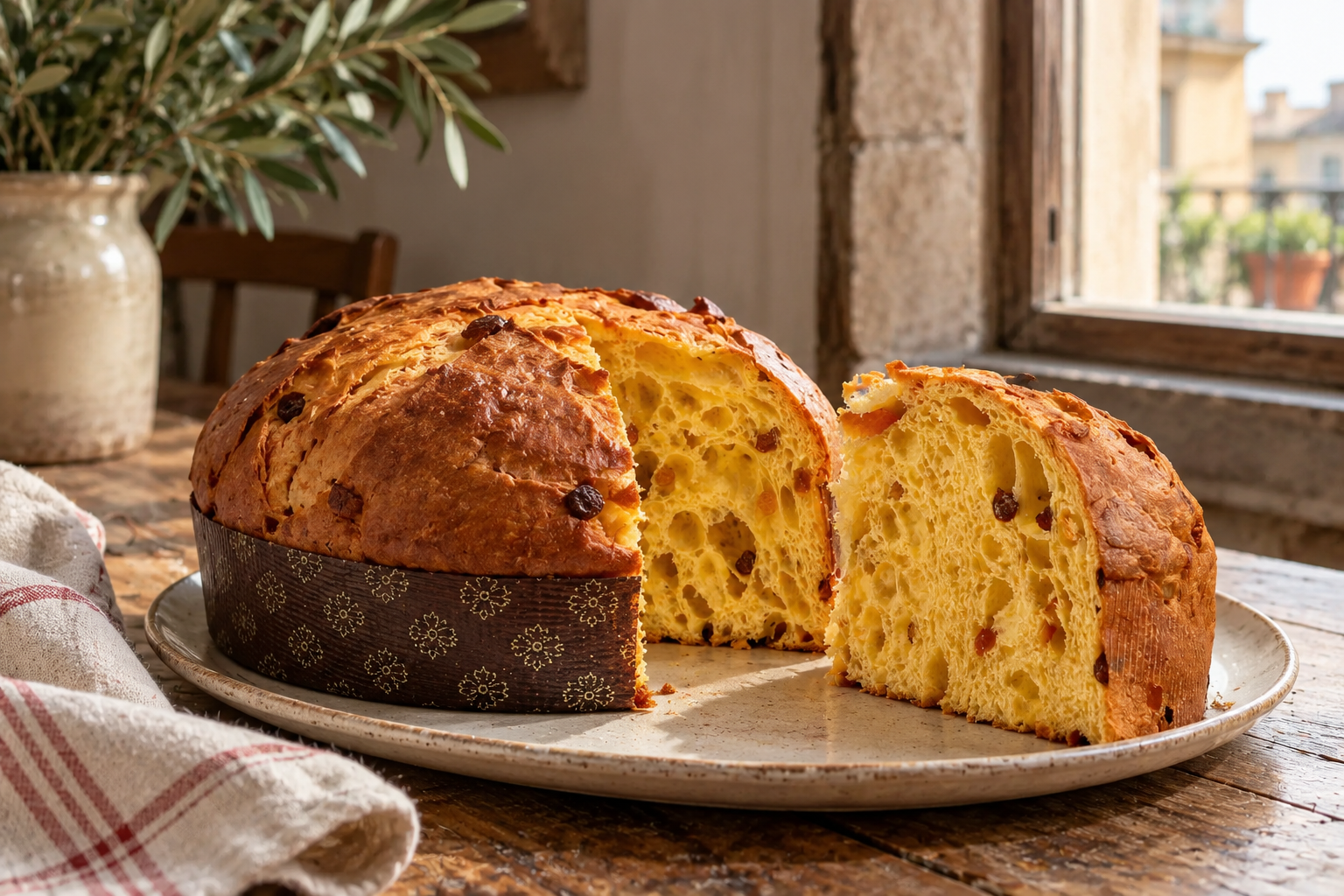
The cake is a matter of loyalty. Milan’s panettone, tall and studded with candied fruit and raisins, faces Verona’s pandoro, star-shaped and dusted with icing sugar. Most homes have both, with a bottle of spumante to go round.
Santo Stefano and the games at the table
26 December, Santo Stefano, is a public holiday in Italy, a day for visiting relatives and finishing what is left from the day before. The holidays are also the season of tombola, a family game like bingo played with cards and a basket of numbered tokens. In Naples every number has a meaning from la smorfia, the old Neapolitan book of dreams, and the caller announces them by their nicknames rather than their numbers, which is half the fun.
Who brings the presents
Babbo Natale, Father Christmas, now brings gifts to most Italian children on the night of the 24th, but he arrived late and he shares the work. In older Catholic households it was Gesù Bambino, the Christ Child. In Bergamo, Brescia, Verona, Cremona and Lodi, Santa Lucia brings presents on the night of 12 December, riding a donkey. In Trieste and in South Tyrol it is San Nicolò on 6 December, and in South Tyrol he arrives with the Krampus, horned figures in fur masks who chase the crowd through the streets.
And on the night of 5 January comes the Befana.
The Befana and Epiphany
The Befana is an old woman on a broomstick who fills children’s stockings on the night before Epiphany: sweets for the good, coal for the bad, though the coal is usually black sugar. Her name comes from epifania, worn down over the centuries, and the most-told legend says she turned down the Magi when they invited her to Bethlehem, then set out after them too late and has been searching ever since, leaving gifts at every house.
Rome celebrates her with a fair in Piazza Navona. Urbania, in the Marche, holds a national Befana festival. In Venice, veteran rowers of the Bucintoro club dress as Befane and race down the Grand Canal to the Rialto, where a giant stocking hangs from the bridge.
The zampognari
In the days before Christmas, in Rome, Naples and the towns of the south, you may hear bagpipes in the street. The zampognari are shepherds and musicians from the mountains of Abruzzo, Molise and Lazio, in sheepskin vests and leather sandals, who play the zampogna and a reed pipe, the ciaramella. They play outside churches and in front of shrines, often Tu scendi dalle stelle, the Christmas hymn that Saint Alphonsus Liguori wrote in 1754 and that every Italian can still sing.
New Year’s Eve and the lentils
Capodanno is for friends, fireworks and a late dinner, the cenone. At midnight, Italians eat lentils, small round coins that promise money in the year ahead, usually with cotechino or zampone, the pork sausages of Modena. Red underwear is supposed to bring luck, and the spumante comes out again. In Naples the fireworks go on long after midnight, and the old custom of throwing broken things out of the window lives on mostly in stories.
The Christmas sweets, region by region
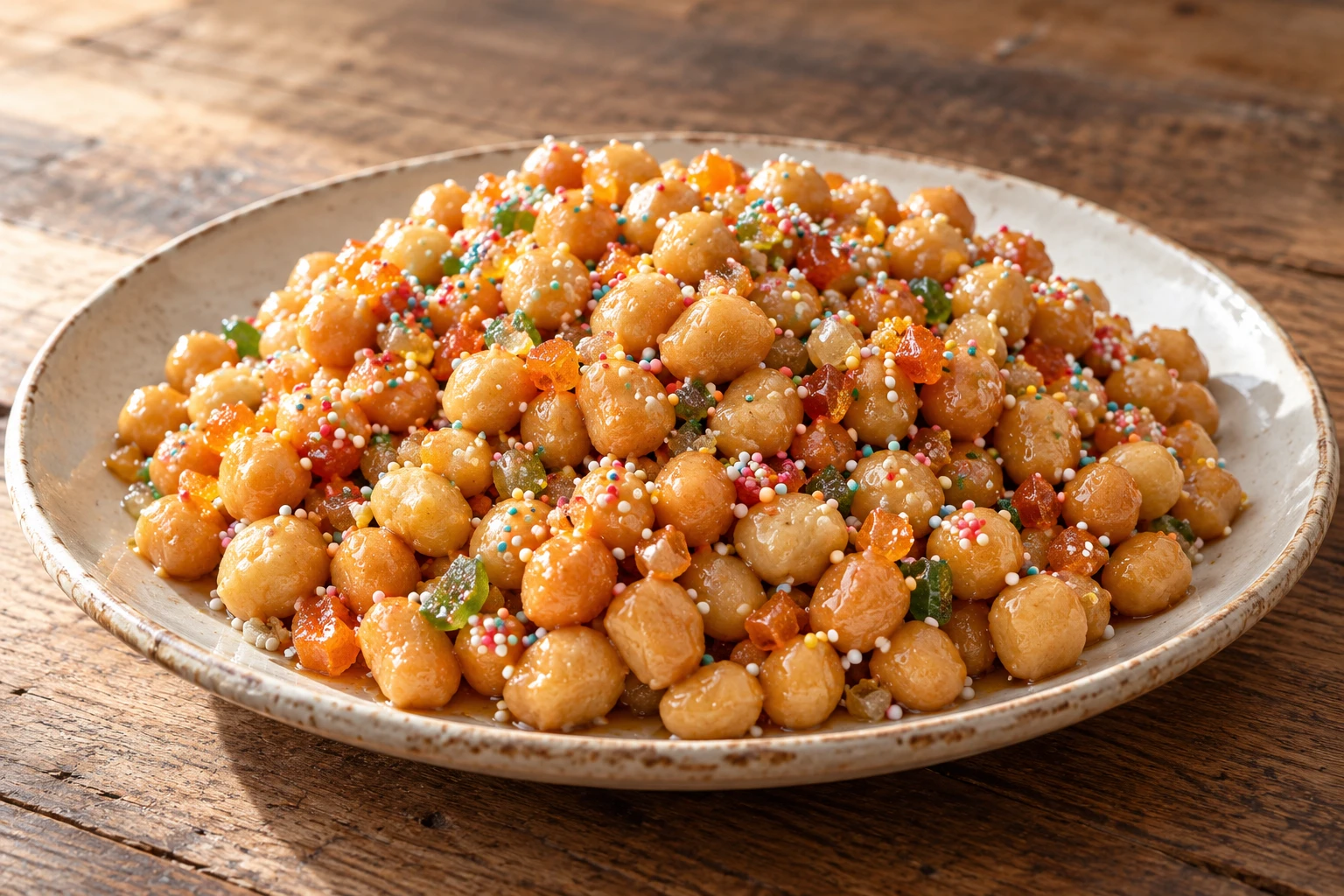
Every region has its own Christmas sweets, and many are made only once a year. Siena has panforte and ricciarelli. Naples has struffoli, honeyed dough pearls piled into a wreath, alongside roccocò and mostaccioli. Puglia makes cartellate, fried pastry roses soaked in vincotto. Sicily has buccellato, a ring of pastry filled with figs and nuts. Genoa has pandolce, Trentino has zelten, and Cremona and Benevento argue over torrone. Ask in any bakery in December what they make only at Christmas, and you will usually go home with something you have never seen before.
Travelling in Italy over Christmas
A few dates shape every trip. 8 December, 25 and 26 December, 1 January and 6 January are public holidays, and on 25 December most museums, shops and markets close. On 24 December shops close early and many restaurants serve only a set Vigilia menu, if they open at all. Italians travel for the long weekend around 8 December and again between Christmas and Epiphany, so book trains and mountain hotels early for both.
The reward is a country lit up for a month, with the best of it in the places Italians themselves go: the Alpine markets, the presepe workshops of Naples, a candlelit village in the Marche and, at the end, a witch on a broomstick.