

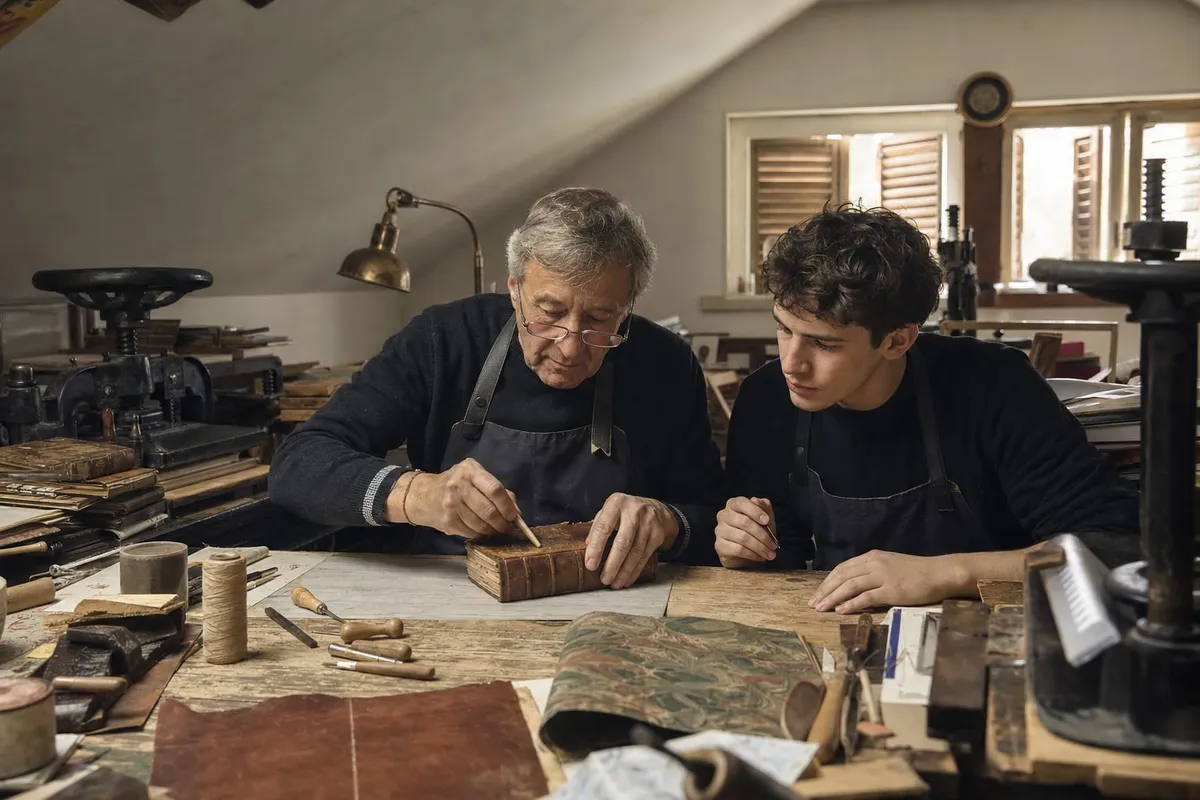
Via dei Fossi runs from Piazza Santa Maria Novella down toward the Arno, narrow enough that a delivery van has to fold its mirrors to pass, and for generations it has been a street of antique dealers, framers and restorers. Florence’s hand-bookbinders, the legatori, keep workshops in this part of the city and across the river in the Oltrarno, around Santo Spirito and San Frediano, often in a single long room: wooden benches, a cast-iron standing press, a wall of wooden-handled tools ranged by length. A legatoria has a smell of its own. Beeswax, animal glue warming on a low flame, vegetable-tanned calfskin, and paper dust that catches the afternoon light when the shutters open.
The apprenticeship is long, measured in years rather than months, and the order in which the work is handed over is almost a ritual. First the sweeping and the paste. Then taking books apart and cleaning them. Then sewing. Then covering. The gold tooling comes last, because it is the part that cannot be undone. For much of the twentieth century the trade passed from master to boy; today the apprentices at the second bench are young women as well as young men, some of them arriving from the city’s restoration schools.
The work that keeps these rooms open is mostly repair. Florence is a city of libraries: the Laurenziana, whose reading room Michelangelo designed; the Riccardiana on Via de’ Ginori; the Marucelliana; the Biblioteca Nazionale Centrale beside Santa Croce; and the archives of churches and old families. All of them hold books that need rebinding every generation or two. Picture a typical job: a seventeenth-century volume, perhaps a copy of Galileo’s Il Saggiatore, published in Rome in 1623, the book in which he wrote that the universe is written in the language of mathematics. It arrives with the spine split down the middle, one board detached and the sewing gone slack. The binder quotes weeks of work, not days.
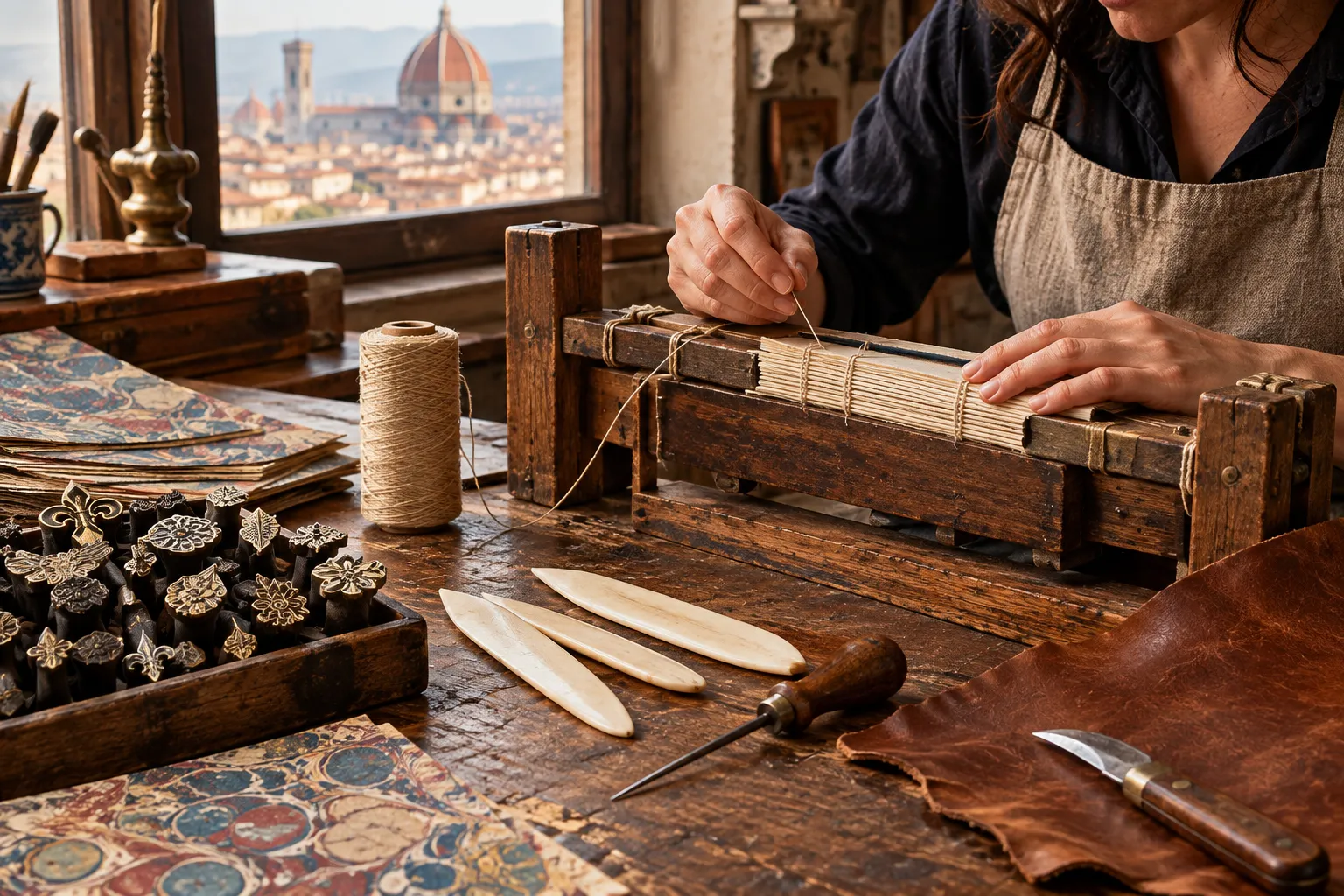
The craft is called legatura a mano, and it divides into a sequence of operations, each with its own vocabulary. Collating, to check that every gathering is present and in order. Taking the book apart. Cleaning. Mending tears with a cooked wheat-starch paste and filling losses with matched paper. Resewing the gatherings onto cords, the raised bands you see across the spine of an old book. Rounding and backing the spine with a hammer. Paring the leather (the scarnitura) until its edges are thin enough to turn neatly over the boards. And then, last, the decoration: gold tooling, pressed hot through gold leaf with brass fillets and stamps, some of them older than anyone in the room. A book teaches whoever is patient enough to listen to it.
A book teaches whoever is patient enough to listen to it.
The modern trade owes a great deal to a disaster. On 4 November 1966 the Arno broke its banks and flooded the city. At the Biblioteca Nazionale Centrale alone, more than a million books, periodicals and documents were soaked in water and mud. Volunteers from all over the world, the angeli del fango (mud angels), formed human chains to carry them out, and restorers from many countries came to work on them. The problem was too big for any single tradition, so for once techniques were shared openly instead of guarded, and much of what is now standard practice in book and paper conservation, from detailed treatment records to freeze-drying wet books, was worked out in Florence in the years that followed. Every binder in the city stands, in some way, on that work.
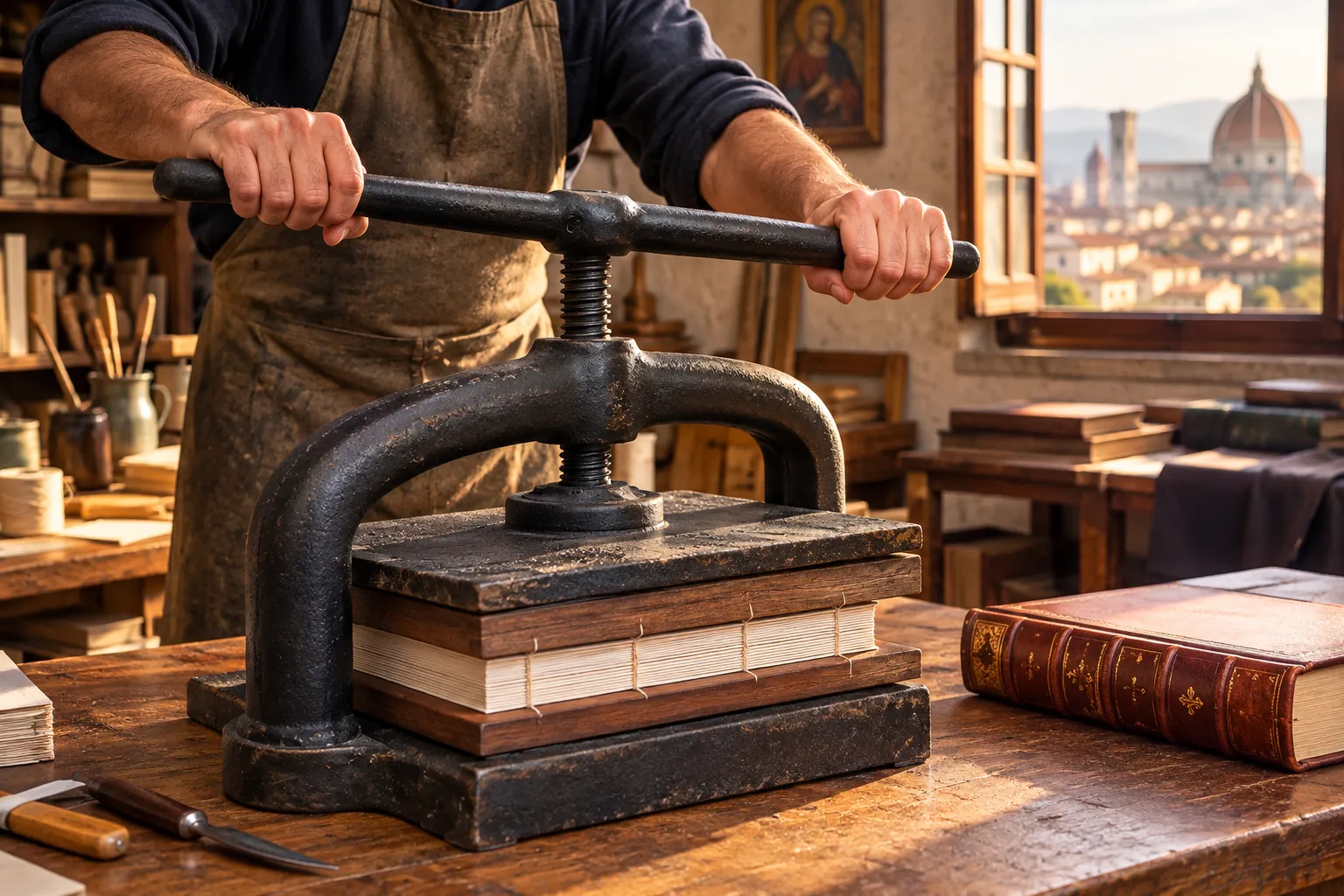
The economics are not generous, and nobody in the trade pretends otherwise. An apprentice’s wage is modest. Tools are acquired slowly (a bone folder, a burnisher, a set of paring knives, often second-hand from an older binder’s cupboard), and the big pieces of equipment are handed down rather than bought. The standing press in the corner of a Florentine bindery may well be a century old, and the question of who will inherit it is taken seriously.
The craft survives for three reasons, in roughly this order. First, the libraries and archives, public and private, which will always need binders. Second, collectors in Italy and abroad, who send rare books to Florence because of its reputation. Third, the schools and conservation programmes that train the next generation and send their students into the workshops as interns and apprentices. The city still supplies the materials, too: Florentine marbled paper, made by floating colours on a thickened bath and laying a sheet on top, still lines the endpapers of books all over the world.
In the late afternoon, a book goes into the standing press, newly sewn, its cords laced through the boards. At the bench opposite, an apprentice pares a piece of calfskin, perhaps from the vegetable tanneries of Santa Croce sull’Arno downriver, with a crescent-shaped knife, working from the flesh side with the blade held almost flat, lifting curls of leather as thin as paper shavings. The master watches for thirty seconds, nods once, and says nothing. The edge, when it is done, is even. In a few more months the apprentice will be allowed to tool a first blind line. Gold comes after that.
When the book goes back to its library, it will look as if nothing has happened to it. That is the point. A binding done well is invisible: the book opens as it opened when it was new, the gatherings lie flat, the new leather sits beside the old without argument. Nobody who reads it will know that someone spent a week paring a single skin, or that the tension of the sewing was checked with the back of a thumbnail and adjusted twice. The book will simply be readable again. The apprentice, in a few years, will be a legatore or a legatrice in their own right. The master will still be at the bench opposite. The book on the bench will be another book.
Sources
- The Assayer · Wikipedia
- Il Saggiatore (1623) · www2.museogalileo.it
- The flood of 1966 · bncf.cultura.gov.it
- Lab Notes: The Florence Flood and the Emergence of Library Conservation · nyhistory.org
- 1966 flood of the Arno · Wikipedia

Comments
No comments yet. Start the conversation.