

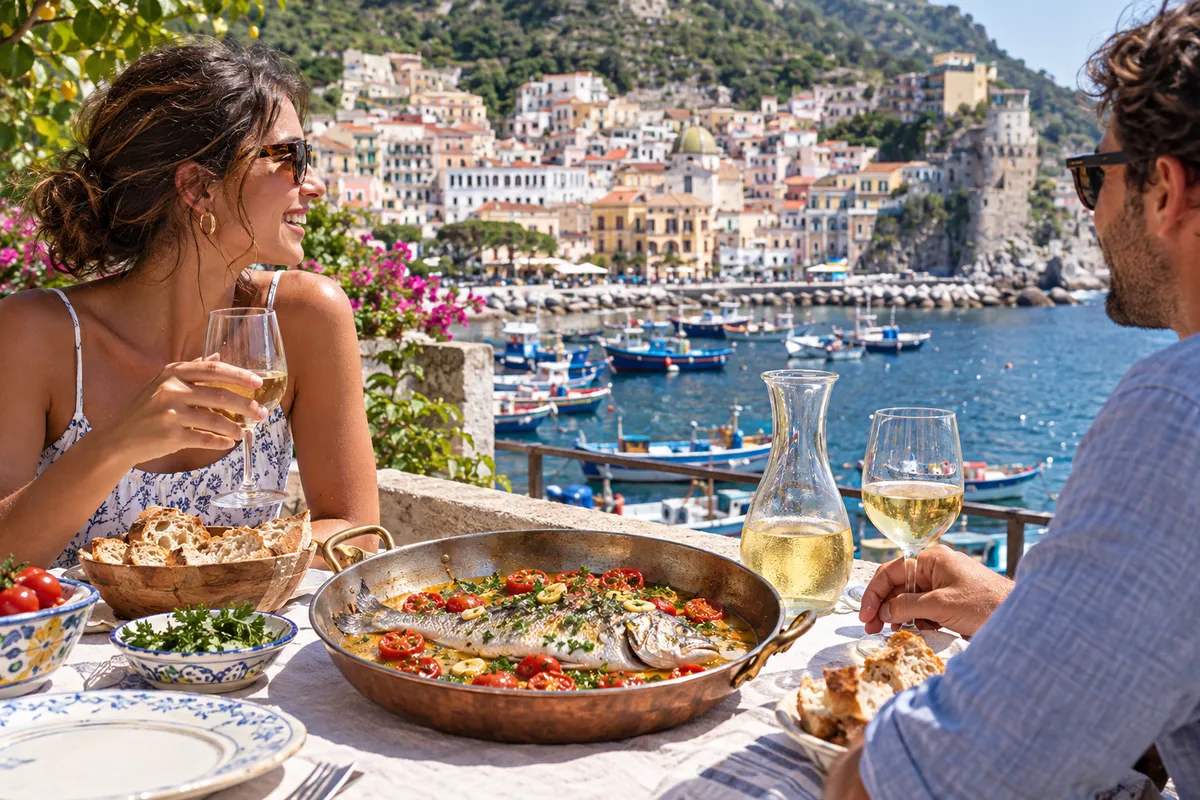
Cetara is the Amalfi Coast town people drive through on their way to somewhere more famous. A fishing village of about two thousand people, pressed into the mouth of a ravine between Vietri sul Mare and Maiori, it has a small beach, a stone watchtower by the harbour, and very little in the way of cliff hotels. What it has instead is fish. Its boats make up one of the largest bluefin tuna fleets in the Mediterranean, its anchovies are among the most prized in Italy, and it has been salting them for centuries. It is also the kind of place where acqua pazza, crazy water, still tastes like what it was: lunch on a boat.
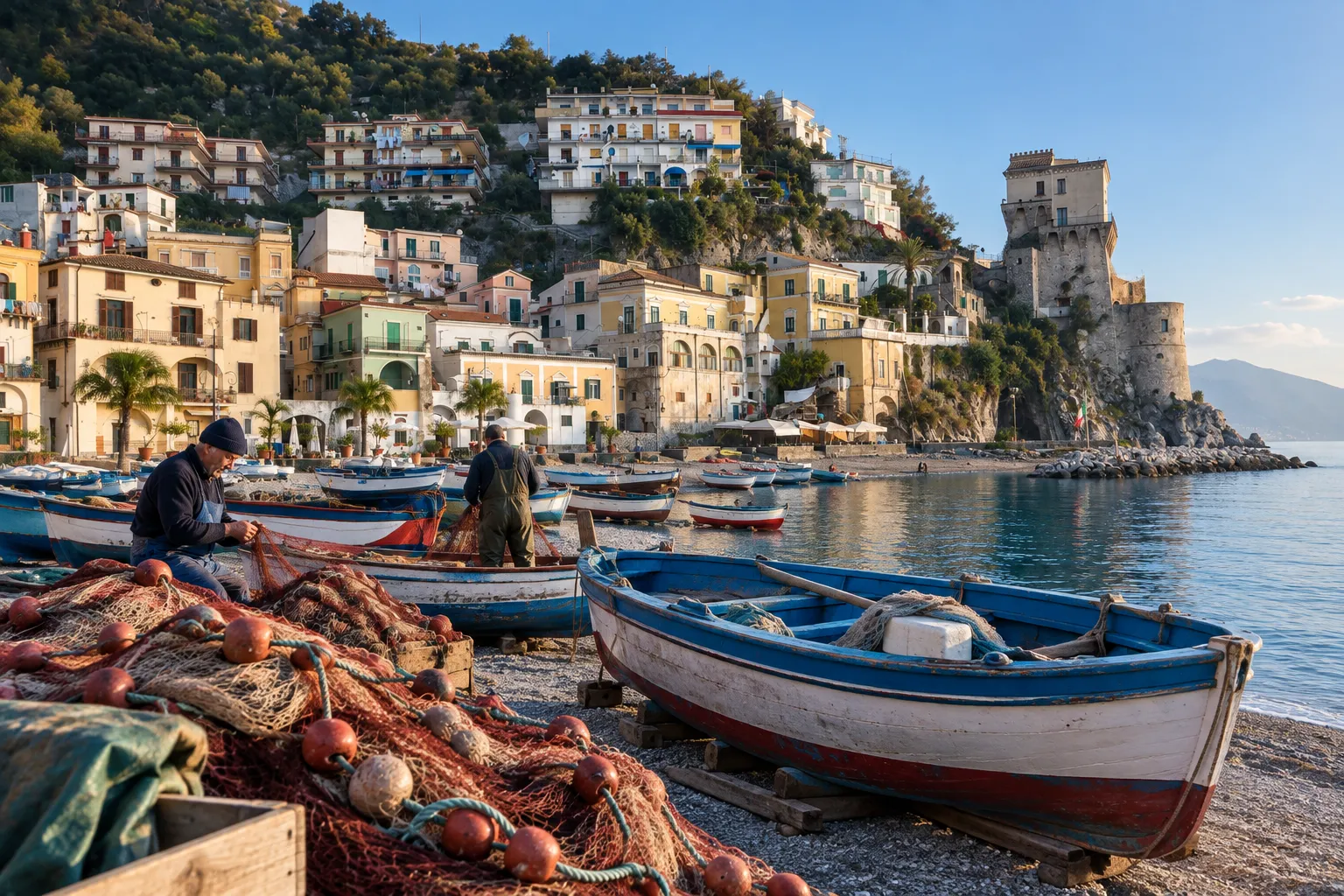
Ask around any harbour on this coast and the version you hear, more or less, is that acqua pazza is not a recipe but a solution. The best of the morning catch goes to the buyers and the fishmongers. What is left over, a scorfano (scorpion fish) with a torn fin, a bream too small to sell, a handful of prawns nobody asked for, can go into the pan. Add oil, garlic, a few tomatoes, a two-burner stove and some water, and you have invented a way to eat. Fishermen are often said to have cooked it in seawater, which would explain the salt. Nobody can prove it, and nobody much minds.
The formula holds, roughly, from Procida to Palinuro, with every town insisting its own version is the right one. Good olive oil, not the one you boil pasta in. Garlic, crushed, sometimes with the skin on. A handful of pomodorini del piennolo, the small, thick-skinned cherry tomatoes of the slopes of Vesuvius, hung in clusters from kitchen rafters (piennolo means hanging) and protected as a DOP. In Cetara, some cooks add a few drops of colatura di alici, the town’s amber anchovy extract, which does the work of salt. The fish, whole, gutted and scaled. Enough water to come halfway up its flank. Ten minutes covered, a few minutes uncovered, a handful of parsley, and a slice of stale country bread in the bottom of the bowl. Nobody measures. The ladle and the thumb do that.
Nobody measures. The ladle and the thumb do that.
The name is the part everyone argues about. Pazza means crazy, but in the kitchen the more convincing reading is improvised: made on the fly, with whatever was to hand. The water is crazy because it is not a stock. No bones were roasted, no aromatics simmered for hours. The tomato does the work of depth, the salt (from the sea, the colatura, or both) does the work of seasoning, and the fish does the work of the fish. From the flame going on to the parsley going in, the whole thing takes about twenty minutes.
Restaurant acqua pazza and boat acqua pazza are not the same dish. In the smart dining rooms higher up the coast, a chef may lay the fish on a drift of confit tomato, spoon the broth around it with intent, and finish it with raw oil and three basil leaves set as if with tweezers. On its day it is excellent. It is not what a fisherman eats. That version is the fish in its broth, the bread at the bottom of the bowl gone soft as the sea, and a second piece of bread in hand for mopping up. The plating is the bowl. The tweezers are fingers.
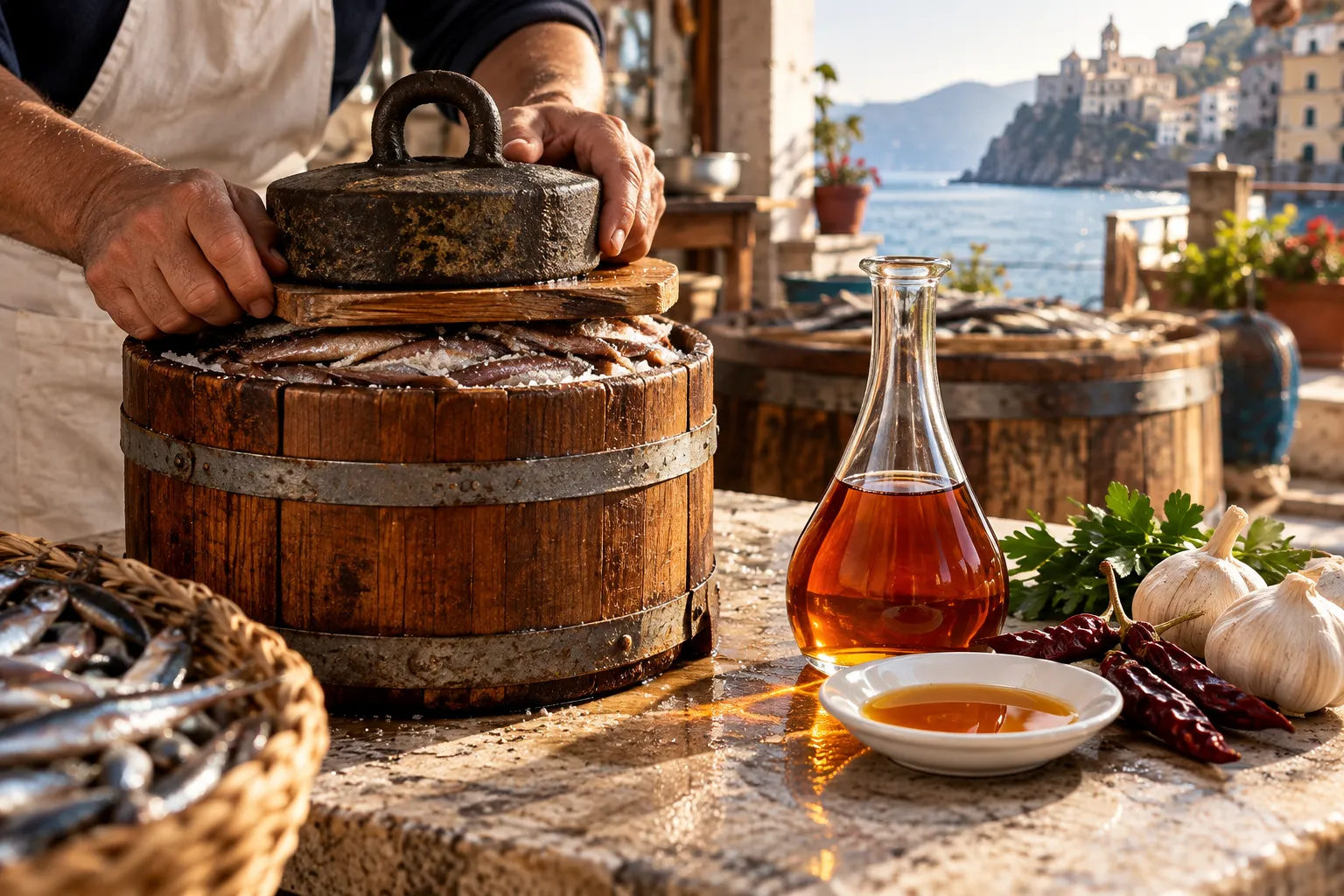
Summer is the dish’s natural season, and the reason is timing. The July catch is close to shore and quick, and fish reach the pan a few hours out of the water. The piennolo tomatoes ripen on the volcano through the summer and are then hung, drying and concentrating, well into winter, which is exactly why Vesuvian families string them up. The colatura keeps its own calendar. Cetara’s anchovies are caught between late March and late July, layered with salt in small wooden barrels called terzigni and pressed under weights. The liquid that seeps out during the long cure is collected and, in late autumn, poured back through the fish, drawn off through a hole in the barrel and filtered through linen. The result has been a protected DOP since 2020, and in Cetara the new colatura traditionally arrives in time for Christmas Eve, when it dresses spaghetti with little more than garlic, oil and parsley.
Eat acqua pazza in Cetara itself, at a trattoria on the main street or a table near the harbour where the bread is always free and the chairs are sometimes plastic, and you will notice what the kitchens uphill cannot quite reproduce. Watch a good cook. The garlic goes into cold oil and colours slowly, and before it tips toward brown the tomatoes go in and split, the colatura (if it is used at all) goes in with a small hiss, the fish lies down on top, and the water follows. Any competent kitchen up the coast can do these steps in the right order. What makes the difference is the oil, green and peppery and Campanian, which throws a smell, when it hits the hot pan, like a beach at the end of August. That, more than anything else, is the dish.
Cooks in Cetara, asked how to make acqua pazza at home, tend to rank the ingredients in order of what cannot be compromised. Colatura first, if you are using it: a real bottle, not a substitute. Tomatoes second: piennolo if you can find them, datterini if not. Oil third: a good extra virgin, never refined. The fish last, because almost any firm white fish will do. A sea bass will do. A bream will do. A scorpion fish is better. It is August. The pan is hot. The oil is in. The garlic goes down. You can smell it already.
Sources
- Cetara: the village of flavours and seafaring tradition · e-borghi.com
- The Tuna Fishery · visitcetara.com
- DOP-Certified Colatura di Alici di Cetara Aging Now · gustiamo.com
- EU Official Journal, 22 June 2020 (Colatura di Alici di Cetara) · eur-lex.europa.eu
- Colatura di alici · Wikipedia
Comments
No comments yet. Start the conversation.